Jason Taulman
7.6K posts

Jason Taulman retweetledi

Jerome Bettis shares the 4 things that get you to greatness.
1. Sacrifice - "You've got to have the ability to sacrifice, and a lot of times that means sacrificing the relationships that mean the most to you."
Greatness costs something. Are you willing to pay the price?
2. Pain - "You're going to have to endure some type of pain in your life, whether physical or mental. You've got to find a way to endure."
Pain is part of the process. You don't avoid it - you push through it.
3. Failure - "You've got to have the ability to understand that you're going to fail, but it's how you recover that makes you a better person."
Failure isn't the end. It's the teacher.
4. Love - "If you love it, then it's not a job - it's a passion. If you love it, you're willing to sacrifice for it, you're willing to go through all type of pains for it. You're willing to go through that failure and understand, 'I will be successful.'"
Love is what makes the sacrifice, pain, and failure worth it.
"If you go through those 4 things and you understand those and you can handle those then success is in your path, and greatness is available to you."
Greatness requires you to show up and take action consistently.
(🎥 NFL)
English
Jason Taulman retweetledi

Pitchers and catchers who call their own pitches make mistakes.
Coaches who call pitches make mistakes.
Coaches who insist on calling pitches from the dugout, there are always multiple pitch types and locations that will work in any count and any situation. It will ALWAYS come down to pitch execution. Throwing it where and how it’s intended.
Just because it’s what you would throw or what “the report” says doesn’t mean it’s the only option. I’d be very careful of that level of thinking and narcissism.
If you call pitches as a teaching method then we would expect for you to have multiple conversations throughout a game explaining your how’s and why’s. If you claim you do it to teach but rarely or never have those discussions, you’re not teaching them. When these young athletes are left to “wait for the next call,”more often than not their minds turn off and become more like robots. That’s not the goal.
Remember this, if we feel we are smart enough to call pitches, then we should be good enough to teach them how to do it too.
PSA: Baseball is not football, stop comparing them. When base runners are taught the game and shown to have ability to steal, they are given the green light. When a batter has worked at drag and push bunts and learned the when and how, they are given the green light. When pitchers and catchers are taught, allowed and encouraged to watch the game, read the batters and know their stuff, they should be given the opportunity as much as possible to PLAY THE GAME!
English
Jason Taulman retweetledi

Urban Meyer shares a message everyone needs to hear - average is not acceptable.
"It's so easy to be average. You know it as well as I know it."
"It takes a little something to be special. It takes a little something special to be a great player."
Then he made the standard clear:
"We don't have enough great players. To hell with that!...We don't wanna coach average. I don't wanna be around you. Why be around average?"
Average is comfortable. It's safe and it's not looking to compete.
"Did you push yourself to be great today? Did you do it? If you didn't do it, you lost a day. We ain't got many days to lose."
Every day you don't push yourself is a day you can't get back. Bring a mindset of excellence to everything you do.
"And if there's a touch of greatness in there, how cool would that be?"
The question isn't whether you have greatness in you. It's whether you're willing to work to find it.
Show up, do the work, and compete.
(🎥 ESPN)
Coach AJ 🎯 Mental Fitness@coachajkings
Urban Meyer: "I don't want to be around you. Why be around average?" Average doesn't announce itself. It sneaks in through the exceptions you make. 1. Your standards 2. Your circle. 3. Your self-talk. 4. Your habits. 5. Your culture. Here's where to find it: (📌Bookmark this)
English
Jason Taulman retweetledi

Coaches should not have to coach energy or effort.
If you do, you will have problems.
Hoop Herald@TheHoopHerald
“Coaches shouldn’t have to push you to work hard, you should push yourself to work hard because you want to be a great player” - Bob Knight
English
Jason Taulman retweetledi

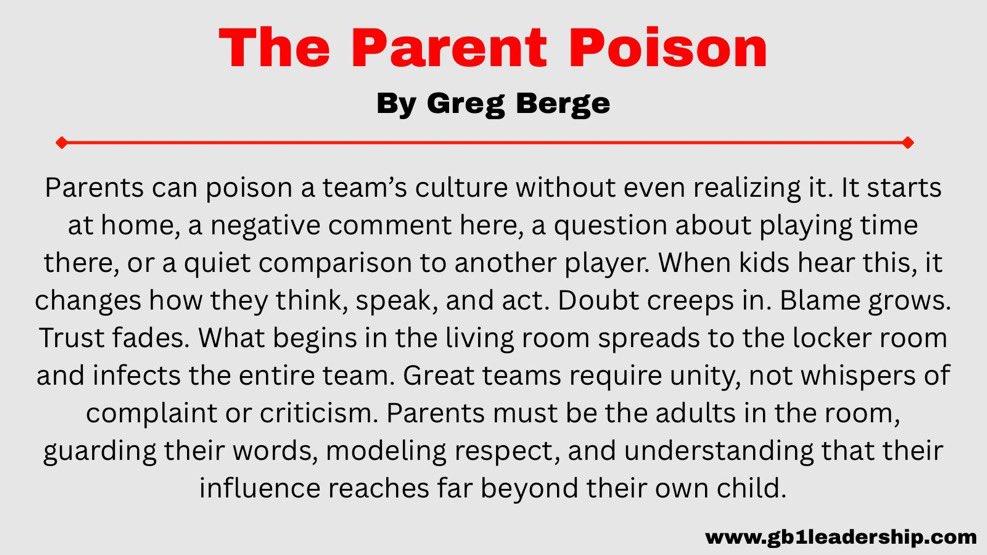
The Parent Poison…
Most parents want the best for their kids.
But sometimes, without realizing it, they slowly poison the very team their child is part of.
It rarely starts with something dramatic.
It starts small.
A comment in the car ride home.
“Why didn’t the coach play you more?”
A comparison.
“You’re better than that kid.”
A quiet complaint at the dinner table.
“That coach doesn’t know what he’s doing.”
Kids hear everything.
And when they hear it, something changes.
Doubt creeps in.
Blame grows.
Trust fades.
The mindset shifts from team first to me first.
What begins in the living room eventually shows up in the locker room.
You see it in body language.
You hear it in conversations.
You feel it in the culture.
Instead of unity, there are whispers.
Instead of accountability, there are excuses.
Instead of growth, there is resentment.
Great teams cannot survive that environment.
Because the best teams are built on three things:
Trust.
Sacrifice.
Shared purpose.
When players start believing the problem is everyone else, those things disappear.
Parents play a powerful role in a team’s culture whether they realize it or not.
The healthiest teams have parents who:
Support the program.
Encourage resilience.
Teach their kids to handle adversity.
They remind their children:
Work harder.
Be a great teammate.
Control what you can control.
They don’t feed excuses.
They build character.
And here’s the truth most people miss:
A parent’s influence extends far beyond their own child.
It affects the locker room.
It affects the culture.
It affects the entire team.
Great teams require unity, not whispers of criticism.
So the challenge for parents is simple.
Be the adult in the room.
Guard your words.
Model respect.
Support the team.
Because what starts at home always finds its way onto the court, the field, or the locker room.
And the best parents don’t poison the culture.
They protect it.

English
Jason Taulman retweetledi

“I was the happiest kid in the neighborhood with this thing.”
- Mariano Rivera 👇
His glove was a paper bag.
No travel teams.
No expensive gear.
Just a kid who loved the game.
Sometimes we make youth sports way too complicated.
Dudes Posting Their W’s@DudespostingWs
Mariano Rivera, arguably the greatest closer in baseball history, shares the glove he used growing up playing baseball in Panama.
English
Jason Taulman retweetledi