
Sabitlenmiş Tweet
Jaycob
12.2K posts


Jaycob
@JaycobYes
@MasonEconomics 📚 | @UICEconomics Alum👨🏻🎓 | “To call the world hopeless is to call it ideal; Because the world is not ideal, it must not be hopeless.”-FN
Katılım Temmuz 2018
2.5K Takip Edilen918 Takipçiler




Jaycob retweetledi

My economics reading group will be hosting a space discussing polycentric production with economist @NathanPGoodman.
Please tune in and feel free to request if you have any questions! 😄
twitter.com/i/spaces/1YxNr…
English
Jaycob retweetledi

Kenneth Boulding as an enchanting, encouraging and engaging professor | The Review of Austrian Economics | Springer Nature Link … Please read Boulding link.springer.com/article/10.100…
English
Jaycob retweetledi

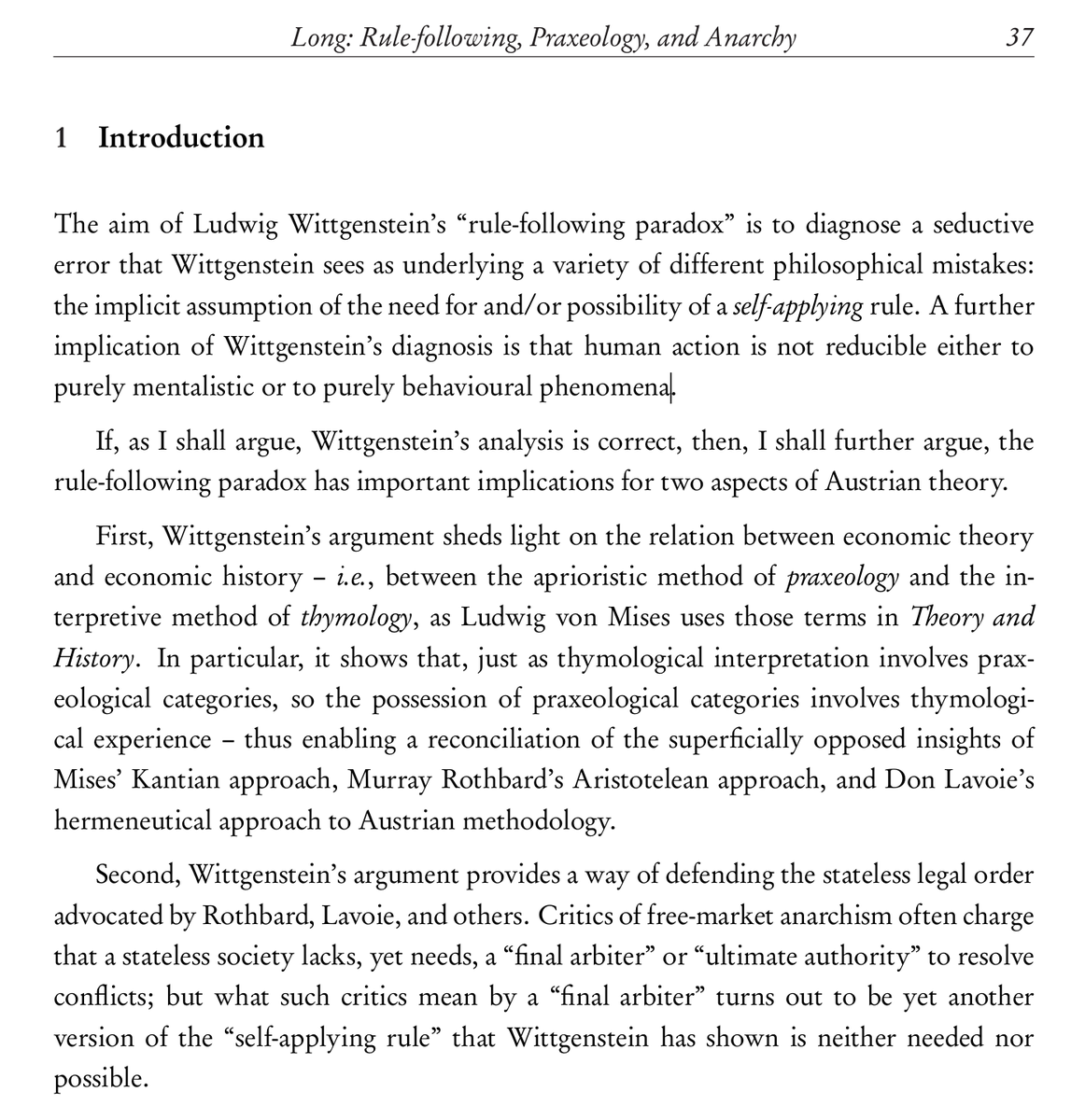
And this just scratches the surface as far as the Wittgenstein-Austrian economics connection goes.
Roderick Long argues Wittgenstein's rule-following paradox contains vital insights for both economic epistemology and political theory.
praxeology.net/RTL-rule-follo…
Rishi | ഋഷി | 🌐🗽🥥🔰🏙@RishiJoeSanu
>His argument is that this information fundamentally does not exist in a form that can be articulated and communicated through, lets say, writing. I wonder how much Ludwig Wittgenstein influenced Hayek in coming up with this considering that they were cousins. Wittgenstein showed that following a rule is a "technique" or a practice. You can't write down the "how-to" for every unique situation, you just act. Hayek's "local knowledge" is this exact type of unwritten, practiced intuition that Wittgenstein was talking about. Moreover, Wittgenstein’s "Language-Games" prove that information only makes sense within its specific, local environment. Once a central planner tries to "write it down" as a static statistic sans vital local context, the "truth" of the information is lost/distorted.
English
Jaycob retweetledi

This only looks absurd if you have no idea what you're talking about.
For starters, it is not obvious that employment ought to fall following an increase in the minimum wage. It is not the unanimous prediction of all models -- e.g., some form of monopsony power would allow for different outcomes.
You can't just assume that your picture of the world is entirely accurate. If you aren't a fool, you check to see if there are problems with it. And even if you are stupid enough to think you're right about everything, other people disagree and you might need to convince them.
Next, the size of the effects and who gets affected matters for a lot of debates surrounding policy. You can't introspectively infer an estimate of magnitude.
Economics, like all science, works by postulating competing stories about the data and finding some margins along which we might be able to exploit enough variation to eliminate at least a few bad stories. It is **the only** way to make any progress. And ample progress, we have made.
Patrick Carroll@PatrickC1995
This whole approach to economics is just so funny to me. "We measured some more triangles and it turns out Pythagoras was actually correct." "We looked at some more real-world syllogisms and the law of non-contradiction is actually true after all." Guys, you're doing it wrong.
English
Jaycob retweetledi

If the industrial policy works it should provide the public with some goal. Otherwise why are we doing it in the first place? Needing some sort of bonus implies the value isn't there in the first place.
Mariana Mazzucato@MazzucatoM
Tesla received billions in government loans, tax credits and subsidies, making Elon Musk the world's richest person. The public? No equity stake, no profit-sharing, no guarantee of affordable access. My working paper with @rodrikdani has now been published in Industrial and Corporate Change. It explores the conditionalities—profit-sharing, reinvestment requirements, knowledge transfer—that can ensure industrial policy delivers public value, not just private wealth. [LINK IN NEXT POST]
English
Jaycob retweetledi

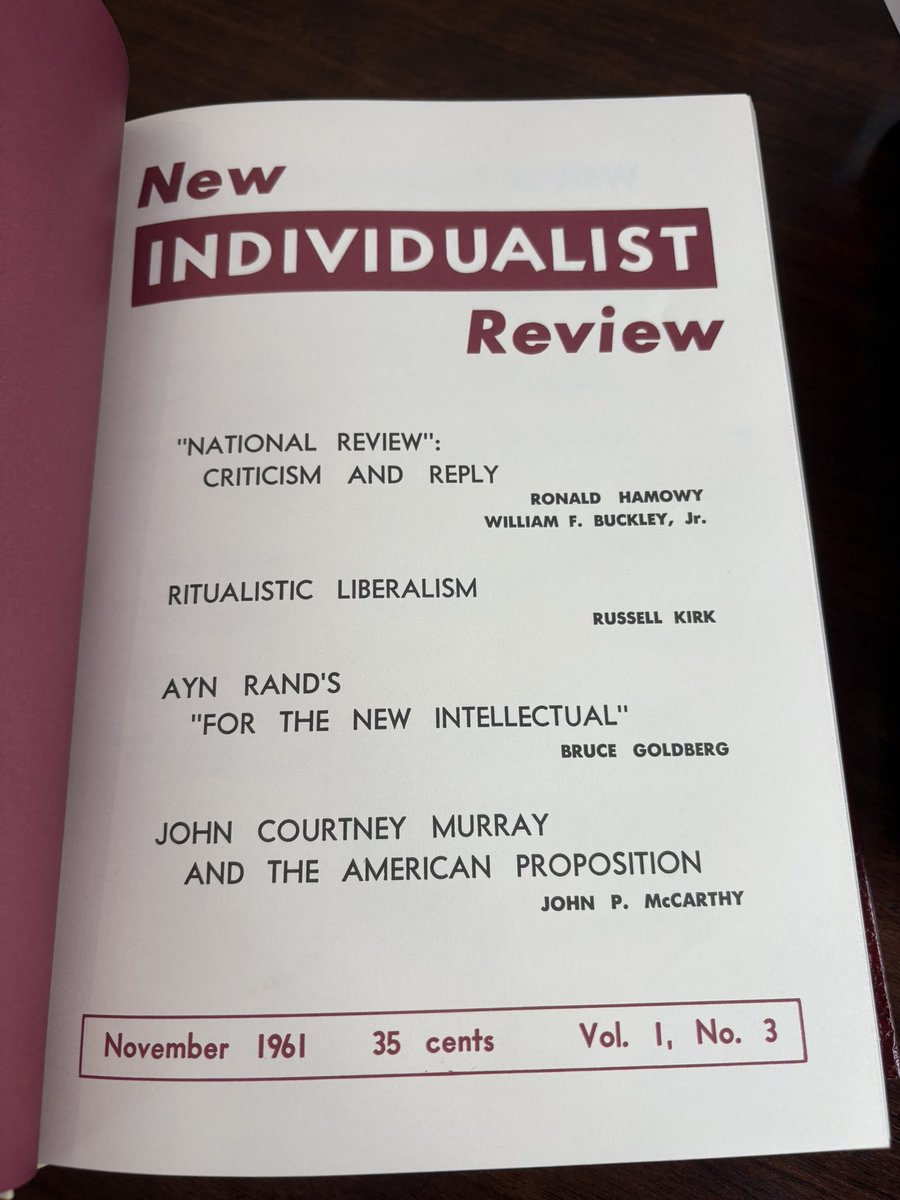
A perfect example of a reprint is @Liberty_Fund’s reprint of “New Individualist Review” which was edited by Ralph Raico and Ronald Hamowy and advised by Hayek, Friedman, and Richard Weaver
A very nice addition to a collection that allows you to delve into the debates in the earliest days of the New Right


David Brady Jr.@realDavidBJr
I am asking publications like Reason, National Review, and Chronicles to do full reprint books of their distant past issues Similar to the reprint of The Libertarian Forum
English
Jaycob retweetledi

Jaycob retweetledi
Tonight I am giving a lecture on "Public Choice Considerations in Macroeconomic Policy" ... I am giddy for this discussion because I think even though it seems obvious too many still ignore the politics of economic policy making. One of the great correctives to this problem is the Center for Study of Public Choice annual Outreach Program ... if you are curious about public policy and about the achievement gap between what is promised and what is realized, this framework might help you think through those issues, and I would contend so much more. @ATabarrok publicchoice.gmu.edu/center-program…
English
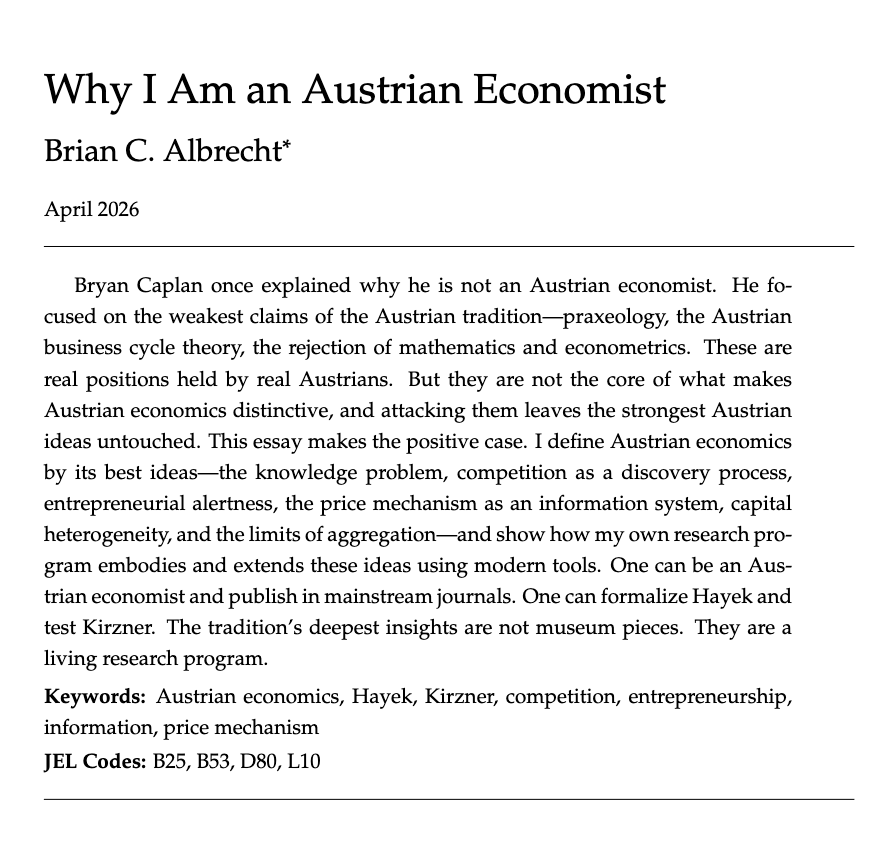
@EconChrisClarke @alexwadecraig @BrianCAlbrecht @EricCrampton @ccoyne1 and @Abigail_R_Hall have a new book on Austrian economics coming out this month that would serve as an excellent introduction to how our department incorporates the Austrian school.
mercatus.org/hayekprogram/r…
English

@alexwadecraig @BrianCAlbrecht @EricCrampton This is welcome news. I did my undergraduate studies at UNLV, and the, uh..., shadows of Rothbard and Hoppe were very bitter. So, I got a lot of negativity to the field thrown at me.
English

Jaycob retweetledi
I think a lot of confusion impacts those encountering the ideas. First, Menger distinguished between exact theory, empirical-realistic theory, and empirical research (history as well as contemporary history/policy). Bohm-Bawerk similarly distinguished between theory, applied theory, and empirical analysis. In 1937, Hayek argued that the pure logic choice was necessary but not sufficient, it had to joined by the situational logic of context specific institutional analysis, and that combined provided the framework for empirical analysis. Second, Mises and Hayek were both very skilled empirical economists as their work at the Austrian Institute for Business Cycle Research demonstrates. Hayek, in fact, learned time series analysis in NY during his 20s and brought that back to Vienna. The reason folks get tripped up is because of what folks think the purpose of statistical analysis is, and the problems identified with aggregation, and with theory absorption. Theory is not "tested" by statistical analysis in this for a variety of reasons. So the naive positivist agenda doesn't work according to these thinkers. But that doesn't mean that empirical work isn't critical to the scientific enterprise. It most certainly is -- the purpose of theory is in fact to aid us in empirical analysis (both history and contemporary history). The Austrian School from Menger onward is not working out the internal logic of an abstract model, but instead refining a set of theoretical constructs that enable the ordinary individual to rise to the height of observational genius through the use of these constructs. It is about understanding and explaining the real world -- how the world works; the human condition; the social order. I wish more folks would read Erwin Dekker's The Viennese Students of Civilization to get a sense of the intellectual context of the founding of the Austrian school, and to read Hayek's Nobel in depth and with care, and with that go back and read Human Action asking yourself how it came out of the Viennese Student of Civilization, and how it produced Hayek's pretense of knowledge critique of the practice of modern economics. I believe we would have a better dialogue about all these issues if we did that.
English

I May have an unhealthy obsession with mutualism that is ruining my life and making all my conversations and topics boring, because they return to this same issue.
English
@EconChrisClarke @BrianCAlbrecht @EricCrampton I’d push back against the claim that Austrians as a whole engage in self-isolation. I’d recommend looking into the @HayekProgram.
English
I'm no expert on Austrian economics, but rejecting Praxeology seems fairly fundamental, no? I know these questions can get into silly No True Scotsman fallacies and purity tests.
I'm a big tent economist, and think your approach is essential. The problem with Austrian School is the self isolation and lack of dialogue, making it unscientific. Rejecting Praxeology and embracing modern economic methods seems essential to being the best Austrian insights into the mainstream.
English
Jaycob retweetledi

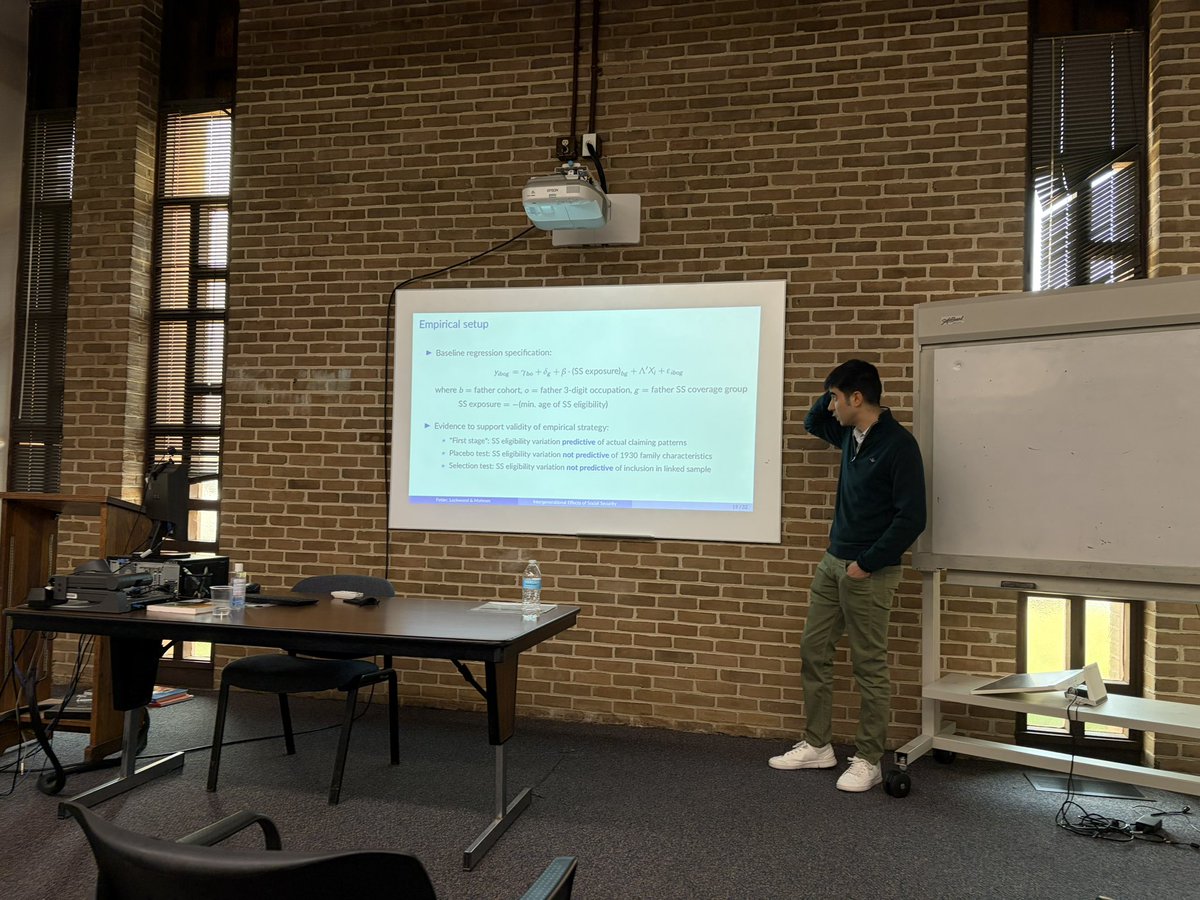
Paul Mohnen showing that Social Security paid for itself by favoring better job matches geographically. Very counterintuitive at first but utterly prior-shattering @Masonomics
English
Jaycob retweetledi
If you have not read The Triumph of Economic Freedom, you really should do so RIGHT NOW. It is really a fantastic guide to economic history and public policy ... Senator Phil Gramm and Don Boudreaux on the Triumph of Economic Freedom | Mercatus Center mercatus.org/hayekprogram/h…
English
Jaycob retweetledi

📖 "It's a great book, but it's not a good book."
@eamonnbutler on why Hayek's masterwork is almost impossible to read — and what he did about it.👇
English
Jaycob retweetledi

you can now read the transcript and watch the video recording of @CassSunstein's excellent recent @mercatus lecture, on The Pursuit of Liberalism!
thepursuitofliberalism.substack.com/p/hayekian-beh…

English
Jaycob retweetledi

My guide to F A Hayek's great (but sadly, not exactly good) book on the evolution of human values is now out! iea.org.uk/publications/h…
English
Jaycob retweetledi
Kenneth Boulding as an enchanting, encouraging and engaging professor | The Review of Austrian Economics | Springer Nature Link link.springer.com/article/10.100…
English
Jaycob retweetledi

Cover and explainer for "What is Liberal Socialism?" is out for @RepeaterBooks! With Paul Crider and Florian Maiwald

English
Jaycob retweetledi

Why the Case Against Economic Freedom Doesn’t Hold Up: What Hickel Gets Wrong About Capitalism and Poverty open.substack.com/pub/unseenandu…
English