Jérôme Batout

1.6K posts

Jérôme Batout banner
Jérôme Batout

Jérôme Batout

@JeromeBatout

La Généalogie de la valeur (Les Belles Lettres). La Revanche de la Province, (Gallimard)

Paris, France Katılım Ağustos 2011
2.2K Takip Edilen2.9K Takipçiler
Jérôme Batout retweetledi

Spencer Hakimian
Spencer Hakimian@SpencerHakimian·
The most openly corrupt president in American history. Bar none.
Spencer Hakimian tweet media
English
184
1.6K
7K
137K
Jérôme Batout
Jérôme Batout@JeromeBatout·
« Modernity, in its current form, is incompatible with replacement-level fertility. By modernity, I do not mean capitalism: fertility fell earlier and faster in socialist economies than in market economies. Socialist Hungary fell below replacement in 1960, and socialist Czechoslovakia in 1966 (both experienced small, short-lived baby booms in the mid-1970s). By modernity, I mean a society organized around rational, large-scale systems and formalized knowledge. »
Jesús Fernández-Villaverde@JesusFerna7026

Smartphones are not the explanation for the recent decline in fertility. Instead, they are an accelerator of deeper forces already at work. Let’s start with the facts. Fertility is falling almost everywhere: in rich, middle-income, and poor countries; in secular and religious countries; and in countries with high and low levels of gender equality. The decline accelerated around 2014. So, no country-specific explanation will work unless you are willing to believe that 200 distinct country-specific explanations arrived at roughly the same time. Smartphones look like the obvious candidate: the first iPhone was released in 2007, and global adoption has been astonishingly fast. Economists understand the first major decline in fertility in advanced economies, from 6 or 7 children per woman throughout most of human history to about 1.8, that occurred between the early 1800s and roughly 1970, well before smartphones. The main drivers were a sharp fall in child mortality (effective fertility was rarely above 3 and often close to 2) and the shift from a low-skill, rural agrarian economy to a high-skill, urban industrial one. We have quantitative models that fit these facts well. Country-specific factors mattered too, of course. Proximity to low-fertility neighbors accelerated Hungary’s decline, while fragmented landowning structures accelerated France’s. But these were second-order mechanisms. This is also why most economists long considered Paul Ehrlich’s doom scenarios implausible. We forecast that fertility in middle- and low-income economies would follow the same path as in the rich, probably faster, because reductions in child mortality reached India or Africa at lower income levels (medical technology is nearly universal, and most gains come from handwashing and cheap antibiotics, not Mayo Clinic-level care). Much of what we see in Africa or parts of Latin America today is still that old story. But in the 1980s, a new pattern appeared. Japan and Italy fell below 1.8, the level we had thought was the new floor. By 1990, Japan was at 1.54 and Italy at 1.36. This second fertility decline began in Japan and Italy earlier than elsewhere, driven by country-specific factors, but the underlying dynamics were widespread: secularization, an education arms race, expensive housing, the dissolution of old social networks, and the shift to a service economy in which women’s bargaining power within the household is higher. The U.S. lagged because secularization came later, suburban housing remained relatively cheap, and African American fertility was still high. U.S. demographic patterns are exceptional and skew how academics (most of whom are in the U.S.) and the New York Times see the world. My best guess is that, without smartphones, Italy’s 2025 fertility rate would be about 1.24 rather than 1.14. I doubt anyone will document an effect larger than 0.1-0.2. Italy was at 1.19 in 1995, not far from today’s 1.14. The TFR is cyclical due to tempo effects, so I do not read too much into the rise between 1995 and 2007 or the decline from 1.27 in 2019 to 1.14 today. The direct effect of smartphones is not zero, but it is not, by itself, that large. Where social media, in general, and smartphones, in particular, matter is in the diffusion of social norms. What would have taken 25 years now happens in 10. Social media are not the cause of fertility decline; modernity is. But they are a very fast accelerator. That is why social media are a major part of the story behind Guatemala (yes, Guatemala) going from 3.8 children per woman in 2005 to 1.9 in 2025. Without them, Guatemala would also have reached 1.9, just 20 years later. Modernity, in its current form, is incompatible with replacement-level fertility. By modernity, I do not mean capitalism: fertility fell earlier and faster in socialist economies than in market economies. Socialist Hungary fell below replacement in 1960, and socialist Czechoslovakia in 1966 (both experienced small, short-lived baby booms in the mid-1970s). By modernity, I mean a society organized around rational, large-scale systems and formalized knowledge. Countries will not converge to the same fertility rate. East Asia is likely stuck near 1, possibly below, given its unbalanced gender norms and toxic education systems. Latin America faces the same gender problem plus weak growth prospects, so I expect something around 1.2. Northern Europe has more egalitarian family structures and might hold near 1.5. The very religious societies are probably the only ones that will sustain 1.8. All of this could change with AI or changes in population composition. We will see. But on the current evidence, deep sub-replacement fertility is the “new new normal.” Unless we reorganize our societies, better learn to handle it as best we can.

English
0
0
0
92
Jérôme Batout retweetledi
Barchart
Barchart@Barchart·
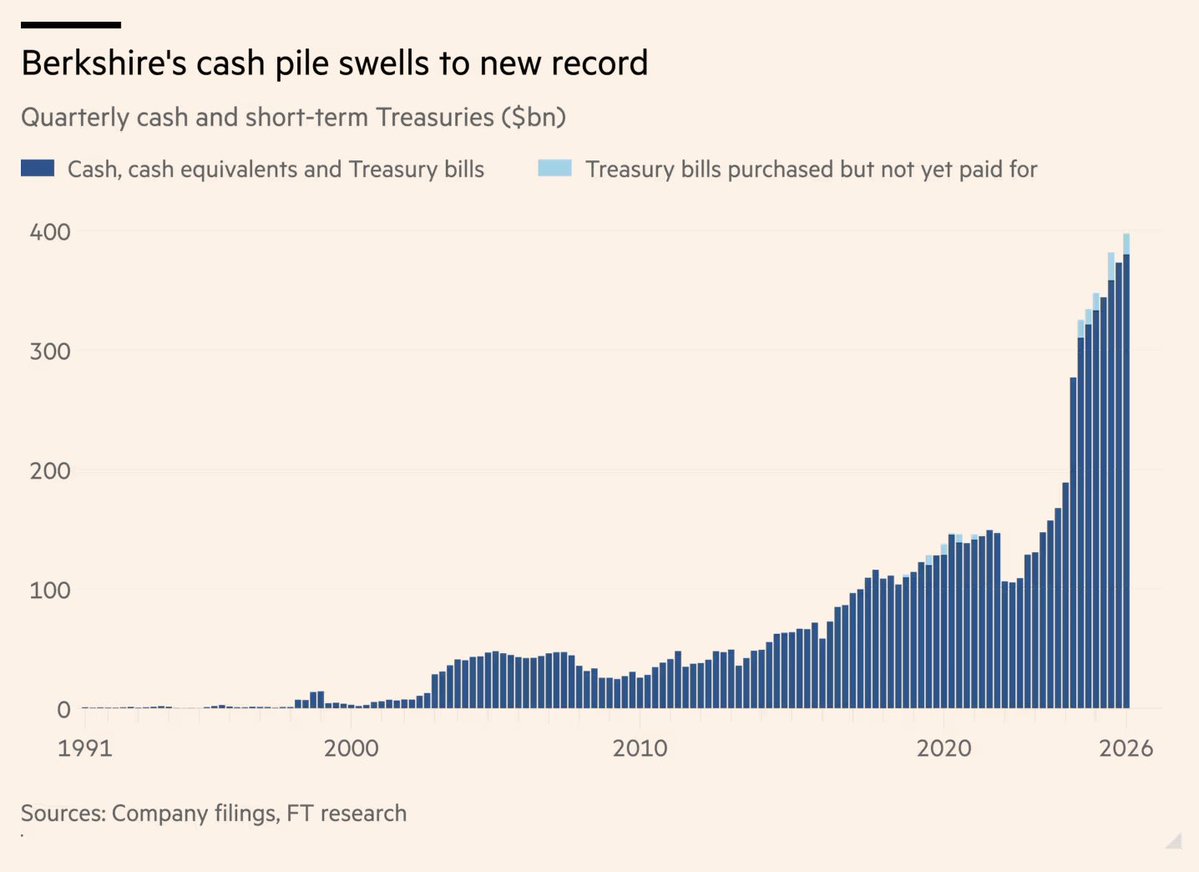
Berkshire Hathaway is now sitting on an all-time high $397 Billion in Cash, enough to buy 478 companies in the S&P 500 🚨🤑
Barchart tweet media
English
122
343
1.9K
178.7K
Jérôme Batout retweetledi
Benjamin Wolf 🇺🇦
Benjamin Wolf 🇺🇦@benbawan·
A thread responding to @luisgaricano’s post on US vs. Europe. Some valid points on tech and equity. But several key claims on living standards in particular don’t hold up or are at the very least cherry-picked. 🧵
Luis Garicano 🇪🇺🇺🇦@lugaricano

We stopped everything to write an answer (link below) to Paul Krugman's two posts of today (one informal, one with a simple model) arguing that Europe is broadly not falling behind the United States. The change measured by the Draghi report, he argues, is mostly due to growth in the technology industry, which has distorted GDP numbers without actually leading to higher standards of living. We should believe our eyes when we walk around France and walk around Mississippi. Krugman is wrong. The measures he uses understate European stagnation. This matters enormously. Divergence with the United States is the strongest evidence for reform in Europe. 1. The growth numbers Krugman compares the United States, France, and Germany at purchasing power parity in current prices. On that measure, France's and Germany's position relative to America has been roughly constant since 2000. But current price comparisons miss productivity gains in sectors where prices fall. If America produces twice as much software while the price of each unit halves, the value of American software output looks unchanged even though the volume has doubled. Most economists therefore use constant prices, which fix the base-year PPP level and apply each country's real output growth on top of it. American output growth has concentrated in tech, where prices have fallen tremendously as productivity rises. In terms of the volume of things produced, America has pulled away from Europe. 2. Is it all the tech industry? Krugman concedes this tech divergence but says it is not welfare-relevant. The American growth lead is an accounting artefact of measuring more iPhones at base-year prices, not a sign that Americans are actually richer, because Europeans buy the same iPhones at the same world prices. This is not the right way to think about the world today, as an earlier Paul Krugman would have argued. His model assumes tradable goods, interchangeable workers, marginal-cost pricing, and no profits. Each assumption fails. Most of what households buy is non-tradable: housing, healthcare, childcare, education. When American tech firms bid workers from haircutting to coding, American haircut wages rise. Germany has no growing tech sector to do the bidding, so German wages stay flat. Technology is not priced at marginal cost. Apple's margins are around 40 percent. Anthropic's inference margins are at 70 percent. The major platforms enjoy network effects, switching costs, and lock-in that hold prices well above what a competitive market would deliver. A large share of the productivity gains in technology stays as profit. A lot of the value of American technology dominance shows up in equity, not in wages. Apple, Microsoft, Nvidia, Alphabet, Meta, and Amazon together are worth $21 trillion, more than the entire combined stock market value of all European stock markets. Around 60 percent of US equity is held by American households. The median French or Spanish household holds almost no equity. The median employee at Meta, a company with almost 80,000 employees, earned $388,000 in 2025. This advantage is not going to go away. Krugman's own 1991 paper, cited in his Nobel prize, showed that comparative advantage in modern industries is produced by increasing returns to scale, specialized labor markets, supplier networks and the agglomeration of suppliers, workers, and ideas in particular places. Once an industry concentrates somewhere, the concentration is self-reinforcing. Europe is being pushed away from the next round of technology industries (AI!). 3. What about inequality? Another retort is that GDP per capita hides substantial inequality, and so even if America is rich on average, this is mostly due to the super wealthy. But despite the US's high pre-tax income inequality, it also achieves higher median incomes than Europe, in part because of such a high base, and in part because it actually redistributes more than many European countries. The cleanest comparison is median equivalised disposable household income: income after cash taxes and transfers, adjusted for household size and purchasing power. According to the OECD's 2021 numbers, the median American earns 30 percent more than the median Dutchman, about 31 percent more than the median German, and about 52 percent more than the median Frenchman. 4. What about hours worked? Krugman points out that while American GDP per person is higher, most of this is because Americans work more. For this divergence to be an hours worked story, Americans must work more relative to Europeans now than they did in 2000. The opposite has happened. Birinci, Karabarbounis, and See in a 2026 NBER paper show that about half of the American-European hours gap that existed in the 1990s has reversed by the end of the 2010s. Americans work fewer hours per person than they did in 2000, while most Europeans work more. 5. Is America not a bad place to live? Walk around Alabama and France: surely the former cannot be substantially richer than the latter? American cities often have poorer centres and richer suburbs or exurbs. European cities preserve richer and more attractive historic cores. A visit to a city as a tourist in America compared with a city in France will leave one having seen different spots on the income distribution. Americans in Europe go to the nicest and richest European cities. Rather than a walking around test, do a driving around test. Go to the periphery of any modern American city and see a level of new-built material wealth that is extremely uncommon in Europe, with thousands of enormous four- or five-bedroom homes. In the South, in places like Nashville and Austin, drive around the downtowns to see hundreds of luxury apartment buildings springing from the ground. This construction boom is replicated virtually nowhere in Europe today. The other question is generational. Housing often costs more in Europe than in the United States, despite the quality of the housing stock generally being much better. Europe has nice city cores but these are inaccessible to young Europeans. Consider the salaries available to entry-level workers. The starting pay for a London police officer is $57,000. In Washington, DC, $75,000. The entry-level Deloitte consultant job in Madrid pays around €28,000, roughly $33,000 per year. In Charlotte, the entry-level Deloitte job pays $63,000. There are many things to dislike about life in America. But relative to 25 years ago, the gap in material wealth has shifted dramatically in America's favor. siliconcontinent.com/p/european-sta…


English
7
21
103
17.7K
Jérôme Batout retweetledi
🇫🇷 Gaullisme ☨
🇫🇷 Gaullisme ☨@Gaullisme_Fr·
« Vos journalistes ont en commun avec la bourgeoisie française d'avoir perdu tout sentiment de fierté nationale. Pour pouvoir continuer à dîner en ville, la bourgeoisie accepterait n'importe quel abaissement de la nation. Déjà en 40, elle était derrière Pétain, car il lui permettait de continuer à dîner en ville malgré le désastre national. [...] En réalité, il y a deux bourgeoisies. La bourgeoisie d'argent, celle qui lit Le Figaro, et la bourgeoisie intellectuelle, qui lit Le Monde. Les deux font la paire. Elles s'entendent pour se partager le pouvoir. Cela m'est complètement égal que vos journalistes soient contre moi. Cela m'ennuierait même qu'ils ne le soient pas. J'en serais navré, vous m'entendez ! Le jour où Le Figaro et l'Immonde me soutiendraient, je considérerais que c'est une catastrophe nationale ! » Charles de Gaulle cité par Alain Peyrefitte dans C'était de Gaulle.
🇫🇷 Gaullisme ☨ tweet media
Français
68
972
2.9K
154.5K
Jérôme Batout retweetledi
Massimo
Massimo@Rainmaker1973·
When Mao Zedong got shocked by the height of Henry Kissinger's wife
English
267
1.6K
23.2K
3.7M
Jérôme Batout
Jérôme Batout@JeromeBatout·
@JCDecaux_France Bonjour voulais vous dire que la colonne est structurellement en panne en fait, elle ne tourne presque plus jamais. Parfois je vous signale et quelqu’un vient réparer mais quelques jours après c’est kaput à nouveau. Il doit y avoir un truc sérieux 😟
Français
0
0
0
15
Darius Rochebin
Darius Rochebin@DariusRochebin·
«Même quand de Gaulle avait tort il avait raison.» 28 avril 1969: de Gaulle s’en va. Cette page admirable où Jean d’Ormesson avoue avoir eu des réserves de bourgeois conservateur devant son côté foutraque - mais génial absolument, la drôlerie rehaussant encore son intelligence.
Darius Rochebin tweet media
Français
14
58
292
21.1K
Jérôme Batout
Jérôme Batout@JeromeBatout·
"On ne comprend absolument rien à la civilisation moderne si l’on n’admet pas d’abord qu’elle est une conspiration contre toute forme de vie intérieure." Georges Bernanos La France contre les robots.
Français
1
1
2
113
Jérôme Batout retweetledi
Pierre Manenti
Pierre Manenti@PierreManenti·
Le biopic « La bataille de Gaulle » (signé Antonin Baudry, réalisateur du Chant du Loup et consacré à l’épopée de la France Libre et du général de Gaulle) se révèle à travers une nouvelle bande-annonce époustouflante ! 🇫🇷 Rendez-vous au cinéma le 3 juin 2026 🍿
Français
13
112
513
50.2K
Jérôme Batout retweetledi
Antoine Tilloy
Antoine Tilloy@AntoineTilloy·
En oubliant temporairement la question de l'égalité entre générations, est-ce que les retraités français se rendent compte qu'on brûle les meubles (coupes majeures dans la recherche publique) en grande partie pour éviter une désindexation ultra mineure de leurs pensions ?
Français
1
1
1
427
Jérôme Batout retweetledi
Peter Berezin
Peter Berezin@PeterBerezinBCA·
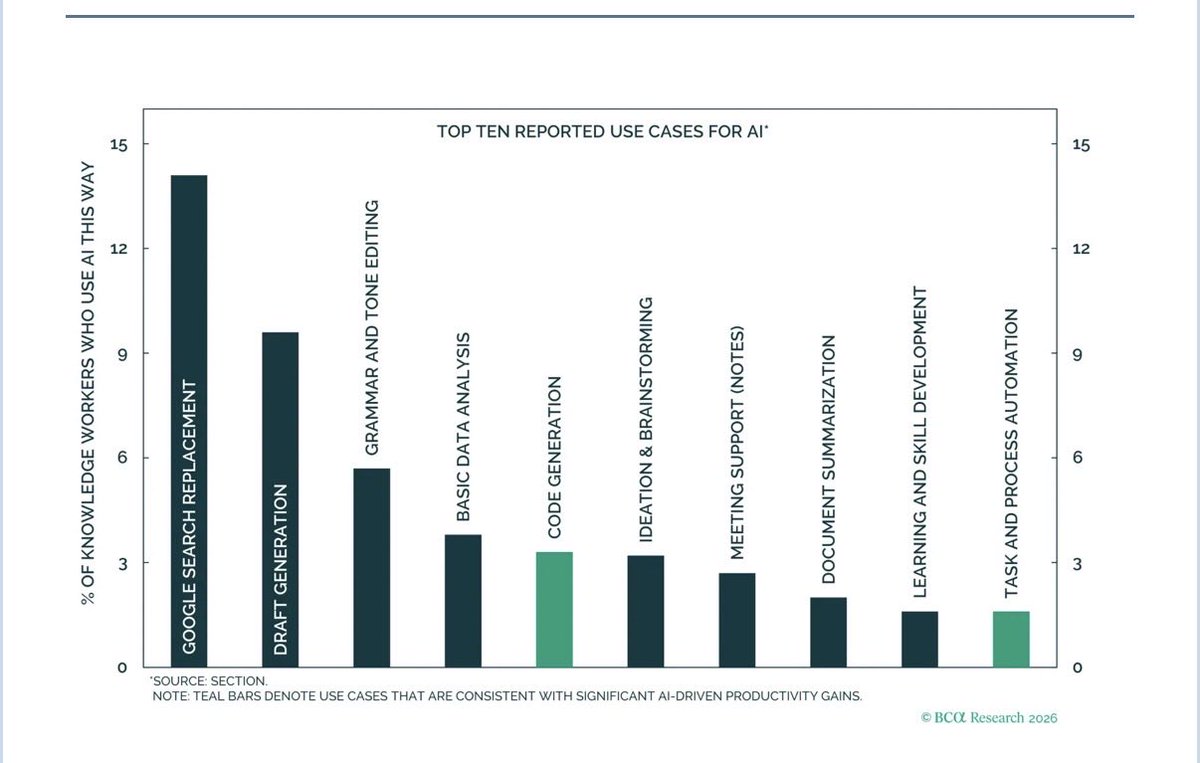
What’s the top reason people give for using AI? Answer: As a replacement for traditional Google search.
Peter Berezin tweet media
English
6
19
106
10.4K
Jérôme Batout retweetledi
Dirk Ehnts
Dirk Ehnts@DEhnts·
Sad news: Robert Skidelsky, the biographer of Keynes and a very able economist and historian, has died. He will be missed. thetimes.com/uk/obituaries/…
English
11
171
600
107.3K
Jérôme Batout retweetledi
Louis Hausalter
Louis Hausalter@LouisHausalter·
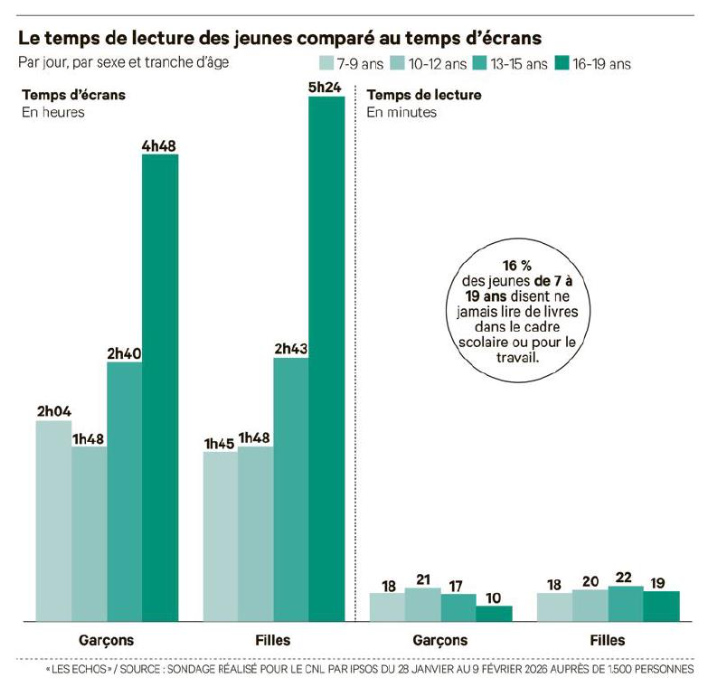
Vu dans @LesEchos. A gauche, le temps d'écrans des jeunes. A droite, le temps de lecture.
Louis Hausalter tweet media
Français
32
100
165
41.6K
Jérôme Batout retweetledi
380k Paris Paname 🔄
380k Paris Paname 🔄@ParisAMDParis·
🎨 Jean Dufy. Île de la Cité c.1954. Paris Notre-Dame
380k Paris Paname 🔄 tweet media
Français
9
250
1.2K
22.1K
Jérôme Batout retweetledi
380k Paris Paname 🔄
380k Paris Paname 🔄@ParisAMDParis·
📸 Charles Marville. L'Hôtel de Ville après avoir été incendié durant la Commune. 1871. Paris Civil War
380k Paris Paname 🔄 tweet media
Français
7
49
319
7.4K