Joe Harris

2.7K posts

Joe Harris

Joe Harris

@JoeHarris4

Working at being a HoF Dad, Pappy & Husband 1st Sharing my passion for teaching & coaching 2nd... this is what I do

Lake Chelan WA Katılım Temmuz 2009
1.1K Takip Edilen1.6K Takipçiler
Joe Harris retweetledi
Matt Lisle
Matt Lisle@CoachLisle·
“You guys make it about the wins and losses. 25 years from now, I want them to pick up the phone and call me because they need me. I’m there for them.” The life of a coach is an investment in people, not just points. Build a legacy that outlasts the jersey.
English
18
461
5.5K
274.9K
Joe Harris retweetledi
WIBCA
WIBCA@WIBCA·
2026 WIBCA ALL STATE TEAMS. Join us this Saturday at Bellevue College for WIBCA ALL-STAR WEEKEND.
WIBCA tweet mediaWIBCA tweet mediaWIBCA tweet media
English
0
16
32
4.9K
Joe Harris retweetledi
Randy Lambert
Randy Lambert@RandyLambertMC·
A Coach Cignetti jewel: “Good players want coached. Great players you can’t coach them enough, they want more, more, more. Inconsistent players want to be coached on their terms.” …(and always have a response or excuse)
English
2
194
686
61.7K
Joe Harris retweetledi
Dylan Rigol
Dylan Rigol@CoachRigol·
Extremely grateful to this man. One of the best coaches I have ever been around. More importantly he is one of the best humans I have ever been around. I am truly proud to have been apart of his staff for the last three years. A true leader of men. Thank You Coach.
Dylan Rigol tweet media
English
2
15
316
8.7K
Joe Harris retweetledi
Andrew Quinn
Andrew Quinn@andrewquinny·
STORYBOOK STUFF: Reece Jenkin’s Colfax boys just capped an undefeated 28-0 season with a state championship. Reece’s son Adrik led the way with a 33 point 12 rebound double double. Immediately after winning, Adrik picked up his dad’s picture and hugged mom Bre and sister Allie.
Andrew Quinn@andrewquinny

Emotional scene tonight in Colfax as beloved boys basketball head coach Reece Jenkin, battling stage 4 cancer, returned to the gym not to coach, but to support son Adrik on Senior Night. Colfax capped an undefeated regular season and Adrik led the way with 38 points in the win.

English
1
93
1.6K
241K
Joe Harris
Joe Harris@JoeHarris4·
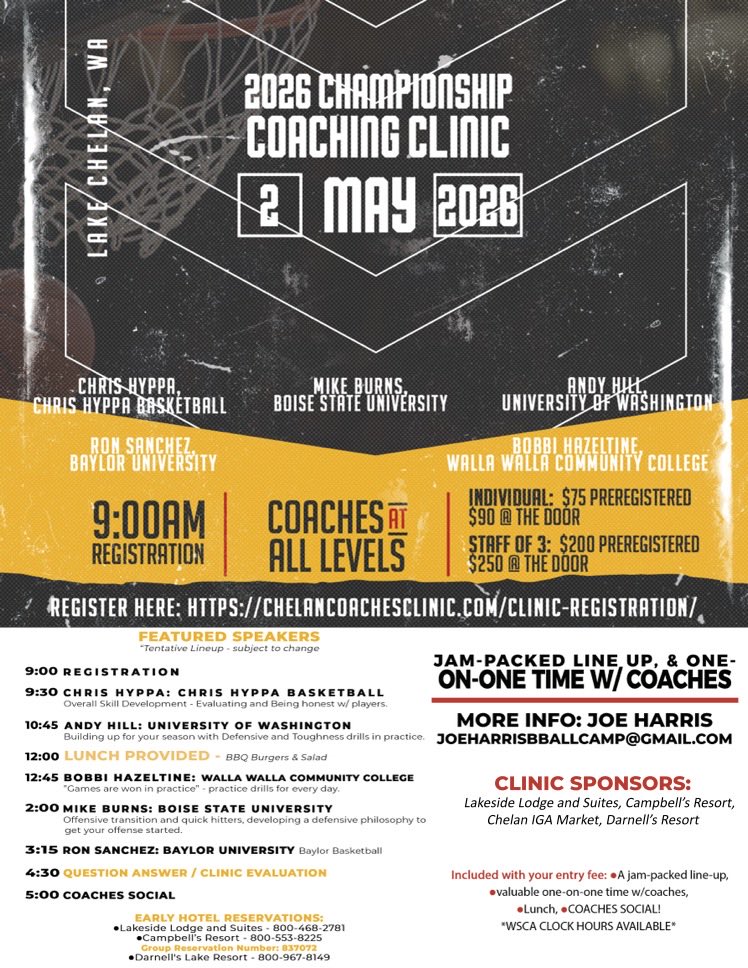
Make some plans to attend- Its never too late to make yourself better! #ChelanClinic EARLY HOTEL RESERVATIONS: Lakeside Lodge and Suites:800-468-2781 Campbells Resort: 800-553-8225 Group Reservation Number: 837072 Darnell's Lake Resort darnellsresort.com. 800-967-8149
English
0
0
0
95
Joe Harris retweetledi
Steve Magness
Steve Magness@stevemagness·
Team USA just won its first Olympic hockey gold in 46 years. On February 22. The exact anniversary of the Miracle on Ice. Forget the storybook narrative for a second. What happened today is a masterclass in what performance science teaches us about pressure, identity, and legacy. Consider the pressure this team was under. They walked into today carrying 46 years of near misses. The US hadn't won Olympic gold since 1980. They lost the gold medal game in 2002 and 2010...both times to Canada. Last year at the 4 Nations tournament, Canada beat them in overtime. That loss was still raw. The 1980 hero, Mike Eruzione, was in the building. He told the players before the game: "It's just a hockey game." It wasn't. And everyone knew it. Canada outshot the US 41-26. They dominated the second and third periods. Nathan MacKinnon missed an open net. Macklin Celebrini had a breakaway and couldn't convert. Devon Toews had Hellebuyck beaten and somehow the puck stayed out. Then Charlie McAvoy cleared a puck off the goal line with his glove. This was not a dominant performance. It was a team surviving enormous pressure and refusing to break. That distinction matters. How does a team perform under that kind of weight? It starts with the environment the coach creates. Mike Sullivan is now the only American-born coach to win multiple Stanley Cups AND Olympic gold. When he took over the Pittsburgh Penguins in 2015, the team was loaded with talent — Crosby, Malkin, Letang — and completely broken. His description: "There was a dark cloud over the locker room." His first move wasn't a new system or a motivational speech. It was a reframe. He told the team: "There are certain things in life we can control and certain things we can't. We needed to focus on the things that we could control and not dedicate any cognitive resources or worry to things we couldn't control." The team adopted a two-word motto: "Just play." Six months later, they won the Stanley Cup. Tonight, he helped USA do it again on the biggest stage in the world. Sullivan builds what he calls a "safe zone for learning." His video review sessions are explicitly NOT about blame. "We don't want a player walking into our video room on eggshells worried about 'Am I going to be in the film? Is Coach going to yell at me?' It's a game of mistakes. Our responsibility is to learn from them." His guiding principle from his college coach: "Before players want to know what you know, they want to know that you care." It's the difference between compliance and buy-in. Buy-in wins championships. Research backs up Sullivan. Fear-based environments don't produce peak performance. Especially when pressure is already high... They produce anxiety, risk-aversion, and choking. When people feel psychologically safe — when they know mistakes won't be weaponized against them — they take smarter risks, recover faster from errors, and perform better under pressure. We could see it in how Sullivan framed this moment in the weeks before the game. "What an incredible opportunity we have in front of us." Not a burden or expectation...Opportunity. He took the unusual step for a hockey team and kept the team in the Olympic Village instead of a hotel. His reasoning: "The Village is part of the experience." The Hughes brothers roomed together. The Tkachuk brothers roomed together. He didn't try to ignore or isolate them from the pressure. He was embedding them in it, together. And then there's the guy who scored the goal. Jack Hughes came into the Olympics injured, underperforming, slotted on the fourth line. Sullivan moved him up mid-tournament because, as he put it, "We thought by moving him and getting him more ice time, he could impact the game more." Hughes's response: "I believe in myself more than anyone. Wherever I was slotted coming into this thing, I knew I was going to play well." A coach who believed in him when results said otherwise. A player who believed in himself when the lineup said otherwise. Then two teeth got cracked in half by a high stick in the third period. And he scored the golden goal anyway. Everyone's going to remember this as the night the US ended a 46-year drought. On the anniversary. In overtime. Against Canada. But the real lesson is quieter than that. The environment you create determines the performance you get. A safe zone for learning. A focus on controllables. Relationships built on care, not fear. Pressure reframed as opportunity. That's what it looks like when a team is ready, with the right environment and support to tackle the ghosts of history. They built a culture where a team could survive 41 shots and a kid with two broken teeth could score the biggest goal of his life. The 1980 Miracle was about belief overcoming talent. Today was different. Today was talent, preparation, identity, and 46 years of accumulated hunger arriving at the same moment. -Steve
Steve Magness tweet media
English
51
383
2.3K
126.4K
Joe Harris retweetledi
Hoop Herald
Hoop Herald@TheHoopHerald·
This really hits home Kelvin Sampson’s first thoughts on being a Hall of Fame finalist “My hero was my father. He coached most of his career through segregation... If this were to happen... I just would've really liked to see his reaction"
English
7
10
87
6.9K
Joe Harris retweetledi
Brad Stulberg
Brad Stulberg@BStulberg·
Norway consistently wins the most medals at the Winter Olympic Games, with a population of just 5.6 million people. A big part of their success is how they treat youth sports—and it’s the opposite of what we do in the US. Here’s what we can learn from Norway: 1. Scorekeeping: In the US: Youth sports tend to be hyper competitive even at early ages. Leagues almost always keep score. In Norway: Scorekeeping isn’t even allowed until age 13. Removing winners and losers keeps the focus on the process not outcomes. It keeps kids engaged longer because it minimizes pressure (and tears) and maximizes fun, learning, and growth. The goal isn’t to win a third grade championship. It’s to love sport and keep playing. 2. Trophies: In the US: If you give everyone a trophy, you’re creating snowflakes who will never gain a competitive edge. In Norway: Whenever trophies are awarded, they are handed out to everyone. If getting a trophy makes young kids feel good, we should give them trophies. Maybe they’ll come back and play again next year!! As for the creation of snowflakes with no competitive edge—Norway’s athletes are tough as nails and all they do is win. 3. Prioritizing Fun: In the US: Far too often, the goal is to win. In Norway: The national philosophy is “joy of sport.” Youth sports in the US are driven by adults, ego, and money. Youth sports in Norway are driven by fun. Only half of kids in the US participate in sports. The number one reason they drop out: because they aren’t having fun anymore. In Norway, 93% of kids participate in youth sports. Fun is the foremost goal. 4. Playing Multiple Sports: In the US: There’s pressure to specialize early and play your best sport year round. In Norway: Try as many sports as you can before specializing as late as college. Norway encourages kids to try all types of sport. This reduces injury and burnout and increases all-around athleticism. It also helps promotes match quality, or finding the sport you are best suited for as your body develops, which is impossible if you commit to a single sport too early. 5. Affordability In the US: There is increasingly a pay-to-play model with high fees for leagues, equipment, and travel. This excludes many kids from playing. In Norway: It’s a national priority to keep youth sports affordable and therefore accessible for all. Kids aren’t priced out, which creates opportunities for everyone to participate (and develop into athletes), regardless of their parents’ income level. We could learn a lot from Norway: In the US, 70% of kids drop out of youth sports by age 13. This not only diminishes an elite-athlete pipeline, but it also destroys an opportunity for healthy habits and all the character lessons kids can learn from sport. In Norway, lifelong participation in sport is the norm. The goal isn’t to have the best 9U team. It’s to develop the best athletes. Those are two very different things. And Norway has the gold medals to prove it.
Brad Stulberg tweet media
English
630
1K
5.3K
2.1M
Joe Harris retweetledi
Andrew Quinn
Andrew Quinn@andrewquinny·
Emotional scene tonight in Colfax as beloved boys basketball head coach Reece Jenkin, battling stage 4 cancer, returned to the gym not to coach, but to support son Adrik on Senior Night. Colfax capped an undefeated regular season and Adrik led the way with 38 points in the win.
English
92
739
26.1K
1.5M
Gunther Eagleman™
Gunther Eagleman™@GuntherEagleman·
🚨ALL OF THIS, EVERY WORD OF IT! “I was raised to stand when the anthem played, hand over heart, eyes on the flag, not out of habit, but out of honor, because I knew what it meant to live in a place where freedom wasn't just a word, but a sacrifice. America was never promised easy. She was promised free, and freedom has never been cheap. It's been bought in battlefield silence and folded flags, in tears on tarmacs and names etched in stone. This country is stitched together with stories of people who kept showing up even when it got hard: farmers, soldiers, mothers working two jobs, kids who believed they could be anything, because here, you still can. We are small towns and big cities, steel mills and skyscrapers, languages that sound different but still say, "This is home." And no, we're not perfect. We never have been. But perfection was never the goal. Progress was. Unity, even in the tension. Freedom, even in the mess. Somewhere along the way, we started forgetting, started tearing down what generations before us gave everything to build. We argue louder than we listen. We cancel quicker than we understand. We treat patriotism like it's a problem when it's the very reason we get to speak at all. This isn't about politics. This is about principle, about remembering that laws matter, that order matters, that borders mean something, that a country that stands for nothing will fall for anything. But yet we still rise every time, because when the world shakes, we don't run. We rebuild. That's the America I know, the one that opens its arms but doesn't forget what it holds up, the one that bends but does not break. So no, I won't apologize for being proud, for believing in the flag and what it stands for, for choosing country over chaos, honor over noise, hope over fear, because I've seen what this country can be when we stop fighting each other and start fighting for one another. "We the people" still means all of us, but only if we act like it. So I'll keep standing, even if I'm standing alone, because America wasn't just built on power. She was built on resolve, and this is the country that I still believe in”
English
146
1.8K
5K
67.1K