Joe Anderson

158 posts

Joe Anderson banner
Joe Anderson

Joe Anderson

@JoeReedAnderson

Aggregate resource constraints, Pepsi Zero, and college 🏈. Inflation is only somewhat a monetary phenomenon.

St. Paul, MN Katılım Aralık 2010
196 Takip Edilen107 Takipçiler
Sabitlenmiş Tweet
Joe Anderson
Joe Anderson@JoeReedAnderson·
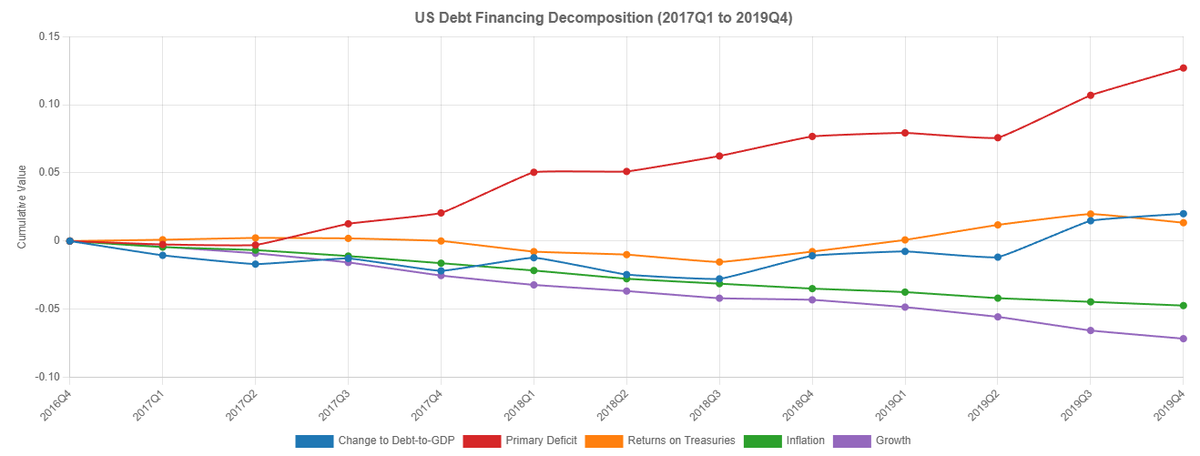
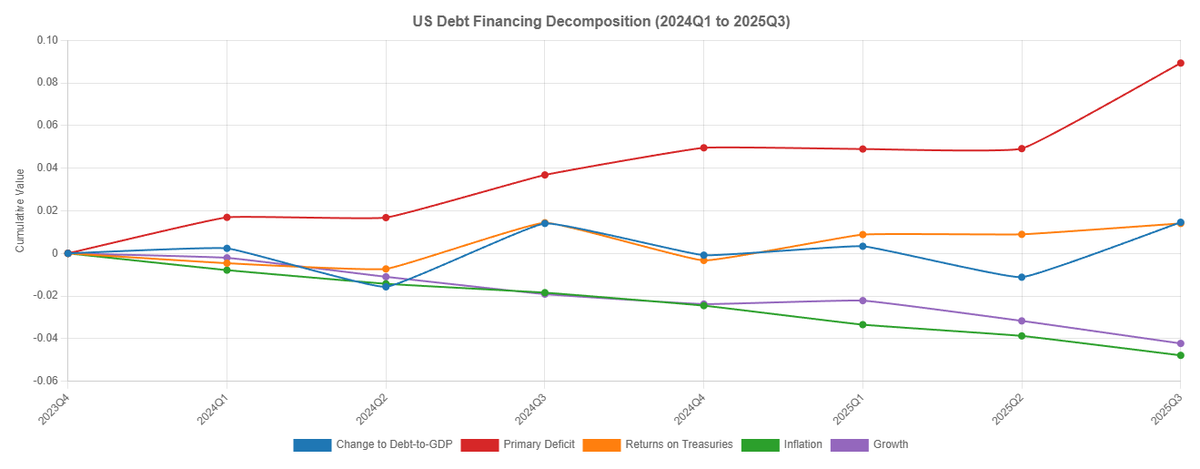
US Debt/GDP rose between 1Q2025 and 1Q2026 to 102.1% (+2.0% change). Driven by: - Primary deficits: +7.1% - Treasury returns: +1.5% - Real growth: -2.5% - Inflation: -4.2% - Returns on reserves and rev. repos: +0.1%
Joe Anderson tweet media
English
1
1
4
266
Joe Anderson
Joe Anderson@JoeReedAnderson·
@40yoap Equilibrium selection problems are known to be challenging. I'll do my part to keep you seizure free from now on 😉
English
1
0
1
33
Gabriel
Gabriel@40yoap·
@JoeReedAnderson Why would you ever write 1Q2025 instead of 2025Q1? Just to give me a seizure?
English
1
0
4
184
Joe Anderson
Joe Anderson@JoeReedAnderson·
US Debt/GDP rose between 1Q2025 and 1Q2026 to 102.1% (+2.0% change). Driven by: - Primary deficits: +7.1% - Treasury returns: +1.5% - Real growth: -2.5% - Inflation: -4.2% - Returns on reserves and rev. repos: +0.1%
Joe Anderson tweet media
English
1
1
4
266
Joe Anderson retweetledi
Ricardo Reis
Ricardo Reis@R2Rsquared·
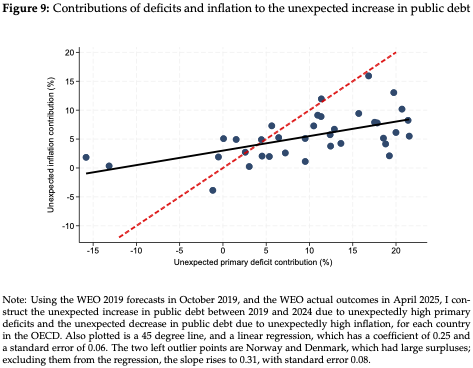
How much did public deficits contribute to the inflation surge of 2021-24? A popular argument notes that inflation rose in the US by almost as much as in other OECD countries. Yet, the US had a large fiscal stimulus in 2021 that most other countries did not. Therefore, the US fiscal stimulus did not contribute to the inflation surge. Is that right? No, it is not. To inspect this claim, you can use expectations data. By virtue of its mandate, the IMF is one of the best forecasters of fiscal variables and all economists pay attention to them. The IMF also forecasts inflation; during 2021-24, it was as right or as wrong as other institutions or surveys. Start from the IMF's forecasts in October of 2019 for the next 5 years of how much public debt would grow and what would be fiscal deficits, interest rates, inflation, and growth rates. Then look at the IMF April 2025 reports of those actual variables. Subtract one from the other and you have how much of the unexpected increase in public debt was due to unexpectedly high deficits, unexpectedly high interest rates, unexpectedly low growth rates and unexpectedly high inflation. The plot compares the unexpected high deficits with the unexpected high inflation terms for OECD countries, using the common units of their impact on the public debt. For countries that ran higher unexpected fiscal deficits, inflation was also unexpectedly higher. Some countries had their stimulus early, others only later. Somer larger, other smaller. Some had more, others less inflation. The accounts of the government let you consistently sum these differences over the 5 years to look beyond timings and to use consistent units. Thinking in terms of surprises and using expectations data allows you to compare countries with very different fiscal trajectories. More generally, in all models and theories of inflation, including fiscal account, expectations are crucial. Using expectations data to inspect them is very informative. Note: as with the initial claim, the plot is a correlation, not a causal statement. Sources: (i) Section 4 in Reis "Why Did Inflation Rise and Fall in 2021-24? Channels and Evidence from Expectations" (ii) This simple exercise is inspired on the analysis of Barro and Bianchi “Fiscal Influences on Inflation in OECD Countries, 2020-23.”
Ricardo Reis tweet media
English
37
150
630
205.4K
Joe Anderson
Joe Anderson@JoeReedAnderson·
3 years ago: "Here's a paper, write 30 titles." Today: "Here's a title, write 30 papers."
Andy Hall@ahall_research

AI research is accelerating. On January 2nd I claimed that Claude Code was coming for academia "like a freight train" and that a single academic would be able to "write thousands of empirical papers." It's been less than two months since then, and worth taking stock of where we're at... In econ, @YanagizawaD has launched a project that is literally writing 1,000 papers. My prediction is already coming true, much faster than I thought it would! Meanwhile, @alexolegimas has released a dizzying array of new research via his substack, leveraging Claude Code extensively. I've released a "research swarm" that writes hundreds of papers, as well as a visualizer for specification searches, an LLM council that can be used for peer review, and more. My students and I have run an extensive experiment on Claude Code and Codex, and surprisingly found that their guardrails discourage p-hacking (though they can be circumvented easily). Everywhere, we're seeing interesting new papers leveraging AI. Progress in adopting Claude Code and other AI tools and using them to produce research is going faster than I expected, and it seems plausible now that it will keep accelerating as the tools improve and more researchers gain familiarity. I'm baffled by any empirical social scientist who isn't paying attention to these trends and isn't changing their practices accordingly. It's not yet clear how these changes will affect knowledge, but it's impossible to ignore what's coming, and what has already come to pass in the last few months.

English
0
0
0
64
Joe Anderson
Joe Anderson@JoeReedAnderson·
US Debt/GDP rose between 4Q2024 and 4Q2025 to 102.2% (+0.6% change). Driven by: - Primary deficits: +7.0% - Treasury returns: 0% - Real growth: -2.7% - Inflation: -3.9% - Returns on reserves and rev. repos: +0.1% From the debt decomposer tool at rb.gy/zzi417
Joe Anderson tweet media
English
0
0
1
98
Joe Anderson retweetledi
Nick Timiraos
Nick Timiraos@NickTimiraos·
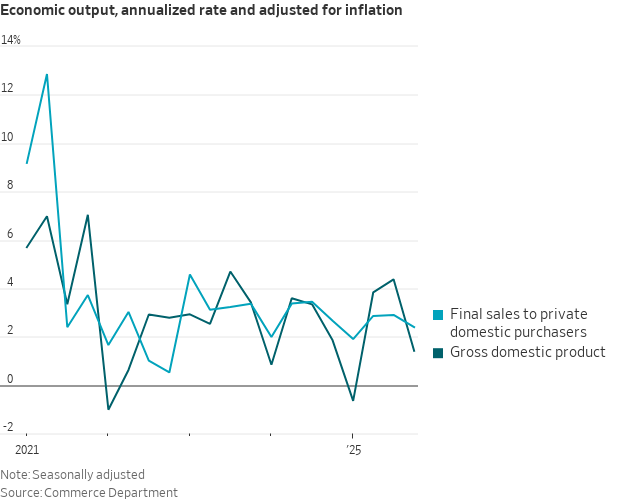
US GDP: A gauge of underlying domestic demand—real final sales to private domestic purchasers (GDP less inventory change, net exports, and government spending)—grew at a 2.4% annualized rate in Q4
Nick Timiraos tweet media
English
9
36
234
89.9K
Joe Anderson
Joe Anderson@JoeReedAnderson·
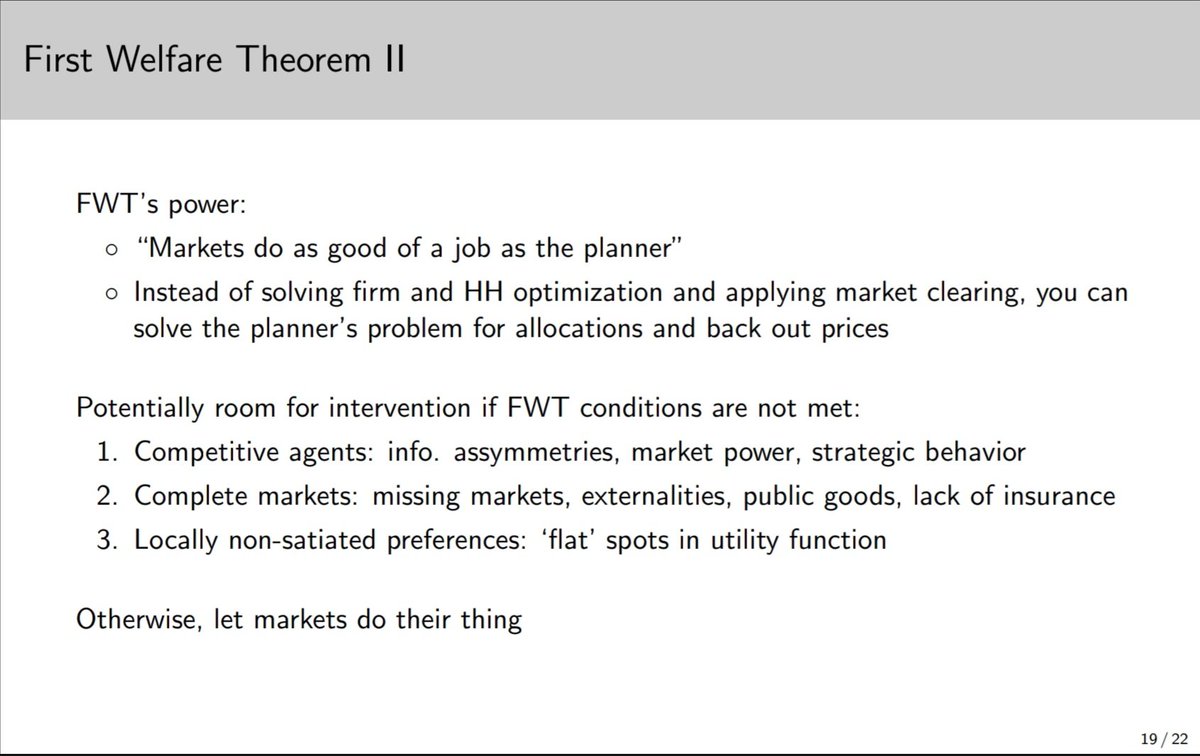
Today, I get to show my students the First Welfare Theorem in action. Nothing beats their reactions when they realize 🤯🤯🤯 It's my favorite lecture of the year.
Joe Anderson tweet media
English
0
0
2
70
Joe Anderson
Joe Anderson@JoeReedAnderson·
I will always be immensely grateful for my education in economics. There is no substitute for the ability to identify and think deeply about trade-offs.
Brian Albrecht@BrianCAlbrecht

Populists across the spectrum, left and right, hate economists. I joked its some puzzle but I think there's a simple reason. It's not about liking capitalism or something. And the disagreement is almost always about how to reason about problems, not about values. Populists want solutions. Economists offer trade-offs. I'm not the first to point this out but its a huge distinction. A carbon tax doesn't solve climate change. It prices carbon so people make better decisions at the margin. To the populist, that sounds like accepting the problem. Same with manufacturing. A tariff doesn't create jobs. It shifts them, from the millions of workers in industries that buy steel to the 160,000 who make it. To the populist, "protect American workers" sounds like a solution. To the economist, the question is: which American workers? We can go down the list. Rent control intends to help renters. It produces housing shortages. The populist sees the economist opposing rent control and concludes: you don't care about poor people. As Sowell put it: "The first lesson of economics is scarcity: there is never enough of anything to fully satisfy all those who want it. The first lesson of politics is to disregard the first lesson of economics." I think, not surprising, the economists are right. It's more than just two different approaches. Thinking in trade-offs forces you to trace each step: who actually bears the cost of a tariff, what happens to housing supply when you cap rents, how a carbon tax changes behavior at every margin. You can't skip ahead to the answer. You have to follow the chain. This is why economists spend careers doing exactly this and still argue about the answers. That's what it looks like when you take the problems seriously. The populist skips all of this based on some intuition pump. Think of the person on a group project who's so confident in the answer that they never bother learning the material. That's populist economic reasoning from inside the discipline. The confidence comes from not having looked at the trade-offs closely enough to see how hard they are. Stewart is the populist left. Oren Cass is the populist right, and he's more dangerous because he sounds like an economist, and plays one on TV, without putting in the work of thinking about trade-offs.


English
0
0
0
51
Joe Anderson
Joe Anderson@JoeReedAnderson·
Don't be fooled. This isn't someone interested in reducing deficits. Today, for each $1 we save on interest expenses from a rate cut, our administration will issue $1.50 in new debt. Cutting rates incentivizes fiscal policymakers to borrow *more.* That's why we do it in crises.
English
0
0
1
17
Joe Anderson
Joe Anderson@JoeReedAnderson·
First term (excl. COVID) Avg. Fed rate: 1.67% Avg. (Spending-Taxes)/GDP per quarter: 1% Second term (thru 2025Q3): Avg. Fed rate: 4.23% Avg. (Spending-Taxes)/GDP per quarter: 1.33% He's borrowing more this time *at higher rates.* (Red lines in the figures)
Joe Anderson tweet mediaJoe Anderson tweet media
The American Conservative@amconmag

President Trump says the US would no longer have a deficit if interest rates were dropped by 2 points. "Every point is $600 billion. Think of that. $600 billion. All he has to do, if we went down two points, we don't have a deficit anymore."

English
1
0
1
38
Joe Anderson retweetledi
Brian Albrecht
Brian Albrecht@BrianCAlbrecht·
Populists across the spectrum, left and right, hate economists. I joked its some puzzle but I think there's a simple reason. It's not about liking capitalism or something. And the disagreement is almost always about how to reason about problems, not about values. Populists want solutions. Economists offer trade-offs. I'm not the first to point this out but its a huge distinction. A carbon tax doesn't solve climate change. It prices carbon so people make better decisions at the margin. To the populist, that sounds like accepting the problem. Same with manufacturing. A tariff doesn't create jobs. It shifts them, from the millions of workers in industries that buy steel to the 160,000 who make it. To the populist, "protect American workers" sounds like a solution. To the economist, the question is: which American workers? We can go down the list. Rent control intends to help renters. It produces housing shortages. The populist sees the economist opposing rent control and concludes: you don't care about poor people. As Sowell put it: "The first lesson of economics is scarcity: there is never enough of anything to fully satisfy all those who want it. The first lesson of politics is to disregard the first lesson of economics." I think, not surprising, the economists are right. It's more than just two different approaches. Thinking in trade-offs forces you to trace each step: who actually bears the cost of a tariff, what happens to housing supply when you cap rents, how a carbon tax changes behavior at every margin. You can't skip ahead to the answer. You have to follow the chain. This is why economists spend careers doing exactly this and still argue about the answers. That's what it looks like when you take the problems seriously. The populist skips all of this based on some intuition pump. Think of the person on a group project who's so confident in the answer that they never bother learning the material. That's populist economic reasoning from inside the discipline. The confidence comes from not having looked at the trade-offs closely enough to see how hard they are. Stewart is the populist left. Oren Cass is the populist right, and he's more dangerous because he sounds like an economist, and plays one on TV, without putting in the work of thinking about trade-offs.
Herbert hovenkamp@Sherman1890

@JessicaBRiedl @jasonfurman so why do populists hate economists?

English
74
379
1.6K
173.9K
Joe Anderson retweetledi
Bloomberg TV
Bloomberg TV@BloombergTV·
President Donald Trump says Federal Reserve Chair nominee Kevin Warsh did not commit to him to lower interest rates, but Trump believes he will cut interest rates without being pressured to do so bloom.bg/3Zb7zbf
English
15
11
51
12.5K
Joe Anderson retweetledi
Joe Anderson
Joe Anderson@JoeReedAnderson·
Warsh's oped hit the WSJ yesterday where he comments on fiscal drivers of inflation. As someone vying for a Fed board seat, was that a good call? I wonder if Trump thinks so. I discuss 4 points he makes here 👇 wsj.com/opinion/the-fe…
English
1
1
2
59
Joe Anderson retweetledi
Nick Timiraos
Nick Timiraos@NickTimiraos·
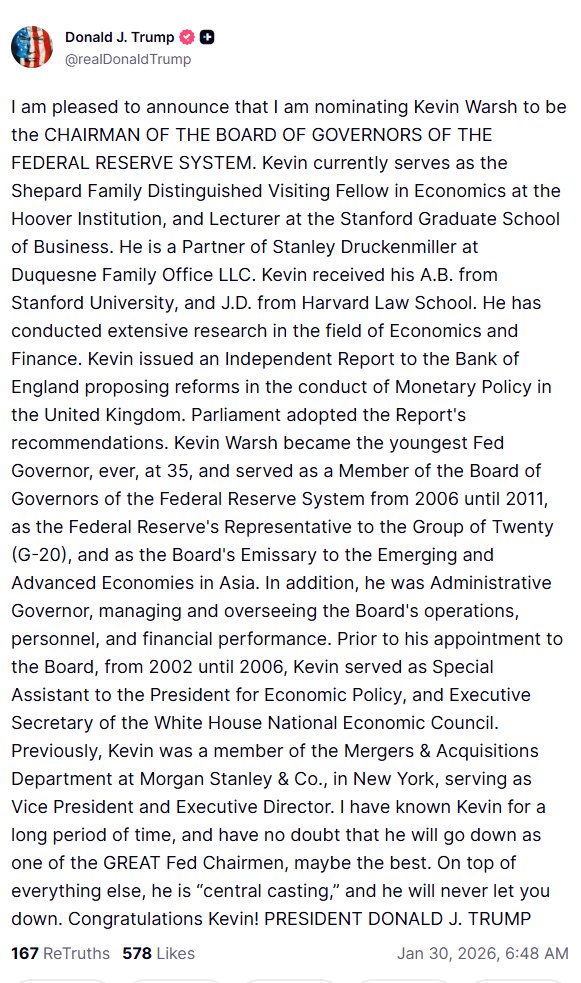
Trump announces Kevin Warsh is his pick to lead the Federal Reserve
Nick Timiraos tweet media
English
49
206
862
178.4K
Joe Anderson retweetledi
Sonu Varghese
Sonu Varghese@sonusvarghese·
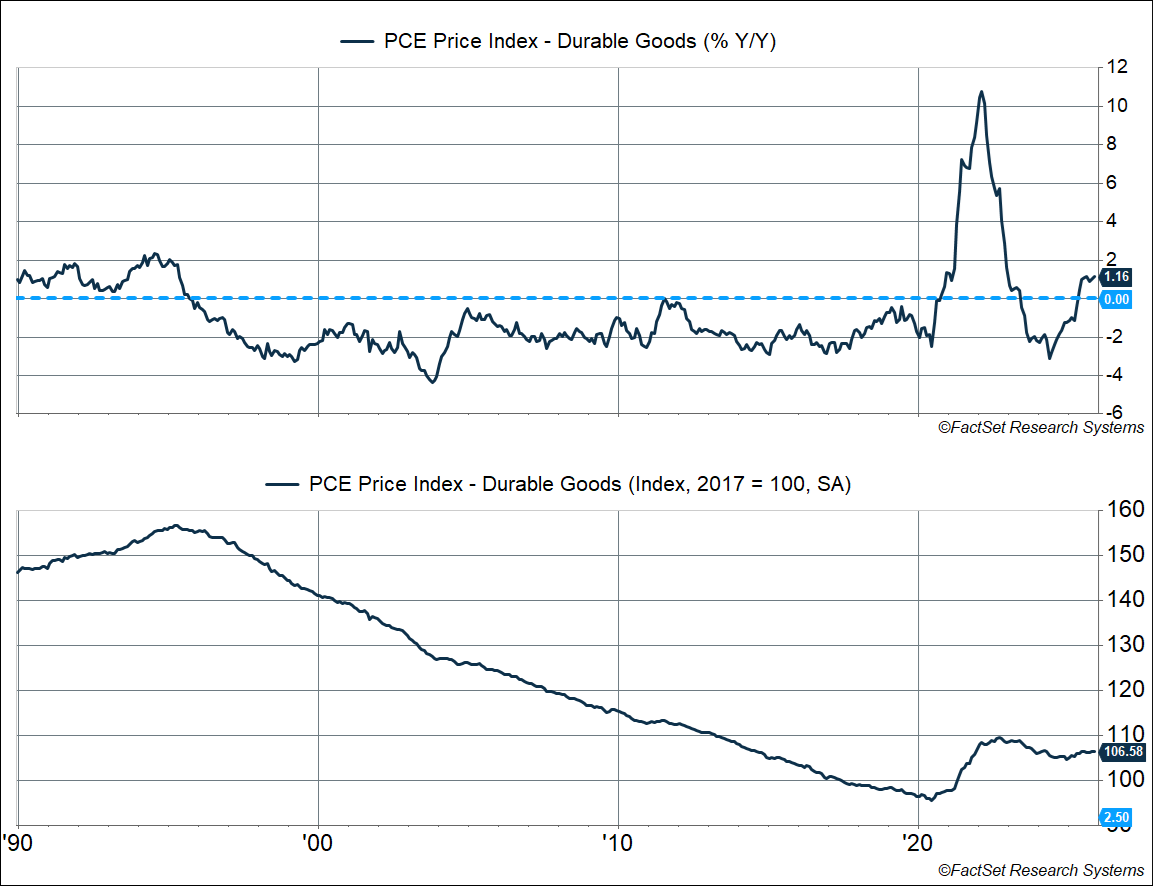
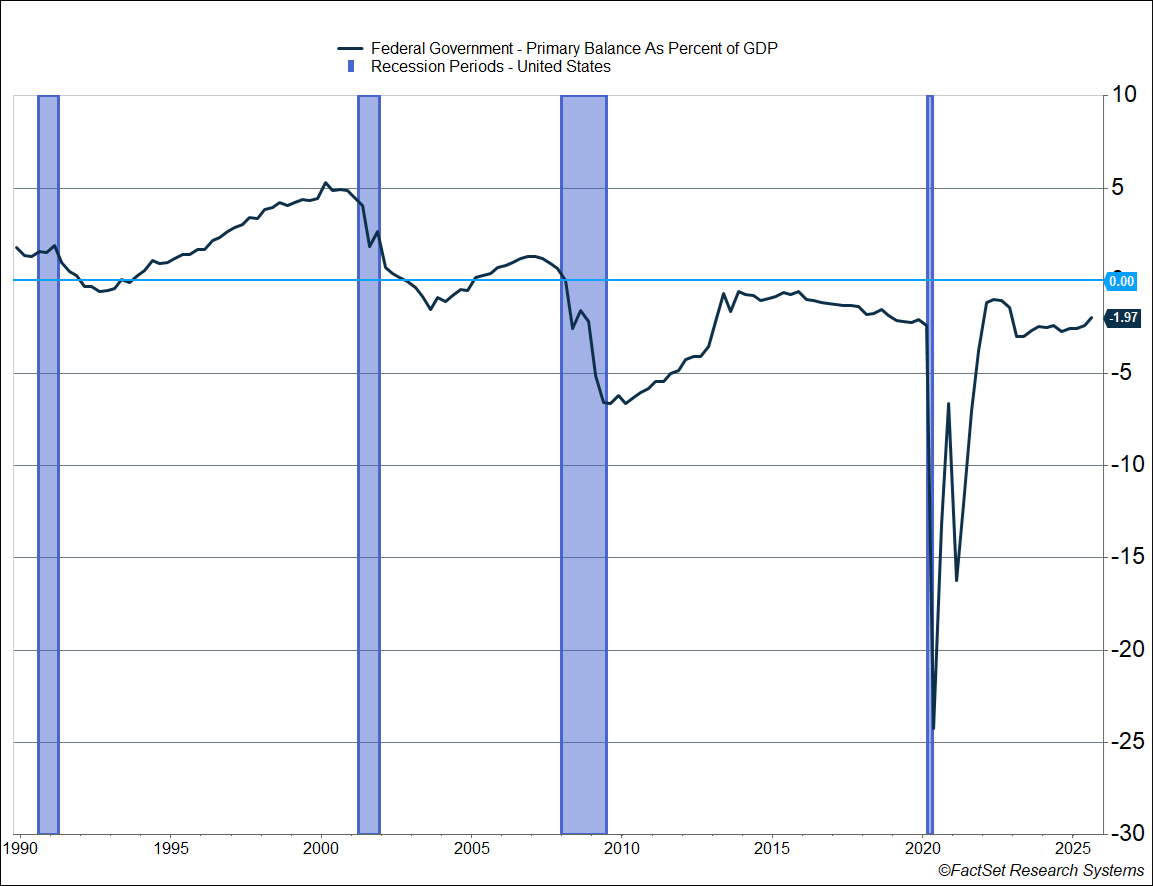
Rieder/Bessent path to low rates is strong productivity growth -> lower inflation A la mid-1990s & Greenspan rate cuts But in the 1990s 👇 - Globalization/trade deals sent goods prices lower ('95 on) - Primary fiscal surpluses (> 3% GDP in late '90s!) Neither the case now
Sonu Varghese tweet mediaSonu Varghese tweet media
Sonu Varghese@sonusvarghese

Rieder at 47% on polymarket 🤨 But quite telling that no candidate is above 50% now - which Warsh & Hasset hit. Rieder was there only briefly Perhaps Trump isnt happy with any of his options, and can't find anyone to take rates to 1% 🤔

English
4
4
40
32.9K