Johann Els

896 posts

Johann Els

Johann Els

@Johannels16

Founder of Medicise. Founder of AVO2 (Pty) Ltd and @vo2account. Deep analysis of physiology (through AI) is future of healthcare, banking and financial services
Cape Town, South Africa Katılım Aralık 2012
2.8K Takip Edilen440 Takipçiler
Sabitlenmiş Tweet
Johann Els
Johann Els@Johannels16·
#Vision is the capacity to believe in what others cannot see, and prepare and plan for it before everyone else see it.
English
2
3
10
0
Johann Els
Johann Els@Johannels16·
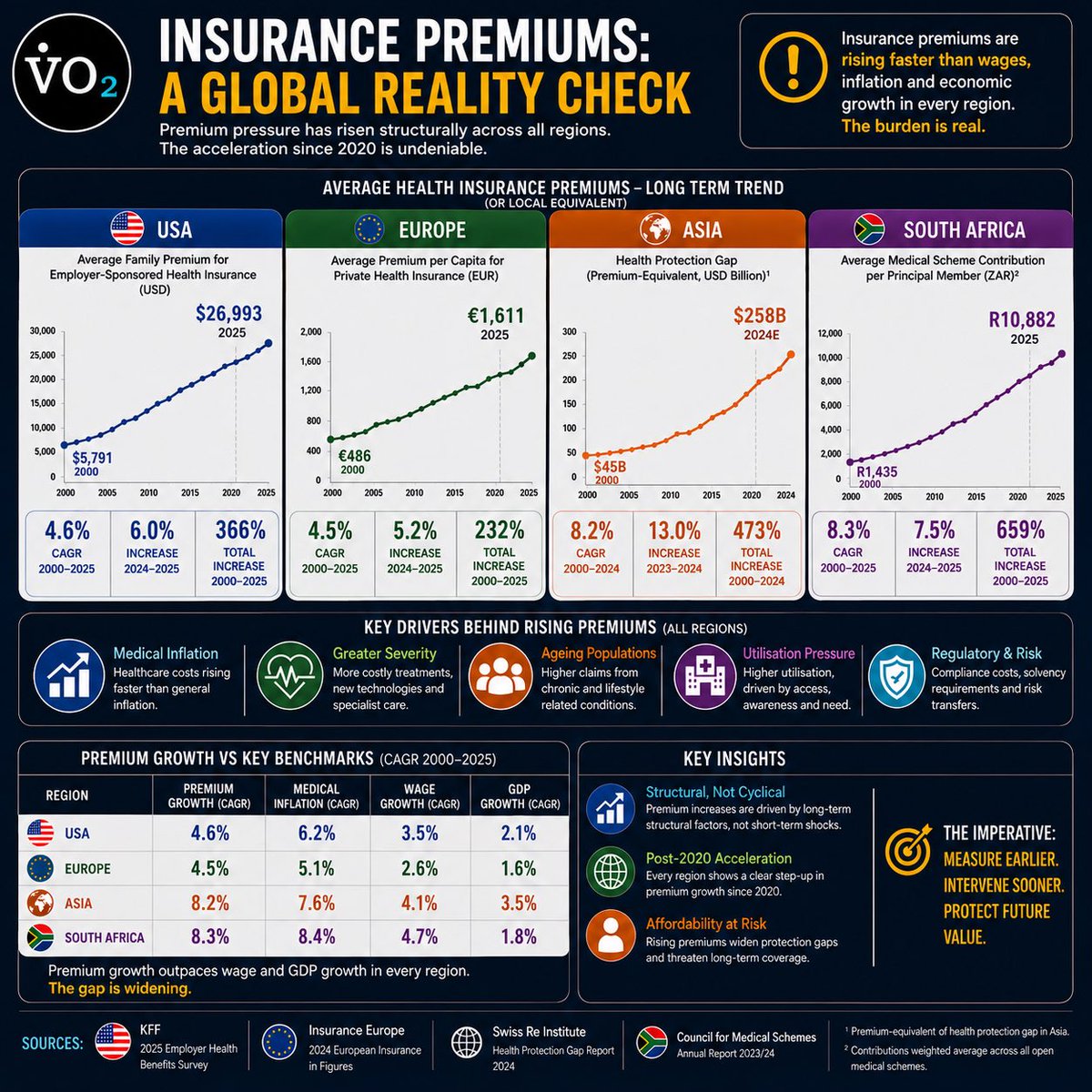
South Africa shows a 659% increase in average health insurance premiums from 2000 - 2025! Costs are exploding faster than inflation. Similar trend happening across the globe but 🇿🇦 is front runner.
Johann Els tweet media
English
0
2
1
65
Johann Els
Johann Els@Johannels16·
The data presented across the USA, Europe, Asia, and South Africa from 2000–2025 demonstrates a remarkably consistent global pattern: Healthcare systems are experiencing accelerating claims inflation, rising claims severity, increasing chronic disease treatment costs, earlier onset of disease, growing ICU/HDU utilisation, higher readmission rates, and rapidly expanding multi-morbidity burdens. Collectively, these are not isolated healthcare trends, but downstream financial signals of what we @vo2account at V̇O₂ describes as “Silent Drift” — a progressive decline in underlying human physiological resilience that is becoming increasingly visible through economic and healthcare system stress. The acceleration in costs and disease complexity suggests that populations are entering chronic disease pathways earlier and remaining within high-cost care systems for longer periods, placing mounting pressure on insurers, employers, hospitals, governments, and ultimately consumers. The consistency of these directional trends across multiple regions implies that the problem is already systemic rather than localised, reinforcing the need for earlier physiological detection, preventative intervention, and new models of Human Energy Intelligence capable of identifying risk before it manifests as expensive clinical disease and financial loss.
Johann Els tweet media
English
0
1
1
95
Johann Els
Johann Els@Johannels16·
The rising annual claims and benefit costs reported by Discovery Life and Liberty since 2020 may represent more than ordinary healthcare inflation — they may be the downstream financial expression of Silent Drift already embedding itself across populations and workforces. While traditional actuarial systems primarily react to visible disease, disability, hospital admissions, and claims events, V̇O₂ Human Energy Intelligence @vo2account measures the upstream physiological deterioration developing years earlier through declining energetic resilience, impaired metabolic flexibility, reduced recovery capacity, autonomic instability, and reduced sustainable function. The steady escalation in claims costs shown in this data aligns with the hypothesis out of our data that the financial system is already beginning to absorb the consequences of hidden physiological decline long before the true underlying cause is formally recognised inside conventional healthcare and actuarial models.
Johann Els tweet media
Johann Els@Johannels16

Silent Drift is the gradual decline in human energetic resilience before traditional systems formally recognize disease. Many people still appear “normal” on standard tests while already experiencing fatigue, poor recovery, reduced stress tolerance, impaired exercise capacity, brain fog, burnout, and declining productivity. It affects every aspect of life — work, relationships, mental resilience, physical performance, finances, and long-term health. Modern systems typically intervene only after major disease, disability, or economic consequences appear, but Silent Drift may develop quietly for years beforehand. At V̇O₂, @vo2account we believe this hidden deterioration in human energy may become one of the most important health, workforce, and economic challenges of the next decade because every business, economy, and financial system ultimately depends on human beings remaining energetically capable of functioning inside the system.

English
0
1
2
156
Johann Els
Johann Els@Johannels16·
An actuary who does not yet know how to interpret Human Energy Intelligence into financial risk models will naturally ignore it — not because the risk is absent, but because traditional systems are still built around lagging indicators such as diagnoses, claims history, hospital admissions, disability events, and mortality trends. Silent Drift operates upstream of these models through measurable deterioration in human energetic resilience years before conventional financial consequences become visible. At V̇O₂, @vo2account we believe this creates one of the largest blind spots in modern actuarial science because by the time the reactionary system finally detects the financial impact, the underlying physiological decline may already be deeply embedded across populations, workforces, healthcare systems, and economies. The challenge is not whether the risk exists — the challenge is that current financial models were never designed to see it this early.
Johann Els@Johannels16

Silent Drift is the gradual decline in human energetic resilience before traditional systems formally recognize disease. Many people still appear “normal” on standard tests while already experiencing fatigue, poor recovery, reduced stress tolerance, impaired exercise capacity, brain fog, burnout, and declining productivity. It affects every aspect of life — work, relationships, mental resilience, physical performance, finances, and long-term health. Modern systems typically intervene only after major disease, disability, or economic consequences appear, but Silent Drift may develop quietly for years beforehand. At V̇O₂, @vo2account we believe this hidden deterioration in human energy may become one of the most important health, workforce, and economic challenges of the next decade because every business, economy, and financial system ultimately depends on human beings remaining energetically capable of functioning inside the system.

English
0
1
1
111
Johann Els
Johann Els@Johannels16·
Since 2020, V̇O₂ Human Energy Intelligence has quantified Silent Drift by measuring the progressive decline in the body’s ability to generate stable, sustainable energy long before traditional disease markers appear. Across the V̇O₂ dataset, this has been reflected through declining FatMax, impaired metabolic flexibility, reduced sustainable aerobic capacity, abnormal ventilatory efficiency, blunted lactate responses, autonomic instability, weaker recovery physiology, and impaired cardiovascular energy delivery under load. While traditional systems only react once disease, disability, claims, burnout, or productivity loss become financially visible, V̇O₂ measures the upstream physiological deterioration years earlier. This creates a potentially powerful new layer of financial and actuarial intelligence because by the time these risks eventually emerge inside conventional healthcare, insurance, workforce, and banking systems, the underlying physiological decline may already be deeply embedded across populations. Silent Drift therefore represents not only a health problem, but potentially one of the largest hidden and currently unpriced economic risks developing globally. @vo2account
Johann Els@Johannels16

Traditional insurance models largely transfer underwriting risk into reinsurance structures, which often shifts the commercial focus toward maximizing policy growth and minimizing customer acquisition cost. The problem is that the entire system still primarily reacts to visible disease, claims, and historical actuarial patterns. It remains largely blind to Silent Drift — the gradual deterioration in human energetic resilience occurring years before major financial consequences appear. As long as this hidden physiological decline remains unmeasured, the underlying risk continues embedding silently across populations, workforces, and economies. By the time it eventually surfaces through rising chronic disease burden, disability, productivity decline, and claims severity, the disruption may already be deeply systemic and significantly more difficult to reverse. At V̇O₂ @vo2account , we believe Human Energy Intelligence may help identify this hidden layer of upstream physiological and economic risk before conventional systems fully recognize it.

English
0
1
1
160
Johann Els
Johann Els@Johannels16·
Traditional insurance models largely transfer underwriting risk into reinsurance structures, which often shifts the commercial focus toward maximizing policy growth and minimizing customer acquisition cost. The problem is that the entire system still primarily reacts to visible disease, claims, and historical actuarial patterns. It remains largely blind to Silent Drift — the gradual deterioration in human energetic resilience occurring years before major financial consequences appear. As long as this hidden physiological decline remains unmeasured, the underlying risk continues embedding silently across populations, workforces, and economies. By the time it eventually surfaces through rising chronic disease burden, disability, productivity decline, and claims severity, the disruption may already be deeply systemic and significantly more difficult to reverse. At V̇O₂ @vo2account , we believe Human Energy Intelligence may help identify this hidden layer of upstream physiological and economic risk before conventional systems fully recognize it.
Johann Els@Johannels16

Silent Drift may become one of the next major categories within the global economy because it describes something traditional systems still struggle to measure: the gradual decline in human energetic resilience before disease, disability, productivity loss, and financial consequences become visible. Today, most healthcare, insurance, banking, and workforce models remain reactive — they respond after the damage appears. But as chronic disease, burnout, fatigue, healthcare inflation, and workforce strain continue rising globally, the economic importance of upstream human energy may become increasingly difficult to ignore. At V̇O₂ @vo2account , we believe Human Energy Intelligence may eventually help organizations understand and measure this hidden layer of physiological and economic risk long before conventional systems detect it.

English
0
1
1
261
Johann Els
Johann Els@Johannels16·
Silent Drift may become one of the next major categories within the global economy because it describes something traditional systems still struggle to measure: the gradual decline in human energetic resilience before disease, disability, productivity loss, and financial consequences become visible. Today, most healthcare, insurance, banking, and workforce models remain reactive — they respond after the damage appears. But as chronic disease, burnout, fatigue, healthcare inflation, and workforce strain continue rising globally, the economic importance of upstream human energy may become increasingly difficult to ignore. At V̇O₂ @vo2account , we believe Human Energy Intelligence may eventually help organizations understand and measure this hidden layer of physiological and economic risk long before conventional systems detect it.
Johann Els@Johannels16

Silent Drift creates a major blind spot in the global economy because most financial and actuarial systems still operate reactively. They measure deterioration only after it becomes visible through claims, disability, absenteeism, productivity loss, or economic stress. At V̇O₂ @vo2account , Human Energy Intelligence aims to identify the hidden physiological decline developing years earlier through objective energetic and functional data. This creates a potentially powerful new layer of financial insight that traditional actuarial models cannot yet fully see or quantify. The challenge is that by the time these risks become visible within conventional reactionary systems, the underlying physiological deterioration may already be deeply embedded across populations, workforces, healthcare systems, and financial structures — making the eventual economic disruption far more difficult and expensive to reverse.

English
0
1
1
218
Johann Els
Johann Els@Johannels16·
Silent Drift creates a major blind spot in the global economy because most financial and actuarial systems still operate reactively. They measure deterioration only after it becomes visible through claims, disability, absenteeism, productivity loss, or economic stress. At V̇O₂ @vo2account , Human Energy Intelligence aims to identify the hidden physiological decline developing years earlier through objective energetic and functional data. This creates a potentially powerful new layer of financial insight that traditional actuarial models cannot yet fully see or quantify. The challenge is that by the time these risks become visible within conventional reactionary systems, the underlying physiological deterioration may already be deeply embedded across populations, workforces, healthcare systems, and financial structures — making the eventual economic disruption far more difficult and expensive to reverse.
Johann Els@Johannels16

The global economy currently has no reliable way to measure Silent Drift — the gradual decline in human energetic resilience before disease, disability, or financial consequences become obvious. As a result, the problem is largely ignored because traditional systems only react once claims rise, productivity falls, burnout increases, or economic strain becomes visible. At V̇O₂, @vo2account we are tackling this problem head-on through Human Energy Intelligence: the measurement of objective physiological function long before conventional systems formally recognize deterioration. The ripple effect is potentially enormous because insurers, banks, employers, and actuaries still largely operate on lagging indicators. They do not yet fully understand how to integrate energetic physiology into financial risk models — even though the downstream consequences may only become economically undeniable years later. That is why Silent Drift may represent one of the largest hidden and currently unpriced risks in the global economy.

English
0
1
1
226
Johann Els
Johann Els@Johannels16·
The global economy currently has no reliable way to measure Silent Drift — the gradual decline in human energetic resilience before disease, disability, or financial consequences become obvious. As a result, the problem is largely ignored because traditional systems only react once claims rise, productivity falls, burnout increases, or economic strain becomes visible. At V̇O₂, @vo2account we are tackling this problem head-on through Human Energy Intelligence: the measurement of objective physiological function long before conventional systems formally recognize deterioration. The ripple effect is potentially enormous because insurers, banks, employers, and actuaries still largely operate on lagging indicators. They do not yet fully understand how to integrate energetic physiology into financial risk models — even though the downstream consequences may only become economically undeniable years later. That is why Silent Drift may represent one of the largest hidden and currently unpriced risks in the global economy.
Johann Els@Johannels16

Silent Drift is the gradual decline in human energetic resilience before traditional systems formally recognize disease. Many people still appear “normal” on standard tests while already experiencing fatigue, poor recovery, reduced stress tolerance, impaired exercise capacity, brain fog, burnout, and declining productivity. It affects every aspect of life — work, relationships, mental resilience, physical performance, finances, and long-term health. Modern systems typically intervene only after major disease, disability, or economic consequences appear, but Silent Drift may develop quietly for years beforehand. At V̇O₂, @vo2account we believe this hidden deterioration in human energy may become one of the most important health, workforce, and economic challenges of the next decade because every business, economy, and financial system ultimately depends on human beings remaining energetically capable of functioning inside the system.

English
0
1
1
196
Johann Els
Johann Els@Johannels16·
Silent Drift is the gradual decline in human energetic resilience before traditional systems formally recognize disease. Many people still appear “normal” on standard tests while already experiencing fatigue, poor recovery, reduced stress tolerance, impaired exercise capacity, brain fog, burnout, and declining productivity. It affects every aspect of life — work, relationships, mental resilience, physical performance, finances, and long-term health. Modern systems typically intervene only after major disease, disability, or economic consequences appear, but Silent Drift may develop quietly for years beforehand. At V̇O₂, @vo2account we believe this hidden deterioration in human energy may become one of the most important health, workforce, and economic challenges of the next decade because every business, economy, and financial system ultimately depends on human beings remaining energetically capable of functioning inside the system.
English
0
1
1
417
Johann Els
Johann Els@Johannels16·
THE WORKFORCE ENERGY CRISIS HAS ALREADY BEGUN. Healthcare costs are no longer just an insurance problem. They are becoming: • a wage problem • a productivity problem • a hiring problem • a corporate growth problem Mercer’s 2026 CFO report found: • Health benefit costs rose 6.7% • Underlying trends exceeded 9% • 36% of companies slowed wage growth • 38% reduced employee benefits • Most CFOs no longer believe current cost-management strategies are working long-term At V̇O₂, we believe the deeper issue is upstream. We call it: Silent Drift The progressive decline in human energetic resilience before traditional systems formally recognise disease. Employees may still appear “normal” while already demonstrating: • impaired metabolic flexibility • reduced recovery capacity • autonomic instability • declining sustainable energy production Businesses are increasingly paying the price long before insurers classify the risk. The next great corporate advantage may not be software, logistics, or automation. It may be workforce energy itself. Because every economy ultimately depends on human beings remaining energetically capable of functioning inside the system.
English
0
0
0
67
Johann Els
Johann Els@Johannels16·
A real world case study of a 55 year old female - chartered accountant complaining of chest pain and tachycardia. Showing my exact point that sometimes the true physiological problem causing the symptoms is only truly exposed during FatMax /VT training. @ProfTimNoakes In this case her body is actually working much harder when she is forced to burn fat but no clear structural problems are present In simple terms, the subject’s heart, lungs, and muscles are still capable of reaching normal peak performance for short periods of time. Her main problem is not that she is “unfit” or unable to exercise. Instead, the problem appears when her body has to sustain steady aerobic activity over time — such as walking uphill, hiking, climbing stairs, or coping with prolonged stress. At first glance, her standard exercise test looked reassuring because she was able to reach normal exercise capacity and produce a good maximal effort. However, when her body was tested during longer periods of controlled aerobic exercise around her fat-burning zone, a different picture appeared. Her breathing became much less efficient, her heart had to work harder and faster to compensate, and extra abnormal heartbeats (PVCs) increased significantly. At the same time, her body showed reduced ability to burn fat efficiently for energy, meaning she switched too early into a more stressful and less sustainable energy state. In healthy people, this type of moderate aerobic exercise should feel stable and comfortable. In her case, the prolonged aerobic work gradually overloaded the body’s energy regulation system. As this happened, the nervous system responded by increasing stress hormones and sympathetic activation (“fight-or-flight” response), causing excessive heart-rate increases, palpitations, chest discomfort, and worsening exercise tolerance. Importantly, this explains why she can sometimes still perform well for short bursts, yet struggle with sustained activity in daily life. The findings suggest that her body currently has difficulty maintaining stable energy production over time rather than a failure of the heart or lungs themselves. The treatment approach is therefore focused on retraining the body to become more efficient and stable during aerobic exercise. By consistently training every 48 hours in the specific low-to-moderate intensity “fat-burning” zone around VT1/FatMax, the goal is to gradually improve fat burning, restore energy efficiency, stabilise the nervous system, reduce abnormal heart responses, and improve her ability to tolerate daily activity without excessive symptoms.
Johann Els@Johannels16

Most people think the true physiological problem only appears during maximal exercise. It may not. Emerging physiology suggests the hidden dysfunction may appear during sustained work around FatMax / VT1 — the exact zone where the body should still be comfortably aerobic. In healthy athletes: lactate remains controlled, ventilation stable, muscles resilient, autonomic regulation coordinated, and the brain receives a “safe to continue” signal. But in individuals with impaired mitochondrial or neuro-metabolic adaptability, the SAME zone may expose: abnormal fatigue, reduced fat oxidation, blunted lactate responses, ventilatory inefficiency, autonomic instability, PVC amplification, brain fog, post-exertional crashes. Importantly: many of these abnormalities may NOT appear during: maximal stress ECG, routine scans, structural investigations, or standard blood tests. Internal case studies in Cape Town demonstrated this clearly: maximal CPET defined the physiological boundaries, but sustained training around FatMax / VT1 exposed the hidden instability. The emerging hypothesis: FatMax / VT1 may function as a physiological “signal amplification zone” where the nervous system continuously evaluates whether stable aerobic energy production remains safe. This aligns remarkably with: @ProfTimNoakes’ central regulation model, Dr Marius Bakken Norwegian threshold model, and Prof George Brooks’ lactate shuttle physiology. The question may no longer simply be: “How hard can the body go?” The more important question may be: “How stable can the body sustain energy production under controlled physiological stress?”

English
1
0
0
220
Johann Els
Johann Els@Johannels16·
Feedback from real world case study. 70 year old male with dilated cardiomyopathy who was set for a Left Ventricular Assistance Device Implantation (LVAD) just informed me his cardiologist confirmed EF now measuring at 40%. Baseline EF was 27%. From February 2025 - May 2026 he trained at 5 watts ramping it up to 20 watts on a medical grade bike with remote ECG monitoring to ensure training is done at fatmax. Cardiology confirmed that LVAD is not necessary anymore and we prevented surgery by consistently training at fatmax. @ProfTimNoakes science / cardiology need to take note of this massive breakthrough to see the clinical value in exercise training at fatmax specifically in chronic care. @TheNoakesF @vo2account
English
0
0
0
113
Johann Els retweetledi
@vo2account
@vo2account@vo2account·
Seems like we found the answer…decentralise formal cardiac rehab by installing medical grade bicycles at patient homes - with remote ECG monitoring and ongoing serial CPET to ensure correct exercise intensity! A new era for chronic care! @TheNoakesF @Johannels16

Johann Els@Johannels16

Feedback from real world case study. 70 year old male with dilated cardiomyopathy who was set for a Left Ventricular Assistance Device Inplantation just informed me his cardiologist confirmed EF now measuring at 40%. Baseline EF was 27%. From February 2025 - May 2026 he trained at 5 watts ramping it up to 20 watts on a medical grade bike with remote ECG monitoring to ensure training is done at fatmax. Cardiology confirmed that LVAD is not necessary anymore and we prevented surgery by consistently training at fatmax. @ProfTimNoakes science / cardiology need to take note of this massive breakthrough to see the clinical value in exercise training at fatmax specifically in chronic care. @TheNoakesF @vo2account

English
0
1
1
298
Johann Els
Johann Els@Johannels16·
The emerging systems-level interpretation is therefore becoming: Sustained exercise around FatMax / VT1 may function as a controlled oxidative stress probe that exposes the organ system with the lowest energetic adaptability reserve. Depending on the dominant vulnerable organ system, the phenotype may manifest differently: myocardium → PVC amplification / electrical instability skeletal muscle → early fatigue / impaired VO₂-work scaling CNS/autonomic system → exaggerated fatigue signalling / dysautonomia lungs → ventilatory inefficiency / dyspnoea amplification liver/metabolic buffering → abnormal lactate recovery kinetics This framework also aligns remarkably well with @ProfTimNoakes’ central regulation model in which the brain limits exercise before catastrophic peripheral failure develops. Within this interpretation: lactate becomes less a marker of “anaerobic failure” and more a marker of permitted metabolic escalation. This may explain why: some athletes achieve extraordinary endurance durability, while others develop: unexplained fatigue, post-exertional crashes, autonomic instability, exercise intolerance, or electrical instability despite preserved structural investigations. Importantly, several independent literature streams now appear to support components of this framework: Threshold physiology / Norwegian Model Dr Marius Bakken: mariusbakken.com/the-norwegian-… Lactate shuttle physiology George Brooks: researchgate.net/profile/George… Lactate production under aerobic conditions Brooks et al: researchgate.net/profile/George… Long COVID CPET physiology Submaximal abnormalities despite preserved peak values: pmc.ncbi.nlm.nih.gov/articles/PMC13… Mitochondrial dysfunction and exercise intolerance pmc.ncbi.nlm.nih.gov/articles/PMC35… Autonomic dysfunction and exercise intolerance sciencedirect.com/science/articl… Ventilatory inefficiency and fatigue syndromes frontiersin.org/journals/medic… Lactate-guided threshold training researchgate.net/publication/36… Insulin signalling and CNS metabolic regulation Role of insulin action in the brain: doi.org/10.1152/ajpend… Central regulation and fatigue physiology described by Prof Tim Noakes’ central governor framework and emerging CNS-mediated fatigue modulation concepts.
Johann Els@Johannels16

Most people think the true physiological problem only appears during maximal exercise. It may not. Emerging physiology suggests the hidden dysfunction may appear during sustained work around FatMax / VT1 — the exact zone where the body should still be comfortably aerobic. In healthy athletes: lactate remains controlled, ventilation stable, muscles resilient, autonomic regulation coordinated, and the brain receives a “safe to continue” signal. But in individuals with impaired mitochondrial or neuro-metabolic adaptability, the SAME zone may expose: abnormal fatigue, reduced fat oxidation, blunted lactate responses, ventilatory inefficiency, autonomic instability, PVC amplification, brain fog, post-exertional crashes. Importantly: many of these abnormalities may NOT appear during: maximal stress ECG, routine scans, structural investigations, or standard blood tests. Internal case studies in Cape Town demonstrated this clearly: maximal CPET defined the physiological boundaries, but sustained training around FatMax / VT1 exposed the hidden instability. The emerging hypothesis: FatMax / VT1 may function as a physiological “signal amplification zone” where the nervous system continuously evaluates whether stable aerobic energy production remains safe. This aligns remarkably with: @ProfTimNoakes’ central regulation model, Dr Marius Bakken Norwegian threshold model, and Prof George Brooks’ lactate shuttle physiology. The question may no longer simply be: “How hard can the body go?” The more important question may be: “How stable can the body sustain energy production under controlled physiological stress?”

English
0
1
1
235
Johann Els
Johann Els@Johannels16·
Most people think the true physiological problem only appears during maximal exercise. It may not. Emerging physiology suggests the hidden dysfunction may appear during sustained work around FatMax / VT1 — the exact zone where the body should still be comfortably aerobic. In healthy athletes: lactate remains controlled, ventilation stable, muscles resilient, autonomic regulation coordinated, and the brain receives a “safe to continue” signal. But in individuals with impaired mitochondrial or neuro-metabolic adaptability, the SAME zone may expose: abnormal fatigue, reduced fat oxidation, blunted lactate responses, ventilatory inefficiency, autonomic instability, PVC amplification, brain fog, post-exertional crashes. Importantly: many of these abnormalities may NOT appear during: maximal stress ECG, routine scans, structural investigations, or standard blood tests. Internal case studies in Cape Town demonstrated this clearly: maximal CPET defined the physiological boundaries, but sustained training around FatMax / VT1 exposed the hidden instability. The emerging hypothesis: FatMax / VT1 may function as a physiological “signal amplification zone” where the nervous system continuously evaluates whether stable aerobic energy production remains safe. This aligns remarkably with: @ProfTimNoakes’ central regulation model, Dr Marius Bakken Norwegian threshold model, and Prof George Brooks’ lactate shuttle physiology. The question may no longer simply be: “How hard can the body go?” The more important question may be: “How stable can the body sustain energy production under controlled physiological stress?”
English
1
3
4
1.5K