Promoting Competition in Policy for Rural, RR Australians. John is a policy advisor to cross bench members of parliament.In the second half of his first century
The biggest danger in politics is people making business rules who’ve never run a business, never hired staff, and never had to make payroll.
Bad policy starts with no real-world experience.
Many of you have asked about how to visit a Bruderhof community.
In our latest substack, we try to answer your questions and let you know about upcoming events at our communities this summer - can't wait to see you! open.substack.com/pub/seasonsofc…
We can’t call ourselves a “clever country” if we refuse to properly fund science. Many Australian researchers spend more than 30% of their working year writing grant applications with a less than 10% chance of success. That's a major drag on a sector which the government says is key to productivity gains.
theage.com.au/national/austr…
This situation stayed heavy on our hearts for days.
A mother crow had been caught in an illegal leg trap, and her leg was badly injured. Letting her go like that would have meant certain death. We could tell she had been caring for babies recently, but we had no idea where they were.
For several days, animal control officers searched everywhere for her chicks, but they couldn’t find them.
At the same time, we were looking after a baby crow that had been orphaned in a completely different area. Holding onto a small hope, we decided to bring the two together.
As soon as the injured mother saw the baby, she walked straight to him. She gently held him with her beak, pulled him close, and then placed herself in front of him, protecting him from the people watching. She was a mother who had lost her babies, and he was a baby who had lost his mother.
The very next day, against all expectations, her babies were finally found.
She raised the orphan along with her own chicks at the rescue while her leg healed. When the time came, they were all released together—one large, happy family.
This will always be one of our most cherished rescue stories.
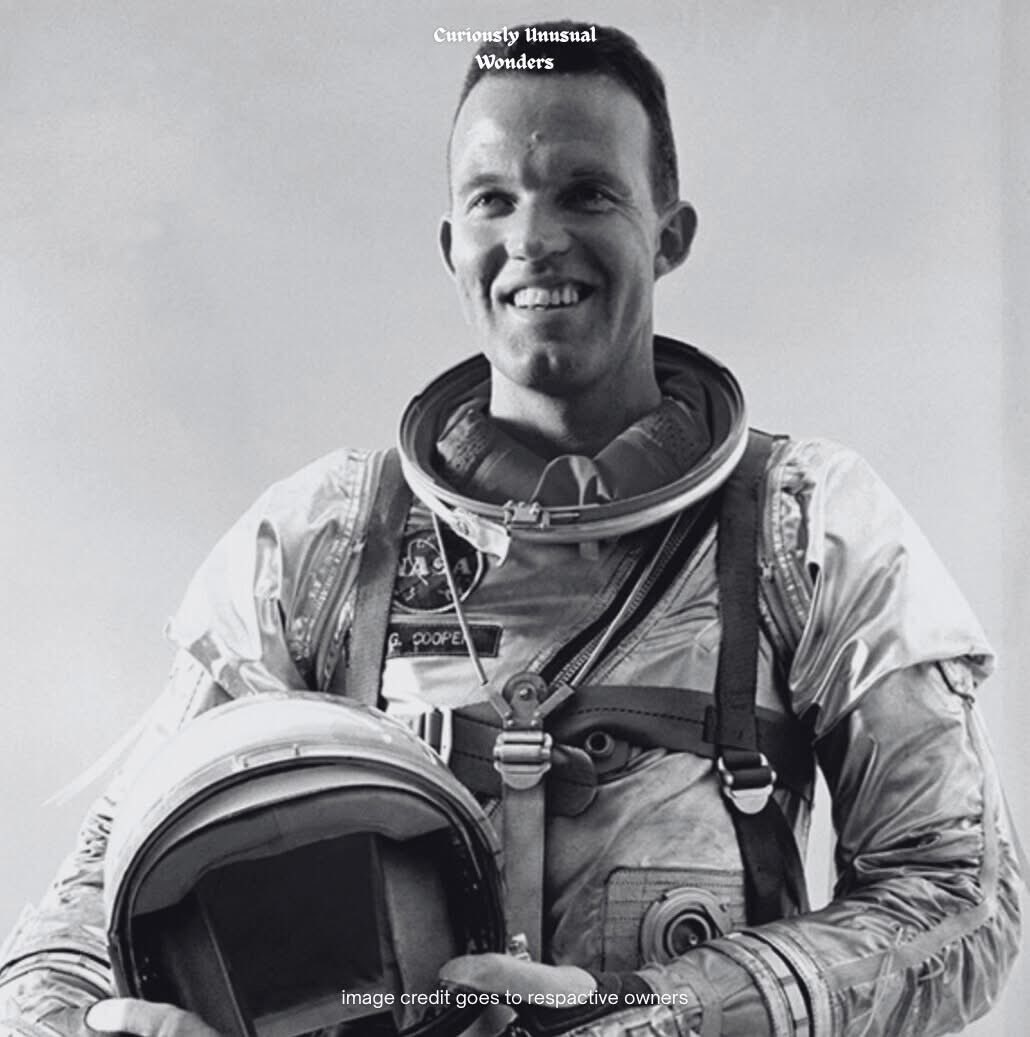
May 16, 1963. Gordon Cooper was orbiting Earth alone inside a capsule barely big enough to turn around in, moving at 17,500 miles per hour.
He had been up there for over a day.
Then the warnings started.
First a faulty sensor screaming that the ship was falling — it wasn't. He switched it off. Then something far worse: a short circuit knocked out the entire automated guidance system. The one that kept the capsule steady. The one that was supposed to bring him home.
Without it, reentry was nearly impossible.
Too shallow an angle and the capsule would bounce off the atmosphere back into space. Too steep and it would incinerate. The margin for error was razor thin — and every computer that was supposed to hit that margin was dead.
Down on the ground, NASA engineers watched the telemetry in silence. They could see everything going wrong. They could fix nothing.
Cooper didn't panic.
He uncapped a grease pencil and drew lines directly on the inside of his window to track the horizon. He looked up at the stars he had spent months memorizing and used their positions to orient the ship by eye. Then he set his wristwatch.
Because when you have no computers left, you become the computer.
At exactly the right moment — calculated in his head, confirmed by the stars outside — he fired the retrorockets. The capsule shook. The sky turned to fire. For several minutes, no one on Earth could reach him as plasma swallowed the ship whole.
Then the parachutes opened.
Faith 7 hit the water just four miles from the recovery ship — the single most accurate splashdown in the entire Mercury program.
The man with a wristwatch and a few pencil marks on a window had outperformed every automated system NASA had.
We talk a lot about technology saving us. And it often does.
But Cooper's story is a quiet reminder that behind every machine, there still has to be a human being who can look out the window, think clearly under pressure, and decide what to do next.
The final backup was never the software.
It was him.
When our Christianity begins to look like vengeance, animosity, and hostility towards the world, rather than love, humility, and compassion, that is when we know we are following someone other than Jesus.
In 2020, LiDAR surveys of a forested hilltop in Burgundy's Saône-et-Loire department picked up something unusual beneath the tree canopy. A series of stone mounds scattered across the forest floor turned out not to be natural formations at all, but the collapsed remains of an ancient Gallo-Roman sanctuary that had been hidden under dense woodland for centuries.
Excavations began in 2023, and the 2025 campaign, six weeks of work involving 35 volunteers and five professional archaeologists, has now revealed the full scale of what's up there. The sanctuary at Mancey covered roughly one hectare on a prominent hilltop overlooking the surrounding countryside.
It included two temples, gathering spaces, circulation paths, and dedicated areas for food preparation and ritual activity. The site remained in use for nearly five centuries, from the end of the Iron Age through the late Roman period.
The better preserved of the two temples, known as Monument M3, is a rectangular structure measuring about 11.6 by 7 meters, with walls still standing up to 1.5 meters high. Its earliest floor dates to the late third century AD. Beneath it, archaeologists found a foundation deposit containing seventeen coins from the late Roman period, including a gold coin issued by the emperor Tetricus I.
Around AD 325, the building was renovated significantly. The floor was raised, a vestibule was added, and interior benches were built along the walls alongside a raised platform interpreted as a cult podium.
It's what was found on that floor that makes this site stand out. A single layer contained nearly 10,000 artifacts connected to ritual banquets. Animal bones from suckling pigs, chickens, small birds, and fish. Fragments of ceramic and glass cups. Burned coins, jewelry, beads, and pins made from metal and bone.
The sheer quality of the objects points to participants from the upper end of local society. This appears to have been an exclusive gathering place rather than a site open to everyone.
Since 2023, the team has recovered around 20,000 artifacts in total, each one precisely geolocated using surveying equipment to map exactly where rituals were being performed within the complex. Metal detector surveys and soil chemistry analysis have also revealed large zones of movement marked by concentrations of Roman shoe nails, suggesting the sanctuary drew regular crowds over many generations.
The Gallo-Roman period represents the blending of local Gallic religious traditions with Roman imperial culture, and sites like Mancey are rare because they show that process playing out over centuries rather than as a single moment of conquest and replacement. The people who came here were already part of a Roman world, but they were still doing something distinctly their own.
#archaeohistories
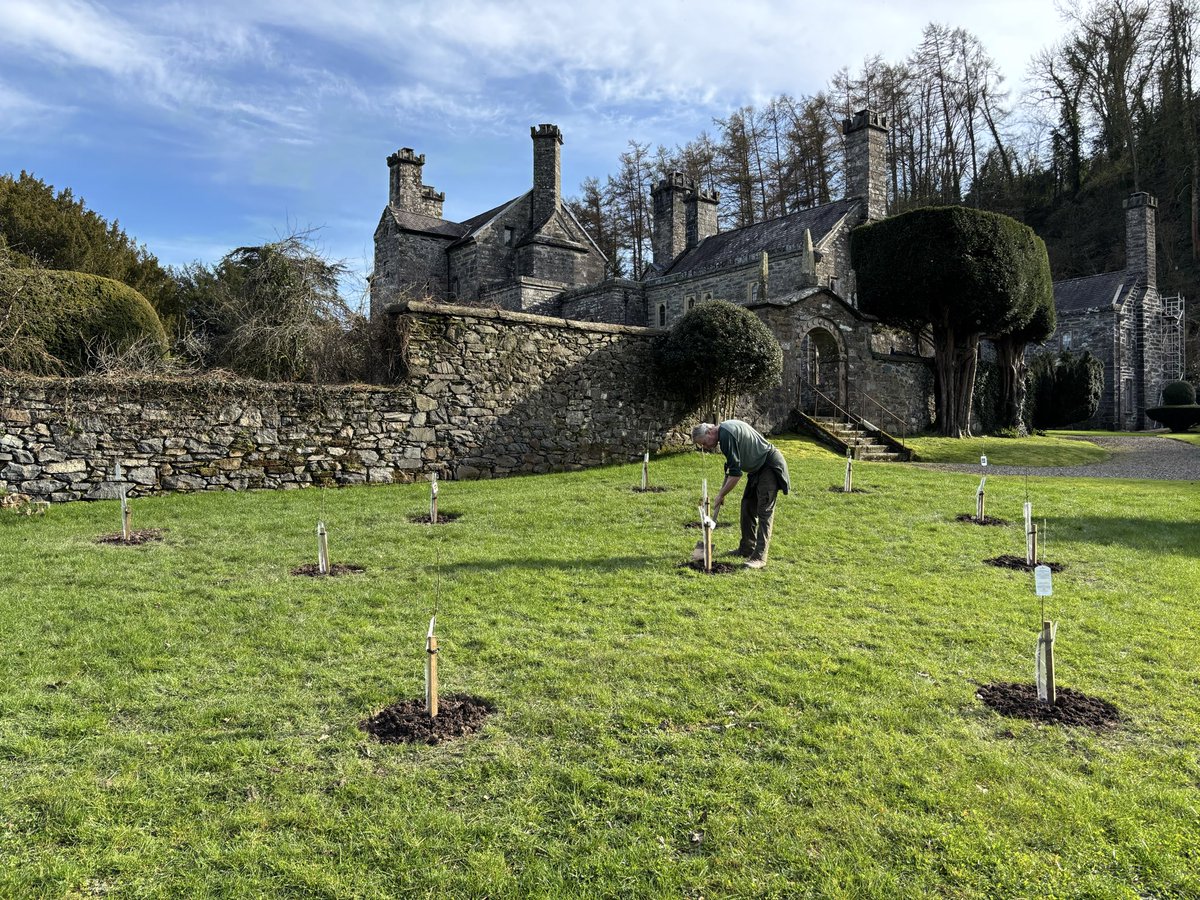
Very excited to see the new orchard going in - all old Welsh varieties of apples. Huge thanks to Welsh Historic Gardens Trust for donating the trees. Thanks to Stephen Emery for facilitating, Ian Sturrock for growing them and Simon for planting them!