John L. Ghiorso

713 posts

John L. Ghiorso banner
John L. Ghiorso

John L. Ghiorso

@JohnLGhiorso

Founder & CEO of VantaFive - An Agency Venture Studio. Founded Orca Pacific (exited). New Main: @John_Ghiorso

San Diego Katılım Eylül 2018
919 Takip Edilen1.7K Takipçiler
Sabitlenmiş Tweet
John L. Ghiorso
John L. Ghiorso@JohnLGhiorso·
After a year of advising, surfing, soul searching and occasional existential void staring, I’m jumping back into the entrepreneurial game. When I walked away from Media.Monks, I genuinely thought I was retiring. I planned on more or less hanging out, learning the guitar, surfing and tinkering with various projects. The thing about sailing off into the sunset though, is after a few months, that sailboat starts to get a bit boring, and lonely. I missed spending my days working on things that mattered, with people that mattered to me. So I decided to build something again. I’m taking my twenty years of agency experience and doubling down on the concept. Specifically, I’m co-founding a venture studio with Garret Caudle, that aims to launch five agencies over the next two years. Garret and I are cheating a bit by taking his company Influent Social and rolling it up as agency number one, but from there, we’ll “seed-strap” four more agencies by the end of 2026. Agency number two is being launched in the next sixty days, and will be focused on one-to-one customized, value additive, outbound messaging - the spiritual successor to cold email. As you might be able to tell by now, the through line in all of this is B2B, and that will continue over agencies three through five. We think there is a massive yet undercapitalized on opportunity in B2B, and emerging technology will further separate the winners and losers. We aim to be the winners’ secret weapon. I’ll have a lot more to say on all of this, as this time around I’ll be building in public, but for now, I’ll throw out a rare “right hook” vis-a-vis Gary V. If you, or anyone you know, could benefit from LinkedIn strategy, LinkedIn content production, or outbound messaging, DM’s are open. ;) See you all soon.
English

4
0
34
1.4K
John L. Ghiorso
John L. Ghiorso@JohnLGhiorso·
In 2017, I was running Orca Pacific. Middle 7 figures. High margins. High client retention. Everyone who knew us thought we were the best in the business. The problem: no one outside my immediate circle knew we existed. I hired Garret to fix that. He was 24. His entire résumé was a liberal arts degree and bartending. But he had a compelling vision, so I brought him in. First thing he tells me: “You have to start posting on LinkedIn.” It was a hard no. Not a soft no. A vehement, morally opposed, this-is-beneath-me no. My thinking at the time, and I’m embarrassed saying this out loud, was that LinkedIn content was for charlatans. That no serious businessperson did that. That I’d look like a narcissistic weirdo. That no one would care. Then Garret showed me a competitor doing it. A successful one. That was enough to get me to test it. I told him, fine…one video. You record me, you ask me a question, I answer it. Two minutes. That’s it. So we did it. That video got thousands of views, dozens of comments, and drove a handful of legitimate leads. I came back to Garret and said, “We’re going all in.” He created a monster. When are we recording more? Where’s my next video? Not because I cared about being known, but because this was suddenly the single highest-leverage thing I could do to grow my business. Over the next two years, Orca Pacific grew from $5M in revenue to $12M. I’d say about 70% of that growth came directly from what I was doing on LinkedIn. And I would not have sold the company without it. Not at the size it was, not at the growth rate it was. It probably made an eight-figure difference in my life in a very direct, through-line kind of way. The reason I’m telling you this isn’t to brag about that outcome. It’s because every founder who refuses to post, and I was one of them, thinks they’re being principled. That they’re above it. That it’s an ego move to put yourself out there. I’d argue it’s the opposite. The real ego move is refusing to do something that could genuinely help your business because you’re worried about how it looks.
John L. Ghiorso tweet media
English
0
0
1
143
John L. Ghiorso
John L. Ghiorso@JohnLGhiorso·
I'm about to upset a lot of agency founders when I say this, but an economic downturn is not an excuse for slow growth. I've run an agency through multiple recessions and economic downturns, and we've always grown 50%+ top line. Commoditized companies get hit in downturns because there's nowhere to go, but companies with strong moats and a strong value proposition can always find a path. So if you're running a small, scrappy agency and are worried about the economic headwinds upon us, you need to do these things now. Number one, go hard on outbound. Inbound is fishing, outbound is hunting. With fishing, you have to sit in the boat and wait. You don't know if you're going to get a bite. It's out of your control. Outbound is hunting. You decide what you want to shoot at, when you want to shoot at it, and you can pick your very specific ICP and go directly after them. Number two, pitch for CFOs, not CMOs. In an economic downturn, everything gets rationalized. Make sure your pitch positions you on provable ROI, and make sure your existing clients are evaluating you on that same basis. If you generate $3 for every dollar they spend, even in a downturn, they'll be much less likely to cut you. Number three, be indispensable. Focus on world-class service and stickiness. We had clients go through layoffs, significant restructuring, and we stayed around because we were an invaluable partner to them, not a vendor. Be too good to ignore, and so embedded they can't live without you. Even in an economic downturn, the world's not ending. Companies still have budgets. They still want to grow, they still want to spend money. The purse strings just get tighter, but there is absolutely a path to growth, even if it's more challenging.
English
0
0
1
102
John L. Ghiorso
John L. Ghiorso@JohnLGhiorso·
I built four successful companies, but still struggle with risk tolerance and imposter syndrome. I like to think it comes from humility, but it's a question I can't seem to shake, especially post-exit with real capital to deploy. Do I put it into safe, diversified investments (stocks, PE, etc.)? Or do I bet on myself, i.e., put it into my own ventures, where I have full visibility, full control, and real conviction? The rational argument is easy. What I'm building is riskier than an index fund, so put a small sliver into my own stuff and the rest into the boring, safe things. But then I think about the other side of that. When I buy a stock, I'm basically handing my money to someone I know nothing about and trusting them to generate a return. Meanwhile, I know exactly what I'm building, who's involved, and where it's headed. I have direct control. So why am I so hesitant to just bet on myself? A mentor of mine didn't hesitate when I brought this to him. "Bet on yourself. If you have investments you directly control, do that first. Then put the rest in the boring stuff." That's hard to argue with, but I still wrestle with it. Am I being arrogant by concentrating too much on my own ventures? Or am I being weirdly conservative by not backing myself enough? I try to be humble and rational about my own abilities, but I think that can actually work against you if you take it too far. You start seeing yourself as just a lucky game piece instead of someone who actually knows what they're doing. I don't have a clean answer. But I think the question is worth sitting with, especially for founders who've had an exit and are figuring out what comes next. How much should you bet on yourself? I still don't fully know.
John L. Ghiorso tweet media
English
1
0
2
176
John L. Ghiorso
John L. Ghiorso@JohnLGhiorso·
Three one-hour conversations in the last few weeks saved me $200K. (And killed my AI agency.) I'd spent the last three months preparing to launch an AI implementation agency, helping marketing teams overhaul their operations with AI. I had a great CEO candidate who was fully qualified and leaned in. The problem I kept facing was that VantaFive, my venture studio, runs on outbound from day one. But you can't run outbound with generic messaging. "We overhaul agency operations with AI," is too vague. You need "We solve X for Y in Z way," which means building specific use cases before you have clients or revenue. This created a catch-22, where you needed deep iteration and market testing before scaling GTM. This model is common for product companies, but they make up for it with rapid scalability and 90% margins. I was facing the worst of both worlds. I knew it was a problem and kept trying to solve it, reworked the positioning, explored different angles, and kept banging my head against the same wall. Then in two weeks, three conversations forced me to put the concept on ice: Conversation 1 was with a serial tech entrepreneur (you'd recognize his companies). We walked through the model together, and his take was blunt: "You're combining the upfront cost of a product company with the scalability of a service company" i.e. worst of both worlds. Conversation 2 was with a GTM expert (scales outbound for internet-famous brands). We tried solving the outbound problem together and couldn't get there. The lack of concise positioning made it impossible. Conversation 3 was with a F50 AI executive. Her take was more nuanced, but it validated the core issues, and put the final nail in the coffin. There are two takeaways from this experience: 1/ A great network can be incredibly powerful, even when they're talking you out of something. 2/ Knowing when to stop is one of the hardest skills for any entrepreneur to develop, but it's worth curating. Opportunity cost is real, and I feel like I dodged a bullet on this one.
John L. Ghiorso tweet media
English
2
0
4
210
John L. Ghiorso
John L. Ghiorso@JohnLGhiorso·
In every great company, there's a founder who's obsessed with solving their customers' problems, and @thesamparr is a great example of this. Instead of being self-promotional, he uses his reach and social capital to promote his customers' and members' businesses without asking for anything in return. This is how you create cult-like, ride-or-die loyalty within a community. I've had a great experience with Hampton so far, and it's clear that it comes from the top. If you're part of Sam's community, let’s connect on LinkedIn. My DMs are open, and I’m always up for a good conversation. linkedin.com/in/johnghiorso/
John L. Ghiorso tweet media
English
2
2
15
4.4K
John L. Ghiorso
John L. Ghiorso@JohnLGhiorso·
If you're trying to sell your agency right now and you don't have a clear AI story, you're going to struggle to find a buyer. It doesn't matter how strong the history is. The first question any serious buyer is asking is how AI is embedded in your delivery model. If you can't answer that clearly, the business starts to look like a turkey the week before Thanksgiving. The agencies that will sell well in the next 24 months are the ones that can show AI making their work faster, cheaper, and harder to replicate… not the ones still trying to figure out where it fits.
English
0
0
3
299
John L. Ghiorso
John L. Ghiorso@JohnLGhiorso·
VantaFive's portfolio grew 500% last year. We're targeting 200% this year. When I tell people that, their minds are blown. Because in the agency world, 30% growth is considered strong. Everyone just accepts that. But I've never understood why. There's no physical law preventing an agency from tripling in a year. It's math, hiring, and operational problems that need solving. Hard problems, sure. But all solvable ones. We've all just accepted that these businesses aren't as serious as SaaS or tech, and I don’t buy it.
English
0
0
1
242
John L. Ghiorso
John L. Ghiorso@JohnLGhiorso·
The CTO of a very large, very old-school organization just told me something I haven't been able to stop thinking about… They've stopped hiring junior engineers entirely. AI does all the work now. In his opinion, senior engineers will still be needed five years from now, but there will be far fewer of them available, because the junior engineers who normally would have worked their way up into those roles were never hired in the first place. The pipeline is empty. So you end up with this bizarre situation where junior talent can't get a job, but senior employees are seeing massive wage inflation. There's an alternative scenario where there are no positions at all, but in his opinion, that's still science fiction. Things might not play out this way. But regardless, the job market is about to get really, really weird. Curious if you're seeing this in your industry yet?
English
0
0
1
243
John L. Ghiorso
John L. Ghiorso@JohnLGhiorso·
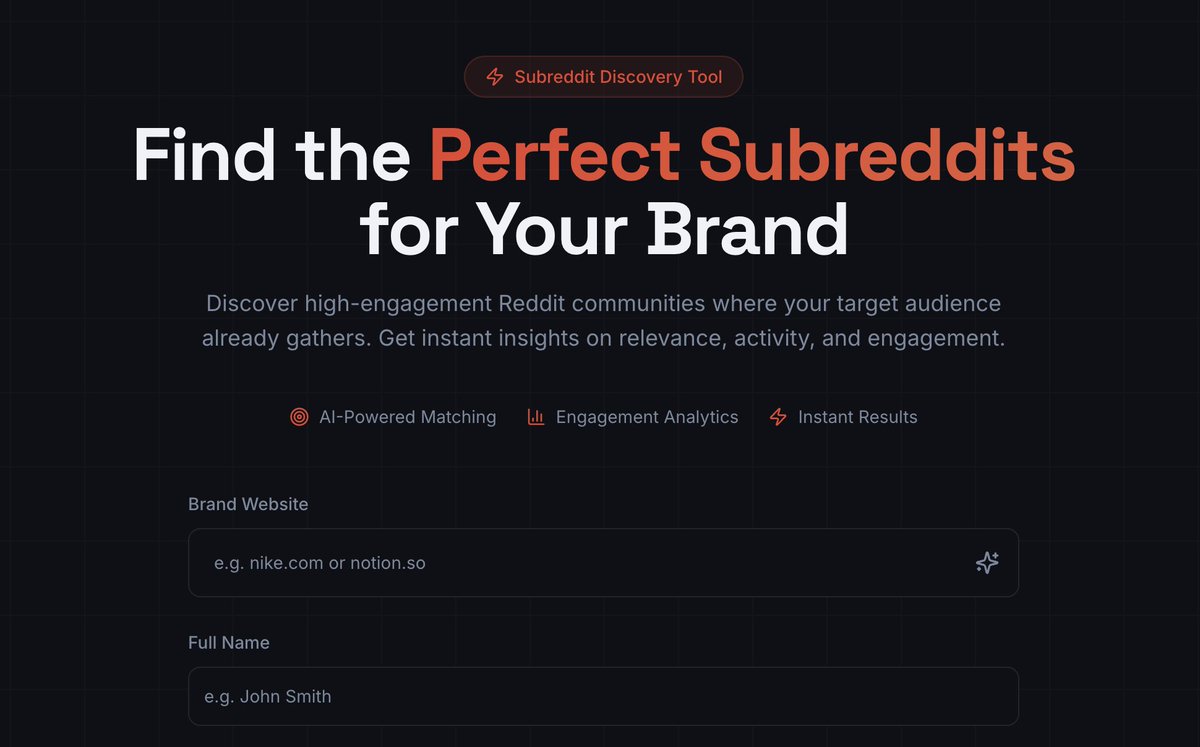
Reddit has 108 million daily active users. It's the #8 most visited website in the world. 74% of its users say it directly influences their purchasing decisions. Right now, there are entire communities on Reddit dedicated to your category, your competitors, and in a lot of cases, your brand specifically. Most marketers understand the above, but don’t know where to start. My team at RECHO built a free tool that closes that gap. Type in your brand name and you'll see every subreddit where your audience already lives, how big it is, how active it is, and how relevant it is to what you sell. Check it out here: brand-reddit-glow.lovable.app
John L. Ghiorso tweet media
English
0
0
1
183
John L. Ghiorso
John L. Ghiorso@JohnLGhiorso·
Here are 9 hot takes rattling around in my head this quarter. Some will resonate. Others will probably make you want to argue with me in the comments. Either way, I'd love to know where you land: 1. SaaS and agencies are converging into the same business category. A SaaS company's moat used to be that building a product was hard and expensive. AI is driving that cost to zero. Meanwhile, the thing agencies always had, deep domain expertise, judgment, strategy, now has leverage and scalability it never had before. One side is losing its moat. The other just found one. 2. Agentic commerce is going to be bigger than e-commerce by 2028. I believe in this enough to be building an entirely new company around it as we speak. 3. Junior roles are being eliminated right now. Everyone's job is about to require thinking like a manager, because everyone will have a team of AI agents underneath them. The people whose only value was execution are already being replaced. 4. Cold email is still the most underrated growth channel in B2B. The top 5% of cold email practitioners are absolutely crushing it right now. Everyone else is running a spam cannon and wondering why it doesn't work. It's not the channel, it's that most people have never learned the actual craft. The bar is simple: every touchpoint should add value to the recipient. 5. The ChatGPT marketplace is going to be a $10B+ channel by the end of 2026, and almost no consumer brand is ready for it. 6. Anyone proudly posting that they "replaced their $500K marketing team with AI agents" is either lying or had a terrible marketing team to begin with. If your people were good, they were already using AI in their workflow. AI should 10x great people, not replace them. 7. LLMs are getting very good at production, but they still lack taste. Not because they haven't been improved upon enough, but because there are fundamental technical limitations. They're not embodied, they don't have consciousness or emotion, so they can't feel what's going to resonate. This means judgment, taste, strategic thinking, and creativity will become the most valuable skills in an AI-driven future. 8. Most agency founders are leaving millions on the table. They have happy clients, a massive TAM, $150K LTV, proven retention, and they're sitting on their hands waiting for referrals. A 1-to-5 CAC-to-LTV ratio is considered crushing it in this industry. A 1-to-10 is world-class. A lot of these companies could hit 1-to-10 and just don't try. They're marketing agencies that don't market themselves. I find that maddening. 9. The public hatred of AI will seem very quaint in two years. Amazon's biggest PR problem in the early 2000s was people being terrified to put a credit card into a website. Then one day everyone just moved on and it seemed completely silly. We're in that moment right now with AI.
English
0
0
2
155
John L. Ghiorso
John L. Ghiorso@JohnLGhiorso·
In 2008, I was pitching Amazon services out of my apartment, no clients, no reputation, and I was crushing it. I was young and cocky and thought I was a genius. In hindsight, I was the one-eyed man in the land of the blind. Companies were scrambling to figure out the platform and there were almost no experts. If you knew anything at all, they would have hired you immediately. I spent the next decade riding that wave, grew the agency to 100 people, and sold it for eight figures to one of the largest marketing services firms in the world. I retired, got bored after six months, and spent the next five years trying to reverse engineer what actually happened. What I found was that my success was a combination of good timing and execution. I already knew how to do execution. So I started obsessing over the timing. The pattern is always the same: A breakthrough technology emerges, consumer behavior shifts fast, and most companies are left flat-footed. For example, TikTok went from a niche app to the most important media company in the world in about 24 months. Brands were scrambling to reach consumers in a place they didn't understand. The TAM was enormous, the supply of real experts was near zero, and companies couldn't build internal expertise fast enough. So they found whoever seemed to know what they were doing and wrote them a check. That gap, between when the shift happens and when the market catches up, is where the margin lives. It's always about 2-3 years wide before it closes. I call it the comet's wake. I saw it with Amazon in 2008. I see it now with LinkedIn, Reddit, and TikTok Shop. Same pattern, different category every time. By the time most people recognize the opportunity, the supply of experts has caught up, margins compress, and what was a wide-open market looks like every other crowded agency category. That's the entire thesis behind VantaFive. Identify the next comet before the market catches up, build the agency around it, and scale before the window closes. We've done it with Reddit through Recho, with LinkedIn through Influent, and with agentic commerce through Rex, which we're building right now because we think it's the biggest wave we've seen yet.
English
0
0
2
142
John L. Ghiorso
John L. Ghiorso@JohnLGhiorso·
I’m competing directly with YC. I know that sounds arrogant but it’s true. Their “software as a service” concept is the same thing I’ve been working on for three years. I’ll admit they have a better name, but it’s synonymous with my “garage agency” concept. And the reality is we’re doing a better job executing. Yes I know they can write big checks, have an amazing network, blah blah, but unlike them, we’re playing to a home field advantage. Unlike YC, VantaFive is stacked with agency veterans, and if you’re trying to disrupt an industry, it probably makes sense to have people with actual experience in it. Yes the software is important but that’s the part that’s becoming commoditized. The service part will be the variable of success, and that’s where we’ll win.
English
0
0
2
130
John L. Ghiorso
John L. Ghiorso@JohnLGhiorso·
Across my portcos, churn sits below 20%. For most agencies, it runs anywhere from 30% to 60%+. Of course the services are great, but stickiness is the biggest driver of low churn. The formula for stickiness comes down to three things: 1. Proprietary technology: Across all VantaFive agencies, we develop proprietary tech and deploy it to all clients. Clients get access to a tech stack they can't get anywhere else. These become embedded in their day-to-day operations and the more a client wants to embed your tech, the more value they see in it. Stickiness is a byproduct of genuinely useful tools/capabilities that people don't want to give up. 2. Deep organizational integration: There's a big difference between an agency that delivers work product and one that's an integrated partner. We pursue the latter. We get inside the client's internal processes, work across departments, and build capabilities their org didn't have before we showed up. We've had clients go through layoffs, PE buyouts, and full restructuring and keep us through all of it, because we'd become a partner (not a vendor) that was too valuable to live without. 3. Proactive and strategic: Vendors wait to be told what to do. They're "order takers". That's easily replaceable, and clients know it. We focus on being strategic and proactive. We identify problems and opportunities, build solutions, and ship them. We work hand in hand with our clients, but we're always leading them, not the other way around. The reality is you can provide a solid service on time and on budget and still be replaceable. You can be a great cog, but you're still just a cog. To thrive in the agency game, your service needs to be irreplaceable.
English
0
0
1
136
John L. Ghiorso
John L. Ghiorso@JohnLGhiorso·
AI shopping is nascent and agentic commerce barely exists, but both could change everything. I’m incredibly optimistic about the future with both, but realistic that you have to meet the market where it is. I'm fascinated by what people building and operating in this space are seeing on the ground. So I want to hear from my network, where does AI shopping/agentic commerce land by end of 2026? Not the science fiction version, the real one. What's actually working, what's getting traction, and where's the money moving? What are the industry’s biggest blind spots right now?
John L. Ghiorso tweet media
English
0
0
1
106
John L. Ghiorso
John L. Ghiorso@JohnLGhiorso·
In the last year, we’ve driven millions in pipeline with cold email. It’s still the biggest growth channel for our portco’s. Here’s the strategy and philosophy that drives it. **→ The first email is never a pitch.** Most cold email looks like this: here's who we are, here's what we do, here's a case study, want to hop on a call? Nobody responds because there's nothing in it for them. The first email has to earn their attention and add value. We look at their active campaigns, their website, their positioning, and find one specific thing worth flagging. Not a generic observation, something they can actually use. They spend 20 seconds reading it and walk away with something genuinely useful. Then we offer to add even more value as a next step. **→ The follow-up is not "just checking in."** I hate “you must be super busy but I just wanted to check in." It's lazy, it signals you have nothing real to offer, and it's why cold email has such a bad reputation. Our follow-up focuses on giving even more away. A free audit, a teardown of a specific campaign, a short strategy doc built around what we actually know about their business. Still no ask. Still just value. The bar we hold ourselves to: if they never became a client, would they still be glad they received this? If the answer is no, then we don’t ship it. **→ The philosophy behind all of it:** Most outbound asks for something before it gives anything. That's why it doesn't work. Start working for the client before they sign with you. Do that consistently and outbound becomes one of the most reliable growth channels you have.
John L. Ghiorso tweet media
English
1
0
2
100
John L. Ghiorso
John L. Ghiorso@JohnLGhiorso·
When I was 19 I spent a summer doing door-to-door sales. I got screamed at by strangers and chased by a very angry dog. It turned out to be one of the most important experiences of my life. The pretense to all of this was something that surprises a lot of people. I was painfully shy growing up. Not quiet-by-nature shy, the kind of shy that deeply frustrated me. The kind where making eye contact with a stranger made me nauseous, and I was terrified that I would never grow out of it. So when a buddy told me he'd made serious money doing door-to-door sales the summer before, I signed up. Partly because I'm coin-operated. But also because I knew that kind of exposure therapy was exactly what I needed. First day on the job, my manager pointed me at a stranger's house and said "go." I was nauseous, heart was pounding, and barely eeked out my pitch before they told me to pound sand. This pattern continued for the first few dozen houses, but by the second day it got a bit easier and by week two something shifted. I could walk up to a strangers door without a second thought. No stomach drop. No racing heart. No sweaty palms. That fear that held me back for so many years was simply gone. Fast forward twenty years and sales is one of my favorite parts of building a business. I never would have predicted that at 19. The fear didn't disappear because I got lucky or naturally grew out of it. It disappeared because I did the scariest thing I could think of, every single day, until it wasn't scary anymore. Running towards fear can be a great strategy, because there’s usually something pretty cool on other side.
John L. Ghiorso tweet media
English
0
0
0
105
John L. Ghiorso
John L. Ghiorso@JohnLGhiorso·
Last year, I grew my agency portfolio from $1M to $5M in ARR. This year, I'm targeting $5M to $10M. Here are the 3 pillars driving that growth: **1. Outbound** We use a combination of cold email and DMs to reach a well-researched, enriched, qualified list of prospective buyers. The volume is significant, 20,000 to 50,000 emails/messages per month per agency. The technical deliverability is critical but so is the creative. The philosophy behind it is simple: always provide more than you ask for. Every outbound message, follow up, lead magnet and call provides asymmetric value to the prospect. **2. Partnerships** Partnerships are crushing right now. They work because we have highly credible founders and high NPS scores. Great partners feel great about sending us referrals because they know (even if they don’t covert) they’ll be taken care of. Our partners fall into two buckets. The first is institutional partners (other agencies, VC, PE, trade groups, networking organizations). Their motivation is primarily strategic: they have clients/portcos with specific needs and want to make sure they’re in good hands. The second is individual partners (solopreneurs, consultants, fractional CXO’s). Their motivation is primarily coincidental operated: referral fees can become a material part of their annual earnings, which creates a real incentive to send us business consistently. There's nothing wrong with either motivation, understanding the difference just lets us tailor the program to each group. **3. Content Marketing** Each CEO creates content around their specific area of expertise. LinkedIn is our home base, but we cross-post on X and are actively ramping up short form video across consumer social platforms. We produce a combination of short form written content, long form written content, and short form video, all sourced from bi-weekly content interviews, podcast appearances, and internal strategy calls. IMO, these are the channels that represent the most alpha opportunity for founder-led service businesses in 2026.
English
1
0
2
115
John L. Ghiorso
John L. Ghiorso@JohnLGhiorso·
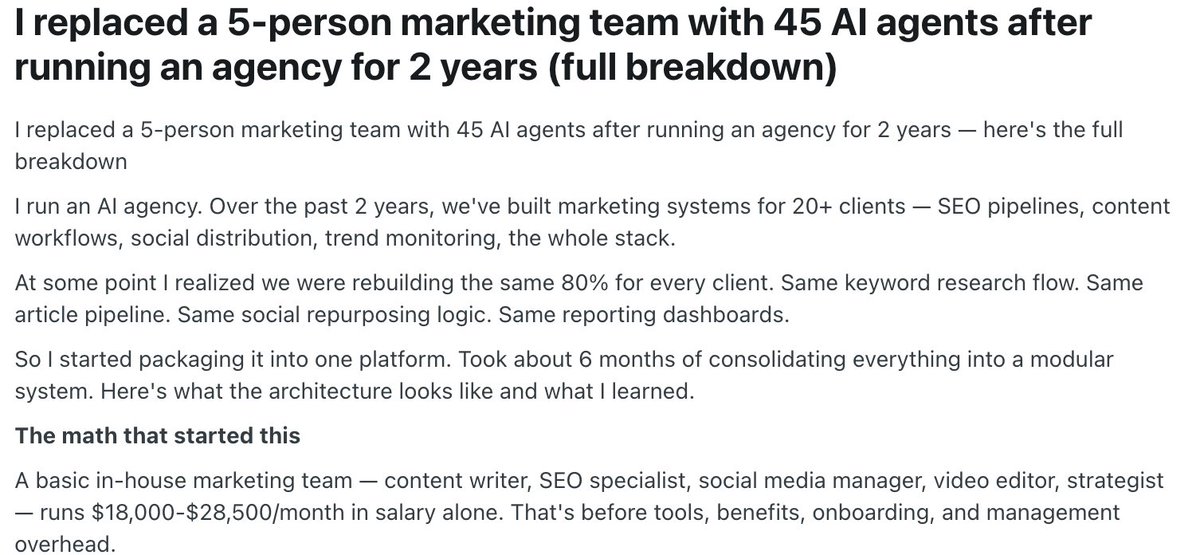
"I just replaced my $500,000 marketing team with AI agents." No, you didn't. And if you actually did, that says a lot more about your team than it does about the technology. If your marketing people were any good, they would already be using AI in their workflow, not getting replaced by it. This is the equivalent of firing your typist pool in 1997 and replacing them with PCs. Okay, but why did you have a typist pool in 1997? That's not a story about how great the technology is. That's a story about how far behind you were. The reality is, AI agents aren't good enough to actually run a marketing function yet. Most of what you see online claiming otherwise makes for a great LinkedIn post and that's about it. Could this change in the future? Sure. But we're not there yet, and the people posting about it just want the engagement. Everyone's sick of it and I think it's worth saying out loud.
John L. Ghiorso tweet mediaJohn L. Ghiorso tweet media
English
1
0
2
235
John L. Ghiorso
John L. Ghiorso@JohnLGhiorso·
I'm launching my next agency and need a co-founder. The company is code-named "Rex", and will be a full-service agentic commerce agency/consultancy. In short, we'll optimize for every aspect of AI shopping and ultimately agentic commerce. We'll handle GEO, infrastructure, product feeds and paid media on behalf of consumer product brands, all aimed at maximizing revenue in this emerging channel. People aren't paying enough attention to agentic commerce, but it's about to pop, so the opportunity to jump into this is now. The co-founder/CEO profile I'm looking for is specific… 1. Deep agency experience on the client side in a leadership role. Someone who's actually run accounts, managed teams, and knows what it feels like when things go sideways and how to fix it. 2. Serious ecommerce chops, specifically DTC or platform commerce (ie Amazon, Walmart). Someone who knows what keeps consumer product companies up at night and speaks their language. 3. Technical SEO/GEO expertise. Specifically from a commercial perspective. Someone who understands the nuances of using SEO/GEO to drive revenue, not just awareness. I know I'm looking for a unicorn, but if this is you, or you know this person, DMs are open.
John L. Ghiorso tweet media
English
2
0
1
106
John L. Ghiorso
John L. Ghiorso@JohnLGhiorso·
Anthropic just told us which jobs are most at risk from AI disruption, and agencies are in the bullseye. I run multiple agencies, so you'd assume my teams, who do exactly the work the report flags, content creation, production, optimization, would be freaking out. They're not. And neither am I. That work IS going away. I don't even think it takes five years. Two or three, maybe. But most people are reading this report wrong. The tasks go away. The job doesn't. Those are two very different things. What actually happens is everyone becomes a manager... not of people, but of the AI agents and workflows doing the work they used to do themselves. Every writer, every designer, every strategist is going to be running a team of tools. That means knowing how to delegate to AI, how to QA the output, how to build the workflow, and how to spot when it's producing garbage. That's a management job, not a production job. The skills that survive are the ones that were always hard to hire for in the first place... strategy, taste, judgment, a real intuition for what resonates with people and why. If I were an agency employee reading this report, I wouldn't be asking whether my job is on the list. I'd be asking whether I know how to be an AI manager. The people with those skills are going to be just fine.
English
0
0
0
62