Jonathan Boone
4K posts

Jonathan Boone
@Jon_Boone
Business intelligence, journalism, Afghanistan, Pakistan.
London, England Katılım Ocak 2009
1.5K Takip Edilen16.1K Takipçiler

@stephenpollard The "fake news" that she denounces was also scoop in her own newspaper by @simeonkerr !
English
Jonathan Boone retweetledi

SCENE. NUMBER TEN. INT. DAY
Aide: “Prime Minister, we have just been destroyed across the country by two insurgent parties, who say we are out of touch, elitist, foolish, and London centric. And voters personally think you are weird and creepy. What can we do? We must do something?”
Pause
PM: “How about we get a 154 year old Baroness and appoint her my special advisor for ‘women and girls’?”
Aide: “You mean Baroness Harman? Cousin of Lady Antonia Fraser, Lady Rachel Billington and Thomas Pakenham, Earl of Longford?”
PM: “Yes exactly. That should win back Wigan. Even better, she worked for the NCCL in the 1970s when they had links with the pro pedophile PIE group, which will destroy the Tory and Reform vote on Tyneside”
Aide says nothing. Blinks
Keir Starmer@Keir_Starmer
I’m delighted to appoint @HarrietHarman as my Adviser on Women and Girls. Harriet is a strong advocate for women and girls and I know she will deliver greater opportunity for women in public life. I’m committed to tackling structural misogyny that is a barrier for too many women and girls. I look forward to working with Harriet to drive forward action on this important issue.

English
Jonathan Boone retweetledi

Shabana Mahmood’s special advisor threatened us with an injunction and two different lawsuits last night in an attempt to block this story linking her to a notorious vote rigging case.
I think it’s strongly in the public interest, so here it is.
birminghamdispatch.co.uk/exclusive-shab…
English
Jonathan Boone retweetledi

Right now, British electricity pricing is bonkers. Prices are disconnected the from the underlying reality in several very important ways.
1. The costs of keeping the grid going, like transmission and balancing, are spread over every unit of electricity sold. This means the price of an extra unit of electricity is vastly higher than the social cost of providing that unit. The cost of having a grid connection at all is, conversely, much lower than it actually costs society to provide you one.
Economically, this amounts to a crippling price cap on grid connections, which is part of why we can't expand infrastructure to plug people in: they don't pay for it. It also amounts to an enormous tax, over 2/3 of the price of electricity, on using an extra unit of it.
Which is presumably why electricity use has cratered since 2003, when we started driving up the cost of our grid like this.
Note how perverse the incentive is here. We are heading into a situation where electricity is extremely expensive because the ratio of grid costs to the amount of electricity put through that grid. Our high prices incentivise everyone to have a connection, but then to use it as little as possible, the EXACT opposite of what we need. We charge the most tax on people use their connection most intensively (i.e., efficiently) and the least on those who use it the least intensively!
2. We impose carbon taxes on electricity produced through gas that we don't impose on gas used directly. This is part of why electricity is so expensive, and means people electrify less than we would like, which leads to less decarbonisation overall. A child, with a basic understanding of supply and demand, would see how perverse this is.
3. We charge the same price for electricity nationwide, and pay the same amount, in a single market, even though electricity is worth more and less at different places. This is part of why people are building solar farms in Scotland, where it is not only less sunny, but which is on the other side of massive grid congestion that we are paying BILLIONS of pounds to relieve. Yet we keep paying people to make the problem worse.
4. We keep buying Contracts for Difference off electricity generators. CfDs say 'we will pay you X for every unit of electricity you produce, whenever you produce it'. (Recent iterations have cut off these payments when prices go negative, but they will still pay them £90 per megawatt hour when the megawatts they are producing are worth 1p each!)
Renewables Obligations Certificates were a lot more honest. They just paid producers a top up on what they got on the open market: a straightforward subsidy. CfDs are a totally hidden subsidy. The amount of subsidy is set by the market trajectory after today. So, for example, every time we sign a new wind CfD we increase the subsidy for past tranches.
The really messed up thing is that CfD recipients do not cover for when they don't provide any power. If the CfD was set on quantity as well, so generators had to pay back money when they didn't produce, to cover the cost of running the grid to accommodate them, and for the gas needed to keep the lights on, then we would get a good sense of how much we were actually paying. Buying a CfD would be buying new electricity at its going rate. Instead, practically all the important pricing functions are hidden.
The result of all these broken pricing systems is poor coordination. Everyone is working exactly as the price system tells them to: plug in but only use your grid connection when the grid is having trouble, use less electricity, don't electrify, add generation far away from where it is consumed, and produce the most electricity possible whenever and wherever you like, not when or where it's rare and expensive. The ultimate result is expensive electricity, industrial decline, and economic stagnation.
English
Jonathan Boone retweetledi

My latest for @smallwars:
What happens if Iran destabilizes?
The real risk isn’t the strikes. It’s what comes after: insurgencies, cross-border militancy, regrouping of Jihadis, drug smuggling, human trafficking, energy disruption, and regional spillover, especially for Pakistan and key U.S. partners in the Gulf.
Are we prepared for the consequences that will follow?
smallwarsjournal.com/2026/04/08/des…
English
Jonathan Boone retweetledi

Perfectly said. My kids just spent a month in shelters so they won't have to spend years of their lives afraid of far worse. Our generation's task is to get this job done. It's a test of resolve. If you have the resolve, you change the course of history.
Mike@Doranimated
Clear
English
Jonathan Boone retweetledi

Yes. Great point. One for @an0n_Nic
The real "working people" are those on >£43-45k. Let me explain…
At £43-45k gross, a single person is paying roughly £6,300 income tax, £2,700 employee NICs, their employer pays circa £4,500 employer NICs on their behalf, then perhaps £3,500 in VAT through consumption, circa £2,000 council tax, fuel duty, excise, the cascade of indirect levies. Only then does that person scrape past the crucial £20k mark.
That £43-45k figure is the bare minimum at which a taxpayer stops being a net drain on the state. Officially. Unofficially it’s higher. I’ll come back to this.
The ONS defines "net recipients" as households receiving more in benefits (including benefits in kind: NHS, education, policing) than they pay in all taxes combined. Already 55% of UK households are net recipients under this framework. Let that one ruminate and stink the gaff out.
TME 2025-26: £1,370bn divided by 68.3m population = £20,059 per head. NHS, education, defence, welfare, debt interest, the lot. Bear in mind that population figure is informed by census and DWP data. The real number of bodies consuming services is higher. The Home Office openly concedes it cannot track expired visa holders. The true fiscal drag is significantly worse.
Per the official (lowballed) data alone, the three thresholds work out roughly as:
Single, no dependants: circa £43,500 gross. One head of spending to cover at £20k.
Couple, no dependants: circa £65-67k gross household. Two heads = £40k burden.
Family of four: circa £105k gross household. This is the most savage figure of all. Four heads of spending at £20k each = £80k burden, only two earners generating tax revenue. The children consume full public spending (education alone runs circa £7k per head per year) while contributing precisely nothing to the revenue side. You need to be comfortably in the top decile of household income to have two kids and not be a net taker. And it gets worse. If the family of four runs on a single earner, which is to say a father working while the mother raises the children, the breakeven figure does not sit at £105k. It sits north of £135k. And that single earner hits the £100-125k personal allowance taper, where the marginal rate spikes to circa 60-67%. The state actively punishes the very household configuration it should be incentivising. The man trying to support a family on one income is taxed as though he is a luxury. Hosed relentlessly no matter what you do.
Now consider. If the excess population above 68.3m is entirely on the consumption side of the ledger, paying no tax, consuming full services, what does that do to the per-capita burden carried by the existing population?
The maths is straightforward. TME is fixed at £1,370bn. That money gets spent regardless. The question is how many heads are consuming it.
70m: Burden rises to £20,558 per head. Hidden liability of circa £34bn, roughly £1,200 per household per year.
75m: £22,027 per head. Hidden liability circa £134bn. Approximately £4,700 per household per year. More than double the average council tax bill. Materialising as longer NHS waits, overcrowded classrooms, infrastructure running beyond capacity.
80m: £23,494 per head. Hidden liability circa £235bn. Roughly £8,200 per household per year. A sum larger than most households' entire income tax contribution, socialised silently across the tax base.
At 75m a family of four needs north of £120k to break even. At 80m it approaches £140k. The median household is not remotely in contention at any scenario.
The £20k figure is itself conservative. Blended TME includes defence and debt interest which do not scale with headcount. The marginal cost of an additional service-consuming resident (NHS, education, housing, policing) is higher than the average.
This is how terminally fucked Britain's social contract is. The only answer at this point is to smash the welfare state to bits.
@trevgoes4th @ColeFusionHQ @db_fink @HayekAndChips
Bear@BearJFK
“If you do everything right we will punish you.” “If you fuck up in life, or fuck other people up and abuse British hospitality, we will give you everything—please vote for us.” Socialism
English

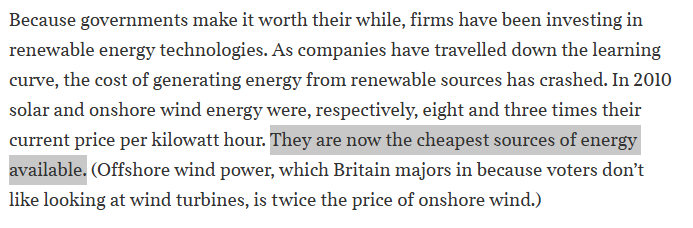
How it started: Solar and onshore wind "are now the cheapest sources of energy available". @emmaduncan, 2023
thetimes.com/comment/articl…
How it's going: Green intermittency gives Britain world's highest electricity prices. @emmaduncan, 2026
thetimes.com/comment/column…


English
Jonathan Boone retweetledi

Unreal numbers 👀⚡️
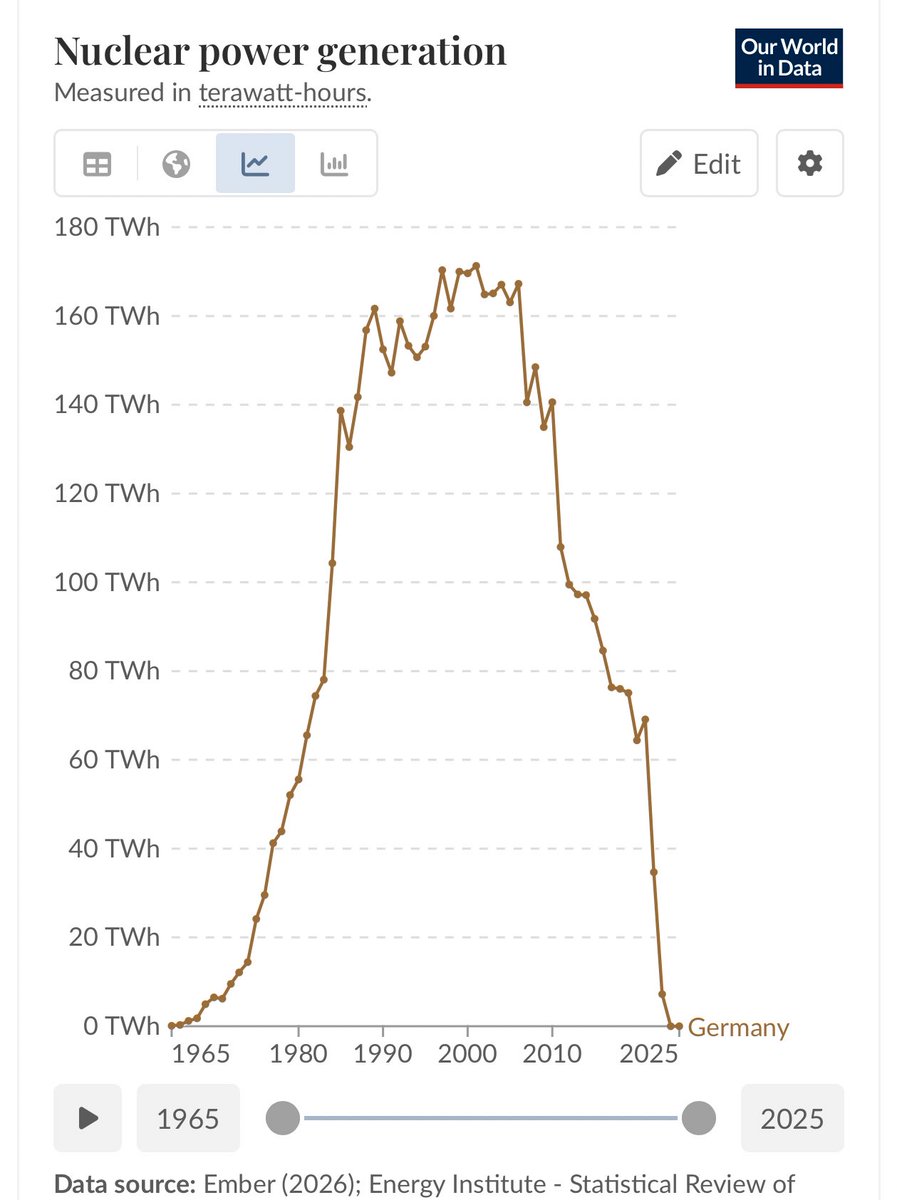
"JPMorgan estimates that, had Germany not phased out nuclear power, the country would have generated 50% less electricity from fossil fuels and 84% less electricity from natural gas in 2024. Electricity prices in Germany would have been around 25% lower, and the country would have imported half as much electricity.."

English
Jonathan Boone retweetledi

UK electricity generation has fallen 25% from its peak in 2004. Per capita electricity consumption is a third the level of the United States. The UK has the most costly electricity in the world. Half the gas we consume comes from the Norwegian side of the North Sea basin. The residual imported LNG has 4x the carbon footprint of supplying our own. And most depressingly of all the result is a deteriorating UK Balance of Payments, a weaker pound, and a bigger hit to the cost of living. And still the useful idiots want to further constrain UK energy production through high taxes, banning new licences, and gold-plating new energy infrastructure. Their luxury beliefs are behind the awful household disposable income growth of recent years. 🤡.
English
Jonathan Boone retweetledi

This morning we released “Ration Pack Britain” - detailing the institutional rationing of the supply side of the UK economy over decades. Policies that have combined to constrain the supply of Energy, Land, and Capital. Lower trend growth has been the inevitable outcome.
This is the other extreme of the Abundance debate, and focuses on how the rationing of aggregate supply has meant UK inflation averaged 3% over the last fifteen years - despite monetary policy aligning with comparable economies which saw no such inflation surge.
The good news - and it is good news - is that ending rationing does not have to be a partisan agenda. The most durable way of lowering the cost-of-living is to free up the supply of key factors of production - and put downward pressure on consumer prices.
The current patchwork of sector plans and PuFins is a charter for lobbying. By contrast, enabling a lower cost of essential factors of production gets into all the cracks of economic activity.
I can be like a broken record on the damage caused by rationing (anyone who was at the terrific @BCG event held by @RaoulRuparel last week knows this!) - but I firmly believe the UK has introduced a swathe of individually virtuous policies that have combined to introduce rationing into the UK for the first time in 72 years.
Another path is essential if trend growth is going to rise from its rather dispiriting 1.5% a year.
English
Jonathan Boone retweetledi

ویدیوی دریافتی: '#لندن، لحظه عملیات پایین آوردن پرچم جمهوری اسلامی و برافراشتن #پرچم شیر و خورشید #ایران در بالکن سفارت #Iran، شنبه ۲۰ دی' 🇮🇷
فارسی
Jonathan Boone retweetledi

The government's Renters' Rights Bill looks like it will be a catastrophe, inadvertently introducing rent controls and reducing the supply of housing even more. It is the clearest evidence that the whole British state that has brought it about is completely broken:
• Written by the civil service
• Introduced by the Tories
• Passed by Labour and the Lib Dems
• Cheered on by the mainstream media
The bill's core provision is to eliminate "no-fault evictions". Many understand this to mean evictions during a rental lease. In fact, this is already impossible. What the new bill does is to stop landlords from being able to regain their property after a lease has expired.
This means that renting a property to someone now means that they get to live in that property indefinitely. A landlord can only evict them if they are selling the property, or plan to move into it themselves, or if a tribunal gives them permission after ruling against the tenant for bad behaviour.
Within these indefinite contracts, rent increases will be capped at whatever the 'market rate' is determined to be by a tribunal. Tribunals will not be able to *raise* rents, as they currently can and often do – only lower them or keep them where they are. The only risk to a tenant is that their challenge is deemed "vexatious".
Not only will rent increases *within* contracts be controlled by courts, rents for *new* contracts will also be controlled by them. Tenants will be entitled to agree a rent, move in, and then immediately take their landlord to a rent tribunal on the grounds that the rent they have just agreed to is "too high".
Rent tribunals will thus have the power to control all rents. All rents will be set under the threat of a tribunal intervening. There will be no "market rate", so the tribunal will have no independent "market rate" to refer to.
A tenant who challenges a rent increase will have their rent frozen at the old, lower rate while their challenge is ongoing (which could take over a year). Like the Building Safety Regulator right now, tribunals are likely to be extremely backlogged, creating huge delays where tenants do not have to pay their new higher rents, if they ever do. Tenants will have huge incentives to challenge nearly all rent increases.
We have already seen how bad courts are at ruling on prices, eg in cases where Next's shop workers have been given the same pay as factory floor workers, and in Birmingham where the council was forced to pay £760m to care workers and teaching assistants because a court decided that these roles were equivalent to jobs like rubbish collectors.
All this amounts to rent controls. These are terrible for many reasons.
1. They will cause landlords to sell up and leave the market. This is both to avoid the risk of being stuck with a bad tenant, and because once the rent has been kept artificially low by a rent tribunal, landlords will be losing money compared to just selling into private owner-occupation.
Rental properties allow for easy doubling up (housesharing) which is much messier under owner-occupation. The effective supply of housing is about to drop. In Ireland, postwar rent controls shrunk the rental market from 26% to 8% of the total housing stock in 40 years. In Britain, 1916–88, the share of properties available for rent went from 75% of the market to 10%.
2. They cause landlords to neglect their properties. Landlords receiving artificially-depressed rents for their properties have no incentive to maintain them. Rent controlled properties, famously, become neglected and fall into decay, as leaks, cracked plaster and broken windows are left unaddressed. The country's housing stock that remains in renting will decay. Our cities will become more decrepit.
3. They stop people from moving around for better jobs. We already have this effect with social housing, where huge amounts of inner London housing (30–40%!) are held by tenants in low wage jobs, or who have no job at all, instead of by people who could move to London to earn and produce more. This will happen to large swathes of the rental market too, stopping people from moving into prosperous cities where they could get better jobs.
4. They stop the supply of new homes for rent. Under rent controls, there is no incentive to build new homes for renting. Britain built essentially no private flats for rent between 1945 and the end of rent controls in 1988. The same was true in France between WWI when it introduced rent controls and the slow end of rent controls in the postwar era.
5. They push renters into the black market. To actually get a place to live, a lot of people will sidestep these new rules and rent informally, with none of the protections we currently have for renters like the deposit protection scheme. This is the sort of scenario that allows landlords to *really* exploit and steal from their tenants.
–
Do not assume that anyone involved with this knows what they're doing. We have already seen, in the case of the Building Safety Regulator and the second staircase regulations (brought in by the same Housing Secretary who designed this bill), how disastrous the consequences of well-intended but misconceived interventions in the housing market can be.
London building has already ground to a halt. And things are about to get even worse.
English
Jonathan Boone retweetledi

Reports from Kabul today point to a targeted strike said to have targeted a senior TTP figure an event that feels both shocking and symbolic. The timing could hardly be more deliberate: it comes as the Taliban’s foreign minister visits New Delhi, a trip seen as part of Afghanistan’s slow re-engagement with India. By choosing this moment, Pakistan seems to be sending a pointed message, a reminder of its reach and its unease over Kabul’s growing warmth with New Delhi. Unlike earlier attacks in the Paktika and Nuristan, this one struck the heart of the capital, signaling not only capability but intent.
What makes this episode stand out even more is the precision of the strike. Pakistan appears to have used drone technology far more advanced than what it has shown in the past, the kind of accuracy that suggests access to new tools, perhaps borrowed or shared by powerful allies like the US and China. It also hints at a changing balance, where Pakistan seeks to reassert control through force rather than diplomacy.
For ordinary Afghans, this moment feels larger than a single strike. It comes at a time when Afghanistan is cautiously opening up to its neighbors, trying to rebuild relationships and possibly reclaim a measure of stability. A strike like this, in Kabul itself disrupts that fragile space. It’s a reminder that regional rivalries still run deep and that Afghanistan’s peace remains caught between the ambitions of others. This was not just an attack on a target; it was a message delivered at the doorstep of Afghan sovereignty yet again.
English
Jonathan Boone retweetledi

Hundreds of Afghans who have been relocated to Britain under a multibillion-pound scheme to protect them from the Taliban have returned to Afghanistan for holidays and other trips, an Afghan source has revealed. 1/
m.youtube.com/watch?v=RD6g5J…
English