Jonathan Ross

1.5K posts

Jonathan Ross

Jonathan Ross

@JonathanRoss321

Double the World's AI Compute Chief Software Architect @ Nvidia, Founder of Groq, Creator of the LPU & Google's TPU

Katılım Kasım 2021
246 Takip Edilen90.7K Takipçiler
Jonathan Ross
Jonathan Ross@JonathanRoss321·
My girlfriend couldn't sleep last night. She wanted an app to inventory her clothes. Her phone was in the bedroom - she didn't want to wake me. So she built the app with Fable. Her first app. Building software was easier than fetching a phone. The domestic Sputnik moment.
English
28
14
296
76.2K
Jonathan Ross retweetledi
Noam Brown
Noam Brown@polynoamial·
2023: LLMs struggle with 4th grade word problems 2024: LLMs can do high school math 2025: LLMs get a gold medal at the IMO Now, GPT-5.6 solves famous frontier math/stat questions. The IMO is today and 5.6 one-shotting a perfect score isn't even news. Where will we be next year?
Edgar Dobriban@EdgarDobriban

AI has helped resolve an important question in statistics. In the area of multiple hypothesis testing, the goal of controlling the false discovery rate (FDR) has been introduced in a seminal paper by Benjamini and Hochberg (1995). They also introduced a method (the Benjamini-Hochberg or BH method) and proved it controls the FDR. This method has been widely adopted in modern high-throughput science, including in genomics, astronomy, economics, etc. The paper has has garnered more than 130,000 citations to date. However Benjamini and Hochberg showed FDR control only when the data for the individual tests are *independent*. In practice, these data are often dependent; a good example is data on genetic variants due to linkage disequilibrium. Later work has focused on extending the validity of the BH procedure, e.g., to a form of positive dependence by Benjamini and Yekutieli (2001). The question of when the BH procedure controls the FDR has remained open. Over the last twenty years, many authors, including Reiner-Benaim (2007), Kim and van de Wiel (2008), Benjamini (2010), Sarkar (2023), Sarkar and Zhang (2025), have conjectured that the BH procedure controls the FDR for two-sided tests using any correlated Gaussian data. These authors have presented both theoretical and empirical evidence supporting, but not directly showing, the conjecture. With the help of AI (specifically GPT-5.6 Sol Pro), I have settled the question in the negative: The Benjamini-Hochberg procedure does *not* generally control the false discovery rate at the desired level for correlated two-sided Gaussian tests. This was done by exhibiting a Gaussian factor model for which, at a nominal level alpha=0.01, the false discovery rate is proved to be FDR>0.0104. There is a lot of interesting commentary to be made: 1. This result should be of interest to everybody in the field of statistics. Emmanuel Candes of Stanford University once called the false discovery rate and the Benjamini-Hochberg procedure "one of the two most important developments in statistics after 1950" (the other being James-Stein shrinkage). The present conjecture is probably the most central question about FDR/BH that was unresolved to date. 2. GPT-5.6 one-shot the problem after 90 minutes of reasoning, whereas with 5.5 I was not able to solve it even after iterating with multiple parallel agents for perhaps 20 hours. So the capability improvement is quite real. Exciting times to live in! 3. The argument is not especially surprising, but it does combine an asymptotic approach (standard for FDR analysis, see e.g., Genovese and Wasserman, Efron, etc) with a numerical certificate in a way that would be pretty non-standard in the field. Once we have the specific example, then straightforward simulations also support that the false discovery rate is indeed higher than the nominal value (see attached fig). 4. The current degree of violation over the nominal level is relatively small (0.104 vs 0.1). So the importance of this result is mainly conceptual. The practical implications remain to be determined. Overall, an exciting development! Preprint is available here (faculty.wharton.upenn.edu/wp-content/upl…) and will be on arxiv tonight; supporting code is here (github.com/dobriban/BH).

English
91
296
2.9K
430.2K
Jonathan Ross retweetledi
Ara Kharazian
Ara Kharazian@arakharazian·
Would remind everyone who says AI is a bubble: AI spending is still accelerating! I don't mean that it's simply growing. I mean the growth rate per-firm is also increasing. In June, median firm AI spend rose 5.7% MoM, from $10.09 to $10.67 per employee. That was faster than May’s 3.8% growth. As of our latest Ramp AI Index. The median firm in the top 10% spent $515 PEPM; the median firm in the top 1% spent $4,855. This is an extremely nascent market with broadening adoption and spending concentrated among a small group of heavy users. Even within highly advanced firms, there are teams early in the adoption curve with room to grow spend.
English
8
26
165
45.8K
Jonathan Ross retweetledi
David Senra
David Senra@davidsenra·
Groq Founder @JonathanRoss321 says the ability to “choose the dominant game being played” is what determines whether a company succeeds or not: “MySpace was focused on number of accounts signed up. Facebook focused on monthly active users—it was the dominant game.” “If you maximize the monthly active, you're going to beat someone who's maximizing accounts signed up. You're playing a better game.” “What most really successful founders and entrepreneurs do is, everyone else is playing this game, and they realize that if you play this higher level game, you win.”
English
17
37
324
33.1K
Jonathan Ross retweetledi
David Senra
David Senra@davidsenra·
“ The better the people, the harder they are to manage” Groq Founder @JonathanRoss321 says that managing 450 employees felt more like managing a group of 5,000 people because it’s much harder to manage a creative organization:
English
8
12
190
25.4K
Jonathan Ross retweetledi
Rohan Paul
Rohan Paul@rohanpaul_ai·
Ex Google CEO, Dr. Eric Schmidt: AI may hit a money wall before it hits a power wall. "The real limit to AI is not energy; it is actually cash. When you add up the cost of these things, if you take round numbers, say $50 billion per gigawatt, then 10 gigawatts is half a trillion dollars. How many companies, countries, and so forth can hand an industry a trillion dollars of capital? Very, very few. The Chinese could certainly do it. I do not know if they are doing it, but I am going to try to find out. In America, there are people who hope that is going to happen. It is interesting that you can finance these things because the brilliance of the American capital market allows us to borrow that kind of money. For example, the Europeans cannot do this, which they are sort of sore about." --- Full video from 'Special Competitive Studies Project' YT channel ( link in comment)
English
58
75
372
62.4K
Jonathan Ross retweetledi
Hudson Institute
Hudson Institute@HudsonInstitute·
"Pointed at the elite, AI concentrates power; pointed at the citizen, AI gives it back." In @WSJopinion, @TomTugendhat explores how AI can help modern states improve public services, strengthen government capacity, and deliver on promises. Read: wsj.com/opinion/can-ai…
Hudson Institute tweet media
English
2
4
18
5.8K
Jonathan Ross retweetledi
NVIDIA AI
NVIDIA AI@NVIDIAAI·
The Nemotron family just passed 100M downloads! Huge thank you to the community building with us and showing what’s possible with open models. Cheers to OSS 🍾
NVIDIA AI tweet media
English
50
72
590
75.7K
Jonathan Ross retweetledi
David Senra
David Senra@davidsenra·
A conversation with @JonathanRoss321, founder of @GroqInc. This is the first podcast that Jonathan talks about his $20 billion partnership with NVIDIA. In this conversation, we talk about his decade building Groq: why West Coast VCs kept passing on the company, how fast Jensen works, overcoming near-death experiences, and why he thinks the entire AI age turns on a single skill — knowing what to ask. Hope you enjoy this conversation: 0:00 The $20 Billion NVIDIA Deal Closed In 3 Weeks 0:25 Why GPUs And LPUs Are Better Together 1:46 When AI Talks To AI, Speed Wins 3:30 Always Start With A Hobby Project 5:55 Ask The Right Questions, Not Answer Them 8:23 There Are Infinite Ways To Be A Leader 13:00 I Was One Of The World's Worst Leaders 14:34 Fewer Constraints, More Room To Surprise You 16:31 At NVIDIA There Is No Politics 19:44 You Have To Learn Confidence 22:23 East Coast VCs Think, West Coast VCs Follow 23:50 The Keynesian Beauty Contest Of Silicon Valley 26:48 The Autonomy That Created The NVIDIA Deal 30:07 Making A Model Smarter By Making It Faster 34:52 Reality Quotient Beats Intelligence Quotient 35:44 Find The Dominant Game And Play It 37:11 A Founder's Job Is Full-Time Change Management 38:34 Return On Luck: Seize It Better Than Anyone 42:54 You Can't Sell Speed, You Have To Let People Try It 46:32 I Intend To: Intentional Leadership 51:07 Groq Bonds: Trading Salary For Survival 54:13 Hire For Negatives, Grow For Positives 58:46 Loss Aversion And Booking The Win Early 1:00:37 How Michael Jordan Weaponized Humiliation 1:03:13 Manufactured Discontent Drives Everything 1:05:02 Every Day Without Compute Has A Real Cost 1:07:07 Code Was Rationed, Now It's Nearly Free 1:10:04 Teach Kids To Ask Questions, Not Answer Them Includes paid partnerships.
English
26
41
391
826.3K
Jonathan Ross
Jonathan Ross@JonathanRoss321·
@davidsenra'a podcast is one of my favorites. Never thought I'd be on it.
David Senra@davidsenra

Groq Founder @JonathanRoss321 says the ability to “choose the dominant game being played” is what determines whether a company succeeds or not: “MySpace was focused on number of accounts signed up. Facebook focused on monthly active users—it was the dominant game.” “If you maximize the monthly active, you're going to beat someone who's maximizing accounts signed up. You're playing a better game.” “What most really successful founders and entrepreneurs do is, everyone else is playing this game, and they realize that if you play this higher level game, you win.”

English
5
3
77
9.7K
Jonathan Ross retweetledi
NVIDIA
NVIDIA@nvidia·
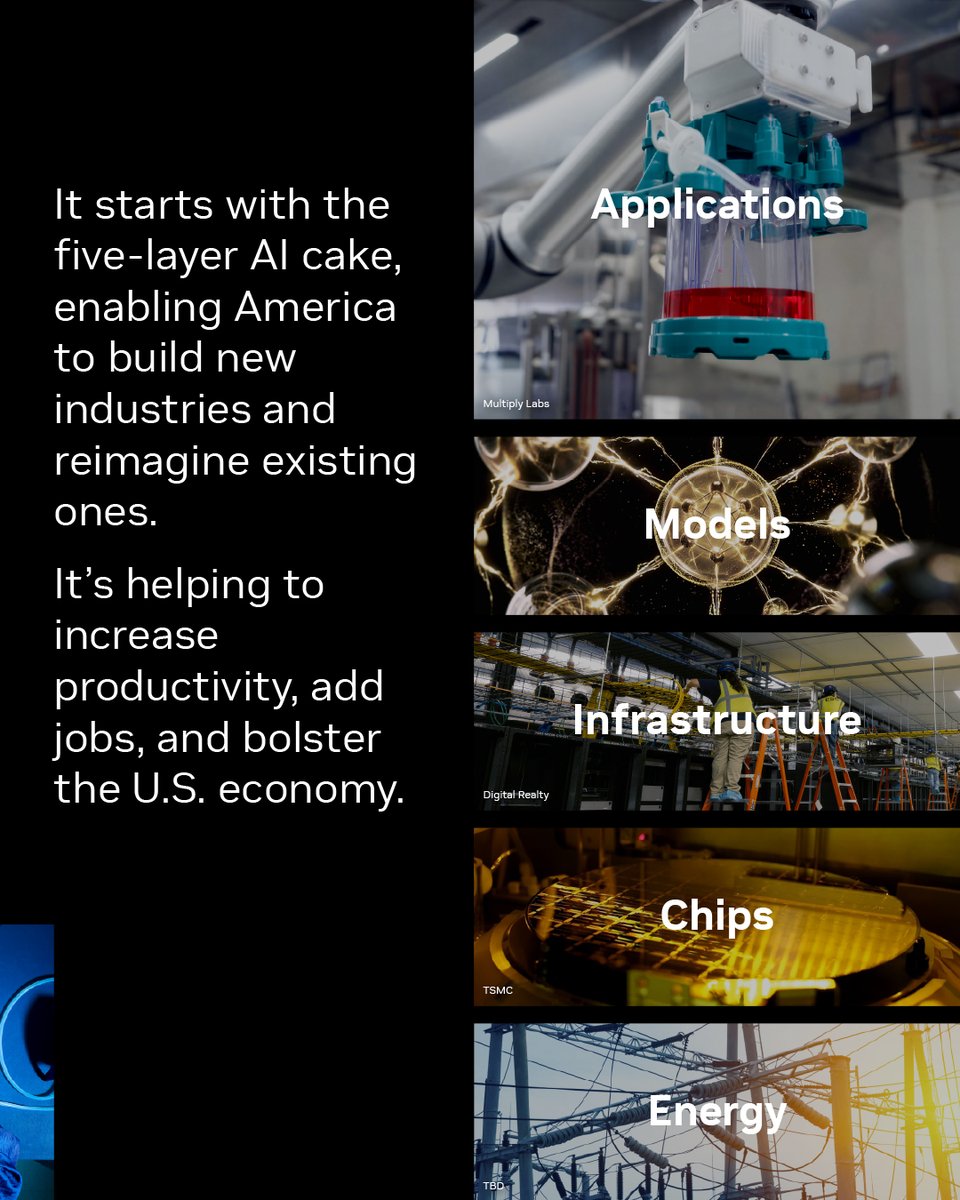
America is a nation of builders. For 250 years, America has built railroads, power grids, factories, semiconductors, and the internet. Now, America is building again.
NVIDIA tweet mediaNVIDIA tweet media
English
29
81
486
62.4K
Jonathan Ross retweetledi
Ara Kharazian
Ara Kharazian@arakharazian·
We can finally say AI isn't killing jobs. A new paper from me, @tryramp, and @RevelioLabs uses firm-level spend and workforce data across 21K U.S. businesses to measure AI's impact on jobs. Firms that adopt AI heavily grow headcount 10% over two years following adoption. Low adopters see no statistically significant change.
Ara Kharazian tweet media
English
165
614
2.7K
839.1K
Jonathan Ross
Jonathan Ross@JonathanRoss321·
Founder Tip: Load up on intern energy and naivety. Today's interns are a question away from most knowledge thanks to LLMs, and they haven't yet learned that what you're asking them for is supposed to be impossible.
English
10
29
335
71.7K
Jonathan Ross retweetledi
Jonathan Ross
Jonathan Ross@JonathanRoss321·
@juliarturc @SDimanchik Instead of teaching kids how to answer questions, e.g. quizzes, tests, etc., instead teach them how to ask questions. AI will handle the answers from now on.
English
2
1
2
256
Jonathan Ross retweetledi
Julia Turc
Julia Turc@juliarturc·
@SDimanchik @JonathanRoss321 I don’t feel like I have the authority to give advice, but I’ll teach mine the same fundamentals I learnt in college… physics, math, logic (if they’re STEM oriented). AI or not, these things don’t change and train your brain to be analytical.
English
4
1
18
3.4K
Julia Turc
Julia Turc@juliarturc·
Early on, @JonathanRoss321 foresaw the unprecedented demand for compute of the 2020s. After pioneering Google's TPUs, he founded Groq, a "Language" Processing Unit dedicated for inference. After joining NVIDIA, he is betting on the GPU+LPU combo to power the agentic chains of AI calling AI calling AI. This interview is part of my larger series on dedicated AI chips, so drop any suggestions/questions below. Thank you @nvidia for hosting us at your HQ! 00:00 Intro 01:00 The Google TPU & Groq origin story 02:41 How is Groq different from a GPU? 04:43 Static scheduling makes Groq faster 05:47 Does Groq work with Mixture-of-Experts? 09:27 Are LPUs limited to text models? 11:03 Diffusion models 13:41 NVIDIA Vera Rubin: the GPU+LPU combo 15:26 Will Groq still be sold as a standalone chip? 16:49 How does agentic AI impact inference economics? 19:21 Will AI replace CUDA kernel engineers? 21:08 Will AI democratize hardware design? 26:11 Jevon's paradox: An endless demand for compute 29:04 What should kids learn in the AI age?
English
10
27
208
47.1K