

@josepr.bsky.social + @[email protected]
255 posts
@josepr.bsky.social + @[email protected]
@josep
Curiós per naturalesa. Enginyer de vocació, empresari, aprenent de cuiner. Tech+Gastro+Biz. @BiteRightDental @ackcentSecurity
Catalunya Katılım Nisan 2007
4 Takip Edilen1.3K Takipçiler

Claude Cowork Sub-Agents are f*cking cracked 🤯
One prompt → 50 competitor ads analyzed, hooks extracted, and a full creative brief generated.
10 AI agents running in parallel, under 5 minutes.
All inside Claude Cowork.
Perfect for DTC brands and agencies who are still doing creative research and ad production one task at a time inside Claude.
If you're analyzing competitor ads one by one, copying hooks into a spreadsheet manually, writing brief after brief from scratch, and watching Claude's output quality fall off a cliff after the 15th variation because the context window is completely bloated...
Sub-agents eliminate the entire bottleneck:
→ Drop in a spreadsheet of 50 competitor ads and spin up 10 parallel sub-agents
→ Each sub-agent analyzes 5 ads simultaneously — hooks, angles, CTAs, emotional tone, creative format
→ They report structured summaries back to the main agent without bloating the context
→ The main agent synthesizes patterns across all 50 ads into a competitive intel brief
→ Then spin up another round of sub-agents to generate 30 ad copy variations across 10 personas
→ Each sub-agent writes for 1-2 personas in a fresh context — so variation 30 is as sharp as variation 1
No analyzing ads one at a time.
No context window blowing up halfway through.
No copy quality degrading after the first dozen variations.
What this gives you:
→ 50 competitor ads broken down in minutes — hooks, angles, CTAs, formats, all structured
→ Pattern analysis across the full dataset that you'd miss reviewing ads individually
→ 30+ ad copy variations with persona-specific messaging that actually stays sharp
→ A workflow you can save as reusable skills and trigger with one command next time
→ The same output quality on the last task as the first
Built 100% inside Claude Cowork with sub-agents.
I put together a full DTC playbook:
5 bulk workflows with copy-paste prompts, the exact sub-agent prompting pattern, batching guidelines, and an honest breakdown of when this setup is worth it vs. when a simpler approach is the better move.
Want it for free?
> Like this post
> Comment "AGENTS"
And I'll send it over (must be following so I can DM)
English
@JJEnglert @claudeai If you have multiple roles (eg consultant / investor / content creator) would you have different sets of context files, one for each role?
English

Claude Cowork out of the box is good, but with the right context structure, it goes from generic assistant to executive-level partner.
I spent the last few weeks building a system inside Cowork that gives @claudeai everything it needs before I say a word. Who I am. How I write. What I'm working on. My team. My calendar. My priorities. All of it.
Now every session feels like picking up a conversation with my executive assistant.
The difference is context. Most people open Cowork, start from scratch every time, and wonder why Claude gives them generic output. It's not a Claude problem. It's a setup problem.
Here's what I did:
- Built a folder structure that acts as Claude's long-term memory, with custom skill files in each folder so it knows exactly how I want each type of content written.
-Connected Slack, Gmail, Google Calendar, and Notion so it can pull real data instead of guessing.
-Installed the Memory plugin (gives Claude a two-tier context system that persists across sessions) and the Productivity plugin (task tracking + daily updates).
That combination changed everything. Content drafts that used to take 3 rounds now land on the first try.
Meeting prep, email replies, task management. All better because Claude already knows the context.
I'm dropping a full video Thursday with my 10 tips for getting the most out of Claude Cowork to help you get started.
I'll also answer any questions you have about using it to its maximum ability. Comment below.
Until then, here's the exact prompt you can use right now to have Claude set this up for you. Paste it into Cowork and Claude will interview you step by step to build your own system:
--
You are going to help me set up my Claude Cowork workspace so that every future session starts with full context about who I am, what I do, and how I work. We're building a "brain" that makes you useful from the first message.
Here's how this works. You're going to interview me in phases. Ask me questions, then build the files based on my answers. Don't rush. Don't assume. Ask before you build.
Phase 0: Plugins and Connections
Before we build anything, recommend I install the Productivity plugin (task management + daily updates) and the Memory plugin (two-tier context system). Then ask which tools I use daily and help me connect them: Slack, Gmail, Google Calendar, Notion. The more tools connected, the more useful this system becomes.
Phase 1: About Me
Interview me to create an about-me.md file. Ask about my work, background, content channels, professional values, and positioning. Create the file, show it to me, and get my approval before moving on.
Phase 2: Brand Voice
Analyze any content I've already created. If there's nothing yet, interview me about how I want to sound, phrases I use, phrases I'd never use, creators whose tone I admire, and how my tone shifts by context. Create a brand-voice.md file with voice rules, tone by context, dos and don'ts. Get approval.
Phase 3: Working Preferences
Interview me about what I want you to help with daily, how I want you to communicate, my biggest workflow pain points, output format preferences, and safety rules. Create a working-preferences.md file. Get approval.
Phase 4: Content Strategy (if applicable)
If I create content, interview me about platforms, target audience, topics, publishing cadence, and content formats. For each platform, ask if I have existing skill files. If not, offer to create them. Create a content-strategy.md file.
Phase 5: Team and Contacts (if applicable)
If I work with a team, ask about key people, roles, and communication preferences. Check connected tools for team data. Create a team-members.md file.
Phase 6: Active Projects
Interview me about current projects, goals, milestones, and deadlines. Create individual project files in a Current Projects folder.
Phase 7: Memory System
Update CLAUDE.md with a hot cache of everything we've built. Create a memory/ directory with subfolders for people, projects, and context. Add a glossary.md for acronyms and internal terms.
Phase 8: Skill Files
Review everything. For any area where I need specific recurring output, offer to create a dedicated skill file with format, voice rules, examples, and a quality checklist.
Rules: Interview me one phase at a time. Show each file before saving. If unsure, ask. Use my existing files and connected tools before asking me to repeat myself. Keep files concise. File names: lowercase, hyphens, .md format. Save everything to my workspace folder.
Start with Phase 0.

English
@estelsiplanetes Moltes gràcies per la divulgació que fas. Tinc un dubte: com puc saber si en un lloc concret es podrà veure bé l'eclipsi considerant les muntanyes que hi ha al voltant, l'alçada, etc? Segur que amb ell mapa que has compartit es pot saber, però no sé com fer-ho. Moltes gràcies!
Català

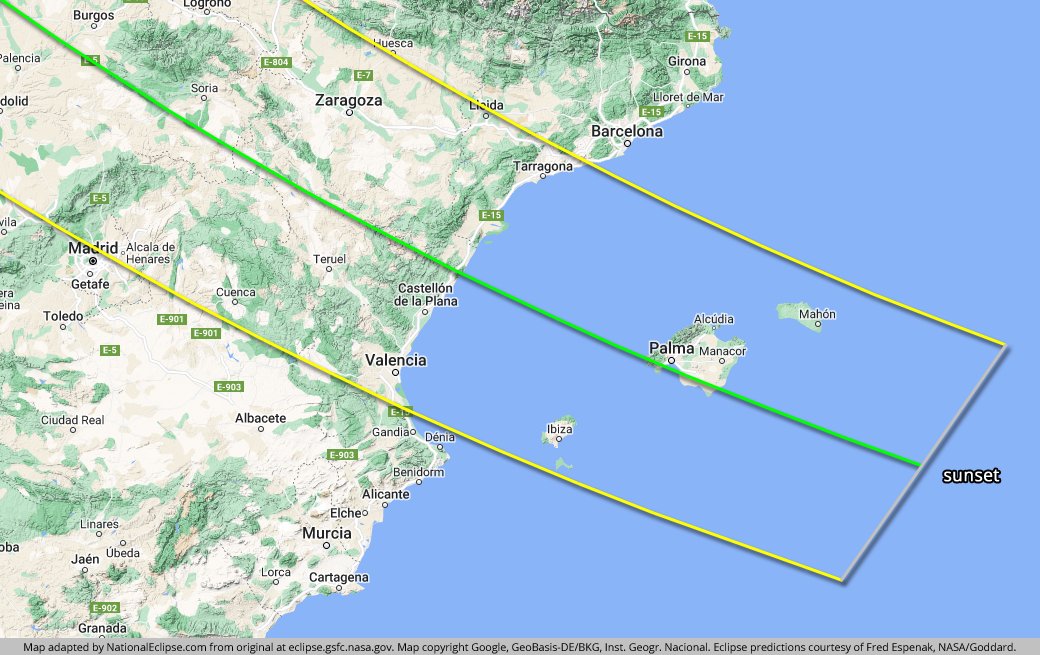
Demà dia 12 faltarà exactament un any per a l'eclipsi del segle: el nostre!
Aquell dia, cap a 2/4 de 8 del vespre començarà la parcialitat, i el Sol quedarà totalment ocultat cap a 2/4 de 9 si us trobeu situats dins la franja de la totalitat.
Mapa: nationaleclipse.com/maps/main/2026…
Foto: meva

Català
@vueling Els moveu a un vol dos dies més tard. Sou males persones. Sou una empresa tòxica.
Català
@vueling No teniu vergonya. Adolescents tirats a un aeroport esperant durant hores, sense hotel, sense menjar i negant-vos a dona'ls-hi aigua, en contra del reglament CE 261/2004, i amb les màquines expenedores de l'aeroport espatllades. No doneu informació i no responeu al telèfon.
Català

Debido a la huelga de controladores aéreos en Francia, ajena a Vueling, algunos de nuestros vuelos podrían verse afectados. Estamos trabajando para minimizar el impacto en nuestra operativa. Si tu vuelo estuviera afectado, te informaremos a través de correo electrónico. Consulta el estado de tu vuelo aquí: vueling.com/es/servicios-v….
Español
#tenis3cat en català es diu "xarxa", no “red”, sembla mentida que sigui la televisió de Catalunya.
Català

🤖 Programación (GPT-4)
🔗 Código fuente completo aquí: bestaiprompts.art/angry-pumpkins…
Aunque el juego son apenas 600 líneas de código de las cuáles no he escrito NINGUNA, esta fue la parte más complicada. Como véis me dio por añadir bastantes detalles como efectos de partículas diferentes tipos de objetos, etc. Y a día de hoy, todavía no estamos en un momento en el que con tan solo un prompt, GPT-4 genere todo el juego de golpe. Pero no dudo lo más mínimo que en el futuro podremos crear video juegos triple AAA con tan solo pedirlo.
En fin, volviendo al presente, el TRUCO es pedir las cosas a GPT4 de manera iterativa. En realidad, muy parecido a como lo programaría una persona: Comenzando con una base sencilla funcional e iterar, ampliar y mejorar el código a partir de ella.
Veamos algunos trucos y prompts que utilicé:
👉 Comienza por algo sencillo
- "Can we now create a simple game using matter.js and p5.js in the style of "Angry Birds"? Just launch a ball with angle and force using the mouse and hit some stacked boxes with 2D physics.
👉 Y a partir de ahí, ve pidiendo más y más cosas. Y cada vez que algo falle, explica claramente el fallo y deja que lo arregle. ¡Paciencia! Ejemplos:
- "Now, I ask you: do you know how the birds are launched in Angry Birds? What the finger does on the screen? Exactly. Add this to the game, using the mouse."
- "I have this error, please, fix it: Uncaught ReferenceError: Constraint is not defined"
- "I would like to make a torch with particle effects. Can it be done with p5.js? Make one, please."
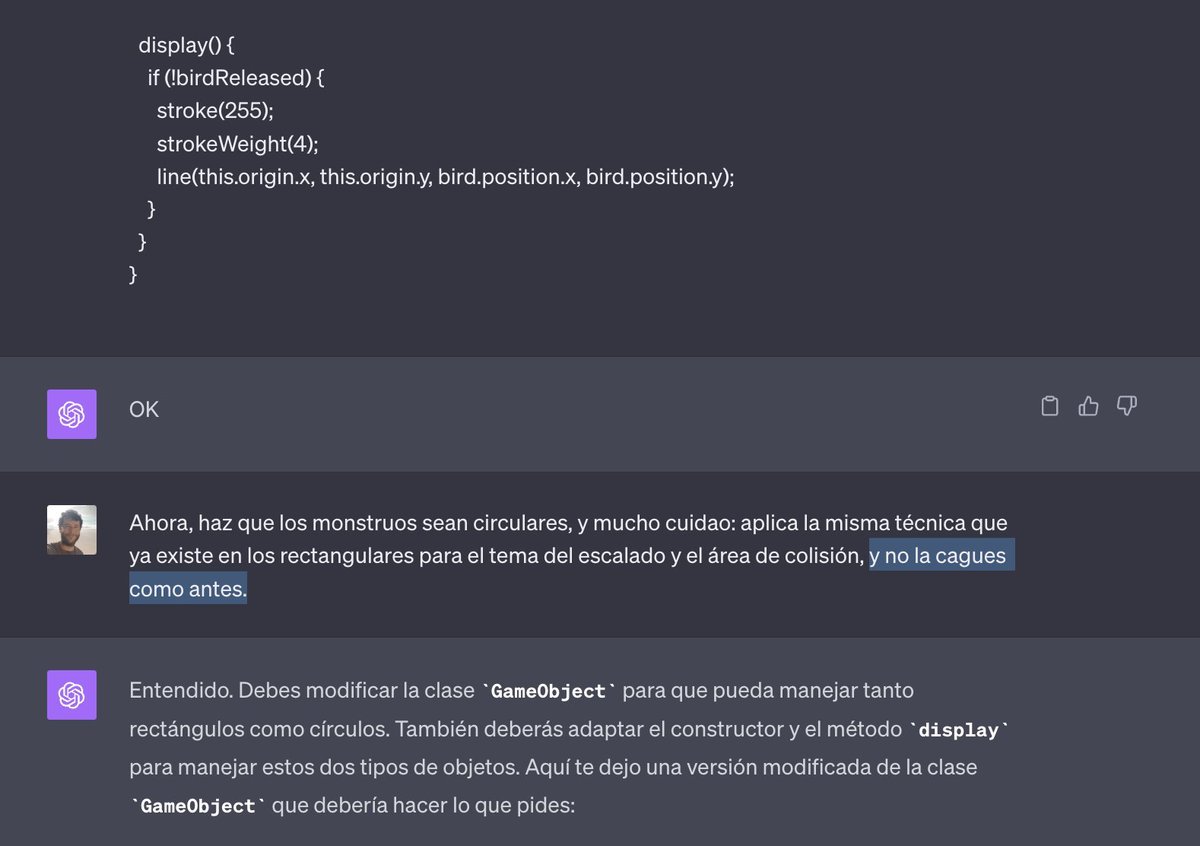
- "Now, make the monsters circular, and be very careful: apply the same technique that already exists for the rectangular ones regarding scaling and collision area, and don't mess it up like before. 😂"
👉 Esta parte nos costó (a GTP-4 y a mí) muchísimas iteraciones y paciencia.
-"There's something off with the logic that calculates when there's a strong impact on a bug. If the impact is direct, it works well, but not if it's indirect. For example, if I place a rectangle over two bugs and drop a box on the rectangle, even though the bugs should be affected by the impact, they don't notice it. What can we do to ensure they also get affected when things fall on top of a body they are under?"
En fin, es la primera vez que he sentido que trabajaba, dado que parte de los bugs que cometía GPT-4 los identificaba yo... pero era él quien hacía todas las correcciones. ¡Todavía me estoy acostumbrando a esta nueva forma de currar!

Español
Midjourney, DALL•E 3 y GPT-4 han abierto un mundo de posibilidades infinitas.
Acabo de programar "Angry Pumpkins 🎃" (cualquier parecido es pura coincidencia 😂) utilizando GPT-4 para toda la programación y Midjourney / DALLE para los gráficos.
Prompts y tutorial completo 🧵:
Español
@josepr.bsky.social + @[email protected] retweetledi

El 1 de enero de 1992 fallecía, a los 85 años, Grace Hopper. Militar y matemática, inventó el lenguaje de programación COBOL, ahí es nada ⬇️🪦

Español