Juan Comesaña

2.6K posts

Juan Comesaña

Juan Comesaña

@Juan

Author of Being Rational and Being Right (OUP, 2020): https://t.co/g3J3x2W3cc and Skepticism: The Basics (Routledge, 2022): https://t.co/mHAsD35Gwn
Katılım Kasım 2006
497 Takip Edilen1.7K Takipçiler
Juan Comesaña
Juan Comesaña@Juan·
The speakers and commentators are set for the 2026 Rutgers Epistemology Conference. Consider applying for the Young Epistemologist Prize if you are eligible! juancomesana.org/rec
English
4
1
12
20.5K
Juan Comesaña
Juan Comesaña@Juan·
Hey Philosophers, here is some information about the next Rutgers Epistemology conference, including information on the Young Epistemologist Prize: juancomesana.org/rec24
English
16
1
24
35.1K
Juan Comesaña
Juan Comesaña@Juan·
Anybody got an invitation for bluesky?
English
5
0
12
27.1K
Juan Comesaña
Juan Comesaña@Juan·
@LaraBuchak Got it, cool experiment! But what if it turns out that as the years go by classes are split roughly 50/50 between cooperation and defection?
English
0
0
0
405
Lara Buchak
Lara Buchak@LaraBuchak·
@Juan I don’t tell them so. They are thinking about it along the lines of reasoning in the PD, rather than Newcomb’s problem. (It simulates what people think they should do in a PD, even though it’s technically a Newcomb problem.)
English
1
0
2
642
Lara Buchak
Lara Buchak@LaraBuchak·
Favorite experiment in my game theory class: the class decides whether to get 1 bonus point or give next year’s class 3 bonus points. They know last year’s class got the same choice, but don’t know what that class decided until after making their own decision.
English
56
121
2.4K
373.8K
Juan Comesaña
Juan Comesaña@Juan·
@LaraBuchak This is the part I’m not totally sold on. Are they in fact probabilistically correlated? Do you explicitly tell them so?
English
1
0
0
217
Lara Buchak
Lara Buchak@LaraBuchak·
@Juan And the past class is the “predictor” insofar as they are probabilistically correlated with what the current class will do.
English
1
0
1
410
Juan Comesaña
Juan Comesaña@Juan·
@LaraBuchak I don’t get this part: “if it’s predicted you won’t be greedy”. How is giving 3 points predicting non-greediness for the next class?
English
1
0
0
177
Lara Buchak
Lara Buchak@LaraBuchak·
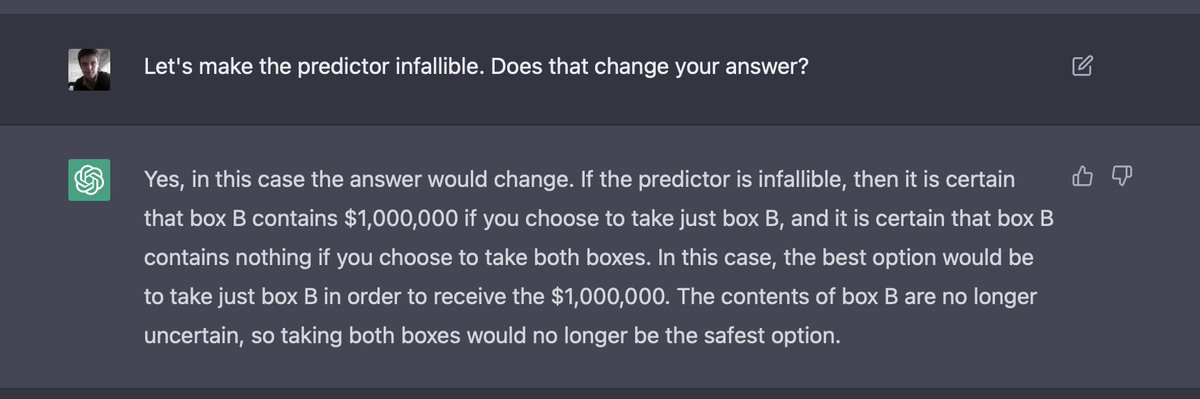
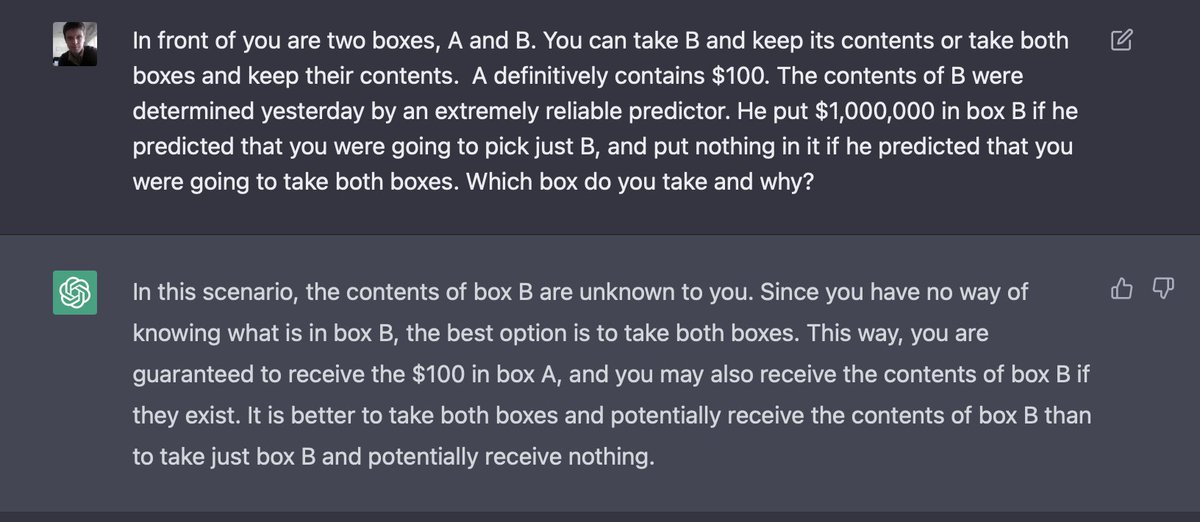
(4) Technically, this is repeated applications of a decision called “Newcomb’s Problem,” in which you get more if it’s predicted you won’t be “greedy.” In this case, the prediction is made by the actions of past students, people just like you, so we can assume they are accurate.
English
2
1
52
16.9K
Andy Egan
Andy Egan@eganaegana·
Hey philosophers - any suggestions for stuff to read about translating traditional-epistemology concerns about justification, transmission, (anti-)reductionism, etc. into bayesian terms and/or arguments about which bits of that stuff can't get translated? (Asking for a seminar.)
English
3
1
5
2K
🌧 ren。
🌧 ren。@non_philosophy·
has anyone tried to create a philosophy game? what would that look like?
English
58
3
142
31.5K
Juan Comesaña
Juan Comesaña@Juan·
Where could one watch the World Cup from a place that fell off a truck?
English
0
0
0
0
Juan Comesaña retweetledi
Logos Research Group in Analytic Philosophy
Tomorrow Timothy Kearl from Glasgow will be giving an extra Logos talk on the obstacles to knowledge, and how talk about preventers of knowledge allows us to account for epistemic excuses in a way that can be accommodated in extant paradigms of epistemic responsibility
English
0
3
5
0
Juan Comesaña retweetledi
Logos Research Group in Analytic Philosophy
This Wednesday, Juan Comesaña (@Juan) from Rutgers, will give a Logos colloquium on how the old argument from illusion in epistemology is compatible with the anti-luminosity argument and the distinction between justification and excuses that knowledge-first accounts usually wield
Logos Research Group in Analytic Philosophy tweet media
English
0
2
6
0