
Shuo Qi

732 posts

Shuo Qi banner
Shuo Qi

Shuo Qi

@June_Qi

Post doc @williamandmary | PhD @SMUEconDept | Microeconometrics and Networks | Simulating Many Unobservables.

Dallas, TX Katılım Ocak 2017
1.5K Takip Edilen751 Takipçiler
Sabitlenmiş Tweet
Shuo Qi
Shuo Qi@June_Qi·
FAULKNER, “All of us failed to match our dream of perfection. So I rate us on the basis of our splendid failure to do the impossible. ” Paris Review - William Faulkner, The Art of Fiction No. 12 theparisreview.org/interviews/495…
English
0
0
5
657
Shuo Qi retweetledi
Peter Hull
Peter Hull@instrumenthull·
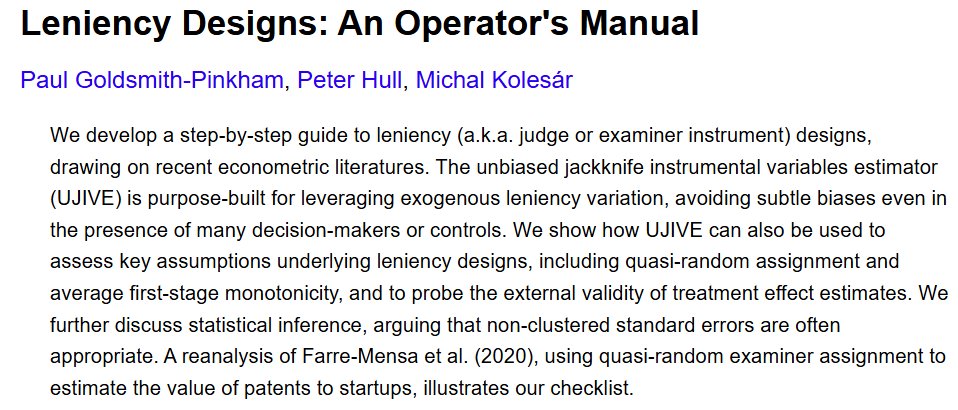
Paul G-P (@paulgp), Michal Kolesár, and I have a new guide to leniency designs (aka judge/examiner IVs), prepared for the JEP The bottom line? Keep calm and UJIVE on!
Peter Hull tweet media
English
13
33
154
91.5K
Shuo Qi retweetledi
Yiqing Xu
Yiqing Xu@xuyiqing·
Glad this paper with @guido_imbens is out in the JEP. The LaLonde paper has had a big impact on my academic journey and continues to teach us about the challenges and possibilities of conducting credible inference using nonexperimental data. aeaweb.org/articles?id=10… Many thanks to Tim for the tireless editing and suggestions. @TimothyTTaylor
Yiqing Xu tweet media
English
6
97
393
55.5K
Shuo Qi retweetledi
Econometrics
Econometrics@eBlogs·
Unbiased Regression-Adjusted Estimation of Average Treatment Effects in Randomized Controlled Trials. arxiv.org/abs/2511.03236
English
0
9
11
850
Shuo Qi retweetledi
Econometrics
Econometrics@eBlogs·
Cross-Validated Causal Inference: a Modern Method to Combine Experimental and Observational Data. arxiv.org/abs/2511.00727
English
0
6
11
831
Shuo Qi retweetledi
Jesús Fernández-Villaverde
Jesús Fernández-Villaverde@JesusFerna7026·
Let me explain why I believe modern economics is such a powerful tool for understanding the world. I’ll do this by discussing a great paper by Simone Cerreia-Vioglio, @UncertainLars, Fabio Maccheroni, and Massimo Marinacci, “Making Decisions Under Model Misspecification,” published in the Review of Economic Studies a few months ago. Imagine I want to drive from UC San Diego to UCLA, but I’ve never driven that route before. I need to build a “model of the world” to guide me, which we usually call a map. Maps are simplified representations of reality. They can’t include every detail if they’re to be useful. Borges, in his short story On Exactitude in Science, makes this point beautifully. (In practice, I don’t draw the map myself—I use an app—but someone still had to make it.) Because maps simplify, I can’t fully rely on them. Maybe last night’s storm knocked down a tree and closed a street, or there’s construction and the ramp off the highway in LA is shut down. This uncertainty matters. Suppose I’m driving to UCLA for an important talk at 11 a.m. If the ramp is closed, I might need 15 extra minutes. When should I set my alarm to arrive on time, while still getting enough sleep to give a good talk? The problem is that I can’t assign precise probabilities to all these contingencies. How likely is the fallen tree? Or new roadwork? Even the best traffic apps can’t capture every disruption, and some might happen after I’ve already left. In economic terms, my “model of the world” (the map) is misspecified—and no matter how hard I try, I can’t fully fix that. But sitting down and crying about misspecification doesn’t answer my basic question: when do I set the alarm? Too early, and I’m exhausted. Too late, and I’m late. Simone and his co-authors offer a way to think about this. They start from the idea that we often hold several structured models of an economic phenomenon, grounded in theory. For example, a central bank might use a standard New Keynesian model and a search-and-matching model of money. Yet, aware that each model is misspecified by design, the bank adds a protective belt of unstructured models—statistical constructs that help it gauge the consequences of misspecification. The beauty of the paper is that it provides an axiomatic foundation for this protective belt (and even generalizes it to include a Bayesian approach). It shows that if a decision-maker’s preferences meet certain conditions —reflecting both rational and behavioral features— then those preferences can be represented by an augmented utility function that formally accounts for misspecification. Crucially, we don’t assume that augmented utility function; we derive it. We start with general, plausible properties of preferences and prove that they imply such a representation. That’s real progress. Instead of writing endless critiques of expected utility or rational expectations (as many have done for decades, with little to show), we now have a formal way to reason about misspecification—precise definitions, clear boundaries of validity, and awareness of what we still don’t know. Take, for instance, a brilliant Penn graduate student on the market, Alfonso Maselli economics.sas.upenn.edu/people/alfonso… His job-market paper pushes this frontier further. He studies cases where a decision-maker not only faces model misspecification but is also unsure which model best fits the data and can’t assign probabilities to them—what we call model ambiguity. In my example, the central bank is unsure whether the New Keynesian or the search-and-matching model fits better, and it worries that both might be incorrect. If you read Simone et al. or Alfonso’s paper, you’ll see how misguided—and, frankly, cartoonish—many of the recent criticisms of economics on X have been. First: the idea that economists don’t understand math or have “physics envy.” The math in these papers is subtle and advanced—utterly different from what physicists do (neither better nor worse, just distinct). An engineer transitioning into economics would find these tools unfamiliar. Second: claims of ideological bias are unfounded. I have no idea about the political views of the authors, and I’d be surprised if anyone could infer them from the analysis—beyond vague guesses about typical academics. Third: This has almost nothing to do with what one learns as an undergraduate, or even in first-year graduate school. If your knowledge of economics stops at an intro textbook, it’s best not to pontificate on the field’s frontiers. Fourth: Is this science? Debating that word’s boundaries is pointless; every definition of “science” breaks down somewhere. The Germans solved this long ago with the idea of Wissenschaft—the systematic pursuit of knowledge, whether of nature, society, or the humanities. By that measure, modern mainstream economics is clearly a Wissenschaft: a disciplined, cumulative, and highly useful effort to understand how the world works. Simone and his co-authors have demonstrated that beyond any reasonable doubt.
Jesús Fernández-Villaverde tweet media
English
43
472
1.8K
344.6K
Shuo Qi retweetledi
Econometrics
Econometrics@eBlogs·
Estimation and Inference in High-Dimensional Panel Data Models with Interactive Fixed Effects. arxiv.org/abs/2206.12152
English
0
7
16
784
Shuo Qi retweetledi
Nicholas Decker
Nicholas Decker@captgouda24·
Who becomes an inventor? Three main factors dictate patenting rates: income, intelligence, and exposure to innovation. People are greatly influenced by the environment in which they are brought up, and that really matters. Let’s take a comprehensive look! 1/
Nicholas Decker tweet media
English
4
55
254
36K
Shuo Qi retweetledi
Jeffrey Wooldridge
Jeffrey Wooldridge@jmwooldridge·
I'm happy to report I sent the final draft of my "TWFE-Two-Way Mundlak" diff-in-diffs paper to Empirical Economics, to appear in a special issue in honor of Robin Sickles. I took out some of the material in the original working paper but added more practically useful stuff.
English
1
21
253
16K
Shuo Qi retweetledi
Econometrica
Econometrica@ecmaEditors·
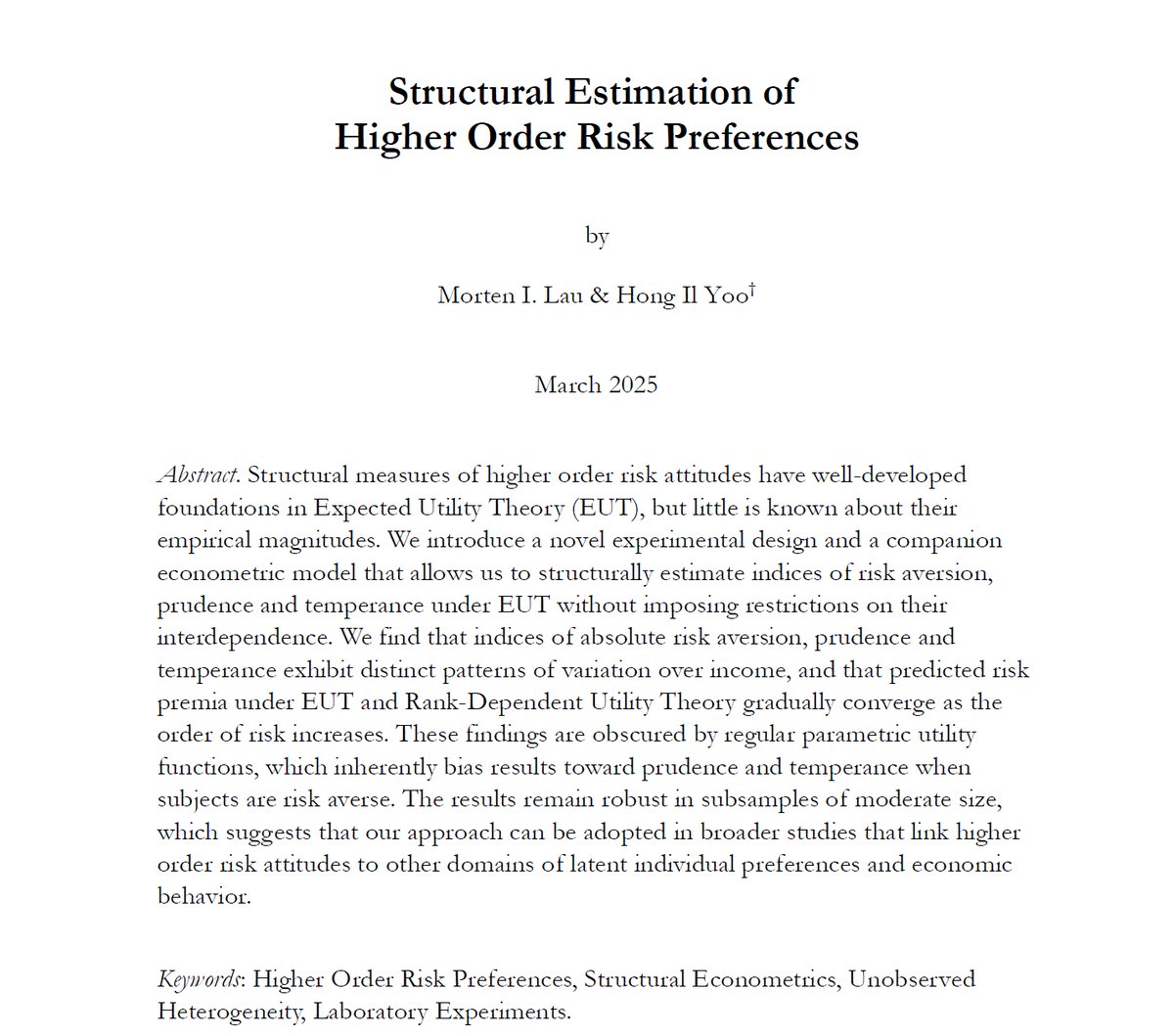
We introduce a novel experimental design and econometric model to estimate risk aversion, prudence, and temperance without imposing their interdependence. Our approach unmasks variation in risk attitudes that existing modeling approaches may obscure. econometricsociety.org/publications/e…
Econometrica tweet media
English
1
24
118
10.1K
Shuo Qi retweetledi
Melissa Dell
Melissa Dell@MelissaLDell·
Neural networks (e.g., LLMs) make often imperfect predictions, introducing biases into analyses that rely on them. Common empirical economics scenarios fall outside the existing literature on debiasing “black-box AI”. Our paper (with @J_S_Carlson) on robust and efficient inference with unstructured data (e.g., text, images) provides a unifying theoretical framework, relates inference with text/images to familiar problems like causal inference, develops new insights into efficiency, and provides practical guidance on common empirical scenarios. arxiv.org/abs/2505.00282
English
2
74
326
36.8K
Shuo Qi
Shuo Qi@June_Qi·
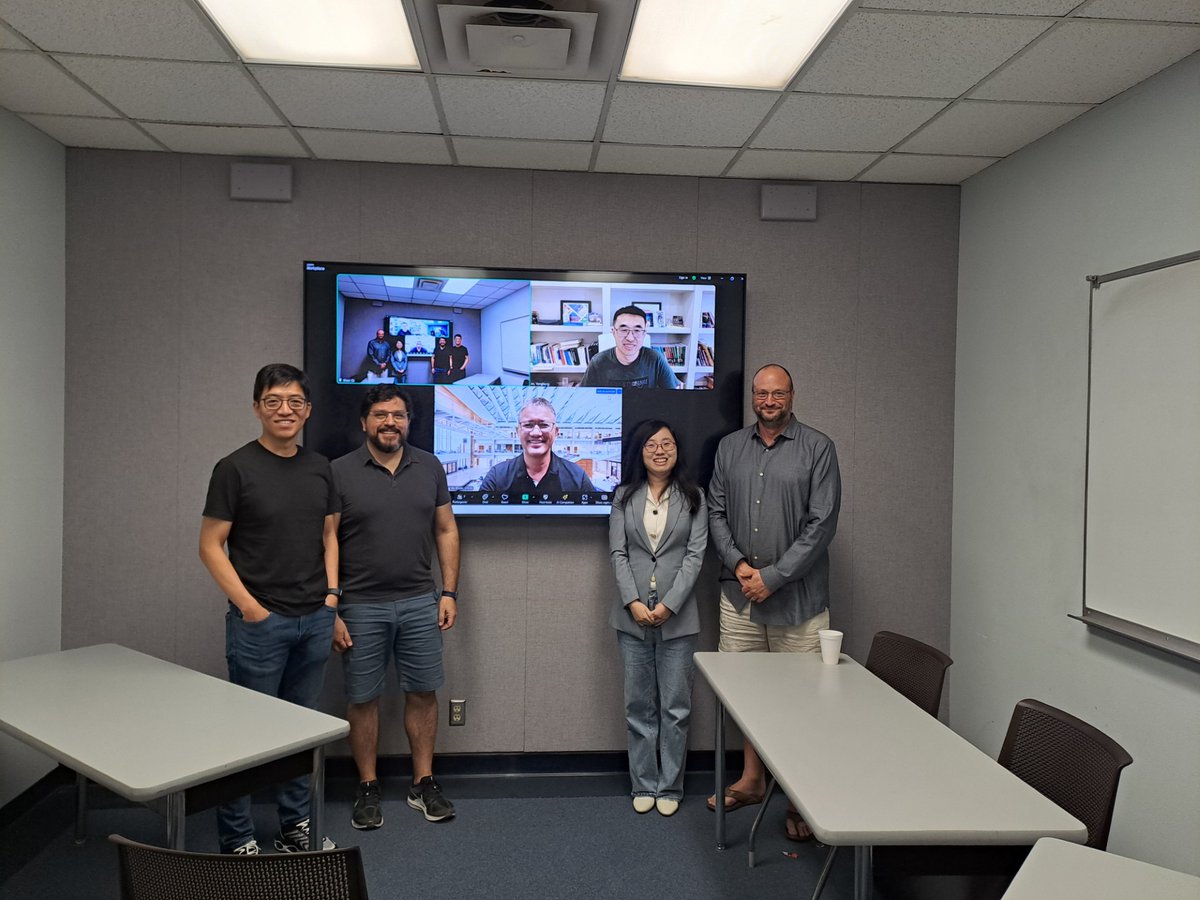
Couldn’t have done it without the incredible support from my committee and the entire @SMUEconDept. Thank you all for guiding me through this journey and making SMU a place of growth and inspiration. Onward to the next chapter!🎓💙❤️ #PhDone #EconTwitter
SMU Economics@SMUEconDept

🥳PhDone!🥂 We are proud to announce the dissertation defense of Dr. Shuo Qi @June_Qi, titled "Essays on Econometric Analysis of Network Data." She will join William & Mary's Global Research Institute @global_wm as a Postdoctoral Fellow in the fall. Congratulations Shuo!💙

English
4
0
18
948
SMU Economics
SMU Economics@SMUEconDept·
🥳PhDone!🥂 We are proud to announce the dissertation defense of Dr. Shuo Qi @June_Qi, titled "Essays on Econometric Analysis of Network Data." She will join William & Mary's Global Research Institute @global_wm as a Postdoctoral Fellow in the fall. Congratulations Shuo!💙
SMU Economics tweet media
English
2
0
18
2K