Justin

9 posts

Justin

Justin

@Justin_Rebo

Katılım Nisan 2018
163 Takip Edilen74 Takipçiler
Justin retweetledi
ARPA-H
ARPA-H@ARPA_H·
NEW: No technology currently exists to repair damaged brain tissue and fully restore lost function. FRONT aims to enable millions with what is considered permanent brain damage to regain lost functions, including motor control, vision, and speech. arpa-h.gov/news-and-event…
English
33
146
584
204.6K
Justin
Justin@Justin_Rebo·
@LidskyPeter @adamgries A couple of weeks ago I replaced the alternator on my car. I had absolutely no idea in exactly what way it was broken, nor the precise mechanism in which it failed. The car runs well now.
English
1
0
0
61
Peter Lidsky
Peter Lidsky@LidskyPeter·
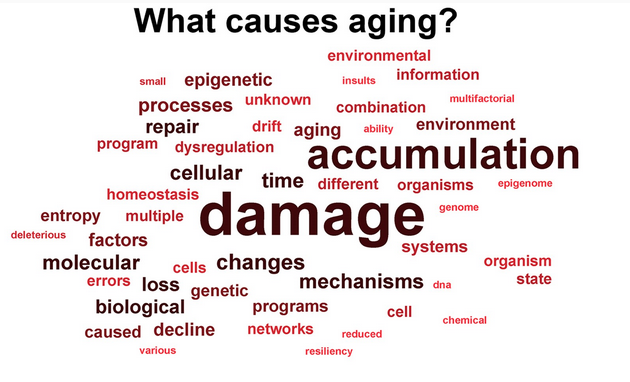
Why is aging (not) about damage accumulation? A recent expert survey paper indicated damage accumulation as a primary cause of aging (doi.org/10.1093/pnasne…). I think this belief is nothing more than a confusion and harm to longevity research. And this is why. First of all, does damage happen in aging organisms? Of course, it does. Pretty much everything deteriorates as we age! So, can aging be interpreted as a damage accumulation process? It can be viewed this way, along with almost any other healthcare problem. For example, infectious diseases can be defined as damage accumulation caused by pathogens. Diabetes is damage accumulation caused by wrong blood sugar concentration. Sickle-shaped anemia is damage accumulation caused by blockage of blood flow by deformed erythrocytes. In all these cases, damage is readily detectable. However, it is caused by well-defined biological factors, and it is not a primary cause of these diseases anyway. Are there diseases caused by damage? Yes, something like food poisoning or broken legs. This is a very special class of health problems, and including aging in this group requires very strong arguments. Can we find such arguments somewhere in the scientific literature? Not really. In 1963, Leslie Orgel proposed a model focused on the accumulating errors in the protein translation machinery. Errors are occurring evenly across all the proteins. However, those that hit proteins responsible for protein synthesis may elevate the number of errors, resulting in further deterioration of fidelity and an error catastrophe (doi.org/10.1073/pnas.4…). Unfortunately, this ingenious idea was found wrong. It can be easily tested by treating cultured cells with drugs that increase levels of errors (e.g., ribavirin). An exponential damage accumulation upon drug removal was never demonstrated. Another compelling damage accumulation model claims somatic DNA mutations as a reason for aging (see, e.g., doi.org/10.1016/j.molm…). Indeed, DNA encodes the primary information on how our organism functions. If this information gets damaged with time, it can be a good model for aging. Accordingly, somatic mutation rates correlate with lifespan if we compare different mammalian species (doi.org/10.1038/s41586…). However, whether these mutations cause sufficient damage to explain aging is still unclear. Moreover, this model drops out short-lived animals such as worms or insects that clearly cannot accumulate enough mutations within several weeks of their life. Why do these animals age? The two above models are somehow specific. But much more often, scientists refer to damage accumulation as an esoteric entity that does not require a firm definition. Some damage hits some cells and some molecules, and that’s it – we age. Vadim Gladyshev tried to formalize this with his deleteriome model (doi.org/10.1111/acel.1…). However, I am still not convinced we have any evidence supporting these views. Would placing animals or humans into some ideal environment, protected from damaging factors, stop or dramatically delay aging? Of course not! Moreover, mild stressors prolong lifespan instead of shrinking it, as damage accumulation models suggest. This is called “hormesis.” Many more, much more significant caveats exist in all the damage accumulation models. For example, aging can be regulated. For instance, in eusocial animals such as bees or ants, queens may live 50 times longer than workers while sharing exactly the same genome. How does damage affect queens 50 times less than workers? And it is not the whole story. If the queen dies, workers sometimes gain the ability to lay eggs. In these cases, they also age much slower, and their lifespan can increase fold times (doi.org/10.1038/s41598…). Why does damage start affecting them so much less? You may say: “this is in insects, who cares about them.” However, similar patterns were also observed in eusocial rodents, such as Fukomysmole-rats (doi.org/10.1371/journa…). Effects are less pronounced, and the system is studied less, but the trends are clearly the same as in insects. How can we explain such things with damage accumulation? Even if we try to be as merciful to this model as possible, we can only hypothesize that not damage per se but downregulation of damage control mechanisms is the primary cause of aging. So far, what we see is more consistent with the model that these mechanisms are switched off as we age. But why do they? This question remains unanswered. But why do so many scientists believe in damage accumulation? I think the reason is that this hypothesis seems intuitive: our bodies decline with age like toothbrushes or combs get worn out. However, this intuition is wrong. Unlike toothbrushes, humans eat and drink. Energy obtained with food may help us regenerate and heal the damage. Early in life, it happens, but later in life, it does not. And we don’t understand why it happens. Summarizing this post, I believe that “aging is because of damage accumulation” is not anyhow better than “something bad happens as an organism ages.” The damage accumulation model does not increase our understanding or produce an actionable plan for further research. Instead, it creates a false impression that we understand something. It is just a placeholder for a paradigm of aging we need to assemble.
Peter Lidsky tweet media
English
19
16
93
8.9K
Justin
Justin@Justin_Rebo·
@MarkHamalainen Most people do nothing no matter what they claim to care about
English
0
0
1
39
Mark Hamalainen
Mark Hamalainen@MarkHamalainen·
Even people who believe aging should be cured mostly don't work on anything that could plausibly achieve that, why? 1) Drift to a path of less resistance - aging is HARD 2) Can't get funding (have you asked enough people?) 3) Reward cycle is too slow (psychological pain) Others?
English
8
1
30
2.3K
Justin retweetledi
Longevity Biotech Fellowship
1/ Announcing the Longevity Biotech Fellowship (LBF)! A nonprofit org and community with the mission to: 🌱 Grow the Longevity Biotech Community 💪 Maximize our Members' Impact 🚀 & Break Bottlenecks to Progress Apply now at longbiofellowship.org! (First cohort Jan 2023)
English
6
37
109
0