Sabitlenmiş Tweet
MKT
10.7K posts


MKT
@KMKTo
エネルギー系/地下3D掘削技術をセンサーとアルゴリズムで支えてます/統計・信号処理/パリ・フランス🇫🇷
France Katılım Aralık 2009
818 Takip Edilen1.9K Takipçiler

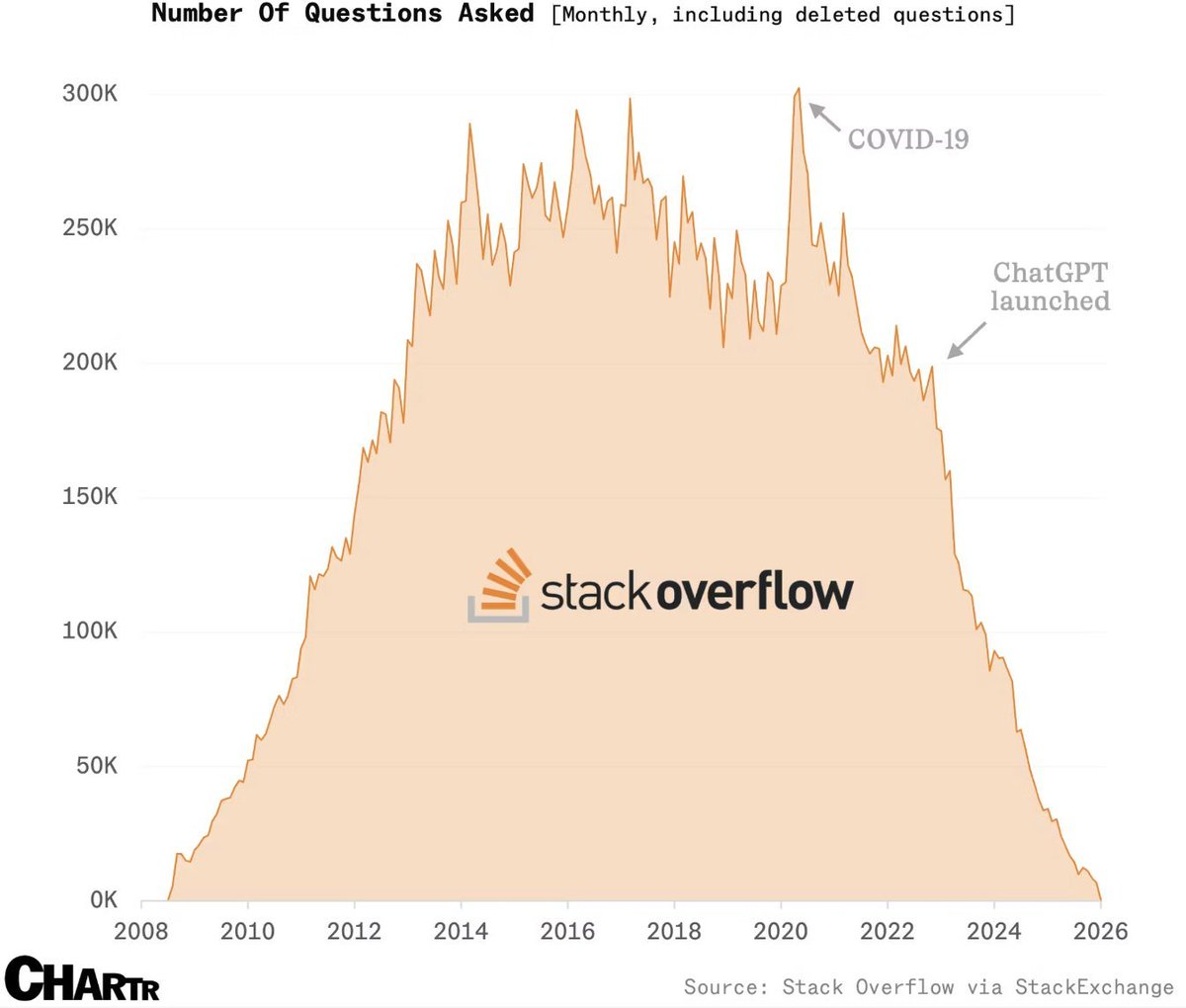
MKT retweetledi

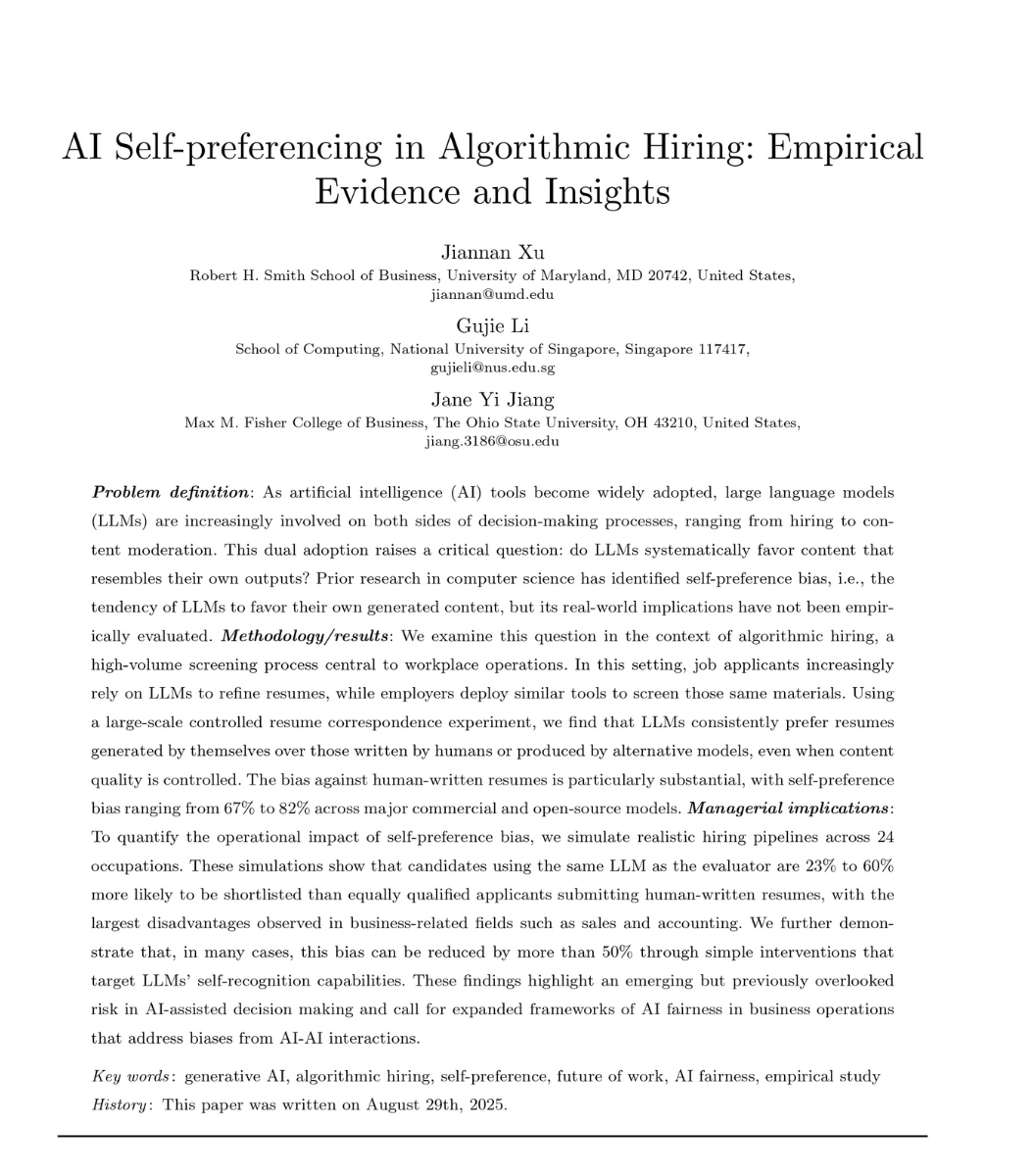
Researchers sent the same resume to an AI hiring tool twice. Same qualifications. Same experience. Same skills. One version was written by a real human. The other was rewritten by ChatGPT.
The AI picked the ChatGPT version 97.6% of the time.
A team from the University of Maryland, the National University of Singapore, and Ohio State just published the receipt. They took 2,245 real human-written resumes pulled from a professional resume site from before ChatGPT existed, so the human writing was actually human. Then they had seven of the most-used AI models in the world rewrite each one. GPT-4o. GPT-4o-mini. GPT-4-turbo. LLaMA 3.3-70B. Qwen 2.5-72B. DeepSeek-V3. Mistral-7B.
Then they asked each AI to pick the better resume. Every model picked itself.
GPT-4o hit 97.6%. LLaMA-3.3-70B hit 96.3%. Qwen-2.5-72B hit 95.9%. DeepSeek-V3 hit 95.5%. The real human almost never won.
Then the researchers tried the obvious objection. Maybe the AI is just better at writing. So they had real humans grade the resumes for actual quality and ran the experiment again, controlling for it. The result was worse. Each AI kept picking itself even when human judges rated the human-written version as clearer, more coherent, and more effective.
It gets worse. The AIs do not just prefer AI over humans. They prefer themselves over other AIs. DeepSeek-V3 picked its own resumes 69% more often than LLaMA's. GPT-4o picked its own 45% more often than LLaMA's. Each model can recognize and reward its own dialect.
Then the researchers ran the simulation that ends careers. Same job. 24 occupations. Same qualifications. The only variable was whether the candidate used the same AI as the screening tool. Candidates using that AI were 23% to 60% more likely to be shortlisted. Worst gap was in sales, accounting, and finance.
99% of large companies now run AI on incoming resumes. Most of them use GPT-4o. The paper just proved GPT-4o picks GPT-4o 97.6% of the time.
If you wrote your own cover letter this week, you did not lose to a better candidate. You lost to a worse candidate who paid OpenAI 20 dollars.
Your qualifications do not matter if the AI prefers its own handwriting over yours.
English
AIが動画をAIで生成しポストし、AIが集まってきてそれにコメントをつけ、人間のアテンションを得る。
本当に終わってるし、終わる目処もないんだろうな。
Shagufta khan@Digital_khan01
इस वीडियो में देखें कैसे एक साधारण सी दिखने वाली चट्टान को तोड़ने पर $2500 की कीमत के सोने के डले और कीमती पत्थर निकले। प्रकृति के पास वाकई बहुत कुछ छिपा है।
日本語
MKT retweetledi
『ゼロから作る Deep Learning ❻ ― LLM編』、まもなく刊行です。
amzn.to/4tOdOie
1巻目から10年。読み続けてくださった皆さんに、心から感謝します。ありがとうございました。

日本語
@Eliakim_Art まずは、あなたが休暇を取り、妻の代わりに子供の面倒と家事を全てすることです。少なくとも4日から5日ほどは。そして妻には出かけて休んでもらうのです。また、あなたは自分がどのような家事を相手に期待してるかを見せる必要があります。
それはもしかしたらあなたには不可能かもしれませんが。
日本語

😥Anonyme :
Je pense à DIVORCER tous les jours depuis 2 ans, et je me déteste pour ça.
J'ai 37 ans, papa de trois enfants (9, 6 et 3 ans), marié depuis 11 ans.
Je travaille à l'usine en 3×8, je rentre crevé, parfois à 5 h du matin, parfois à 13 h, parfois à 21 h.
Je ramène l'argent, je paye le loyer, les factures, la bouffe, les vêtements, les activités des enfants, les cadeaux de Noël.
Ma femme ne travaille pas.
Elle reste à la maison depuis la naissance du deuxième, et je n'ai jamais rien dit.
Je trouvais ça normal : les enfants ont besoin d'une maman à temps plein.
Mais quand je rentre... rien n'est fait.
Les enfants sont sales, les cheveux colles, les vêtements tachés de la veille.
1/2👇🏽
Français
@AudeJavel79 . The whole chamber erupted in giggles at the absurdly cute story! 🐘🐪😂
English
@AudeJavel79 In 2019 Danish Parliament, PM Mette Frederiksen couldn’t stop laughing while explaining: The government bought 4 retired circus elephants… but one (Ramboline) had a “best friend” — a camel named Ali. They ended up buying the camel too because it would be “cruel” to separate them
English
AIがヒトに勝る時代の自然な流れなのか。
顧客がほぼ政府である場合、企業自身の社会的同義も政府と寄り添う形になる
こういう事象は特にPalantirに限った事ではないのだろうと思いつつ、ここまで自信を持って民衆を無視した発言が出来るというのは、自身の価値や技術に揺るぎない自信がある表れ。
Palantir@PalantirTech
Because we get asked a lot. The Technological Republic, in brief. 1. Silicon Valley owes a moral debt to the country that made its rise possible. The engineering elite of Silicon Valley has an affirmative obligation to participate in the defense of the nation. 2. We must rebel against the tyranny of the apps. Is the iPhone our greatest creative if not crowning achievement as a civilization? The object has changed our lives, but it may also now be limiting and constraining our sense of the possible. 3. Free email is not enough. The decadence of a culture or civilization, and indeed its ruling class, will be forgiven only if that culture is capable of delivering economic growth and security for the public. 4. The limits of soft power, of soaring rhetoric alone, have been exposed. The ability of free and democratic societies to prevail requires something more than moral appeal. It requires hard power, and hard power in this century will be built on software. 5. The question is not whether A.I. weapons will be built; it is who will build them and for what purpose. Our adversaries will not pause to indulge in theatrical debates about the merits of developing technologies with critical military and national security applications. They will proceed. 6. National service should be a universal duty. We should, as a society, seriously consider moving away from an all-volunteer force and only fight the next war if everyone shares in the risk and the cost. 7. If a U.S. Marine asks for a better rifle, we should build it; and the same goes for software. We should as a country be capable of continuing a debate about the appropriateness of military action abroad while remaining unflinching in our commitment to those we have asked to step into harm’s way. 8. Public servants need not be our priests. Any business that compensated its employees in the way that the federal government compensates public servants would struggle to survive. 9. We should show far more grace towards those who have subjected themselves to public life. The eradication of any space for forgiveness—a jettisoning of any tolerance for the complexities and contradictions of the human psyche—may leave us with a cast of characters at the helm we will grow to regret. 10. The psychologization of modern politics is leading us astray. Those who look to the political arena to nourish their soul and sense of self, who rely too heavily on their internal life finding expression in people they may never meet, will be left disappointed. 11. Our society has grown too eager to hasten, and is often gleeful at, the demise of its enemies. The vanquishing of an opponent is a moment to pause, not rejoice. 12. The atomic age is ending. One age of deterrence, the atomic age, is ending, and a new era of deterrence built on A.I. is set to begin. 13. No other country in the history of the world has advanced progressive values more than this one. The United States is far from perfect. But it is easy to forget how much more opportunity exists in this country for those who are not hereditary elites than in any other nation on the planet. 14. American power has made possible an extraordinarily long peace. Too many have forgotten or perhaps take for granted that nearly a century of some version of peace has prevailed in the world without a great power military conflict. At least three generations — billions of people and their children and now grandchildren — have never known a world war. 15. The postwar neutering of Germany and Japan must be undone. The defanging of Germany was an overcorrection for which Europe is now paying a heavy price. A similar and highly theatrical commitment to Japanese pacifism will, if maintained, also threaten to shift the balance of power in Asia. 16. We should applaud those who attempt to build where the market has failed to act. The culture almost snickers at Musk’s interest in grand narrative, as if billionaires ought to simply stay in their lane of enriching themselves . . . . Any curiosity or genuine interest in the value of what he has created is essentially dismissed, or perhaps lurks from beneath a thinly veiled scorn. 17. Silicon Valley must play a role in addressing violent crime. Many politicians across the United States have essentially shrugged when it comes to violent crime, abandoning any serious efforts to address the problem or take on any risk with their constituencies or donors in coming up with solutions and experiments in what should be a desperate bid to save lives. 18. The ruthless exposure of the private lives of public figures drives far too much talent away from government service. The public arena—and the shallow and petty assaults against those who dare to do something other than enrich themselves—has become so unforgiving that the republic is left with a significant roster of ineffectual, empty vessels whose ambition one would forgive if there were any genuine belief structure lurking within. 19. The caution in public life that we unwittingly encourage is corrosive. Those who say nothing wrong often say nothing much at all. 20. The pervasive intolerance of religious belief in certain circles must be resisted. The elite’s intolerance of religious belief is perhaps one of the most telling signs that its political project constitutes a less open intellectual movement than many within it would claim. 21. Some cultures have produced vital advances; others remain dysfunctional and regressive. All cultures are now equal. Criticism and value judgments are forbidden. Yet this new dogma glosses over the fact that certain cultures and indeed subcultures . . . have produced wonders. Others have proven middling, and worse, regressive and harmful. 22. We must resist the shallow temptation of a vacant and hollow pluralism. We, in America and more broadly the West, have for the past half century resisted defining national cultures in the name of inclusivity. But inclusion into what? Excerpts from the #1 New York Times Bestseller The Technological Republic: Hard Power, Soft Belief, and the Future of the West, by Alexander C. Karp & Nicholas W. Zamiska techrepublicbook.com
日本語
それは逆説的にどんな分野でも言えることではないでしょうか。法務は「社長が法律をもっとわかっていれば…」と思うものですし、研究所は「営業畑の社長が技術出身だったら」なんて思うわけです。意思決定者がデータの視点を持つことが(超)重要ですが、逆説的に同じことが別の分野で言えると思いますよ
Suguru | データサイエンティスト@st_data_science
組織の中で意思決定は、誰でも行う機会はあると思うんです、決裁範囲が異なるだけで。 そして組織でなくても、自身の人生において、どれだけ多くのデータ分析者が実際に「データを考慮して意思決定できているだろうか?」と思うんですよね。 意思決定者の目線に立てば当然「データだけでは判断できない」わけで。その当事者意識は、データ分析への姿勢を大きく変えると思うのです。
日本語
例えば経理や法律等を「データ」と捉えるかどうかはあるけれど、それ以外の一般的なデータ「だけ」を扱う人が組織の意思決定を行うのは難しいのでは(役割と言うのはそう言う意味ですよね)。
データ「も」扱える人が意思決定するのはもちろん+だと思う。
Suguru | データサイエンティスト@st_data_science
これ、私は真逆の考えなんですよね。 生成AIによってデータサイエンティストに求められるものが移りゆく中、最近は「データに基づいて取り組みたい」という姿勢そのものがDSなのでは、と思うようになりました。 意思決定と分析役務の提供を切り分けると、データサイエンティストは「データ解析を意思決定に取り入れたい」という他者の存在に依存したものになります。 私はむしろ、その意思決定者の方が、よりデータドリブンに価値を生み出しているという意味で、分析者よりデータサイエンティスト的なのではないかとさえ思うわけです。 それは勿体無いというか、せっかく分析者自らがその知見を持っているならば、普段の自身の意思決定においてもデータの視点を取り入れて決定する、という方がよりデータサイエンティストらしい生き方なのではないか?と最近は思うんですね。
日本語
MKT retweetledi