

Exposing Shaykhs Of Aden
551 posts

Exposing Shaykhs Of Aden
@KashfAden
Documenting the oppression and corruption of Dr Arafat al-Muhammadi and his associates against Salafis and their methodology in United Kingdom, Yemen and Sudan
Katılım Aralık 2025
24 Takip Edilen345 Takipçiler


“What is wrong with it!!”
This was Shaykh ʿAbdullāh—may Allah forgive him—his response regarding the ruling on ʿArafāt meeting with those who carried out the coup against the Yemeni government!…
From what came in a letter from Shaykh ʿAlī al-Ḥudhayfī al-ʿAdanī حفظه الله, dated 17 Shaʿbān 1447H, to Shaykh ʿAbdullāh al-Bukhārī, the following:
“When the criticisms concerning the brothers (of the Shaykhs of Aden) reached you, I asked those close to you to say to your eminence: ‘Indeed, ʿArafāt al-Muḥammadī and those with him traveled from al-Madīnah al-Nabawiyyah to Riyadh in order to meet with those who carried out the coup against the Yemeni government, and I requested from your eminence that you advise them.’ So those close to you conveyed the matter to your eminence, and you said, O Shaykh ʿAbdullāh: ‘What is wrong with it?’—meaning: ‘And what is wrong with their visit?’
I was greatly astonished—by Allah—at this response, because the scholars are keen to keep the Salafi daʿwah away from political conflicts. So how then if there are inclinations toward one of these political parties, let alone standing with some parties against the government, let alone these parties calling for the division of Yemen.
I was greatly shocked by your response, and I was expecting from your eminence that you would say: ‘Yes, this is a mistake, and we will advise them, inshā’Allāh.’ But when I heard your eminence say: ‘What is wrong with it?’ despair struck me, and I immediately realized that the matter was lost, so I withdrew from the issue.”
End of his words.
Exposing Shaykhs Of Aden@KashfAden
A Letter to Shaykh 'Abdullah al-Bukhari Shaykh 'Ali al-Hudhayfi al-'Adani said: In the name of Allah, the Most Gracious, the Most Merciful. Praise be to Allah, Lord of the worlds, and I bear witness that there is no god but Allah alone, without any partner, the Protector of the righteous. I bear witness that our Prophet Muhammad is His servant and Messenger – may Allah’s prayers and peace be upon him. To proceed: To His Eminence, Shaykh Dr. 'Abdullah al-Bukhari – may Allah grant him success in all that is good. Peace, mercy, and blessings of Allah be upon you. I ask Allah Almighty that my message reaches you while you are enjoying abundant health and well-being, you and your family and children. Shaykh 'Abdullah: I kindly request that you grant me a brief moment of your time to look into this message, which I have written with the intention of drawing attention to serious matters occurring within the da'wah (Islamic call). These are injustices and deviations caused by some students of knowledge. We have been patient for a long time despite these deviations, saying that these matters would be dealt with wisely and calmly over time. We were very patient, not out of fear of anyone, nor because I am unable to respond to anyone, but I was patient out of concern for the da'wah, fear of the warning against division, mercy for the youth from being lost, and caution against the gloating of enemies. However, unfortunately, it has been of no benefit whatsoever, and the situation is worsening rapidly, to the extent that problems have occurred in many places. These matters relate to the issue of Aden and other locations. The First Matter: The Issue of Aden Regarding the issue of Aden, I tried to address the problem that some preachers in Aden fell into, to the best of my ability, sparing no effort. My Lord knows how much time and effort this has taken from me. I am writing to you about the problem in Aden after a long time, during which I was very patient with many things for a long period. I say to Your Eminence: despite the many trials (fitan) I have been through, I do not know of a trial in which I was more patient than in this one, nor was I harmed by anyone as I was harmed in this trial. If you were to gather all the false accusations made against me in previous trials, by Allah, they would be few compared to what has been falsely attributed to me in this trial. We were very patient, but unfortunately, it was of no use. I tried to correspond with you several times, and I learned that the letters reached you, yet you did not reply to them. Some of your students delivered to you a file concerning those called the "Shaykhs of Aden," against whom there were serious observations. These included involving the Salafi da'wah in political conflicts and leaning towards certain political parties seeking to overthrow the Yemeni government in pursuit of the secession of the South from the North. Some of these brothers sought to obtain a fatwa (religious ruling) to support these parties in their fight against the government and its institutions. Unfortunately, Dr. 'Arafat al-Muhammadi assisted them in this, using deception. He advised them to conceal from Shaykh Rabee' that the war in Aden was supervised by Hani and that the fatwa was for the benefit of his party. I took a reasonable and fair approach with the brothers, requesting that Your Eminence advise these brothers and warn them against this dangerous action, to keep the da'wah far away from political conflicts. 'Arafat al-Muhammadi and those with him traveled from Madinah to Riyadh to meet with those staging a coup against the Yemeni government and inform them that a fatwa supporting fighting the government had been obtained. This was at a time when the war with the government had reached its peak. They said, "We asked Shaykh 'Abdullah al-Bukhari about traveling to Riyadh to meet the leaders of the Southern Transitional Council, and he permitted us." I initially thought that the matter was not clear to Your Eminence. When the criticisms against these brothers reached you, I asked those close to you to inform Your Eminence: "'Arafat al-Muhammadi and those with him traveled from Madinah to Riyadh to meet those staging a coup against the Yemeni government." I requested that Your Eminence advise them. Those close to you raised the matter with Your Eminence, and you said, O Shaykh 'Abdullah: "Ish fiha?" meaning: "What is wrong with their visit?" By Allah, I was very surprised by this response, as scholars are keen to keep the Salafi da'wah away from political conflicts. So what if there is a leaning towards one of these political parties, let alone supporting some parties against the government, let alone calling for the division of Yemen? I was greatly taken aback by Your Eminence's response. I was expecting Your Eminence to say: "Yes, this is wrong, and we will advise them, insha'Allah." But when I heard Your Eminence say, "Ish fiha," I became despondent and immediately realized that the issue was lost, so I withdrew from the matter. I was informed that Your Eminence declared the Shaykhs of Aden free of any wrongdoing without hearing from a single virtuous brother as a witness, and you did not ask me for any witnesses. The witnesses who know the situation from the beginning are many, and some of them were close to you in Madinah. Furthermore, you mocked me and the things I wrote. You said about the matters I raised: "His writing is like the writing of children," and you said about me that I am "bankrupt" (intellectually). Yet the matters I wrote about are serious, relating to rebellion against the government, bloodshed, and the division of Yemen. The style was clear, and I only asked Your Eminence to advise these young men. There was a great uproar caused by Your Eminence's words, O Shaykh 'Abdullah, stirred up by Dr. 'Arafat al-Muhammadi and his associates. I wrote to Your Eminence, saying: "O Shaykh 'Abdullah, I have heard your words about me. I say: May Allah forgive you, O Shaykh 'Abdullah. I only ask you to advise the youth to stay away from chaos and occupy themselves with good." However, you responded to me with harsh words that did not bode well, increasing my sadness further. After some time, the brothers insisted on traveling to Madinah for reconciliation. I was not convinced of this, but I agreed to travel under intense pressure from virtuous individuals whom I feared losing. When we arrived in Madinah and informed you of our presence, requesting a meeting with Your Eminence, I was surprised that you requested that I not bring anyone with me. This was despite the presence of some virtuous individuals in Madinah who were capable of explaining matters to you. These brothers had previously tried to reach you but could not, and Your Eminence was in dire need of hearing witnesses. Truthfully, during our visit to you, things occurred from Your Eminence that greatly saddened us, even though we came from a distant place for the purpose of reconciliation. Among the least of these things that saddened us was what you accused me of, without any right whatsoever, saying: "You did not travel except to extract a response from me," or something similar – I do not recall the exact phrase – knowing that I was not content with traveling except under pressure. Then, Your Eminence threatened us, saying you would not remain silent and would speak out. This is besides the harsh words you said to the virtuous brother accompanying me on the trip, even though he had done nothing to deserve such words spoken against him. These words were the last we heard from you. During the reconciliation period, Salah Kantoush spoke with others – on Facebook or elsewhere – mentioning that Your Eminence had permitted them to respond to me. This reached me, and I was surprised how Your Eminence could permit them to respond to me. Nevertheless, I did nothing. Then, these people broke the reconciliation, witnessed by several witnesses (many in number). They took over some of the mosques where we used to teach classes on Tawheed (monotheism) from their brethren, expelling us without any right. Yet, Your Eminence said nothing, not a single word. I tried to speak with some virtuous scholars about this matter, but unfortunately, it was of no benefit. These people have reached an astonishing level of recklessness; they hung banners of the Southern Transitional Council in the classrooms of Ahl al-Sunnah mosques – banners bearing the emblem of Southern secession. They also placed boards at the doors with fixed pictures of the scholars participating in the courses. This was unknown in the da'wah in previous times, and Your Eminence has not uttered a single word. I do not know why nothing has been issued from you. Either Your Eminence is aware of this and has not spoken – and by Allah, this is a very serious matter – or Your Eminence is unaware, in which case Dr. 'Arafat al-Muhammadi and his ilk must be held accountable, because they know of these things and do not inform you. Dr. 'Arafat al-Muhammadi has excelled in waging war against me using various methods and tactics: Among his methods is that he, or some of his followers, wrote dozens of articles under pseudonyms, filled with dozens of unjust accusations. These included matters that were between me and 'Arafat al-Muhammadi that no one else knew, except he distorted them and did not mention my arguments. Another method was that he secretly warned against me for years. Whenever I went somewhere, I found that he had preceded me, discouraging non-Arab beginners from studying Tawheed and 'Aqeedah (creed). Then, Dr. 'Arafat al-Muhammadi culminated this with an explicit public warning against me, without considering the potential benefits or harms. This warning follows the methodology of the Hadaadiyyah (a group known for excessive criticism), not the methodology of Ahl al-Sunnah in the field of jarh wa ta'dil (criticism and praise), because, to this day, he has been unable to provide proof for the criticism. Among his statements that have been relayed to me is that I have Hadaadi tendencies and that I insult the esteemed scholar Shaykh Rabee' and Shaykh 'Abdullah al-Bukhari. All these statements are conveyed without the slightest evidence. I sent you three letters at different times: a. A letter I submitted to you with 'Abd al-Ilah al-Rifaa'i containing details about 'Arafat's statements and his conduct towards me from several years ago, before the Madinah reconciliation. Your Eminence did not respond. b. Another letter was via text message. c. A third letter after 'Arafat's warning, which I sent to you via text message through a brother in Madinah. I asked him, "Did the message reach the Shaykh?" He said, "Yes, the message reached the Shaykh." In it, I informed you of what your student, 'Arafat al-Muhammadi, was doing in terms of transgressing against innocent people. But unfortunately, Your Eminence did not reply to anything. 'Arafat al-Muhammadi was not content with just warning against me. He withdrew from the battlefield, leaving the arena to some thugs to insult virtuous individuals, hurling all sorts of abuses and accusations at them. Among these reckless individuals is the Hadaadi liar, Ahmad Badkhan, who insulted Shaykh Muqbil al-Wadi'ee – may Allah have mercy on him – on multiple occasions, and to this day, there is no knowledge of his sincere repentance. After the recent events in Hadramawt, Your Eminence spoke some words regarding the events. I wish that Your Eminence would guide the brothers with advice – even general advice – warning the preacher brothers in Aden once again against supporting political parties. People should know that Your Eminence has advised these brothers, especially since nothing has been issued from Your Eminence to counter the heinous actions committed by these people. The youth are in need of such words. The situation of the youth who were sympathetic to Dr. 'Arafat is poor; it is not a situation that pleases anyone who loves the youth, fears for them, and fears for the Salafi da'wah. Some of these youth insult Saudi Arabia in WhatsApp groups. Some, when asked about their rulers in Yemen, say, "I am withholding judgment (mutawaqqif)." Another, when asked about his rulers in Yemen, remains silent and does not answer. The Second Matter: The Issue of Egypt 'Arafat al-Muhammadi praises the Hadaadi, Hisham al-Bayli, whom the Salafi preachers in Egypt have unanimously agreed to abandon and avoid. At the same time, he warns against 'Ali al-Hudhayfi and others. The Third Matter: The Issue of Birmingham 'Arafat al-Muhammadi falsely accused a virtuous brother, Abu Iyaad (abuiyaad.com/w/arafat-lies) , one of the Salafis in Britain, of things that are not true. This caused a great fitnah (trial/conflict) among the youth, not only in Britain but across the Salafi youth in all of Europe. Some brothers from Britain and elsewhere contacted me to discuss this matter. The followers of 'Arafat al-Muhammadi in Britain and elsewhere began testing the youth regarding their stances; whoever disagreed with them was fought. By Allah, I swear, brothers informed me of this. The tragedy is that 'Arafat al-Muhammadi remains, to this day, unable to produce any evidence for what he falsely accused these virtuous brothers of. Even if we assume there was an audio recording of Abu Iyaad, it was a private recording, and brother 'Arafat al-Muhammadi could have handled the matter with wisdom and good counsel. My question to you, O Shaykh 'Abdullah: Does Your Eminence intend to leave matters as they are, without advising the youth? I request that you advise 'Arafat al-Muhammadi and advise the youth influenced by him to stop testing their brothers. You know – may Allah bless you – the statements of the Imams regarding testing people with such issues. The War on Senior Students of Knowledge Shaykh 'Abdullah: a. There is a war against senior preachers who are students of major scholars like Shaykh Rabee' al-Madkhali, Shaykh an-Najmi, Shaykh 'Ubayd al-Jabiri, and Shaykh Muqbil al-Wadi'ee – may Allah have mercy on them. Does Your Eminence approve of sidelining these virtuous individuals from the da'wah? b. 'Arafat and his followers test the youth regarding matters for which testing is not permissible. By Allah, it is forbidden for him to test people on such matters. Matters could have been rectified with wisdom and good counsel. Will all these matters be left without being addressed? I request that Your Eminence address these matters, because if they are not addressed quickly, they will destroy the Salafi da'wah, tear it apart, and cause the enemies to gloat over it. Dr. 'Arafat al-Muhammadi is the Cause of These Fitnas As long as 'Arafat al-Muhammadi deals with preachers in these ways, the problems, fitnas, and disputes will continue. 'Arafat is a very evil man. I ask that you listen to sincere witnesses who want good for the Salafi da'wah. They are far purer than 'Arafat al-Muhammadi, and there is no animosity between them and 'Arafat al-Muhammadi. If evil things become known about a man, and reports about him become recurrent (mutawatirah) from all sides, it is not permissible to ignore these reports as if nothing was heard or known. I have come across things concerning Dr. 'Arafat al-Muhammadi. Some of these things I witnessed myself during my acquaintance with him, from knowing his stances with certain political parties. Other things are numerous reports about him conveyed to me by many virtuous brothers from many countries, Arab and non-Arab, which no fair-minded person can dismiss¹. All these reports indicate that he is a very dangerous man for the Salafi da'wah. Reports have become recurrent (mutawatirah) about him causing corruption through many channels, making it impossible that those conveying them colluded on lies. These reports have come from Madinah, Yemen, Bahrain, Egypt, Indonesia, Britain, and other places. For some of these mentioned countries, the reports are recurrent, coming from multiple sources. So what if they are combined with other reports? If reports reach the level of recurrence for a single individual due to their numerous chains, what about when they become recurrent among many trustworthy, virtuous individuals from different countries? These reports cannot be ignored, even if each individual report might not be authentic on its own – so what if they are authentic in themselves? By Allah, it is not permissible to ignore this recurrence . Dr. 'Arafat al-Muhammadi has divided the Salafis in many places around the world through his recklessness, oppression, and scheming. He conceals facts, praises some people of innovation, praises some deviant individuals, covers for other deviants, fights students of knowledge who stand up to his schemes, unleashes his foolish gang against them, and more. This man's schemes have reached the point of concealing matters from scholars to obtain a fatwa supporting some political parties in shedding innocent blood and overthrowing the rulers. His schemes have reached the point of aiding those who call for the division of Yemen. What malice is there beyond this? By Allah, this man should be subjected to a fair trial and punished in a way that deters him and his likes from among the treacherous. He deceived some youth and cast them into the arms of certain political parties in Yemen, leaving those poor young men lost, victims of this man. Scholars have criticized the Hadaadiyyah for declaring the Salafis who err as innovators due to mistakes that do not warrant takfir (excommunication) or tabdi' (declaring innovation). As for 'Arafat al-Muhammadi and his followers, they have fought the honorable ones and expelled them from Salafism because they were honorable and trustworthy guardians of the da'wah who refused to involve Salafism in the conflicts of political parties. Many people have impugned the integrity of 'Arafat al-Muhammadi. Those who impugn him are scholars and students of knowledge, many in number, who know him well. They accuse him of serious matters. It is not permissible to leave him to corrupt the da'wah. By Allah, it is not permissible to remain silent about these recurrent (mutawatirah) deviations. Remaining silent about them causes immense harm to the Salafi da'wah. For by Allah, Allah will question us about the da'wah, about the division among the youth, and about the gloating of the people of innovation over the da'wah. I write this article of my own accord; no one asked me to, let alone is backing me. I remained patient in past years not because I am unable to act, but hoping that mature, reasonable people would intervene and rectify matters. However, unfortunately, I see the situation worsening. May Allah's prayers, peace, and blessings be upon His servant and Messenger. (Shaykh) 'Ali al-Hudhayfi al-'Adani 17 Sha‘bān 1447 AH (February 16, 2026) ¹ Unlike what we used to hear before, where reports often stemmed from disputes between parties, and Allah forbid that we assist in injustice when we know it is injustice. Note: Shaykh Ali al-Hudhayfi al-'Adani said: “I finished this letter on 17 Sha’ban 1447 AH, and I sent it to Shaykh ‘Abdullah al-Bukhari, and he received it on 28 Sha’ban of the same year – meaning that nearly forty days have passed. And yet, until now, he has not replied. This is the fourth letter, and before it were three letters.” t.me/AliAlHuthaifi5…
Català
Exposing Shaykhs Of Aden retweetledi

⭕️De Methodologische en Morele Afwijkingen van Broeder Mohemmed Ibn Khalīfah @ibnkhalifa
🔗 Nederlands:
cutt.ly/1tZef4G1
⭕️The Methodological and Moral Deviations of Brother Mohemmed Ibn Khalīfah @ibnkhalifa
🔗 English:
cutt.ly/TtZegBJX
✏️ Shaykh ‘Alī Al-Hoedhayfī حفظه الله
CY
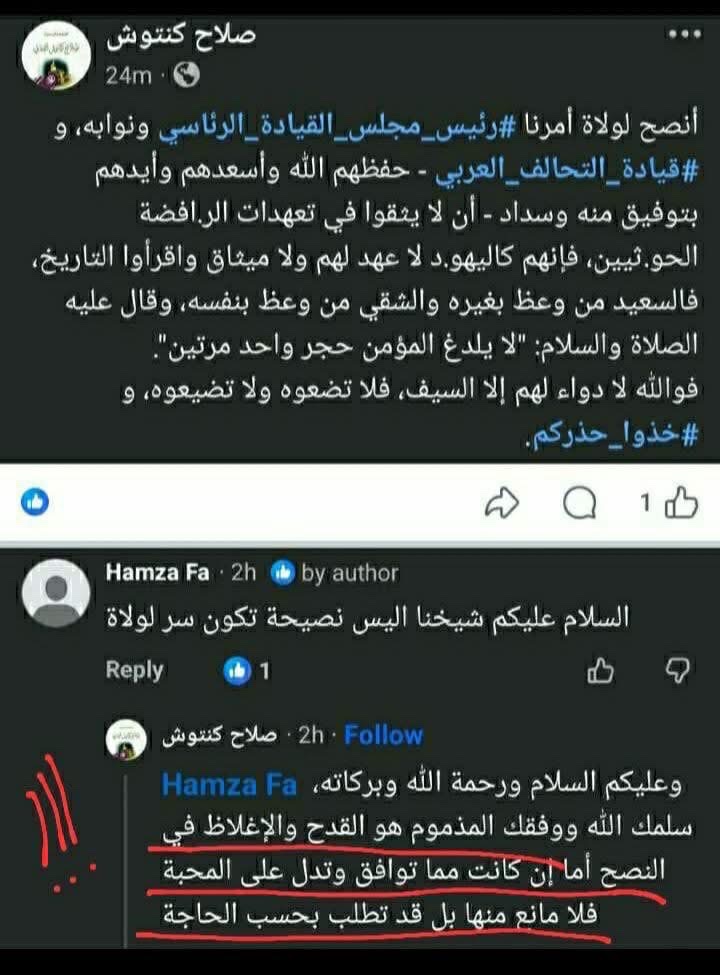
[Salah Kuntūsh's repentance on 'public advice' contains manipulation, malice, and cunning in the manner of partisan groups!!!]
Ṣalāḥ Kuntūsh said:
“I advise our rulers — the President of the Presidential Leadership Council and his deputies, and the leadership of the Arab Coalition — may Allah preserve them, make them happy, and support them with success and correctness — that they should not trust the promises of the Rāfiḍah Houthīs, for they are like the Jews: they have no covenant and no trustworthiness. Read history, for the fortunate one is he who takes admonition from others, and the miserable one is he who takes admonition from himself. And he ﷺ said: “The believer is not stung from the same hole twice.”
By Allah, there is no cure for them except the sword, so do not put it down and do not waste it, and take your precautions.”
Hamza Fa replied:
“Peace be upon you, our Shaykh. Is not advice to the rulers supposed to be given secretly?”
Ṣalāḥ Kuntūsh replied
“وعليكم السلام ورحمة الله وبركاته،
Hamza Fa,
May Allah keep you safe and grant you success. What is blameworthy is criticism and harshness in advice. As for that which is in agreement with and indicates love, then there is no harm in it; rather, it may even be required depending on the need.”
Ahmed bin Atef Al-Rwashdeh / Jordan / Jerash / Al-Katah : Date: 9/Dhul Qa'dah/1447 AH
"That the advice in which I urge the rulers to be wary of the Rafidah's pledges and their cunning is a 'path of the Khawarij'."
You said, O Kuntūsh, in your repentance: "So people understood from it that I am proceeding upon the way of the Khawarij"!
We want your understanding, not that you backtrack and repent from what you call: "people's understanding". This is an obvious evasion!
The bitter question is: Did you retract because you are legally convinced that your action was the "path of the Khawarij", or did you retract "politically" to absorb the "noise" and make this "people's understanding" rather than your own understanding, after the "clear" Salafis explained the danger of this path?
Linking the error to "people's understanding" is an implicit exoneration of oneself from the error. So what is the thing that Salah Kuntūsh repented from?
If he repented from "people's understanding of his understanding", he did not attribute it to the invalidity of his own understanding, even though this is the understanding of the Salaf, and it is a path not known to the truthful in repentance!
And where is the repentance, O Kuntūsh, from the corrupt "principle of love and affection"?
Because this is another corrupt foundation besides the public advice itself.
You established that public advice is permissible if wrapped in affection. This is a partisan, Qutbi foundation that demolishes the principle of "secrecy of advice". So have you retracted from this specific foundation?
Your retraction from the first "post" while retaining the "corrupt principle" in the other post, where you detailed that advice is divided into two halves, means that you still consider public advice "wrapped in affection" permissible, and that you only retracted from "people's understanding" of your first post. This is manipulation of religion, not a return to truth!
The requirement of repentance according to the Salaf is "clarification", not "mumbling"!
Sheikh Rabee' constantly states: "Whoever corrupts a principle must rectify that very principle."
And you have not shown us the invalidity of your novel division of public advice into "a part for affection and a part for harshness"!
So why have you not declared the invalidity of this division and made clear that public advice is condemnable in all its forms?
For your retraction remains a "taqiyyah retraction" to salvage whatever can be salvaged of your crumbling status!
Continue the retraction and its clarification by saying:
"I had written a post that contained public advice to the rulers, then I fell into another false principle by making public advice into 'two halves': 'advice with harshness' and 'advice with affection'! Public advice is a false path that contradicts the fundamentals of Ahl al-Sunnah wal-Jama'ah. I further clarify by saying: I erred and transgressed when I established that public advice is permissible if it is with 'affection and love'. The truth by which I profess to Allah is that public advice to the ruler is a condemnable innovation and a path among the paths of the Khawarij al-Qa'diyyah, whether wrapped in affection or severity. Publicity is never legislated. I repent to Allah from this corrupt principle and from that contradictory advice."
We demand from Salah Kuntūsh a clear statement without mumbling:
Do you acknowledge that your principle of "permissibility of publicity if with love" is an innovated principle contradicting the consensus of the Salaf?
And is your retraction a repentance from the creed of the Khawarij al-Qa'diyyah, or is it merely an "apology to the people" because they "misunderstood you"?
For Salafism is clarity, without the wily evasion of foxes. Truth is not excused by affection, and falsehood is falsehood even if covered in the garments of love.
Brother Ahmed bin Atef
facebook.com/10000415275628…
English
Shaykh Fawaz bin Ali Al-Madkhali said:
What consideration do you give to interests and corruptions in your endorsement of Hisham Al-Bayli and your desperate defense of him?
What benefit is there in your bad words about Imam Al-Rabee', Imam Al-Albani, and the Egyptian scholars – and I specifically mean those who warned against Hisham Al-Bayli: Sheikh Al-Allamah Hassan Al-Banna and Al-Allamah Ali Al-Waseefi, may Allah have mercy on them?
What benefit is there in your disparagement of Sheikh Abu Iyad without any reason – rather, you slandered him unjustly?
What benefit is there in your war against Sheikh Ali Al-Hudhaifi and his call, because he adhered to the Salafi methodology in dealing with the rulers in Yemen, unlike you and the Aden gang who served separatist party agendas, rebellion against Yemeni legitimacy, and the Arab coalition?
What benefit is there in your attempt to discredit Sheikh Nizar Hashim because of his criticism of Abdullah Al-Bukhari's stance on the war in Sudan and its rulers?
What benefit is there in your lying about our Sheikh Imam Rabee' Al-Madkhali, may Allah have mercy on him?
What benefit is there in your attempt to undermine the prestige of a group of contemporary scholars in closed sessions?
You are the one ignorant of the Salafi methodology, the pretentious and truly empty one – the bearer of the banner of disparaging the Sunni scholars of this era – and the defender of some of the Haddadiyyah who attack them. Rather, your approach towards some contemporary scholars is precisely that of the Haddadiyyah.
You are the one who instigates discord; you have dragged the call into discord.
No heed is given to you nor to your likes among the enraged infiltrators.
(Shaykh) Fawaz bin Ali Al-Madkhali
Monday, 10 Dhul Qa'dah 1447
April 27, 2026
facebook.com/10000415275628…
English
Shaykh Fawwāz bin ʿAlī al-Madkhalī said:
In a clear attempt to debase Shaykh Abū ʿIyāḍ and al-Maktabah al-Salafiyyah (Salafi Publications) in Britain, it became necessary for them to justify ʿArafāt’s oppression against Abū ʿIyāḍ and his declaring him an innovator without any rightful basis. Therefore, his fanatical followers in various countries were set loose to spread as many lies, fabrications, and deceptions as possible about Shaykh Abū ʿIyāḍ.
This method was also used repeatedly by ʿArafāt al-Muḥammadī against Shaykh ʿAlī al-Ḥudhayfī, Shaykh Nizār Hāshim, and others.
ʿArafāt is a man of fitnah, fallen in the eyes of the Salafis, and whoever shows partisanship and fanaticism for him joins him—and there is no honor in that.
Ever since his feet stepped into al-Madīnah al-Nabawiyyah, the daʿwah has been set ablaze with trials and tribulations, and division and deviation have occurred.
(Shaykh) Fawwāz bin ʿAlī al-Madkhalī
Sunday
9 Dhū al-Qaʿdah 1447
26 April 2026

Català
[The Clear Statement in Explaining the Situation of ʿArafāt al-Muḥammadī]
Episode Ten
[Reflections on the Positions of the Intruder ʿArafāt al-Muḥammadī: Between Defending Hishām al-Baylī and Attacking al-Rabīʿ, al-Albānī, Ḥasan al-Bannā, and ʿAlī al-Waṣifī – may Allah have mercy on them – and Stirring Controversy in Secret Among His Followers Regarding the Positions of Ahl al-Sunnah]
Shaykh Fawwāz bin ʿAlī al-Madkhalī said:
My brother, Muhannad Badawī ʿAtīq al-Sūdānī, informed me that he attended a gathering of the so-called ʿArafāt al-Muḥammadī on August 5, 2025 – eight months ago – where ʿArafāt al-Muḥammadī defended Hishām al-Baylī desperately and said: "I do not commend him, but there are people who do not spread knowledge and only appear during times of tribulation; they fear that al-Baylī will draw the masses away from them."
Among what he said: "Hishām al-Baylī is allowed to criticize al-Albānī, and he is excused, because some have 'scratched' (defamed) al-Baylī, so al-Baylī scratches them back like cats."
He also said: "Search for any error, and you will not find anything against Hishām al-Baylī; he is on the same path as us.” ʿArafāt lays the groundwork for falsehood in ways more malicious than those of al-Ḥalabī.
And he said: "Anyone who scratches (defames) al-Baylī, al-Baylī has the right to scratch him back, even if it is Sheikh Ḥasan al-Bannā."
Also: "Samīr al-Qāhirī blames me because I defend al-Baylī, and al-Baylī attacks Sheikh Ḥasan. So I invited Samīr to my house and said to him: ‘What is your opinion of Sheikh Ḥasan al-Bannā?’ Samīr said: ‘Yes, he has some negligence.’"
Based on the above: By this conduct, ʿArafāt al-Muḥammadī has beautified falsehood and defended its people, and even laid a foundation for it with expressions whose reality is deviation from the methodology of the righteous predecessors.
What ʿArafāt has asserted and what has been reported from him – desperate defense of Hishām al-Baylī – despite al-Baylī being known for his attacks on scholars of Ahl al-Sunnah who are a test for people in this era, foremost among them Imām al-Albānī, the illustrious scholar Ḥasan al-Bannā, and the illustrious scholar ʿAlī al-Waṣifī (may Allah have mercy on them) – and even accusing al-Albānī of agreeing with the Murji’ah – this is one of the greatest slanders and ugliest injustices. For al-Albānī (may Allah have mercy on him) is one of the great revivers of this era, and both near and far have testified to his service and support of the Sunnah.
So how can someone who attacks the imams of the Sunnah be excused? How can that be considered mere "mutual scratching"? This debased logic from this infiltrator ʿArafāt opens the door to chaos, strips away the reverence due to knowledge and its people, and turns the arena into a playground for insults and retaliation, not for knowledge and clarification.
ʿArafāt's statement – that whoever "scratches" al-Baylī should be scratched back, even if it is one of the great scholars – is a corrupt foundational principle that contradicts what Ahl al-Sunnah follow: honoring scholars, recognizing their status, and refuting errors with knowledge and justice, not with vindictiveness and whims.
Furthermore, his justification for attacking Imām al-Albānī is among the falsest of falsehoods.
As for his claim that there is no error on al-Baylī, that is among the most astonishing things, sheer obstinacy. For al-Baylī's attack on al-Albānī and his accusation of irjā’ is enough to expose his deviance, let alone what he has issued – accusing the people of authority in Egypt who removed former President Muḥammad Mursī from office of disobedience (khurūj), his call not to ask for mercy on the illustrious scholar Ḥasan al-Bannā and the illustrious scholar ʿAlī al-Waṣifī (may Allah have mercy on them), and he has been warned against by many scholars and virtuous people, and his matter has long been settled among Ahl al-Sunnah.
Moreover, this style of defense – based on belittling grave errors, attacking those who give sincere advice, and accusing them of envy or fear of losing followers – is the method of the people of whims, not the methodology of Ahl al-Sunnah who place truth above all men.
By Allah, O brothers, have you seen anyone more brazen than this so-called ʿArafāt al-Muḥammadī, who desperately defends a misguided innovator, one of the heads of the Ḥadādiyyah in Egypt?
Do you still have any doubt that he is an infiltrator against the Salafīs and their call?
Our eminent sheikhs have drawn their swords for more than three decades defending Imām al-Albānī and his creed, and their statements are well-known and circulated in books and audio recordings. Then this infiltrator comes in the Prophet’s City (Madīnah) to defend – with utmost brazenness – the one who attacked him.
The first to accuse Imām al-Albānī of irjā’ were the Khawārij of the Quṭbīs, such as Muḥammad Quṭb, followed by Safar al-Ḥawālī and the Ḥadādiyyah. And what ʿArafāt al-Muḥammadī has issued – defending this Egyptian Ḥadādī, Hishām al-Baylī, scrutinizing Sheikh al-Albānī’s jurisprudential and ḥadīth choices, and the attacks that have been transmitted by testimonies of Ahl al-Sunnah and previously published on my page – leaves no room for doubt that the man holds no regard for the great scholars; rather, he seeks to undermine their reverence in people's hearts to elevate himself.
Likewise, his belittling of those who criticize and warn against Hishām al-Baylī – and he undoubtedly means the illustrious scholar Ḥasan al-Bannā and the illustrious scholar ʿAlī al-Waṣifī – and his disparagement of the status of Sheikh Ḥasan al-Bannā is another disaster added to the series of his catastrophes and scandals that will remain a stain of disgrace on his forehead.
Nor should we forget his attack on our Sheikh, Imām Rabīʿ al-Madkhalī (may Allah have mercy on him), his statement about him – that he has an excessive dose in his condemnation of the deviants – and his accusation of exaggeration in criticism and refutation, as reported by the virtuous brother, Sheikh Naṣr ibn Muḥammad al-Qaʿīṭī.
The man – based on the totality of the testimonies that have been reported, what he has issued of attacks on the scholars of Ahl al-Sunnah, and his suspicious movements concerning Yemen and the Transitional Council (al-Intiqālī) – leaves no room for doubt that he is a dangerous infiltrator who shows Ahl al-Sunnah something different from what he reveals in closed gatherings, and that he is the "bearer of the banner of undermining scholars and their reverence in this era," an extension of those before him among the people of innovation, such as al-Ḥalabī, al-Māribī, al-Maghrawī, the Alexandria Call (daʿwah) gang in Egypt, Muḥammad Ḥassān, al-Ḥuwaynī, ʿAbd al-Laṭīf al-Kurdī, Muḥammad al-Maʿbarī, and the Ḥajūriyyūn.
Sheikh Bilāl al-Sālimī (may Allah preserve him) described him well when he called him "the cunning fox."
And I ask you, O Samīr al-Qāhirī: Is this how you show loyalty to your Sheikh Ḥasan al-Bannā – whom you have repeatedly praised, and to whom after Allah you owe a debt? Is this how you answered ʿArafāt al-Muḥammadī by saying that the Sheikh (al-Bannā) had some negligence in the context of speaking about Hishām al-Baylī, even though your Sheikh only warned against al-Baylī because of his attack on the creed of Imām al-Albānī?
And who is ʿArafāt to attempt to topple the reverence of firmly-grounded scholars and defend those who attack them?
O Salafīs, ʿArafāt al-Muḥammadī is adopting a plan to undermine all the efforts of the scholars of Ahl al-Sunnah in establishing the pillars and clarity of this call (daʿwah), and time only exposes him further. That is why the followers of his party have for more than five years been fighting against the advice of our Sheikh, Imām Rabīʿ al-Madkhalī (may Allah have mercy on him), which calls for clarity in methodology, positions, and the call!
What is even more astonishing is that the fanatics of ʿArafāt have drawn their swords against the truthful Ahl al-Sunnah in defense of ʿAbdullāh al-Bukhārī, despite the errors he fell into. Yet we have not seen any reaction from them against what has been reported about ʿArafāt – the lies about our Sheikh Imām Rabīʿ, the attacks on him and on the illustrious scholars Ḥasan al-Bannā, ʿAlī al-Wuṣayfī, and Imām al-Albānī, and his desperate defense of Hishām al-Baylī!!
To Allah we belong and to Him we return.
(Shaykh) Fawwāz bin ʿAlī al-Madkhalī
Friday
7 Dhū al-Qaʿdah 1447
April 24, 2026
t.me/fawaz_almdkhli…
Exposing Shaykhs Of Aden@KashfAden
[The Clear Statement on the Situation of Arafat Al-Muhammadi] Episode Seven Shaykh Fawaz bin Ali Al-Madkhali said: In recent times, it has been observed that Arafat Al-Muhammadi and his gang have taken the lead in talking about the necessity of "adhering to the respect of scholars" and "honoring them." However, those who reflect on the positions of these people will find a clear contradiction between the claim and the application. One of the most prominent examples of this is what came from Arafat Al-Muhammadi in his dealings with a great scholar and caller to Islam in this era—our sheikh, the noble Imam Rabee' bin Hadi Al-Madkhali, may Allah have mercy on him. It is known that Arafat Al-Muhammadi previously slandered Sheikh Rabee', then later retracted that and apologized, and the sheikh—may Allah have mercy on him—forgave him. However, the problem lies in the fact that this retraction was not the end of the matter; rather, it was followed by a continuation of harshly critical statements unbefitting the status of scholars, as it has been reported that he accuses the sheikh of "sometimes exaggerating in refuting the one who disagrees, and denouncing things that should not be denounced." This statement contains within it an aspersion against the methodology of a scholar known for defending the Sunnah and warning against innovation for decades, and for protecting the call to Islam from foreign elements. Sheikh Rabee'—by the testimony of many scholars—is among the most prominent of those who stood against deviant movements, and his refutations were based on scholarly foundation and transmission from the pious predecessors. Even if his words are sometimes harsh, they are in the context of defending the religion—an approach well-known among Ahl al-Sunnah throughout the ages. It is not particular to our sheikh the Imam; rather, our sheikh is less harsh in his criticism of the leaders of innovation compared to many of the imams of the Salaf and scholars of the 4th and 5th Islamic centuries. Furthermore, whoever reflects on Arafat Al-Muhammadi's manner of addressing those who are older than him and more established in calling to Islam will notice a certain coldness and ill manners—something inconsistent with the claim of glorifying and respecting scholars. The false slanders issued by this person against the two sheikhs Nizar Hashim and Ali Al-Hudhaifi, his lies about our sheikh Imam Rabee' bin Hadi Al-Madkhali (may Allah have mercy on him), and his endorsement of Hisham Al-Bayli—who slanders the two great scholars Muhammad Nasir Al-Din Al-Albani and Hassan Al-Banna (may Allah have mercy on them)—are nothing but evidence that he holds scholars in no regard. What is even more astonishing is that after all these disgraceful acts, he wants to give us lessons in ethics, even though our criticisms of him and others are based on clear evidence that he avoids addressing. So, O you who blindly follow him, does it please you that he slanders your sheikh, the esteemed scholar Rabee' Al-Madkhali? If you say, "We are not pleased by this action of his!" We say to you: Then why do you blindly follow him, remain silent about his disgraceful acts and sinful slanders—rather, why do you even defend him?!! (Shaykh) Fawaz bin Ali Al-Madkhali Thursday 21 Shawwal 1447 April 9, 2026 t.me/fawaz_almdkhli…
Română
[Uncovering the ambiguities regarding the article: ‘Calamities concerning the reality of ʿArafāt’”
And in it is the fourth calamity, which is the distortion and alteration of the fatwā of Shaykh Rabīʿ (may Allah preserve him).]
In the name of Allah, the Most Gracious, the Most Merciful.
"Clarifying the Obscurities in the Message of the Catastrophes." Praise be to Allah. I bear witness that there is no god but Allah alone, with no partner. I bear witness that Muhammad is His servant and Messenger—may Allah bless him, his family, his companions, and grant them peace. To proceed: Allah Almighty said: "Do not mix truth with falsehood nor conceal the truth while you know." And He Almighty said: "O People of the Scripture, why do you mix truth with falsehood and conceal the truth while you know?" Ibn Abbas (may Allah be pleased with them both) said regarding these verses: "Do not mix truth with falsehood, nor honesty with lying."
This being said, by Allah’s praise and success, I have issued a message that I included in two audio recordings. The first audio, titled "We Patch Our Worldly Life by Tearing Our Religion," mentioned ten instances of how some who are called 'Shaykh of Aden' lean toward the party of Hānī bin Buraik, and how some of them manipulated a question to Sheikh Rabīʿ to produce a fatwa that suited their desires. I also mentioned the fatwa of our Sheikh Rabīʿ—which refutes their contradictory conduct—in employing the Salafi call for the benefit of Hānī bin Buraik’s party. Dr. ʿArafāt al-Muḥammadi (may Allah guide him) became furious and angry at this audio because he shares with them many of those instances of leaning toward this party. So he attacked me and denied what I had reported about him. I responded to him, with Allah’s help and grace, with another audio that complements the first, which I named "The Catastrophes Regarding the Reality of ʿArafāt." By it, Allah exposed some of the grave enormities and outrages that undermine trustworthiness and impugn justice. By my Lord, I made my audio well-ordered and refined, avoiding misrepresentation and confusion, and sought to be just, truthful, and fair. I mentioned the testimony of two virtuous sheikhs—ʿAlī al-Hudhayfī and Sāmiḥ al-ʿAdanī—about ʿArafāt concealing Hānī’s name from our Sheikh Rabīʿ so that a fatwa supporting Hānī bin Buraik’s party would be issued. That silenced ʿArafāt and left him speechless.
Among what I mentioned about ʿArafāt al-Muḥammadi (may Allah guide him) was that at the end of Shaʿbān in the year 1440 AH, ʿArafāt al-Muḥammadī and those with him entered upon Sheikh Rabīʿ to ask about the ruling on dealing with Hānī. They handed him a paper about that, and Sheikh Rabīʿ read it himself. When he finished reading, he said: "Nothing new, do not deal with Hānī." Then some in the gathering tried to change the Sheikh’s fatwa by mentioning some of Hānī’s good qualities and some matters that supposedly required dealing through Hānī. But the Sheikh’s answer (may Allah preserve him) was an absolute and decisive prohibition. Then they left Sheikh Rabīʿ’s room, and one of them said: "There is no need to spread this fatwa." This is my statement verbatim. Then I said: Sheikh Ḥafīẓ al-Junaydī related this incident to some of our brothers. Then Sheikh Ḥafīẓ al-Junaydī (may Allah forgive us and him) tried, through obfuscation and misrepresentation, to show ʿArafāt’s innocence and downplay the matter of concealment. Far, far from it—truth is clear and falsehood is but a murmur.
For this reason, I sought help from Allah Almighty and wrote this message to affirm my second audio, naming it "Clarifying the Obscurities in the Audio ‘The Catastrophes.’" I say, seeking Allah’s help—and my success is only from Allah, upon Him I rely and to Him I turn.
Clarifying the First Obscurity: My statement: "Sheikh Ḥafīẓ al-Junaydī related it to some of our brothers." Sheikh Ḥafīẓ commented: "It was not for Amīn to base his speech on reports." I say: Where are the reports he claims? These brothers are well known to Sheikh Ḥafīẓ (may Allah forgive him). They are four virtuous and well‑known Salafīs. Here is the text of their testimony written to me after reading your article in which you objected—to embellish Dr. ʿArafāt and whitewash him after the scandal he brought upon himself. In their testimony they said: "Praise be to Allah, and blessings and peace be upon the Messenger of Allah. Regarding what our brother Amīn Mushabbiḥ has reported from Sheikh Ḥafīẓ al-Junaydī in his audio ‘The Catastrophes Regarding the Reality of ʿArafāt,’ we bear witness to it, and we heard it from Sheikh Ḥafīẓ. Allah is Witness to what we say."
I remind you, my brother Ḥafīẓ (may Allah guide you), of the place of the gathering and what transpired between you and them. Perhaps you forgot or overlooked it. First, this occurred on a Saturday night after the ʿIshā’ prayer, after the Eid al-Aḍḥā, at the Mosque of the Companions in this year of ours. Second, you said to them in that gathering that Munīr al-Saʿdī, after leaving Sheikh Rabīʿ’s gathering, said to you the same fatwa: "First, there is no need to spread it." Third, you told them that after you returned from the land of the Two Sanctuaries and arrived in beloved Yemen, Munīr called you—after one of those who had attended the session with you at Sheikh Rabīʿ’s had revealed what took place in the Sheikh’s session—and Munīr objected, saying: "Didn’t we agree not to spread this fatwa?" And you, my brother Ḥafīẓ, said something else. So remember, my brother, may Allah guide you.
Clarifying the Second Obscurity: In my audio "The Catastrophes" I said: "We have been informed about you, ʿArafāt, that you are the one who said: ‘There is no need to spread this fatwa.’ So, are you the one who said it, or what?" I say: This question that I directed to Dr. ʿArafāt was not based on nothing; I based it on something I have—namely, what my brother Ḥafīẓ was told by some of those four witnesses in that gathering: that one of those present with you at the session with Sheikh Rabīʿ says that ʿArafāt al-Muḥammadi is the one who said: "There is no need to spread this fatwa." I told them: "I am the one whom Munīr al-Saʿdi informed. And if someone else testifies against ʿArafāt, let him come forward with his testimony." I say: This is the reason I directed a question to ʿArafāt al-Muḥammadi in the audio "The Catastrophes." I said: "We have been informed about you, ʿArafāt, that you are the one who said: ‘There is no need to spread this fatwa.’ So, are you the one who said it, or what?" Then why did you attack me, my brother Ḥafīẓ, when you were aware of this? You said: "It was not for him to base his speech on reports," while you knew about the witness’s testimony—the brothers informing about that gathering. May Allah guide you.
Clarifying the Third Obscurity: In my audio "The Catastrophes" I said: "Munīr al-Saʿdi said: ‘We agreed not to spread the fatwa.’" I say: As for your statement, my brother Ḥafīẓ (may Allah forgive us and you): "I never witnessed this about Sheikh ʿArafāt, nor to my knowledge did it happen"—I say this is strange and astonishing. My report came from Munīr, and I did not hear the exact words from ʿArafāt al-Muḥammadī that he was the speaker. Rather, I mentioned that it is included implicitly in the agreement, and that reports have come that he is the leader and the one ordering concealment. Here is an explanation that suffices and satisfies.
First, the fingers of accusation point to ʿArafāt. Among the four of you, one spread Sheikh Rabīʿ’s fatwa after returning to Yemen and did not join you in the agreement—and he is the best and most virtuous of you. The second said that ʿArafāt al-Muḥammadī is the one who said: "There is no need to spread this fatwa." And you testified that it was Munīr who said it. Sheikh ʿAlī al-Hudhayfi asked you: "Is it ʿArafāt?" and you evaded answering. So is my statement attributing testimony to you, O Ḥafīẓ, about ʿArafāt, such that you deny it? Or did you merely want to clear ʿArafāt by any means, even through chicanery, obfuscation, and mixing of words? Fear Allah and be mindful of Him. For ʿArafāt al-Muḥammadī is indeed involved in this concealment, even if he was not the one who ordered it.
Second, the witnesses testified before me and others that Munīr al-Saʿdī said: "We agreed not to spread the fatwa." And it is known that ʿArafāt himself raised the paper to Sheikh Rabīʿ containing the question about dealing with Hānī bin Barīk. You yourself confirmed this by saying: "Sheikh ʿArafāt was only a transmitter of the question to Sheikh Rabīʿ (may Allah preserve him)." So ʿArafāt is one of those who agreed to conceal it, without any doubt or question, because Munīr said "we agreed"—using the plural form.
Third, I directed the question in the audio to Dr. ʿArafāt: "We have been informed about you, ʿArafāt, that you are the one who said: ‘There is no need to spread this fatwa.’ So, are you the one who said it, or what?" Then why did you insert yourself, O Ḥafīẓ, and answer on behalf of ʿArafāt? Is he mute and cannot speak, or tongue-tied and cannot articulate, or weak and sought your help, or what? Why did you not leave room for ʿArafāt al-Muḥammadī to answer my question himself? I kept repeating the question again and again, saying: "We have been informed about you, ʿArafāt, that you are the one who said: ‘There is no need to spread this fatwa.’ So, are you the one who said it, or what?" Is there any answer to this?
Fourth, it has become evident from ʿArafāt al-Muḥammadī’s behavior that he writes about matters concerning Hānī bin Buriak, especially regarding Sheikh Rabīʿ. Among that is the past testimony of the two sheikhs, ʿAlī al-Ḥudhayfī and Sāmiḥ al-ʿAdanī. There are many instances showing his leaning toward Hānī’s party, too many to mention now. Even if all he did was to convey the fatwa on fighting from the City of the Messenger of Allah (peace be upon him) to the leaders of Hānī’s party in Riyadh—so we are neither surprised nor do we find it unlikely that it is ʿArafāt. And Allah knows your secrets and your private counsels.
A Note: Sheikh Ḥafīẓ (may Allah guide him) wanted to exonerate ʿArafāt from the issue of concealment by any means. Among what he said: "It was a private question from Sheikh ʿAlī al-Ḥudhayfī to Sheikh Rabīʿ, and not meant for publication at that time, to his knowledge." And Ḥafīẓ said: "Sheikh ʿArafāt was only a transmitter of the question to Sheikh Rabīʿ (may Allah preserve him). Sheikh ʿArafāt conveyed to Sheikh ʿAlī the Sheikh’s answer, and praise be to Allah, he did not conceal it at all." I say: Sheikh ʿAlī al-Ḥudhayfī (may Allah preserve him) issued an audio recording in which he denied what was attributed to him. Thus, by Allah’s praise, the truth of what we said about ʿArafāt has become clear. All credit is to Allah alone.
Clarifying the Fourth Obscurity: In my audio "The Catastrophes," I mentioned their session with Sheikh Rabīʿ regarding the fatwa that was concealed, and I summarised parts of it. Here is the clarification.
My statement in "The Catastrophes": "Then some of those in the gathering tried to change the Sheikh’s fatwa by mentioning some of Hānī’s good qualities and some matters that required dealing through Hānī." First, the one who tried to change the Sheikh’s fatwa was Munīr al-Saʿdi. I do not know why he did that, nor why he made that attempt. O Allah, (we seek) Your gentleness and forgiveness. Second, my statement: "by mentioning some of Hānī’s good qualities"—Munīr al-Saʿdi (may Allah guide him) started enumerating Hānī’s good qualities, among them saying: "Hānī made mosques available to the Salafīs." And he said: "After the killing of Sheikh Yāsīn, Hānī gave each of the sheikhs four chairs," and he mentioned other things. Then the Sheikh repeated his fatwa, affirming that he does not deal with Hānī at all. Then Munīr kept on with the Sheikh until Sheikh Rabīʿ became angry and said: "Hānī has turned his back on Salafism. Hānī—or the socialists? Hānī has turned away from the Sunnah." Then Sheikh Rabīʿ said angrily in this session: "Ask others. Ask al-Fawzān. Clarify the man’s situation." This is the summary of the session and the summary of what was obscure in it.
Conclusion: I conclude with a fourth catastrophe added to the previous three in the audio "The Catastrophes Regarding the Reality of ʿArafāt": that Munīr al-Saʿdi said—about Sheikh Rabīʿ’s fatwa that they concealed—to some of our brothers: "Sheikh Rabīʿ wants us to deal with Hānī, but he does not want the fatwa to come from him because Hānī is counted as one of his followers. Rather, he wants it to come from someone else. That is why Sheikh Rabīʿ told us: ‘Ask others.’" I say: Glory be to Allah! How he cut the entire incident, concealed it, then altered and changed it! O Allah, what a wonder! And I ask: Did Dr. ʿArafāt al-Muḥammadi share with Munīr al-Saʿdi in distorting and changing the fatwa, just as he shared in concealing it? I say to every Salafī who is protective of the Salafi call: your brother Amīn Mushabbiḥ has not violated the Salafi methodology in exposing errors. For these people—their errors have become grave and their missteps heinous, to the point that they have resorted to manipulating the fatwas of the imam of jarḥ and taʿdīl (criticism and praise), concealing them and then altering them. Should one remain silent about such people? Allah is the One Who grants success and guides to the path of righteousness. May Allah make it good, and He is the best Disposer of affairs. And praise be to Allah, Lord of the worlds. Written by your brother, Amīn Mushabbiḥ.
k.top4top.io/m_37646iplr1.m…
Exposing Shaykhs Of Aden@KashfAden
[Calamities concerning the reality of ʿArafāt] In the name of Allah, the Most Gracious, the Most Merciful. This is an article titled "The Catastrophes in the Reality of ‘Arafāt." Praise be to Allah. I bear witness that there is no god but Allah, alone with no partner. I bear witness that Muhammad is His servant and Messenger—may Allah’s prayers, peace, and blessings be upon him, his family, and his companions. To proceed: Allah Almighty said: "If they had been true to Allah, it would have been better for them." And the Messenger of Allah (peace and blessings be upon him) said: "Truthfulness leads to righteousness, and righteousness leads to Paradise. A person tells the truth until he is recorded with Allah as a truthful person. Lying leads to wickedness, and wickedness leads to Hellfire. A person lies until he is recorded as a liar." How beautiful is the saying of the early poet: "Lying is a disease, truthfulness is the cure." Now then, Sheikh ‘Arafāt al-Muḥammad (may Allah guide him) has issued a flimsy article in which he accused me of lying and published it. From his article, his hostility and rancor toward me became apparent, to the point that he burdened my words with what they cannot bear, describing me as "untrustworthy." So I sought Allah’s help to repel his falsehood, transgression, lies, injustice, and slander, so that those who see it may know the man’s scheming against the Salafi da‘wah, his deceit, and his lies. Then, to establish my innocence and the innocence of those who were falsely accused before me—namely, the two virtuous sheikhs, ‘Alī al-Ḥudhayfī and Sāmiḥ al-‘Adanī—regarding their testimony about what happened when the fatwa of fighting in Abyan and Aden was extracted from the eminent scholar, Rabī‘ as-Sunnah. [That testimony is] that ‘Arafāt said: "Do not mention Hānī, because Sheikh Rabī‘ gets angry. Do not mention Hānī, because Sheikh Rabī‘ gets angry." My discussion with him covers three catastrophes: · First Catastrophe: The reason he labeled the "reporter" as spreading lies and untrustworthiness. · Second Catastrophe: Affirmation of the two sheikhs’ statement about ‘Arafāt concealing from Sheikh Rabī‘ al-Madkhalī the mention of Hānī bin Barīk. · Third Catastrophe: Concealment of Sheikh Rabī‘’s fatwa prohibiting dealings with Hānī. Here is the detailed account of these catastrophes to know the reality of ‘Arafāt. I say, and by Allah I seek strength and refuge. First Catastrophe: The reason he labeled the "reporter" as spreading lies and untrustworthiness. His comment on my publishing what reached me from Sheikh ‘Abdullāh al-Bukhārī (may Allah preserve him)—my saying: "Yes, it reached me that the Sheikh said: 'Yes, it reached me that those mentioned in the audio 'We Patch Our Worldly Life by Tearing Our Religion' should clear themselves.'" Then ‘Arafāt al-Muḥammad said critically: "Publishing this report and Amīn’s saying 'It reached me' does not absolve him from spreading lies, at the very least. This shows that Amīn is untrustworthy." I say: This is strange and astonishing to reasonable people and to those who have mastered the science of hadith terminology. It is refutable from several angles: First angle: The chapter of "reports" (balāghāt) is well-known among hadith scholars. Indeed, it was employed by great imams. Among these are the balāghāt of Imām Mālik in the Muwaṭṭa’. They are of the type "suspended" (mu‘allaq) – one cannot assert their certainty; rather, weakness is the default due to the broken chain until connected by a reliable chain. Many of Mālik’s balāghāt have been found connected via weak or very weak chains, although many are authentic. Likewise, I do not think it escapes you—the balāghāt of Imām az-Zuhrī and other hadith scholars—all recorded in the depths of hadith and terminology books sufficiently. Second angle: It is known that balāghāt may be mentioned due to difficulty reaching the chain. What if you knew, my brother ‘Arafāt (may Allah guide you), that this report reached us in meaning through the committee of "as-Salḥ" that the sheikhs of Aden approved, and that Sheikh ‘Abdullāh al-Bukhārī (may Allah preserve him) approved? Rather, our virtuous brother, the mujāhid ‘Abd ar-Raḥmān al-Lahadī—the owner of the "as-Salḥ" audio—said that Sheikh ‘Abdullāh al-Bukhārī asked about me, saying: "Who is this? Ayman or Amīn?" He did not know my name. Had you asked Sheikh Zakarīyā bin Shu‘ayb al-‘Adanī, he would have informed you, because some brothers mentioned it to him, so he knows them. Would you then say that these people spread lies and are not absolved, even at the very least, and that they are untrustworthy like Amīn Mushabbaḥ? Third angle: What al-Bukhārī mentioned regarding the ḥadīth of ‘Ā’ishah about the beginning of revelation, where az-Zuhrī (may Allah have mercy on him) added: "…until the Prophet (peace be upon him) grieved, as has reached us, a grief that made him repeatedly climb to the tops of high mountains to throw himself down. Whenever he stood at a mountain peak to throw himself, Jibrīl would appear and say: 'O Muḥammad, you are indeed the Messenger of Allah,' so his heart would be at ease and he would return. When the interval of revelation became long, he would do the same again." Al-Albānī (may Allah have mercy on him) commented on this report narrated by az-Zuhrī as a balāghah, after discussing its chain: "Once you know the lack of authenticity of this addition, then we can rightly say it is a rejected addition (munkar) in meaning, because it is unbefitting for the infallible Prophet (peace be upon him) to attempt suicide by throwing himself from a mountain, regardless of the motive. He is the one who said (peace be upon him): 'Whoever throws himself from a mountain and kills himself, he will be in the Fire of Hell, throwing himself therein eternally, forever.' (Agreed upon by al-Bukhārī and Muslim)." And see the treatise "Defense of the Prophetic Hadith" by Imām al-Albānī (may Allah have mercy on him). So look, my brother ‘Arafāt (may Allah guide you), at al-Albānī’s statement that it is a rejected addition, yet he did not say about az-Zuhrī that he "spreads lies, at the very least." And so on. We do not know of any scholar who attributed to Mālik spreading lies because of his balāghāt, some of which contain unknown ḥadīths, as mentioned by Ibn ‘Abd al-Barr. It is known that balāghāt did not diminish their status and rank, let alone describe them as spreading lies. So why did you vilify and attack Amīn Mushabbaḥ, saying he spreads lies and that Amīn is untrustworthy, when he simply reported what reached him like others, and he reported from Sheikh al-Bukhārī—not from the Messenger of Allah (peace be upon him) as Imām Mālik and az-Zuhrī did? Or is it, O ‘Arafāt, that rage and anger [motivate you] because of the scandal you were exposed to and the catastrophe that struck you and your companions in the article "We Patch Our Worldly Life by Tearing Our Religion," wherein you share many if not all of their tendencies? And know that "We Patch Our Worldly Life by Tearing Our Religion" has a second installment containing ten criticisms, most of which concern you, but I withheld it out of respect for the efforts of my virtuous brothers. Now, however, I must clarify some of it as sincere advice to Salafis and to refute the accusation of lying against me. Second Catastrophe: Affirmation of the two sheikhs’ statement about ‘Arafāt concealing from Sheikh Rabī‘ as-Sunnah the mention of Hānī bin Bureik. I said in the audio "We Patch Our Worldly Life by Tearing Our Religion": "‘Arafāt said: 'Do not mention the Transitional Council in front of Sheikh Rabī‘, because he gets angry at their mention'—or words to that effect." This is the text of my statement. I say: ‘Arafāt al-Muḥammad commented on this: "He has lied about me in his audio, and I do not know that he has repented from his lie." I say in clarification: The two sheikhs—‘Alī al-Ḥudhayfī and Sāmiḥ al-‘Adanī—testified to this. Sheikh al-Ḥudhayfī said in his testimony: "Ṣalāḥ Kantūsh told me in my house that before entering upon Sheikh Rabī‘, Dr. ‘Arafāt al-Muḥammad told them: 'Do not mention Hānī bin Bureik. Do not mention Hānī bin Bureik to Sheikh Rabī‘.'" And Sheikh Sāmiḥ said in his testimony after solemn oath: "Dr. ‘Arafāt told us: 'Do not mention Hānī in front of Sheikh Rabī‘, because he gets angry.'" So I say in response to this distortion: First, is it not known that Hānī and the Transitional Council are two sides of the same coin? So there is no difference between concealing the mention of Hānī or the Transitional Council, especially since Sheikh Rabī‘ does not approve of them and speaks harshly about both. Second, if you, O ‘Arafāt, were fair, just, and complying with Allah’s command "If you speak, then be just," you would have considered my phrase "or words to that effect" and taken it as a mistake (wahm), not as a lie, and you would not have accused me of lying. So I now correct my transmission. I say according to what the two sheikhs said: You indeed said, O ‘Arafāt: "Do not mention Hānī bin Barīk to Sheikh Rabī‘ al-Madkhalī, because he gets angry." I also say that among the indications pointing to your lie in denying what is proven against you is the weakness and obvious feebleness in your response to Sheikh Sāmiḥ—you did not dare to accuse him of lying. Regarding my mistake of substituting "Transitional Council" for "Hānī," you said: "He has lied about me in his audio, and I do not know that he has repented from his lie." Reasonable and fair-minded people who know these two sheikhs can distinguish. I ask every fair-minded person: Is it conceivable that these two sheikhs—‘Alī al-Ḥudhayfī and Sāmiḥ—would agree upon a lie, such that Sāmiḥ would tell al-Ḥudhayfī, "Lie to Ṣalāḥ, and I will lie about ‘Arafāt," or that al-Ḥudhayfī would say that to Sāmiḥ? Or is it, O ‘Arafāt, that you accuse others of your own defect, and then slip away? Third Catastrophe: Concealment of Sheikh Rabī‘’s fatwa prohibiting dealings with Hānī. I say, and with Allah is success: The greatest of calamities, the disaster of disasters, the catastrophe of catastrophes occurred at the end of Sha‘bān in the year 1440 AH. ‘Arafāt al-Muḥammadī and those with him entered upon Sheikh Rabī‘ to ask about the ruling on dealing with Hānī. They handed him a paper about it, and Sheikh Rabī‘ read it himself. When he finished reading, he said: "Nothing new—do not deal with Hānī." Then some in the gathering tried to change the Sheikh’s fatwa by mentioning some of Hānī’s good qualities and some matters that supposedly required dealing with Hānī. The Sheikh’s answer (may Allah preserve him) was an absolute and decisive prohibition. Then they left Sheikh Rabī‘’s room, and one of them said: "There is no need to spread this fatwa." Sheikh ‘Abd ar-Raqīb al-‘Alābī narrated this incident to us in the mosque of ‘Umar bin al-Khaṭṭāb in front of a group of brothers. Sheikh Ḥafīẓ al-Junaydī also narrated it to some of our brothers, and he was among those present in the gathering with Sheikh Rabī‘ (may Allah preserve and care for him). I say: Among those present was ‘Arafāt al-Muḥammadī. He did not spread this fatwa. Witnesses testified that one of those present in that gathering—Munīr as-Sa‘dī—said: "We agreed not to disclose the words of Sheikh Rabī‘." So observe the dishonesty in not publishing the words of Sheikh Rabī‘ and their tampering with the words of this eminent scholar because it did not suit their desires. This matches what ‘Arafāt accused me of lying about and what he accused Sheikh Sāmiḥ al-‘Adanī of lying about—for that seems to be the habit of ‘Arafāt. It has been reported to us about you, O ‘Arafāt, that you are the one who said: "There is no need to spread this fatwa." So, are you the one who said it, or what? Conclusion: I say: Indeed, Allah knows your secrets and your private talks. Nothing is hidden from Him. He knows the liar from the truthful. So fear Allah and be with the truthful. Allah is sufficient for us, and He is the best Disposer of affairs. And praise be to Allah, Lord of the worlds. Written by your brother, Amīn Mushabbaḥ, in Muḥarram of the year 1440 after the Hijrah of the Prophet (peace be upon him). c.top4top.io/m_2058hjo2w1.m…
English
Exposing Shaykhs Of Aden@KashfAden
[We patch up our worldly life by tearing apart our religion] Shaykh Amīn Mishbaḥ al-ʿAdanī said: Praise be to Allah. I bear witness that there is no god but Allah alone, with no partner. And I bear witness that Muhammad is His slave and Messenger—may Allah bless him, his family, and his companions and grant them peace. To proceed: A period of time has passed while we are in confusion about what is happening in the circles of the Salafi call in Aden, and from what we see from some known figures referred to as the Shaykhs of Aden, such as Muneer al-Saadi, Salah Kantoush, Nasser al-Zaydi, and Abbas al-Jawnah—may Allah guide them—of a clear and apparent leaning towards the party of Ruwaybidah, Hani bin Bureik, the Transitional Council. This leaning of theirs is not hidden from those who have known the Salafi call from long ago, I mean from the beginning of the call of the reviving scholar, Imam Muqbil al-Wadi’i, may Allah have mercy on him. Indeed, some of our youth who are deceived by the leaning of these people towards this political party, due to their ignorance of the true nature of the Salafi call and their trust in them—their leaning appears in many forms. I will suffice with ten, no more. First: Their failure to describe the Transitional Council as just one party among parties. Second: Their failure to disassociate themselves from this political party, coupled with presenting doubts in its favor. Third: Their failure to denounce the violations of this party, not even a single mentioned violation; rather, they agree with much of what it does, as you will see shortly. Fourth: Their denunciation of those who denounced and exposed the flaws of this party and its true political nature, as occurred in their denunciation of the virtuous Shaykh Ali al-Hudhayfi in his well-known letter, "A Word of Truth about the Transitional Council." Fifth: Placing hopes on this party, wishing for its victory and ascendancy, and their statement that it is less evil than the corrupt, bankrupt party—the bankrupt Muslim Brotherhood party, from which they disassociated themselves long ago, and this disassociation is not a recent development—But this Disassociation doesn’t exist for the Transitional Council despite their knowledge that it is a party that has thrown itself into the arms of socialists and secularists, and even seeks normalization with the Jews, may Allah protect us. Look at the fatwa of Rabi' al-Sunnah for the people of Libya clarifying who is more evil and further from Islam between the secular parties and the bankrupt Muslim Brotherhood party, and you will find the truth of the matter and the reality of this evil, may Allah protect us. Sixth: Their writing of personal statements and signing of party forms bearing the logo of this party—the logo of communism—which clearly shows their affiliation and membership in this party. Moreover, they issue fatwas permitting signing these forms, so many Salafis were deceived and signed. Worse still, unfortunately, they denounced our Shaykh Ali al-Hudhayfi, may Allah preserve him, for not signing these party forms and for issuing a fatwa prohibiting such signing. Seventh: Their agreement with some of the party’s ideas, indeed with the very foundation upon which this party was established—the call for separation, the separation of South Yemen from the North. This was evident from the fatwa of Salah Kantoush, and even from the statement of Kantoush and Muneer al-Saadi to some of our brothers that they do not want unity even with the Shafi'is of the North, under the pretext that they are lax in fighting the Houthis. Eighth: Some of them maintaining contact with the deputy of this party, Hani bin Bureik, after the severe warning issued by the scholar Rabi', may Allah preserve him, and traveling for treatment to Egypt at his expense—as happened with Abbas al-Jawnah in the story of the money exchange, and with Nasser al-Zaydi in his travel to Egypt, until his humiliation and captivity became apparent before Ruwaybidah Hani in a video, his head bowed, shaken to the ground, unable to lift it, while this Ruwaybidah beside him spoke falsely and slanderously. Moreover, Sheikh Abdul Raouf Abbad has explicitly stated that he takes money from Hani for the Shaykhs as witnesses have testified. Ninth: Their concealment of mentioning the Transitional Council so that a fatwa would come out in line with their desires. Recently, there was an uproar from them over a fatwa they attribute to the scholar Rabi' al-Sunnah regarding the ongoing fighting in Abya between the Transitional Council and the army in Shuqrah, that fighting alongside this party is legitimate. On this basis, some who claim to follow the Sunnah went and fought with them, either with the blade and iron or with the tongue and statement, as is not hidden. The truth of this fatwa attributed to Imam Rabi' al-Sunnah is that they conspired and agreed not to mention that the fighting would be alongside the Transitional Council. The reason is that Sheikh Arafat, may Allah guide him, told them before going in: "Do not mention the Transitional Council (Hani Ibn Bureik) in front of Sheikh Rabi', for he becomes angry at their mention," or words to that effect. So they agreed, rejoicing, and asked Sheikh Rabi', and the answer came as they claimed—may Allah protect us from following desires. This suffices to show the falsity of attributing it to the Sheikh, may Allah preserve him. Tenth, and it is among the greatest, most heinous, and most ugly: Their concealment of Sheikh Rabi''s fatwa on the ruling of joining the Security Belt, as it is an old fatwa issued approximately a year and a half ago or more, known to these sheikhs—may Allah protect us. Its content: If the Security Belt is under the Transitional Council, then joining it is not permissible. Yet to this day, they are affiliated with the Security Belt in moral guidance, while knowing it—i.e., the fatwa—they draw monthly salaries, each of them having four guards who protect them, who also receive monthly salaries and allowances. Unfortunately, they concealed this fatwa which would expose them and reveal their flaws, so it never saw the light. By Allah, I only learned of it two days ago. Oh, the wonder and sorrow! Conclusion: I advise those mentioned earlier among the known Shaykhs of Aden to repent and seek forgiveness, for these great enormities and abominations are not committed by a religious person who knows the Sunnah, especially the Sunnah—covering up and concealing the fatwa of Sheikh Rabi' that contradicts your desires, for this is a trait from the traits of the Jews. Allah Almighty said: "And when Allah took a covenant from those who were given the Scripture, that they would make it clear to the people and not conceal it, they threw it behind their backs and exchanged it for a small price—how wretched is that which they exchange." And praise be to Allah, Lord of the worlds. Said by your brother, Ameen Mishbah.” Written by Amīn Mushbah al-ʿAdani Year: 2019/2020 The Shaykhs of Aden are: * Khidr bin ʿAbdullāh al-Bākhashī * Abū Muʿādh ʿAbd al-Raʾūf bin ʿAbbād * ʿAbbās bin ʿAlī bin Nāṣir al-Jawnah * Jalāl bin Thābit al-ʿAdanī * Munīr bin Saʿīd al-Saʿdī * Aḥmad bin Ḥasan al-Muḥammadī Brother to Arafat al-Muhammadi, He was a member of the so-called Transitional Council, and his name was registered on the party’s official website stcaden.com/post/amp/8083 facebook.com/10000415275628… * Ḥafīẓ al-Junaydī * ʿAbdullāh bin Saʿīd al-ʿĪsāʾī * Zakariyyā bin Shuʿayb * Ṣalāḥ Kantūsh * ʿImād bin Aḥmad al-ʿAdanī * Nāṣir bin Aḥmad al-Zaydī * Majdī al-ʿAskarī * Aḥmad bin Sulaymān Bādkhan Among others facebook.com/10000415275628…
ZXX
[Calamities concerning the reality of ʿArafāt]
In the name of Allah, the Most Gracious, the Most Merciful. This is an article titled "The Catastrophes in the Reality of ‘Arafāt." Praise be to Allah. I bear witness that there is no god but Allah, alone with no partner. I bear witness that Muhammad is His servant and Messenger—may Allah’s prayers, peace, and blessings be upon him, his family, and his companions. To proceed: Allah Almighty said: "If they had been true to Allah, it would have been better for them." And the Messenger of Allah (peace and blessings be upon him) said: "Truthfulness leads to righteousness, and righteousness leads to Paradise. A person tells the truth until he is recorded with Allah as a truthful person. Lying leads to wickedness, and wickedness leads to Hellfire. A person lies until he is recorded as a liar." How beautiful is the saying of the early poet: "Lying is a disease, truthfulness is the cure."
Now then, Sheikh ‘Arafāt al-Muḥammad (may Allah guide him) has issued a flimsy article in which he accused me of lying and published it. From his article, his hostility and rancor toward me became apparent, to the point that he burdened my words with what they cannot bear, describing me as "untrustworthy." So I sought Allah’s help to repel his falsehood, transgression, lies, injustice, and slander, so that those who see it may know the man’s scheming against the Salafi da‘wah, his deceit, and his lies. Then, to establish my innocence and the innocence of those who were falsely accused before me—namely, the two virtuous sheikhs, ‘Alī al-Ḥudhayfī and Sāmiḥ al-‘Adanī—regarding their testimony about what happened when the fatwa of fighting in Abyan and Aden was extracted from the eminent scholar, Rabī‘ as-Sunnah. [That testimony is] that ‘Arafāt said: "Do not mention Hānī, because Sheikh Rabī‘ gets angry. Do not mention Hānī, because Sheikh Rabī‘ gets angry." My discussion with him covers three catastrophes:
· First Catastrophe: The reason he labeled the "reporter" as spreading lies and untrustworthiness.
· Second Catastrophe: Affirmation of the two sheikhs’ statement about ‘Arafāt concealing from Sheikh Rabī‘ al-Madkhalī the mention of Hānī bin Barīk.
· Third Catastrophe: Concealment of Sheikh Rabī‘’s fatwa prohibiting dealings with Hānī.
Here is the detailed account of these catastrophes to know the reality of ‘Arafāt. I say, and by Allah I seek strength and refuge.
First Catastrophe: The reason he labeled the "reporter" as spreading lies and untrustworthiness. His comment on my publishing what reached me from Sheikh ‘Abdullāh al-Bukhārī (may Allah preserve him)—my saying: "Yes, it reached me that the Sheikh said: 'Yes, it reached me that those mentioned in the audio 'We Patch Our Worldly Life by Tearing Our Religion' should clear themselves.'" Then ‘Arafāt al-Muḥammad said critically: "Publishing this report and Amīn’s saying 'It reached me' does not absolve him from spreading lies, at the very least. This shows that Amīn is untrustworthy."
I say: This is strange and astonishing to reasonable people and to those who have mastered the science of hadith terminology. It is refutable from several angles:
First angle: The chapter of "reports" (balāghāt) is well-known among hadith scholars. Indeed, it was employed by great imams. Among these are the balāghāt of Imām Mālik in the Muwaṭṭa’. They are of the type "suspended" (mu‘allaq) – one cannot assert their certainty; rather, weakness is the default due to the broken chain until connected by a reliable chain. Many of Mālik’s balāghāt have been found connected via weak or very weak chains, although many are authentic. Likewise, I do not think it escapes you—the balāghāt of Imām az-Zuhrī and other hadith scholars—all recorded in the depths of hadith and terminology books sufficiently.
Second angle: It is known that balāghāt may be mentioned due to difficulty reaching the chain. What if you knew, my brother ‘Arafāt (may Allah guide you), that this report reached us in meaning through the committee of "as-Salḥ" that the sheikhs of Aden approved, and that Sheikh ‘Abdullāh al-Bukhārī (may Allah preserve him) approved? Rather, our virtuous brother, the mujāhid ‘Abd ar-Raḥmān al-Lahadī—the owner of the "as-Salḥ" audio—said that Sheikh ‘Abdullāh al-Bukhārī asked about me, saying: "Who is this? Ayman or Amīn?" He did not know my name. Had you asked Sheikh Zakarīyā bin Shu‘ayb al-‘Adanī, he would have informed you, because some brothers mentioned it to him, so he knows them. Would you then say that these people spread lies and are not absolved, even at the very least, and that they are untrustworthy like Amīn Mushabbaḥ?
Third angle: What al-Bukhārī mentioned regarding the ḥadīth of ‘Ā’ishah about the beginning of revelation, where az-Zuhrī (may Allah have mercy on him) added: "…until the Prophet (peace be upon him) grieved, as has reached us, a grief that made him repeatedly climb to the tops of high mountains to throw himself down. Whenever he stood at a mountain peak to throw himself, Jibrīl would appear and say: 'O Muḥammad, you are indeed the Messenger of Allah,' so his heart would be at ease and he would return. When the interval of revelation became long, he would do the same again." Al-Albānī (may Allah have mercy on him) commented on this report narrated by az-Zuhrī as a balāghah, after discussing its chain: "Once you know the lack of authenticity of this addition, then we can rightly say it is a rejected addition (munkar) in meaning, because it is unbefitting for the infallible Prophet (peace be upon him) to attempt suicide by throwing himself from a mountain, regardless of the motive. He is the one who said (peace be upon him): 'Whoever throws himself from a mountain and kills himself, he will be in the Fire of Hell, throwing himself therein eternally, forever.' (Agreed upon by al-Bukhārī and Muslim)." And see the treatise "Defense of the Prophetic Hadith" by Imām al-Albānī (may Allah have mercy on him). So look, my brother ‘Arafāt (may Allah guide you), at al-Albānī’s statement that it is a rejected addition, yet he did not say about az-Zuhrī that he "spreads lies, at the very least." And so on. We do not know of any scholar who attributed to Mālik spreading lies because of his balāghāt, some of which contain unknown ḥadīths, as mentioned by Ibn ‘Abd al-Barr. It is known that balāghāt did not diminish their status and rank, let alone describe them as spreading lies. So why did you vilify and attack Amīn Mushabbaḥ, saying he spreads lies and that Amīn is untrustworthy, when he simply reported what reached him like others, and he reported from Sheikh al-Bukhārī—not from the Messenger of Allah (peace be upon him) as Imām Mālik and az-Zuhrī did? Or is it, O ‘Arafāt, that rage and anger [motivate you] because of the scandal you were exposed to and the catastrophe that struck you and your companions in the article "We Patch Our Worldly Life by Tearing Our Religion," wherein you share many if not all of their tendencies? And know that "We Patch Our Worldly Life by Tearing Our Religion" has a second installment containing ten criticisms, most of which concern you, but I withheld it out of respect for the efforts of my virtuous brothers. Now, however, I must clarify some of it as sincere advice to Salafis and to refute the accusation of lying against me.
Second Catastrophe: Affirmation of the two sheikhs’ statement about ‘Arafāt concealing from Sheikh Rabī‘ as-Sunnah the mention of Hānī bin Bureik. I said in the audio "We Patch Our Worldly Life by Tearing Our Religion": "‘Arafāt said: 'Do not mention the Transitional Council in front of Sheikh Rabī‘, because he gets angry at their mention'—or words to that effect." This is the text of my statement. I say: ‘Arafāt al-Muḥammad commented on this: "He has lied about me in his audio, and I do not know that he has repented from his lie." I say in clarification: The two sheikhs—‘Alī al-Ḥudhayfī and Sāmiḥ al-‘Adanī—testified to this. Sheikh al-Ḥudhayfī said in his testimony: "Ṣalāḥ Kantūsh told me in my house that before entering upon Sheikh Rabī‘, Dr. ‘Arafāt al-Muḥammad told them: 'Do not mention Hānī bin Bureik. Do not mention Hānī bin Bureik to Sheikh Rabī‘.'" And Sheikh Sāmiḥ said in his testimony after solemn oath: "Dr. ‘Arafāt told us: 'Do not mention Hānī in front of Sheikh Rabī‘, because he gets angry.'" So I say in response to this distortion: First, is it not known that Hānī and the Transitional Council are two sides of the same coin? So there is no difference between concealing the mention of Hānī or the Transitional Council, especially since Sheikh Rabī‘ does not approve of them and speaks harshly about both. Second, if you, O ‘Arafāt, were fair, just, and complying with Allah’s command "If you speak, then be just," you would have considered my phrase "or words to that effect" and taken it as a mistake (wahm), not as a lie, and you would not have accused me of lying. So I now correct my transmission. I say according to what the two sheikhs said: You indeed said, O ‘Arafāt: "Do not mention Hānī bin Barīk to Sheikh Rabī‘ al-Madkhalī, because he gets angry." I also say that among the indications pointing to your lie in denying what is proven against you is the weakness and obvious feebleness in your response to Sheikh Sāmiḥ—you did not dare to accuse him of lying. Regarding my mistake of substituting "Transitional Council" for "Hānī," you said: "He has lied about me in his audio, and I do not know that he has repented from his lie." Reasonable and fair-minded people who know these two sheikhs can distinguish. I ask every fair-minded person: Is it conceivable that these two sheikhs—‘Alī al-Ḥudhayfī and Sāmiḥ—would agree upon a lie, such that Sāmiḥ would tell al-Ḥudhayfī, "Lie to Ṣalāḥ, and I will lie about ‘Arafāt," or that al-Ḥudhayfī would say that to Sāmiḥ? Or is it, O ‘Arafāt, that you accuse others of your own defect, and then slip away?
Third Catastrophe: Concealment of Sheikh Rabī‘’s fatwa prohibiting dealings with Hānī. I say, and with Allah is success: The greatest of calamities, the disaster of disasters, the catastrophe of catastrophes occurred at the end of Sha‘bān in the year 1440 AH. ‘Arafāt al-Muḥammadī and those with him entered upon Sheikh Rabī‘ to ask about the ruling on dealing with Hānī. They handed him a paper about it, and Sheikh Rabī‘ read it himself. When he finished reading, he said: "Nothing new—do not deal with Hānī." Then some in the gathering tried to change the Sheikh’s fatwa by mentioning some of Hānī’s good qualities and some matters that supposedly required dealing with Hānī. The Sheikh’s answer (may Allah preserve him) was an absolute and decisive prohibition. Then they left Sheikh Rabī‘’s room, and one of them said: "There is no need to spread this fatwa." Sheikh ‘Abd ar-Raqīb al-‘Alābī narrated this incident to us in the mosque of ‘Umar bin al-Khaṭṭāb in front of a group of brothers. Sheikh Ḥafīẓ al-Junaydī also narrated it to some of our brothers, and he was among those present in the gathering with Sheikh Rabī‘ (may Allah preserve and care for him). I say: Among those present was ‘Arafāt al-Muḥammadī. He did not spread this fatwa. Witnesses testified that one of those present in that gathering—Munīr as-Sa‘dī—said: "We agreed not to disclose the words of Sheikh Rabī‘." So observe the dishonesty in not publishing the words of Sheikh Rabī‘ and their tampering with the words of this eminent scholar because it did not suit their desires. This matches what ‘Arafāt accused me of lying about and what he accused Sheikh Sāmiḥ al-‘Adanī of lying about—for that seems to be the habit of ‘Arafāt. It has been reported to us about you, O ‘Arafāt, that you are the one who said: "There is no need to spread this fatwa." So, are you the one who said it, or what?
Conclusion: I say: Indeed, Allah knows your secrets and your private talks. Nothing is hidden from Him. He knows the liar from the truthful. So fear Allah and be with the truthful. Allah is sufficient for us, and He is the best Disposer of affairs. And praise be to Allah, Lord of the worlds. Written by your brother, Amīn Mushabbaḥ, in Muḥarram of the year 1440 after the Hijrah of the Prophet (peace be upon him).
c.top4top.io/m_2058hjo2w1.m…
Exposing Shaykhs Of Aden@KashfAden
[All the audio recordings of the Yemeni Shaykh Amīn Mushbiḥ (may Allah preserve him) in refutation against ʿArafāt al-Muḥammadī and the Shaykhs of the Transitional Council (Shaykhs of Aden)] These audio recordings were from years ago. The first audio: Titled: “We patch up our worldly life by tearing apart our religion” Audio link: g.top4top.io/m_3764ey4jd1.m… The second audio: Titled: “Calamities concerning the reality of ʿArafāt” Audio link: c.top4top.io/m_2058hjo2w1.m… The third audio: Titled: “Uncovering the ambiguities regarding the message: ‘Calamities concerning the reality of ʿArafāt’” And in it is the fourth calamity, which is the distortion and alteration of the fatwā of Shaykh Rabīʿ (may Allah preserve him). Audio link: k.top4top.io/m_37646iplr1.m…
English
[All the audio recordings of the Yemeni Shaykh Amīn Mushbiḥ (may Allah preserve him) in refutation against ʿArafāt al-Muḥammadī and the Shaykhs of the Transitional Council (Shaykhs of Aden)]
These audio recordings were from years ago.
The first audio:
Titled:
“We patch up our worldly life by tearing apart our religion”
Audio link:
g.top4top.io/m_3764ey4jd1.m…
The second audio:
Titled:
“Calamities concerning the reality of ʿArafāt”
Audio link:
c.top4top.io/m_2058hjo2w1.m…
The third audio:
Titled:
“Uncovering the ambiguities regarding the message: ‘Calamities concerning the reality of ʿArafāt’”
And in it is the fourth calamity, which is the distortion and alteration of the fatwā of Shaykh Rabīʿ (may Allah preserve him).
Audio link:
k.top4top.io/m_37646iplr1.m…
Română
[Exposing the Deception of the Foolish Separatist Partisan of Aden, Shakib al-Adani]
Defending My Brother, Sheikh Sharif Abu Bakr al-Turbani – May Allah Preserve Him
Praise be to Allah.
To proceed:
I have read a feeble piece of writing by a foolish man from the fools of Aden, a separatist who rebels against the fatwa of the esteemed scholar Rabīʿ ibn Hādī al-Madkhalī (may Allah have mercy on him). He goes by the name Shakib al-Adani, and in it he accuses the virtuous Salafi shaykh aSharif al-Turbani (may Allah preserve him) of adopting the “diluting” principle of Ali al-Halabi: “Do not let our disagreement over others become a disagreement among ourselves”!!
This is a tremendous slander and an exposed deception, which only fools the one whom Allah has blinded. Therefore, it was incumbent upon me – in support of the truth and in defense of the honor of my brother Sheikh Sharif al-Turbani – to expose the falsehood of this claim with clear evidence and proofs, from the words of Sheikh Sharif himself and from the reality that contradicts the article of this lying, foolish, scheming man from Aden.
1. The Origin of the Suspicion and the Corrupt Understanding of the Foolish Adani
The evidence used by Shakib al-Adani to accuse Sheikh Sharif is an old post by the Sheikh, in which he recounted an incident that occurred between him and Imam Rabīʿ (may Allah have mercy on him). The summary, as Sheikh Sharif said:
“Sheikh Rabīʿ is keen on the unity of the Salafi ranks; any person who has methodological criticisms should not become a cause for splitting the Salafi ranks between those who attack and those who praise. Rather, we must cooperate and not let this deviant person become a cause for our division. Instead, we must set him aside and reject him so that the Salafis remain one unblemished rank.”
So this separatist fool came with his “separatist” understanding and misinterpreted the words, using them to accuse the Sheikh of following al-Halabi’s principle! This is among the worst ignorance and injustice.
2. The Words of Sheikh Sharif Are Exactly the Methodology of the Salaf and a Refutation of al-Halabi’s Principle
In truth, the words of Sheikh Sharif are exactly the methodology of the Salaf and an explicit refutation of al-Halabi’s principle in several ways:
1. The Sheikh calls for setting aside and rejecting the deviant, while al-Halabi calls for silence about him:
Sheikh Sharif says: “We must set him aside and reject him so that the Salafis remain one rank” – this is boycott and warning.
Al-Halabi’s principle says: “Stay silent about the deviant so that we do not differ because of him.” How different the two methodologies are!
2. The Sheikh prioritizes Salafi brotherhood over the deviant, while al-Halabi prioritizes the deviant over brotherhood:
The Sheikh said: “Rather, my words are exactly the Salafi methodology: setting aside the one who opposes and prioritizing brotherhood among Salafis over this person who causes division among us.”
This is what the Sheikh applied with the opposing “Shaykhs of Aden” – he prioritized the unity of the Salafi ranks over them and called for rejecting and repelling them, not for remaining silent about them.
3. The Practical Reality of Sheikh Sharif Refutes al-Adani’s Claim
O fool of Aden, if Sheikh Sharif truly adopted al-Halabi’s principle as you claim, then answer me with these decisive points that demolish your foundation:
1. Why did the Sheikh respond to you and warn against you?
Sheikh Sharif says: “How can you claim, O villain, that we call for al-Halabi’s principle when we have not excused you for your errors? Rather, Salafis from all over the world have waged war against you and warned against you to protect the da‘wah and to protect the unity of the Salafi ranks from your methodological deviations!! If we followed al-Halabi’s principle, we would have excused you, not responded to you, and not warned against you!!!!”
This is a decisive point you cannot answer except by conceding.
2. Why does he oppose you because of your praise of al-Hadadi, Hisham al-Bayli?
The Sheikh said: “Among the reasons for our disagreement with you, O fool, is your praise of al-Haddadi, Hisham al-Bayli. So how can you say that we follow al-Halabi’s principle and that we openly tamper with the Salafi methodology?!!”
Al-Halabi and his followers are the ones who remain silent about the Hadadis, whereas Sheikh Sharif breaks ties because of them. So how can he be accused of following their principle?!!!
3. Why does he demand Dr. al-Bukhari take a Salafi stance against you?
The Sheikh said: “Tell me, O villain, why do we demand Dr. al-Bukhari to take a Salafi stance towards you and towards your methodological deviations? If we followed al-Halabi’s principle, we would not demand such things from your sheikh, al-Bukhari!”
If he were following al-Halabi’s principle, he would have said: “Do not let our disagreement with the Adanis become a disagreement between us and al-Bukhari.” But instead, he demands that al-Bukhari disavow you – this demolishes the principle from its very foundation.
4. Who Is Truly Tampering with the Salafi Methodology?
The one truly tampering with the Salafi methodology is not Sheikh Sharif al-Turbani, who remains steadfast upon the positions of the scholars. Rather, it is:
1. The one who rebels against his ruler, “Abd Rabbuh Mansur Hadi and Rashad al-Alimi.”
2. The one who opposes the major scholars and calls for separation between the south and the north.
3. The one who divides the Salafis and attacks the steadfast Salafis who follow the path of the scholars.
4. The one who betrays Imam Rabīʿ (may Allah have mercy on him) and violates his counsels/fatwas.
5. The one who “gulps down” the money of Hani bin Buraik into his stinking belly and turns the da‘wah into a ladder for worldly gain and partisanship.
These are your descriptions, O fool of Aden. So how can you throw them at others? “She shot me with her own affliction and slipped away.”
Sheikh Sharif al-Turbani – may Allah preserve him – is among the clear Salafi shaykhs , known for speaking the truth, refuting the people of innovation, and defending the Salafi methodology.
So stop lying and deceiving. Reconsider your opinion. Know that the rope of lies is short, the truth is manifest, and falsehood is a clatter.
We stand with our Salafi scholars as one rank, setting aside the deviants and not flattering them. This is the methodology of the Salaf that Sheikh Rabīʿ followed, that Sheikh Sharif follows, and that we follow with them, by Allah’s permission.
{And those who have wronged are going to know to what [kind of] return they will return.}
Written by:
Jalal Abi Zayd al-Huraysi
May Allah forgive him, his parents, and his teachers
Sunday, 2 Dhu al-Qi‘dah 1447
facebook.com/10006347950816…
English
[We patch up our worldly life by tearing apart our religion]
Shaykh Amīn Mishbaḥ al-ʿAdanī said:
Praise be to Allah. I bear witness that there is no god but Allah alone, with no partner. And I bear witness that Muhammad is His slave and Messenger—may Allah bless him, his family, and his companions and grant them peace. To proceed: A period of time has passed while we are in confusion about what is happening in the circles of the Salafi call in Aden, and from what we see from some known figures referred to as the Shaykhs of Aden, such as Muneer al-Saadi, Salah Kantoush, Nasser al-Zaydi, and Abbas al-Jawnah—may Allah guide them—of a clear and apparent leaning towards the party of Ruwaybidah, Hani bin Bureik, the Transitional Council. This leaning of theirs is not hidden from those who have known the Salafi call from long ago, I mean from the beginning of the call of the reviving scholar, Imam Muqbil al-Wadi’i, may Allah have mercy on him. Indeed, some of our youth who are deceived by the leaning of these people towards this political party, due to their ignorance of the true nature of the Salafi call and their trust in them—their leaning appears in many forms. I will suffice with ten, no more.
First: Their failure to describe the Transitional Council as just one party among parties.
Second: Their failure to disassociate themselves from this political party, coupled with presenting doubts in its favor.
Third: Their failure to denounce the violations of this party, not even a single mentioned violation; rather, they agree with much of what it does, as you will see shortly.
Fourth: Their denunciation of those who denounced and exposed the flaws of this party and its true political nature, as occurred in their denunciation of the virtuous Shaykh Ali al-Hudhayfi in his well-known letter, "A Word of Truth about the Transitional Council."
Fifth: Placing hopes on this party, wishing for its victory and ascendancy, and their statement that it is less evil than the corrupt, bankrupt party—the bankrupt Muslim Brotherhood party, from which they disassociated themselves long ago, and this disassociation is not a recent development—But this Disassociation doesn’t exist for the Transitional Council despite their knowledge that it is a party that has thrown itself into the arms of socialists and secularists, and even seeks normalization with the Jews, may Allah protect us. Look at the fatwa of Rabi' al-Sunnah for the people of Libya clarifying who is more evil and further from Islam between the secular parties and the bankrupt Muslim Brotherhood party, and you will find the truth of the matter and the reality of this evil, may Allah protect us.
Sixth: Their writing of personal statements and signing of party forms bearing the logo of this party—the logo of communism—which clearly shows their affiliation and membership in this party. Moreover, they issue fatwas permitting signing these forms, so many Salafis were deceived and signed. Worse still, unfortunately, they denounced our Shaykh Ali al-Hudhayfi, may Allah preserve him, for not signing these party forms and for issuing a fatwa prohibiting such signing.
Seventh: Their agreement with some of the party’s ideas, indeed with the very foundation upon which this party was established—the call for separation, the separation of South Yemen from the North. This was evident from the fatwa of Salah Kantoush, and even from the statement of Kantoush and Muneer al-Saadi to some of our brothers that they do not want unity even with the Shafi'is of the North, under the pretext that they are lax in fighting the Houthis.
Eighth: Some of them maintaining contact with the deputy of this party, Hani bin Bureik, after the severe warning issued by the scholar Rabi', may Allah preserve him, and traveling for treatment to Egypt at his expense—as happened with Abbas al-Jawnah in the story of the money exchange, and with Nasser al-Zaydi in his travel to Egypt, until his humiliation and captivity became apparent before Ruwaybidah Hani in a video, his head bowed, shaken to the ground, unable to lift it, while this Ruwaybidah beside him spoke falsely and slanderously. Moreover, Sheikh Abdul Raouf Abbad has explicitly stated that he takes money from Hani for the Shaykhs as witnesses have testified.
Ninth: Their concealment of mentioning the Transitional Council so that a fatwa would come out in line with their desires. Recently, there was an uproar from them over a fatwa they attribute to the scholar Rabi' al-Sunnah regarding the ongoing fighting in Abya between the Transitional Council and the army in Shuqrah, that fighting alongside this party is legitimate. On this basis, some who claim to follow the Sunnah went and fought with them, either with the blade and iron or with the tongue and statement, as is not hidden. The truth of this fatwa attributed to Imam Rabi' al-Sunnah is that they conspired and agreed not to mention that the fighting would be alongside the Transitional Council. The reason is that Sheikh Arafat, may Allah guide him, told them before going in: "Do not mention the Transitional Council (Hani Ibn Bureik) in front of Sheikh Rabi', for he becomes angry at their mention," or words to that effect. So they agreed, rejoicing, and asked Sheikh Rabi', and the answer came as they claimed—may Allah protect us from following desires. This suffices to show the falsity of attributing it to the Sheikh, may Allah preserve him.
Tenth, and it is among the greatest, most heinous, and most ugly: Their concealment of Sheikh Rabi''s fatwa on the ruling of joining the Security Belt, as it is an old fatwa issued approximately a year and a half ago or more, known to these sheikhs—may Allah protect us. Its content: If the Security Belt is under the Transitional Council, then joining it is not permissible. Yet to this day, they are affiliated with the Security Belt in moral guidance, while knowing it—i.e., the fatwa—they draw monthly salaries, each of them having four guards who protect them, who also receive monthly salaries and allowances. Unfortunately, they concealed this fatwa which would expose them and reveal their flaws, so it never saw the light. By Allah, I only learned of it two days ago. Oh, the wonder and sorrow!
Conclusion: I advise those mentioned earlier among the known Shaykhs of Aden to repent and seek forgiveness, for these great enormities and abominations are not committed by a religious person who knows the Sunnah, especially the Sunnah—covering up and concealing the fatwa of Sheikh Rabi' that contradicts your desires, for this is a trait from the traits of the Jews. Allah Almighty said: "And when Allah took a covenant from those who were given the Scripture, that they would make it clear to the people and not conceal it, they threw it behind their backs and exchanged it for a small price—how wretched is that which they exchange." And praise be to Allah, Lord of the worlds. Said by your brother, Ameen Mishbah.”
Written by Amīn Mushbah al-ʿAdani
Year: 2019/2020
The Shaykhs of Aden are:
* Khidr bin ʿAbdullāh al-Bākhashī
* Abū Muʿādh ʿAbd al-Raʾūf bin ʿAbbād
* ʿAbbās bin ʿAlī bin Nāṣir al-Jawnah
* Jalāl bin Thābit al-ʿAdanī
* Munīr bin Saʿīd al-Saʿdī
* Aḥmad bin Ḥasan al-Muḥammadī
Brother to Arafat al-Muhammadi, He was a member of the so-called Transitional Council, and his name was registered on the party’s official website
stcaden.com/post/amp/8083
facebook.com/10000415275628…
* Ḥafīẓ al-Junaydī
* ʿAbdullāh bin Saʿīd al-ʿĪsāʾī
* Zakariyyā bin Shuʿayb
* Ṣalāḥ Kantūsh
* ʿImād bin Aḥmad al-ʿAdanī
* Nāṣir bin Aḥmad al-Zaydī
* Majdī al-ʿAskarī
* Aḥmad bin Sulaymān Bādkhan
Among others
facebook.com/10000415275628…

English
“Kuntoosh’s ‘scale’ continues to indicate an increase in ‘foolishness’ in the original inventor of this scale!
Kuntoosh raised the word ‘mujmaʿūn’ (مجمعون)!
Whereas the correct form is ‘mujmaʿīn’ (مجمعين), because it is the predicate (khabar) of ‘kāna’ (كان).
Written by: Al-Judhāmī
facebook.com/10001273288903…

Exposing Shaykhs Of Aden@KashfAden
Upon Kuntoosh’s own “scale,” he is a “fool”! Kuntoosh of the Transitional (camp) has come up with a “scale” by which foolishness is tested and measured. This “scale” has spread in the “stagnant” markets, so we decided to use it against its original inventor — the honorable “engineer” Kuntoosh “Pasha.” We applied it to Kuntoosh himself and found that it also points to his foolishness. This device revealed to us that Kuntoosh made a mistake regarding the defective noun (ism al-manqūṣ), writing “qāli” (قالي) while keeping the yāʾ, whereas it is obligatory to حذفها (omit it), as is well known among the أهل العربية (people of the Arabic language). Thus, it should be “qālin” (قالٍ), not “qāli” (قالي)! Written by: Al-Judhāmī facebook.com/10006177324518…
[Salah Kantoush follows in the footsteps of the people of innovation before him in searching for spelling mistakes in some of the responses of Ahl al-Sunnah and exaggerating their significance]
Shaykh Fawaz bin Ali al-Madkhali said:
Indeed, people of whims, especially those whose chests are filled with grudges and malice, are intensely eager to attack the students of the Athar (heritage) and the Sunnah. When they are unable to confront honorably like men, they resort to another door, accusing them of lacking proficiency in grammar and language, rejoicing over slips that hardly anyone is safe from, deluding themselves that they have thereby achieved their goal and attained their desire — venting their spite and seeking victory for those who have deviated from the methodology of Ahl al-Sunnah wal-Jama'ah.
This path has been taken by the burnt imitator Salah Kantoush after he failed to find anything to discredit the responses of Ahl al-Sunnah, and after suffering a clear and evident defeat in that regard. So this time he began digging through the margins, finding nothing but a minor slip, which he then turned into something great and magnified until he portrayed it as a catastrophic destruction.
This reminds me of our Sheikh, Imam Rabee' al-Madkhali (may Allah the Exalted have mercy on him), when some people of innovation found nothing in his methodology to bring him down, and they were utterly overwhelmed by his responses to them. They began searching through some of his books and articles, hoping to find some linguistic or spelling errors, and they magnified their significance before their followers.
Our Sheikh, Imam Rabee', responded to them in Bayān Fasād al-Mi'yār (p. 24), saying:
"I say: I have never claimed infallibility or perfection in any of my scholarly works or otherwise... Nor does any scholar or sensible person claim that. A scholar may fall into many errors and violations of the Book and the Sunnah, let alone linguistic and spelling errors.
He may search for a hadith or the biography of a man in its expected sources but not find it, and then apologize. He may be an imam in a certain field yet have stumbles in that field. Here is Sibawayh, an imam in language, yet Ibn Taymiyyah pointed out eighty errors in his work. How many a jurist has his errors? How many a hadith scholar or exegete has their many errors?
All these errors do not harm their reputation nor diminish their status, for nothing diminishes a man's status except committing major sins, engaging in innovation, or hostility to Ahl al-Sunnah. This is the methodology of Ahl al-Sunnah wal-Jama'ah. As for the people of innovation, especially the spiteful among them, due to their eagerness to bring down Ahl al-Sunnah, they rejoice at such slips that no one is safe from, thinking that they have attained what they dream of and wish for — taking revenge for their masters who deliberately abandoned the methodology of Ahl al-Sunnah in creed and law, intentionally deviating from much of it.
So when they find some insignificant slips, they place them alongside major innovations and portray them as destructive enormities." End quote.
In this era, Salah Kantoush has been preceded in this as well by the Jahmi innovator Al-Kawthari who used to disparage the imams of Ahl al-Sunnah over grammar and Arabic language — because they are giants in knowledge and methodology compared to those for whom the people of opinion are partisan, in methodology, creed, jurisprudence, and principles.
Salah Kantoush knows that some linguistic and spelling errors do not harm their authors nor diminish their status, and they have predecessors in that.
Take Al-Hafiz Ibn 'Adi, an imam in hadith defects and jarh wa ta'dil, author of Al-Kamil fi al-Du'afa. Some scholars pointed out his linguistic mistakes (lahn) in Arabic.
Al-Hafiz Abu 'Abd al-Rahman al-Nasa'i (may Allah have mercy on him) said that lahn (grammatical mistakes) is not held against the muhaddithun, and he mentioned examples of imams in this field, among them Ismail ibn Abi Khalid who made lahn, Sufyan, Malik ibn Anas, and other muhaddithun. [Al-Khatib in Al-Kifayah (vol. 2, p. 555)].
Many scholars' lessons and books are not free of linguistic or spelling errors. Even book editors point them out in the footnotes, but they do not diminish their status, because such errors are part of human nature — perfection belongs to Allah alone. Ahl al-Sunnah wal-Jama'ah have never made these errors a reason to impugn anyone's scholarly competence.
This has been the methodology of scholars, past and present — unlike those who have invented twisted methods of foul disputation, while falsely claiming to follow the Salafi methodology.
It appears, O Salah Kantoush, that you are a stubborn person — you know the truth but act against it to support yourself and your gang of 'Arafat. Hence, you sometimes come up with catastrophic errors in creed and fundamentals, other times you employ false analogy, and you use deception and trickery in an attempt to influence poor young people. By doing so, you only increase your distance from the way of students of knowledge in scholarly debate. Perhaps you have inherited this deception through your association with partisan politicians and your relationship with Hani bin Buraik.
O assembly of Salafis, do you see how the party of 'Arafat spreads ignorance among Salafi youth?!
(Shaykh) Fawaz bin Ali al-Madkhali
Saturday, 1 Dhul Qi'dah 1447
April 18, 2026
facebook.com/10000415275628…
English