Sabitlenmiş Tweet
Kaspa Class
2.3K posts

Kaspa Class
@KaspaClass
Kaspa Class : Learn How Kaspa is building the Future of Crypto with Innovation, Speed and Security
In a decentralized 🌍 Katılım Nisan 2025
596 Takip Edilen2K Takipçiler

Great video! Btw currently 95% in $KAS
The Kaspa Onion ꓘ@thekaspaonion
PROOF KASPA IS THE FINAL FORM OF MONEY New Video!!! Kaspa just did something insain! PLEASE SHARE!!!!
English

@AGratefulApe Kas, Btc, Eth, Sol etc will likely coexist because people value different things in crypto. I support PoW and tbh I don’t see PoS coins as providing real value, but the space includes many different perspectives and user preferences
English

@KaspaClass I'm not against healthy competition. My base case is that Kaspa tech promise is superior but less verified. My belief is that SOV with digital coins is winner take all and BTC + additional tech (fedimints/lightning/future dev) etc likely beats Kaspa due to the first mover adv.
English

@AGratefulApe @zerogaig3r There is a technical reason too :
If you only kept blue blocks, you’d have to decide that before seeing the full DAG, which isn’t possible in a decentralized, asynchronous network.
English

@AGratefulApe @zerogaig3r Yes it would still be a DAG. Why not just keep the blue ones & discard Red ones ? bcs it would
1. reintroduce wasted work (orphaned blocks )
2.Hurt miners, whose blocks would be discarded bcs of latency, or non well connected
3.Limit parallelism and throughput
👇
English

⚖️ Kaspa vs Bitcoin
🧠 1. Mempool (Transaction Handling)
Bitcoin
•Uses a mempool (waiting room for transactions).
•When blocks are full → transactions get stuck → fees increase.
•Congestion is common during high demand.
Kaspa
•Also has a mempool, but:
•Processes multiple blocks per second (blockDAG) instead of one every ~10 minutes.
•Transactions clear much faster, so backlog is minimal.
👉 Key difference:
Kaspa’s design almost eliminates mempool congestion, while Bitcoin often experiences it.
💰 2. UTXO Model
Both use the same core model:
Bitcoin
•Uses UTXO (Unspent Transaction Output) model.
•Very secure and battle-tested.
•Enables simple validation and parallelism.
Kaspa
•Also uses UTXO.
•Optimized for high throughput and parallel block processing.
👉 Key difference:
Same foundation, but Kaspa scales UTXO usage far more aggressively.
⚡ Did Satoshi Nakamoto create the Lightning Network?
No — Satoshi did NOT create the Lightning Network.
•Satoshi Nakamoto designed Bitcoin (2008–2009)
•The Lightning Network was proposed much later in 2015
👨💻 Who created Lightning?
•Joseph Poon
•Thaddeus Dryja
They published the Lightning whitepaper:
“The Bitcoin Lightning Network: Scalable Off-Chain Instant Payments”
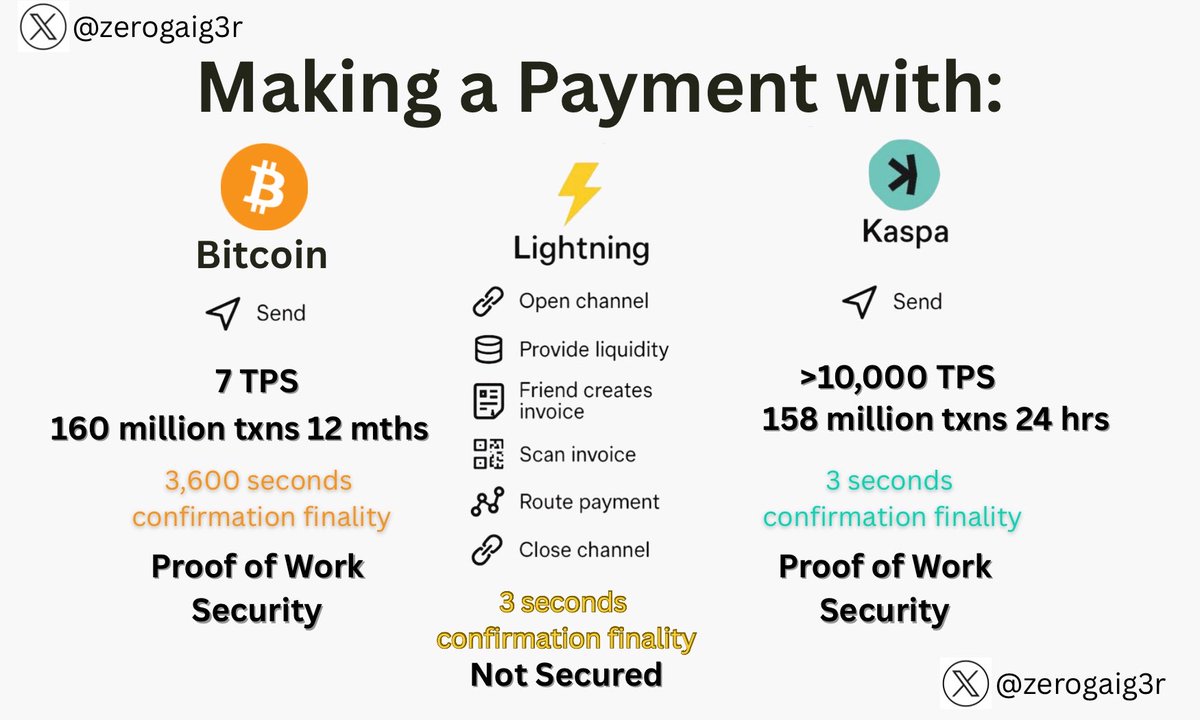
⚡ 1. Can Lightning Network be implemented on Kaspa?
Technically → YES (in theory)
•Kaspa uses a UTXO model, like Bitcoin
•Lightning (Lightning Network) is built on UTXO + smart scripting
•So a payment channel system similar to Lightning could be engineered
👉 Nothing fundamentally prevents it at a protocol level.
🚫 2. Why Kaspa doesn’t need Lightning
Kaspa was designed to solve the exact problem Lightning tries to fix:
Bitcoin problem:
•Slow (~10 min blocks)
•Limited throughput
➡️ Needs Lightning (off-chain scaling)
Kaspa design:
•BlockDAG → parallel blocks
•~10 blocks/sec (targeting 100+)
•Near-instant confirmations
👉 Result:
•Fast + cheap on Layer 1
•No need for payment channels
Key insight:
Kaspa already does on-chain what Lightning tries to achieve off-chain.
This is explicitly discussed by Kaspa developers: its base layer aims for mass payments without relying on L2 channels
🧱 3. Philosophical mismatch
Lightning introduces:
•Payment channels
•Liquidity constraints
•Routing complexity
•Potential intermediaries
Kaspa philosophy:
•Keep everything simple and on-chain
•Avoid extra layers that fragment liquidity or UX
Even Kaspa’s founder has suggested that traditional L2s can be misaligned with its design goals
🔄 4. What Kaspa is building instead (important)
Instead of Lightning-style channels, Kaspa is moving toward:
🧩 Layer 2 (but not Lightning-style)
•ZK rollups
•EVM-compatible layers (e.g. Kasplex)
•Smart contract layers
👉 These are for:
•DeFi
•programmability
•scaling beyond payments
NOT for basic payments (which L1 already handles)
Sources confirm:
•Kaspa is actively developing rollup-based L2 systems
•ZK and L2 ecosystem is expected to expand through Q4 2026
⚖️ 5. Lightning vs Kaspa approach
Feature : Bitcoin + Lightning : Kaspa
Scaling method : Off-chain (channels) : On-chain (blockDAG)
Complexity : High : Low
UX : Can be tricky : Simple
Liquidity issues : Yes : No
Need for L2 payments : Required : Not required
🧠 Final Answer
•✅ Lightning-style systems are technically possible on Kaspa
•❌ But they are not needed and likely won’t be a focus
•🔥 Kaspa’s goal is to replace the need for Lightning entirely
@SatsySiren @realvijayk


English

@AGratefulApe Kaspa scales at the base layer, unlike Bitcoin, making $KAS fast, cheap, and high-throughput, ideal as a sequencer for tech rails. Imo Sol/Eth aren’t decentralized and can be censored. Agree it could compete with BTC as SOV but is it bad or healthy competition?
English

@KaspaClass I'm skeptical of this because why would people SOV BTC and use KAS as the tech layer? Kas is POW as well wouldn't it be more efficient to use BTC SOV and Eth/Sol as the tech rails?
If we use Kas at some point the max supply will lead to it becoming SOV competing with BTC right?
English

@AGratefulApe @zerogaig3r A DAG has multiple tips, and new parallel blocks can reference these tips. After blocks are mined, GHOSTDAG orders them using the blue–red block classification & the K-cluster mechanism. A chain has only one tip, so only a single block can be mined at a time.
English

@AGratefulApe @zerogaig3r In $KAS , miners don’t compete , each block references multiple previous blocks, so many blocks can coexist and none are orphaned. In Bitcoin, each block references only the latest one, so only one block can be accepted at a time, and all others are discarded.
English

@AGratefulApe @zerogaig3r 5/ If an attacker controls less than 51% of the network hash power:
No double-spend is possible.
No chain reorganization can occur, because their blocks are classified as red and never become part of the blue main chain. Red blocks can exist, but they don’t affect consensus
End/
English

@AGratefulApe @zerogaig3r 4/
That’s basically how the GHOSTDAG protocol works.
To get more concrete : an attacker would still need >51% of the network hash power, just like in Bitcoin, to have their blocks accepted as blue blocks the main chain 👇
English

@AGratefulApe @zerogaig3r Everything in GHOSTDAG is explained and mathematically proven, it’s not just a claim. The paper is academic research, peer-reviewed, and provides proofs of security, exactly like Bitcoin. In other words, GHOSTDAG is proven in the same way as Bitcoin: not more, not less
English

@KaspaClass @zerogaig3r I think Kas needs clearer explanations about why it can actually maintain the same security w/ faster speed not just claim it. Maybe only a high mcap + time can prove that?
English

@AGratefulApe @zerogaig3r 3/3
The main differences are more practical: blocks are produced much more frequently, multiple blocks can be accepted instead of competing for a single winner,no orphans and there’s less wasted work.
English

@AGratefulApe @zerogaig3r 2/3
If you have a specific part that’s confusing, feel free to ask. As for Kaspa mining, it’s not fundamentally different from Bitcoin. It’s still Proof-of-Work, and hashpower still determines influence 👇
English

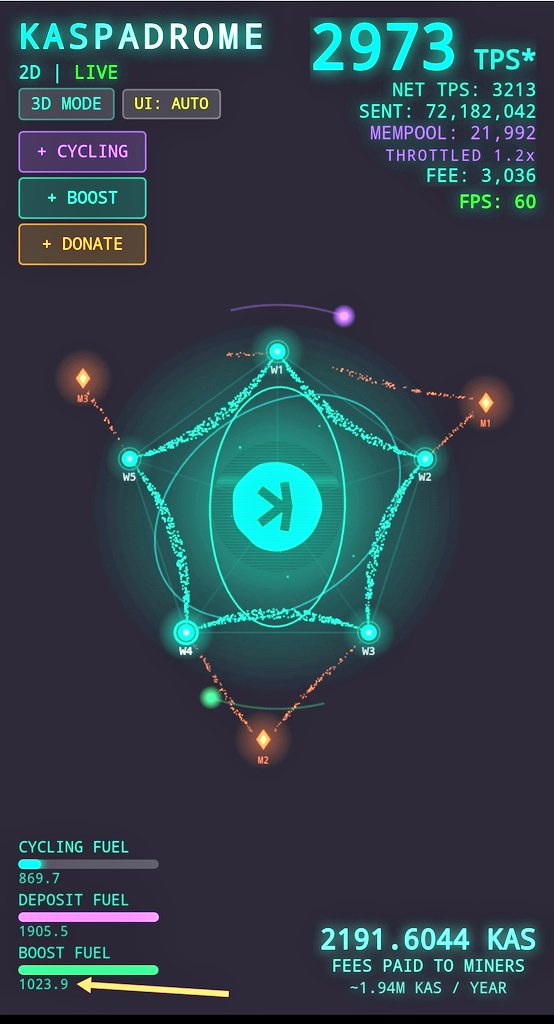
@Justinf_DeFi It lets anyone test network capabilities, while generating fees for miners. It’s a great way to observe network behavior, fees, inclusion time, and wallets under constant load.
A practical showcase of $KAS tech strength , not just theoretical
English

@KaspaClass I’m curious what’s the point of this exactly? Is it for future AI agents sending and receiving micro transactions?
English

@SPoatoe @Kaspadrome The comunity is sending Kaspa to fuel the app
English

$KAS
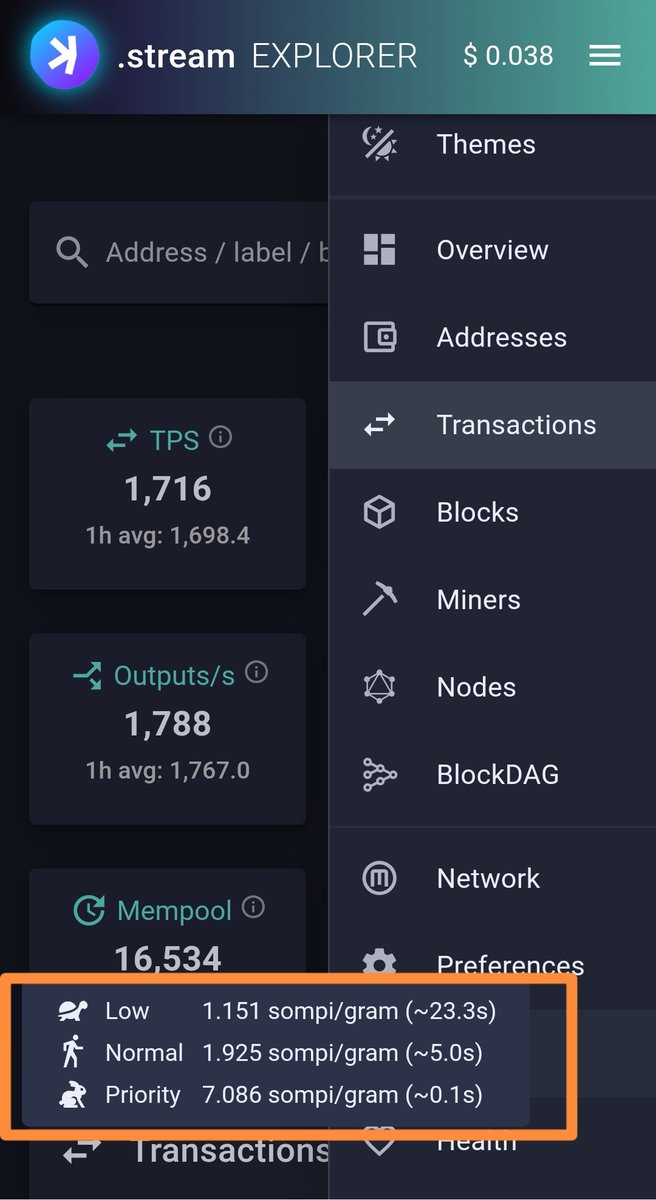
1000+ Kaspa just boosted @Kaspadrome , expect high TPS for the next few hours 👀
Good moment to explore tx inclusion:
try low, medium & priority fees across different wallets and see how long your tx takes to be included under high load in different conditions ⏱️


English