Kayle Hatt

11.3K posts

Kayle Hatt banner
Kayle Hatt

Kayle Hatt

@KayleHatt

#GCdigital. Previously did other things. Interested in #PublicPolicy #Innovation & #GCdigital. Tweets are my own, RT=/= blah, blah, blah, etc

Ottawa, Ontario Katılım Mayıs 2010
1K Takip Edilen2K Takipçiler
Kayle Hatt retweetledi

Robert Reich
Robert Reich@RBReich·
10 years ago, Bernie Sanders warned America of the unintended consequences that could emerge from a regime change war with Iran. Watch.
English
92
670
1.7K
63.7K
Kayle Hatt retweetledi
Maclean’s Magazine
Maclean’s Magazine@macleans·
In 2026, the workplace is a war zone. Companies are forcing employees back to the office. Zoom calls are taking place in bathroom stalls. And AI is everywhere. All this and more in Maclean's special work issue.
Maclean’s Magazine tweet media
English
3
4
16
8.6K
Kayle Hatt
Kayle Hatt@KayleHatt·
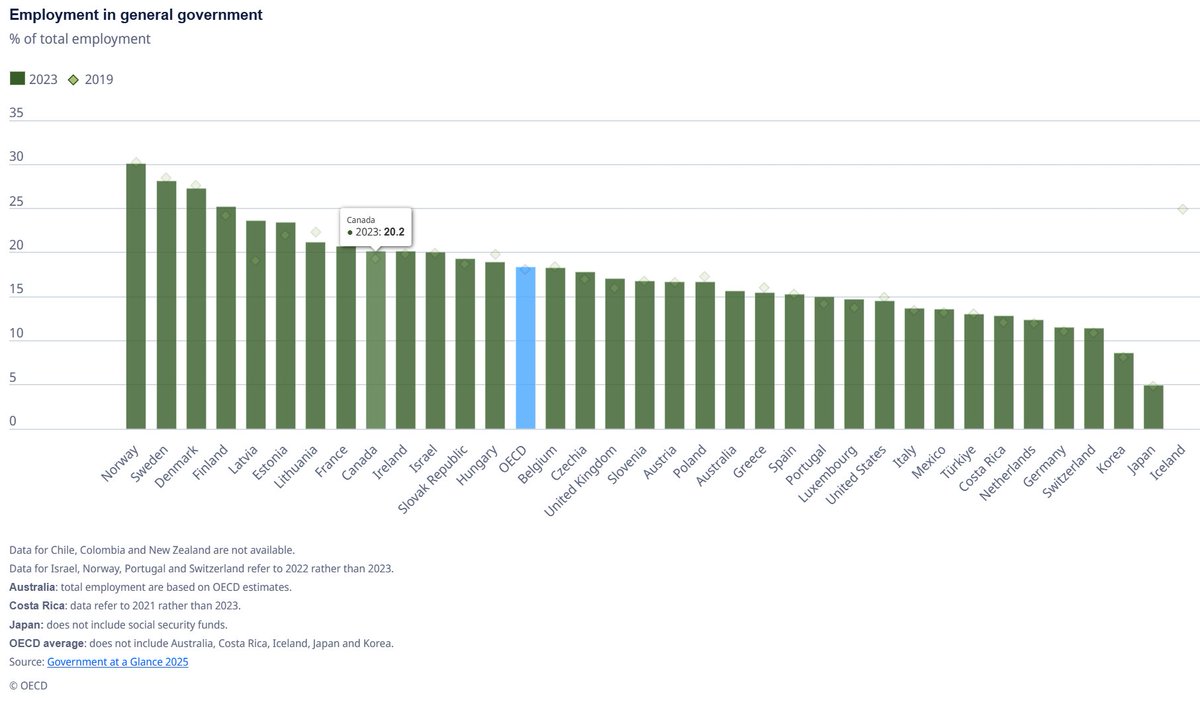
Keep this in mind when someone says the size of the public sector is problematic. Because there are a lot of really important things that we rely on that are part of that public sector.
English
0
0
0
6
Kayle Hatt
Kayle Hatt@KayleHatt·
Given that nearly a third of public sector workers in Canada are in healthcare+social services, the 5.5% difference between the size of the public sector in Canada and the US doesn't seem so big. Altho, the US has a larger military/police sector.
English
1
0
0
10
Kayle Hatt
Kayle Hatt@KayleHatt·
For some context, here is the latest OECD comparison. Canada is on par with many other advanced economies with strong social safety nets. We're only 5-6% higher than the US, despite having a public healthcare system in our #.
Kayle Hatt tweet media
Kirk Lubimov@KirkLubimov

Canada has a huge issue with public sector bloat but I don't think most realize how bad it is. Around 25% of these employed in Canada work for the public sector but in many provinces, it's over 30%. The main reason for high taxes & low productivity. Breakdown by province:

English
1
1
3
191
Kayle Hatt
Kayle Hatt@KayleHatt·
@pothen Probably not. OAC only applied to people who wanted to go to university, so it wouldn't reduce the average for others According to international data, 6 secondary years for Canada is an international norm (gr.7-12) but some are > data.worldbank.org/indicator/SE.S…
English
0
0
0
10
Kayle Hatt
Kayle Hatt@KayleHatt·
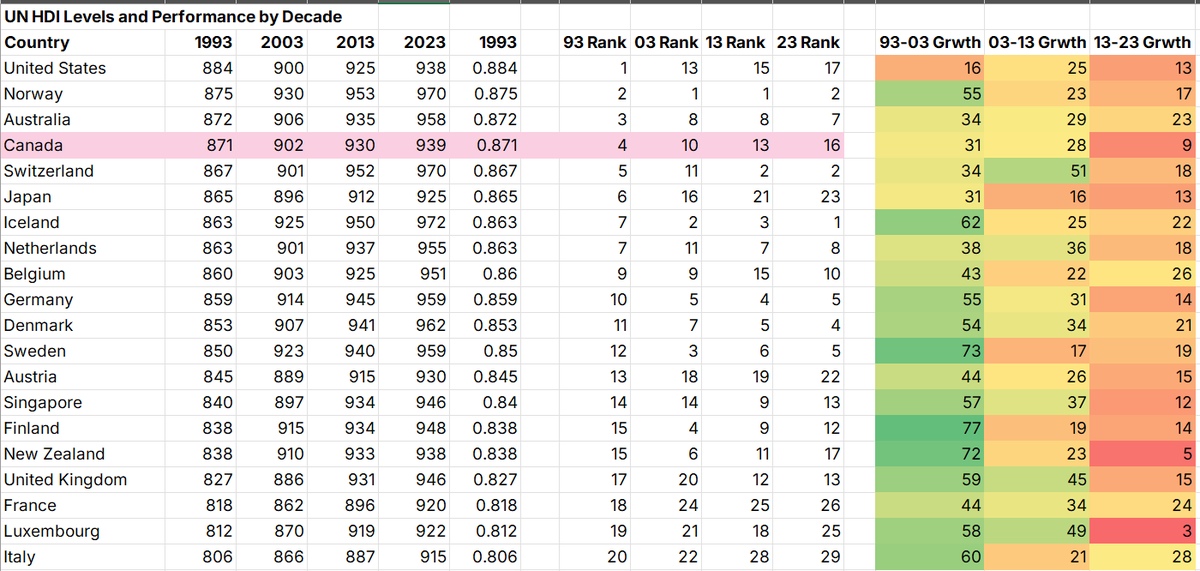
But we could also acknowledge that its an imperfect indicator. Its best at creating groupings/clusters or a general positioning (500 vs. 700 vs. 900) ... rather than a precise indicator for measuring small differences between top countries (939 vs 970).
English
0
0
0
6
Kayle Hatt
Kayle Hatt@KayleHatt·
So the bottom line is ... UN HDI measures life expectancy, education in years and GDP (or GNI). The best way to boost Canada's score would be increasing the years of PSE (and were already working on GDP growth).
English
2
1
1
64
Kayle Hatt
Kayle Hatt@KayleHatt·
@MikePMoffatt @tylermeredith Yes. Plenty of ways that Canada could be better (which is why I've spent my life in public policy and working for the public good).
English
0
0
0
16
Kayle Hatt
Kayle Hatt@KayleHatt·
@MikePMoffatt @tylermeredith It is great that Norway and others have improved so much. And yes we could be getting better, faster. But Canada is a great place to live and getting better. We can make it even better (and I want to). But 93.9% means we are an A+ country not something to be alarmed about
English
1
0
0
38
Kayle Hatt
Kayle Hatt@KayleHatt·
@MikePMoffatt @tylermeredith Both things can be true. In 1993, we were 4th with 871/1,000 points on the index. Now we're 16th with 939/1,000. I would rather be 16th with 939 or 30th at 975 than 4th at 871.
English
2
0
1
33