The Kenyan Investor

504 posts

The Kenyan Investor

The Kenyan Investor

@KenyanInvestorr

Breaking down Kenya's markets for the everyday investor: T-bills, Bonds, NSE stocks,Finance AI |. Email [email protected]. Not Financial Advice

Nairobi Katılım Nisan 2026
61 Takip Edilen615 Takipçiler
Sabitlenmiş Tweet
The Kenyan Investor
The Kenyan Investor@KenyanInvestorr·
The hardest part of investing isn't spotting a rising stock. It's having the conviction to hold them through volatility. That conviction doesn't come from hype but comes from understanding the business, studying the numbers, and knowing why you bought it in the first place. #NSE
English
0
2
4
240
The Kenyan Investor
The Kenyan Investor@KenyanInvestorr·
NSE Weekly: More green than red. 32 stocks gained, 19 declined and 5 were unchanged this week. 🏆 Top 5 Gainers • Car & General (CGEN) +24.45% • Family Bank (FMLY) +13.74% • Kenya Re (KNRE) +7.98% • HF Group (HFCK) +7.63% • Centum (CTUM) +7.00% 📉 Top 5 Losers • Kenya Airways (KQ) -5.44% • Eaagads (EGAD) -5.17% • Uchumi (UCHM) -4.85% • Sameer Africa (SMER) -4.58% • Unga Group (UNGA) -3.38%
The Kenyan Investor tweet media
The Kenyan Investor@KenyanInvestorr

The NSE closed the week with positive breadth: 32 gainers, 20 losers and 4 unchanged. 🟢Top 5 gainers • UNGA +22.04% • Family Bank +10.60% • Sameer Africa +9.75% • Kapchorua Tea +7.65% • EABL +7.33% 🔴 Top 5 losers • Home Afrika -10.26% • Britam -10.08% • Umeme -5.63% • Standard Group -4.21% • Nairobi Business Ventures -3.60%

English
0
2
2
143
The Kenyan Investor
The Kenyan Investor@KenyanInvestorr·
Most Kenyans don't lack health insurance because they don't want it. They lack products built for how they earn. Britam has launched medical cover from Sh336 a month (about Sh11 a day) for informal workers. The real innovation isn't the premium. It's building insurance around Kenya's informal economy instead of expecting the informal economy to fit traditional insurance. #Insurance #Britam
The Kenyan Investor@KenyanInvestorr

Britam is quietly writing one of the biggest comeback stories on the NSE. Jan: ~KSh9.20 Now: Above KSh20 More than 100% gain YTD. The catalyst? Investors are looking beyond today's earnings and toward the return of dividends after six years drought. That's how markets price the future. #KenyanInvestor #NSE

English
0
3
4
284
The Kenyan Investor
The Kenyan Investor@KenyanInvestorr·
KPC has made some board change and the most important change at Kenya Pipeline isn't the new board faces, it's what the board now represents. The newly constituted board brings together Dr. Ramathan Ggoobi (economist), Irene Pauline Bateebe (energy engineer), Eng. Meshack Otieno Kidenda (civil engineer), Samson Kipkemboi Burgei (public sector administrator) and CPA Ronald Kenyanya Nyamosi (accountant). The mix reflects a deliberate balance of technical expertise and regional representation. Uganda's 20% stake comes with veto rights over CEO appointments and other key strategic decisions. That's why the CEO recruitment stalled until Kampala's nominees formally joined the board. KPC is no longer just a Kenyan state corporation. It's evolving into a regional infrastructure company with shared Kenya–Uganda governance, where strategic decisions increasingly reflect cross-border ownership rather than national control alone. #KPC
English
0
4
4
286
The Kenyan Investor
The Kenyan Investor@KenyanInvestorr·
CBK has reopened three infrastructure Treasury bonds, giving investors another chance to lock in long-term fixed income while financing public infrastructure. The offer includes: • IFB1/2019/016 (9.3 years to maturity) – 11.75% coupon • IFB1/2021/018 (12.7 years) – 12.67% coupon • IFB1/2021/021 (16.2 years) – 12.737% coupon The government is seeking to raise KSh150 billion. Retail investors can participate from KSh50,000, while competitive bids start at KSh2 million per tenor. Bids close on 12 August, with settlement on 17 August. One thing worth remembering: the coupon rate is not the return you’ll necessarily earn. Since these are reopened bonds, investors bid based on yield. If demand is strong and the bond is priced above par, your actual yield will be lower than the coupon. If it’s priced below par, your yield will be higher. For income-focused investors, the auction results will be more important than the headline coupon rates. #Bonds #FixedIncome #Kenya
The Kenyan Investor tweet media
English
0
3
7
998
The Kenyan Investor
The Kenyan Investor@KenyanInvestorr·
Good news a lot of Kenyan investors haven't clocked: you can hold a slice of Nvidia and gold right here on the NSE, in shillings. Two cross-listed ETFs proved it this year. The Satrix World ETF ran Sh761 to Sh941, and Absa NewGold Sh4,080 to Sh4,945. Up to 24% over 12 months. The part I like most: no offshore account, no dollar wire. Just an NSE broker and a CDS account. Global diversification used to feel out of reach. Not anymore. Source: Business Daily, Jul 2026 #NSE
English
0
3
7
572
The Kenyan Investor retweetledi
Shimbirta
Shimbirta@Shimbirta2·
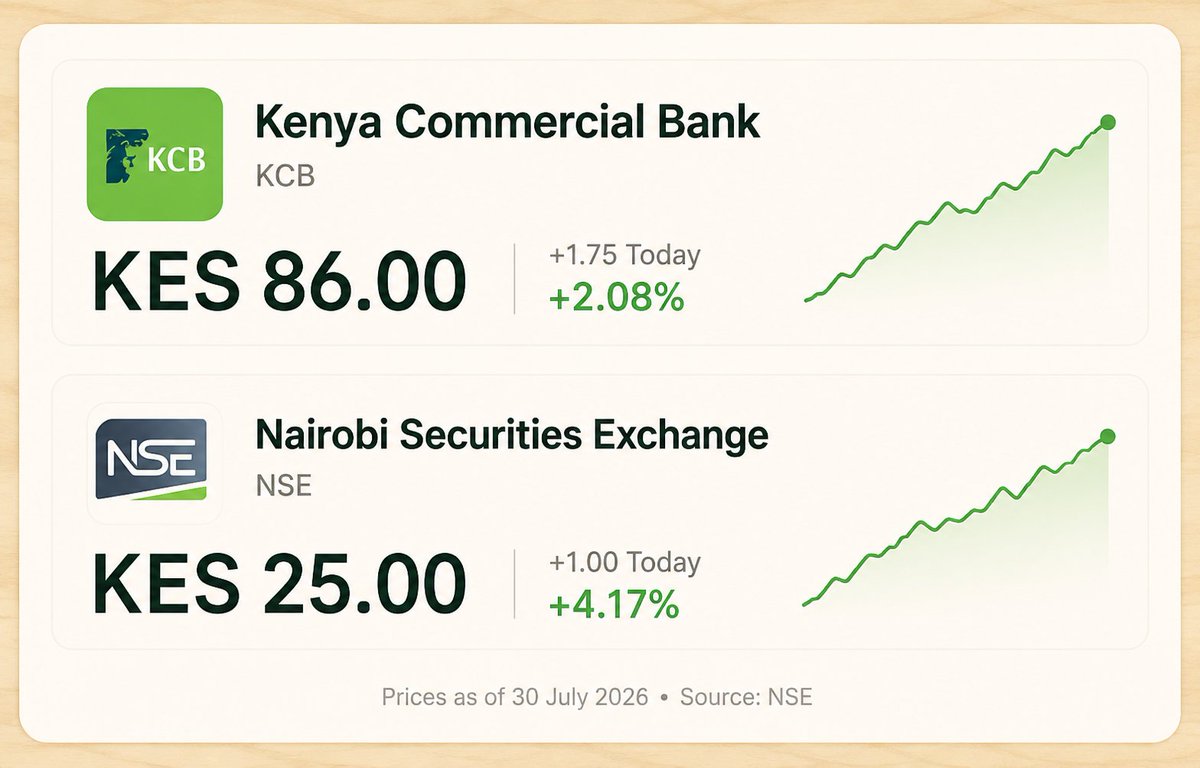
KCB touched a new all-time high of KES 86.50 today. NSE closing the day as a top gainer! Do you think there's still more room to run for the two?
Shimbirta tweet media
English
4
11
59
2.5K
The Kenyan Investor retweetledi
Abojani Investment 🇰🇪🇺🇬🇹🇿
As of June 2026, there were 737,891 women investors at the NSE and 1,517,868 male investors Of the 20.92bn shares held by individual investors, women had 5.9bn, while men held 15bn shares Source: CMA Q2 Statistical Bulletin
English
3
7
42
3.4K
The Kenyan Investor
The Kenyan Investor@KenyanInvestorr·
Well put. I'd also add PAPSS to the conversation because it makes the same point from an African perspective. It's a better payment rail, but it doesn't create FX liquidity. If there isn't enough shilling or naira depth, the faster rail doesn't change that. And that's really the challenge in Kenya. The transfer itself can happen almost instantly, but getting in and out of shillings at scale still depends on licensed on- and off-ramps. Until that layer is fully developed and supported by regulation, that's where most of the friction remains.
English
1
2
2
25
Samuel M
Samuel M@corridor_intel·
A useful framing is circulating this week: Africa now has three parallel settlement rails developing simultaneously. SADC-RTGS for regional currencies, CIPS for yuan-denominated trade, and stablecoin infrastructure for 24/7 digital settlement. The read is that this represents growing optionality away from correspondent-bank dependence, and directionally that's correct. What the framing misses is that each rail carries a distinct constraint at the currency level, not just the settlement level. Angola's kwanza is a managed, thinly-traded currency. Its inclusion in SADC-RTGS builds a settlement pipe, but doesn't itself create FX liquidity depth behind that pipe. Yuan clearing through CIPS operates inside China's capital controls, bounding its use to China-linked trade and debt rather than general-purpose settlement. Stablecoins remove messaging and timing friction, but every payout still depends on a licensed on/off-ramp wherever cash needs to land locally. The operative distinction for any institution evaluating this shift: rail-level optionality and currency-level liquidity depth are two different things, and conflating them is where treasury teams tend to overestimate how quickly correspondent-bank dependence actually declines.
English
1
0
2
59
The Kenyan Investor retweetledi
Abojani Investment 🇰🇪🇺🇬🇹🇿
Money Market Funds are a good place to start your investing journey. You can start defensive by putting your money in a top money market fund and go aggressive when you have accumulated enough money. MMFs are a good investment option because they are low risk and highly liquid.
English
1
2
29
2.5K
The Kenyan Investor retweetledi
NSE PLC
NSE PLC@NSE_PLC·
📈 The market extended its gains, with all major NSE indices closing higher. The NSE 20 Share Index led the benchmark indices with a 0.47% gain, while CAR General topped the gainers' chart, advancing 9.61%.
NSE PLC tweet media
English
0
3
9
1.4K
The Kenyan Investor retweetledi
Abojani Investment 🇰🇪🇺🇬🇹🇿
For most successful mergers, the first 3 - 5 years are typically dedicated to integration, cultural alignment and operational consolidation. Years 6 - 10 are often for accelerated growth, innovation and value creation. By 2030, NCBA could provide an interesting case study of what a well-executed merger can achieve.
English
0
1
14
2.2K
The Kenyan Investor
The Kenyan Investor@KenyanInvestorr·
That's a good point @corridor_intel . Banning the yield doesn't remove the demand for dollar savings. It just changes where people go to find it. If some end up using offshore platforms instead, regulators could actually lose visibility over that activity. I also agree that the settlement side is a different conversation. Whether or not stablecoins pay yield, tokenized settlement can still make markets more efficient. The real challenge is finding a framework that manages the risks without pushing users outside the regulated system.
English
0
0
0
5
Samuel M
Samuel M@corridor_intel·
Missing piece: banning yield doesn't eliminate the demand for dollar-denominated savings, it just removes the local, licensed venue for it. Kenyans who wanted that yield now either accept KES deposit rates or move the capital to an offshore stablecoin venue with no local oversight at all. Which is a worse outcome for exactly the systemic-risk concern the ban is trying to manage. Settlement use case is unaffected either way, which is the part regulators usually get right.
English
1
0
1
13
The Kenyan Investor
The Kenyan Investor@KenyanInvestorr·
Kenya's Treasury has banned interest on stablecoins. Not the coins, the yield. The logic: a stablecoin that pays you interest is basically a dollar bank account with no licence and no deposit protection. If enough Kenyans parked savings there, banks lose the cheap deposits they lend from. That's the real fear: a slow bank run. So it protects the banking system. Fair enough. But it also quietly closes one way a saver could earn on dollars. My take? I get it. Though "protecting you" often means protecting the banks too. Stablecoins can still be used to pay and settle here. Just not to earn. #CryptoKE #InvestingKE
English
1
2
2
67
The Kenyan Investor
The Kenyan Investor@KenyanInvestorr·
“Near-instant” only holds if the whole settlement chain is digital. If fiat still moves through banks or intermediaries, that layer becomes the bottleneck. Curious if the partnership will address FX/cash settlement or stay focused on tokenization, custody, and fractional ownership. The blockchain can settle tokens in seconds, but the trade is only as fast as its slowest off-chain step.
English
0
0
1
12
Samuel M
Samuel M@corridor_intel·
Having worked around settlement infrastructure, "near-instant" claims usually describe the on-chain leg only. If USDT isn't yet approved for settlement in Kenya, someone still has to convert diaspora dollars into KES-denominated shares through a licensed intermediary before the trade is actually done. That conversion step, not the blockchain leg, is normally where the real settlement time sits. Worth watching whether the MoU addresses that conversion layer or just the custody/fractionalization layer.
English
1
0
1
18
The Kenyan Investor
The Kenyan Investor@KenyanInvestorr·
Tokenizing the NSE could be a big step forward, but it's worth separating the potential from the promise. The upside: • Fractional ownership, making shares more accessible. • Near-instant settlement instead of waiting days. • Easier participation for Kenyans in the diaspora. • A potentially deeper and more liquid market. The hurdles: • It relies on USDT, a private dollar stablecoin that isn't yet approved for settlement in Kenya. • New technology introduces risks, from custody issues to smart-contract vulnerabilities. • And for now, it's only an MoU, with no implementation timeline. The opportunity is real. So are the challenges. The real test is what gets built. #NSE
English
1
3
6
484