
Not so much rhyme, but reason.

32K posts

Not so much rhyme, but reason. banner
Not so much rhyme, but reason.

Not so much rhyme, but reason.

@Know_4yourself

A teacher who listens, a student who questions, a son that honors, a brother that supports, an uncle that laughs and a man that thinks more then eats, almost.

Bangkok, Thailand Katılım Mart 2013
470 Takip Edilen221 Takipçiler
Not so much rhyme, but reason.
@WhiskeyPriest @oliverburdick I could into see it as idolatry if they bestowed upon Mary the power of God himself to judge the souls of others, and to seen as powerful as God, but nowhere that I am aware does or has the church ever taught this.
English

0
0
0
4
Not so much rhyme, but reason.
@WhiskeyPriest @oliverburdick But what about this, for example, if scripture was interpreted that Mary was the woman in Revelations 12: ‘a woman clothed with the sun, moon under her feet, and a crown of twelve stars appears. Then to present Mary as the verses says is only reflecting scripture….
English
2
0
0
7
Oliver Burdick
Oliver Burdick@oliverburdick·
We’re supposed to worship Jesus, Not his mom.
English
437
153
1.8K
40.6K
Not so much rhyme, but reason.
@WhiskeyPriest @oliverburdick …and it isn’t idolatry if they see her as Holy, full of Grace. If Christ said ‘behold your mother,’ while on the Cross, referring to her as Mother if Christ, and mother to the church is merely referring to scripture. Is it not?
English
0
0
0
4
Not so much rhyme, but reason.
@needGod_net What does God say about children? Do children have in depth understanding of faith? Or do they merely believe what they are told and do what Christ tells them to do?
English
0
0
0
38
Not so much rhyme, but reason.
@MCulhaven51091 @sola_chad You are right about the councils. They solidified what the church believed but it was not easy. The councils were accepted as the church’s way to establish doctrine until the Protestants adopted sola scriptura so they became their own authority…like yourself.
English
0
0
0
2
Morgan Culhaven
Morgan Culhaven@MCulhaven51091·
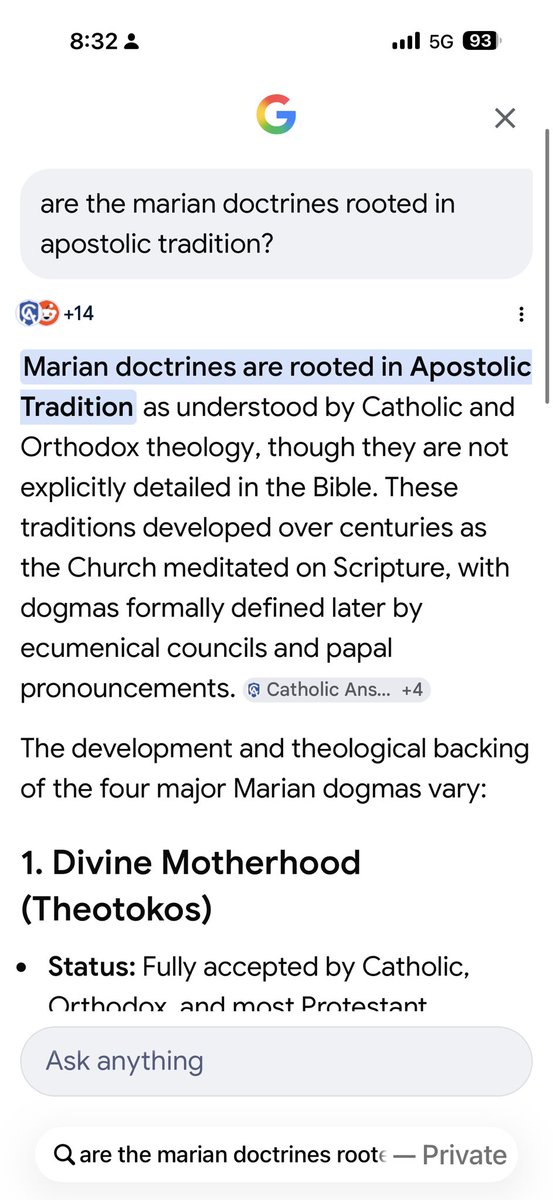
You really need to stop thinking that Google's AI is an authoritative source. Besides, this image actually proves the opposite of what it intends. The early church did immediately worship Jesus as divine (see Acts 2, Philippians 2:6-11, Colossians 1:15-20, John 1:1-14, Hebrews 1, etc.). What the councils (Nicaea 325, Constantinople 381, Chalcedon 451) clarified were precise philosophical definitions against heresies like Arianism (denying full deity) and later Nestorianism/Eutychianism (muddling the two natures). But the core truth that Jesus is fully God and fully man was already clearly taught by the apostles in the first century. Paul, writing decades after the resurrection, declares: “In him the whole fullness of deity dwells bodily” (Colossians 2:9) “Though he was in the form of God… born in the likeness of men” (Philippians 2:6-7) Christ as “God over all” (Romans 9:5) The apostles didn’t need a council to know who Jesus was. They walked with Him. Now apply the same logic to Mary: If later councils could “develop” exalted Marian dogmas (perpetual virginity, sinlessness, Assumption, co-redemptrix, etc.) centuries after the apostles, why do we never see even the slightest hint of them in the New Testament...not in the epistles, not in Acts (the history of the early church), and not even from James or Jude (her own sons) or John (the apostle Jesus entrusted her to)? The Christological councils were defending and defining what the apostles had already delivered. Marian dogmas add entirely new categories with NO apostolic root. That’s the key difference. The silence in the epistles is not because “theology was still developing.” It’s because the Holy Spirit directed the church’s focus to Christ alone. The apostles gave us the faith “once for all” (Jude 3). Later additions that exalt Mary contradict that apostolic foundation.
English
5
0
0
17
Not so much rhyme, but reason.
@MCulhaven51091 @sola_chad …of being the final interpreter and authority of scripture and apostolic tradition please provide your stamp of approval from God himself. If not, you are merely a man, who with the best of intentions, is assuming authority you have no right to claim.
English
0
0
0
1
Not so much rhyme, but reason.
@MCulhaven51091 @sola_chad …unless you yourself choose to disagree with what the early church believed for the first 1500 years. So, it is Morgan Culhaven who wa given the authority to interpret scripture and apostolic traditions. Not those that established the church. If you have some sort of proof…
English
0
0
0
2
Not so much rhyme, but reason.
@MCulhaven51091 @sola_chad …the original teachings from being distorted. Google AI has all the references. Your only argument is that they don’t reference Mary. But again, that doesn’t mean the actual teachings are wrong. And no, they don’t contradict the bible at all…
English
0
0
0
3
Not so much rhyme, but reason.
@MCulhaven51091 @sola_chad However, you are incorrect. Yes, they knew Christ was believed to be God. You act as though the early church has everything put together. They didn’t. They absolutely needed them. If you read the History of Christianity, Diarmaid Macullough, it reveals how they had to keep…
English
0
0
0
5
Hunter Biden
Hunter Biden@HunterBiden·
Hope resides in real conversations like these, finding the humanity in each other first. That’s how we cross the divide. Thank you @RealCandaceO. Candace x Hunter Biden: The Interview youtu.be/Ux1kzgQxkws?si…
YouTube video
YouTube
English
1.6K
1.2K
13K
555.1K
Morgan Culhaven
Morgan Culhaven@MCulhaven51091·
This analogy fails completely. The first four ecumenical councils were defending and defining what the apostles had ALREADY clearly taught in the New Testament about Christ’s full deity and full humanity. Again, as I showed you elsewhere, the Scriptures are saturated with it: “In him the whole fullness of deity dwells bodily” (Col 2:9) “God over all, blessed forever” (Rom 9:5) “The Word was God… became flesh” (John 1:1, 14) Philippians 2:6-8, Hebrews 1-2, etc. The councils responded to heresies (Arianism, etc.) that arose after the apostolic age. They were not inventing new doctrines. They were guarding the apostolic faith. Marian dogmas are the exact opposite. There is NO apostolic root for: Perpetual virginity (after Jesus’ birth) Sinlessness / Immaculate Conception Bodily Assumption Co-redemptrix / Mediatrix / Queen of Heaven, etc. The New Testament writers (again, including her sons James and Jude, as well as John, who cared for her) never mention her again after Acts 1. No epistle writer, no Acts record of the early church, ever exalts her or points believers to her. Paul names dozens of believers and co-workers but gives Mary NO attention. The image in your post actually proves my point: these Marian dogmas were formally defined from the 5th century onward, with the last one in 1950. That is not “development” of apostolic teaching. It is later addition by men. Early “tradition” on perpetual virginity largely stems from the Protoevangelium of James (mid-2nd century), a non-inspired, legendary writing rejected by the early church as unreliable. Even among the Fathers, there was disagreement. Tertullian (the guy who coined the term "Trinity" and other things) for example, affirmed Mary had other children). The apostles delivered the faith “once for all” to the saints (Jude 3). They had no hesitation teaching complex truths about Christ. The total silence on any exalted role for Mary is not because “it took longer to explain.” It’s because those later Marian additions have nothing to do with that apostolic foundation.
English
4
0
0
17
Not so much rhyme, but reason.
Not so much rhyme, but reason.@Know_4yourself·
@MCulhaven51091 @sola_chad …there are many things not mentioned in the epistles which are doctrine in the church. This doesn’t mean they aren’t true, or can’t be true. It means they weren’t inspired to be written to those audiences by those writers.
English
0
0
0
4