

NO.01
12.1K posts

NO.01
@KoenigManja
LSNA THE GALLERY ALGORITHMIC SINGULARITY ART By NO.01
Niedersachsen, Deutschland Katılım Eylül 2021
2.1K Takip Edilen1.8K Takipçiler
Was passiert, wenn Mathematik zu Kunst wird — und Kunst zur Legende?
Es gibt Momente, die sich nicht wiederholen lassen.
Nicht in der Natur. Nicht in der Wissenschaft.
Und jetzt auch nicht in der Kunst.
LSNA THE GALLERY zeigt Werke, die exakt einmal existieren —
geboren aus einem singulären algorithmischen Zustand,
für immer festgehalten auf Hahnemühle Fine Art Paper.
Das sind keine Bilder. Das sind mathematische Ereignisse.
Die außergewöhnlichsten Roboter-Visionen, die je ein Algorithmus erschaffen hat —
kuratiert, authentifiziert, und niemals reproduzierbar.
Wer sie sieht, versteht:
Die Zukunft hat bereits begonnen. Und sie sieht atemberaubend aus.
Entdecke die Galerie, bevor jemand anderes es tut:
lsna.space
Deutsch
LSNA THE GALLERY presents
Time
No.01
A work born from a singular mathematical state —
curated, authenticated, and preserved
as a permanent object on Hahnemühle fine art paper.
This image was created once.
It will not be created again.
Algorithmic Singularity Art · 1/1
lsna.space

English
NO.01 retweetledi

🚨 HUGE NEWS 🚨
The CLARITY ACT is heading to the Banking Committee THIS WEEK, officially confirmed by Bill Hagerty, signaling that regulatory clarity for crypto is closer than ever.
2026 will change EVERYTHING. 🔥
English
NO.01 retweetledi

Extrem gute Nachrichten für DeFi auf XRP!
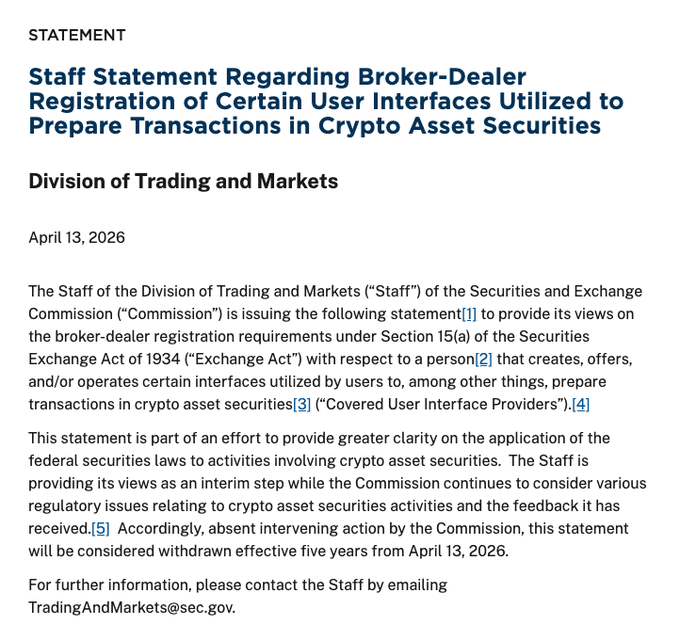
Gestern (13. April 2026) hat die US-Börsenaufsicht SEC genau das veröffentlicht, worum es im ursprünglichen Post ging: ein klares Staff Statement zur Broker-Dealer-Registrierung von User Interfaces für Crypto-Asset-Securities.
Was sagt die SEC?
Die Behörde erklärt, dass bestimmte „Covered User Interfaces“ (also Wallets, Browser-Erweiterungen oder Apps, die Nutzer dabei helfen, Transaktionen auf Blockchains vorzubereiten) keine Broker-Dealer-Registrierung brauchen – unter klar definierten Bedingungen:
- Der Nutzer behält volle Selbst-Verwahrung (self-custodial wallet) → die Oberfläche hält keine Gelder, hat keinen Zugriff auf Private Keys und führt keine Transaktionen aus.
- Der Nutzer kann alle Parameter selbst anpassen und bekommt Bildungsmaterial.
- Keine Werbung für bestimmte Trades, keine Investment-Empfehlungen, keine Preis-Kommentare („bester Preis“ etc.).
- Nur feste Gebühren (z. B. pro Transaktion als Prozentsatz oder Flat-Fee), keine versteckten Payments oder Order-Flow-Zahlungen.
- Klare Offenlegungspflichten zu Gebühren, möglichen Interessenkonflikten, verwendeten Protokollen und Sicherheitsmaßnahmen.
Wenn diese Regeln eingehalten werden, sagt die SEC-Staff ausdrücklich: Wir haben keine Einwände gegen den Betrieb solcher Interfaces ohne Broker-Dealer-Registrierung.
Warum ist das für XRP riesig?
Genau das beschreibt der ursprüngliche Post perfekt:
XRP Ledger hat bereits auf Protokollebene eine vollwertige DEX mit Orderbüchern, Automated Market Makern (AMM) und nativem Cross-Currency-Routing.
Das heißt: Wer nur eine Oberfläche (UI) zum XRP-DEX anbietet,
- hält keine Nutzer-Gelder,
- führt keine Orders selbst aus,
- routet alles nativ über das Protokoll.
Es ist quasi der ideale „Covered User Interface“-Fall, den die SEC jetzt explizit erleichtert. Man muss keinen eigenen DEX bauen und keine teure Kathedrale errichten – man nutzt einfach den riesigen, öffentlichen Basar („bazaar that carves mountains“), den das XRP-Protokoll schon bereitstellt.
Diese SEC-Klarstellung ist ein Game-Changer für DeFi auf XRP. Sie gibt Entwicklern und Projekten in den USA jetzt genau die regulatorische Sicherheit, die der native Protokoll-DEX von XRP schon technisch ermöglicht hat. Dezentral, effizient und jetzt auch regulatorisch deutlich einfacher – das ist wirklich extrem gute Nachricht für das gesamte XRP-Ökosystem! 🚀
#XRP #XRPL
Deutsch
NO.01 retweetledi
It’s time Congress passes the Clarity Act. It’s now or never.
English
NO.01 retweetledi
🚨 BREAKING NEWS 🚨
$2 TRILLION Barclays CEO CONFIRMS on Fox their move into XRP & crypto.
Morgan Stanley opened the door… now the flood is coming.
Every bank is next 🚀
English
NO.01 retweetledi

Project Crypto is designed so once Congress acts, @SECGov & @CFTC are ready to implement the CLARITY Act.
@SecScottBessent is right. It's time for Congress to future-proof against rogue regulators & advance comprehensive market structure legislation to President Trump's desk.
Treasury Secretary Scott Bessent@SecScottBessent
Congress has spent the better part of half a decade trying to pass a framework to onshore the future of finance. It is time for @BankingGOP to hold a markup and send the CLARITY Act to President Trump’s desk. Senate time is precious, and now is the time to act.
English
NO.01 retweetledi

Congress has spent the better part of half a decade trying to pass a framework to onshore the future of finance.
It is time for @BankingGOP to hold a markup and send the CLARITY Act to President Trump’s desk.
Senate time is precious, and now is the time to act.
English
@xrp_deutschland Many people still believe XRP needs to reach $10,000 to be useful.
But as you explained, for payments it doesn’t matter if XRP is $1 or $1,000,000 — the value transferred stays the same.
The real question isn’t price… it’s utility and liquidity.
English

🚨 XRP wird komplett unterschätzt und David Schwartz sagt es eigentlich ganz offen!
Stablecoins wirken auf den ersten Blick logisch: stabil, reguliert, „sicher“.
Aber genau das ist auch ihre größte Schwäche.
Sie funktionieren immer nur relativ zu einer Währung.
Globales System? Mehrere Jurisdiktionen? Unterschiedliche Währungen?
Dann bricht dieser Vorteil sofort weg.
Und noch wichtiger:
Stablecoins sind kontrollierbar.
Sie können eingefroren werden. Zurückgeholt werden.
Am Ende entscheidet nicht das Netzwerk – sondern eine Instanz.
Das ist kein globales Settlement-Asset.
Und genau hier kommt XRP ins Spiel.
XRP ist nicht an eine Währung gebunden.
Es ist neutral. Liquid. Global einsetzbar.
Das ist der Unterschied zwischen „digitalem Geld“
und einem echten Brücken-Asset.
Was viele komplett übersehen:
Wenn du in einem globalen System arbeitest, willst du kein Asset,
das politisch, rechtlich oder zentral steuerbar ist.
Du willst etwas, das funktioniert.. egal wo.
Und genau das beschreibt Schwartz zwischen den Zeilen.
Stablecoins = Tool
XRP = Infrastruktur
Und Infrastruktur gewinnt immer.
Leute… es ist eigentlich so offensichtlich. #xrp
David 'JoelKatz' Schwartz@JoelKatz
There are some cases where volatility is a huge problem and so a stablecoin is a better choice than a cryptocurrency. Similarly there are some cases where a regulated asset with a trusted counterparty is a benefit. But cryptocurrencies have three big advantages over stablecoins. 1) A stablecoin can only be stable with respect to one currency and a stablecoin denominated in the fiat you need it to be stable relative to may not exist with the qualities you want. Applications that involve multiple jurisdictions with different native fiats don't benefit as much from the stability. 2) A stablecoin can be frozen or clawed back by its issuer. Ripple, for example, can't refuse a US court order. And the US courts may decide that other things matter more than you do even if you've done nothing wrong. For example, if some country asserts that you've supported terrorism and claims secret evidence, is a US court going to protect you even if you claim that your only support for terrorism was in the form of speech criticizing that government's human rights record? Do we expect AI agents to defend themselves in courts? Do you want to have to? 3) For most cryptocurrencies most of the time, the upside is worth more than the downside. So if you don't need stability, you might prefer a cryptocurrency over a stablecoin for many applications. If I had to lock up some money in an escrow for a year, I might well prefer XRP or BTC to USD because I know USD isn't going up.
Deutsch
NO.01 retweetledi

BREAKING🚨: #RIPPLE RELEASES $XRP PAYMENT SETTLEMENT VIDEO FOLLOWING REPORTS THAT U.S. BANKS MAY BEGIN USING $XRP
ON APRIL 17, A GLOBAL PARTNERSHIP REPORTEDLY VALUED AT $2.16 TRILLION IS EXPECTED TO GO LIVE ON THE XRPL.

English
NO.01 retweetledi

Wow!! Today is Quantum Day! Google released new research on Quantum risk in Blockchains.
Highlighting XRP and its efforts multiple times. Here are the findings and why especially Bitcoin:
>Denis testnet of the XRP Ledger with full quantum proof algorithms.
>XRP's native key rotation ability for accounts, unlike ETH and Solana.
>Google found that a lot fewer physical and logical qubits can break public blockchains than expected! In less than 9 minutes so that's enough to attack Bitcoin.
So a key rotation alone is not enough to protect, the submitted signature can attacked.
>What is truly remarkable is they made the public disclosure of their findings via ZKP 😮 literally proving what they found without giving away the path to it.
Amazing.


English
NO.01 retweetledi


@XRPneubauer @MC81236843 David Joel Katz oder mein letzter Post von ihm
Deutsch

@KoenigManja @MC81236843 Dein Name taucht immer beim Olli in den Livestreams auf :-) beim Schwartz find ich nix , meinst du crypto Family? Den habe ich hier noch nicht
Deutsch

Dieser Banker behauptet, die Zentralbanken hätten sich auf einen Festpreis von 5.000 US-Dollar für XRP geeinigt. timestabloid.com/this-banker-cl…
Deutsch
@XRPneubauer @MC81236843 Geh mal gucken was David heute gepostet hat vor 4 Stunden
Deutsch
@MC81236843 Würde doch meiner Meinung nach da gegen sprechen das der xrp Code mit dem Ledger dezentral ist , dann müsste der Preis ja von einer zentralen Einheit programmiert werden oder habe ich ein Denkfehler und wenn das so wäre, wären jetzt schon keine xrp mehr verfügbar
Deutsch
NO.01 retweetledi

@unknowDLT It's very simple. It's saying that the higher the price of XRP, other things being equal, the cheaper it is to use it for payments.
English