
Sabitlenmiş Tweet
AK
349 posts


AK
@KokolAlex
Trader dedicated to mastering the markets 📈
Katılım Ocak 2021
600 Takip Edilen141 Takipçiler
@TheOneLanceB Hi @TheOneLanceB, solid post!
Could you make a video on DOM and tape reading and elaborate a little on these inefficiencies? :)
English

THE SHORTEST TIMEFRAMES HAVE THE MOST EDGE!
This is a view I’ve mentioned before in interviews, but I’ve never taken the time to fully expand on.
In general, you want to be an expected value maximalist (within risk constraints). And the shortest human timeframes offer that. Yes, I mostly do bigger picture trades now but that’s due to scalability and quality of life, not bc they offer the most edge.
The paradox of markets is this:
-The shortest timeframes often have the biggest dislocations (most “edge per minute”)
-The longest timeframes often have the biggest tailwind (asset prices tend to rise over time)
-The middle is where many traders get chopped up
This principle is the reason why there were traders at Trillium that could be positive hundreds of days in a row. You’ll never see that with a swing trader or value investor.
1. Why short timeframes can have so much edge
At very short horizons, markets can be temporarily inefficient because of:
-forced behavior (stops, liquidations, margin pressure)
-delayed human interpretation of information
-mechanical flows around opens/closes
-short-lived supply/demand vacuums
Those create moments where price can be “wrong” for seconds/minutes relative to where it’s about to reprice.
In fact, at the extreme short end of human discretionary trading like the two following examples, you can find opportunities that approach 100% win rate with a profit factor of 10+. Of course there is a trade-off which I’ll get into.
2. Order flow imbalances
One of the biggest short-term edges is understanding order flow imbalance. Yes, these happen far less of the now than they used to as discussed in my interview yesterday with Serge. But they still exist particularly during times of market extremes.
-aggressive buyers/sellers temporarily overwhelm passive liquidity
-one-sided flow causes price to overshoot or stall
-liquidity can disappear at key moments, then refill at new levels
You’ll see this around:
-opening auctions
-panic flushes / squeezes
-large fund rebalancing windows
-crowded positioning unwinds
This is where the tape can get dislocated from “fair” value in the short run and where active traders can extract edge. It is also why some of those hyperscalpers like @EdBarry4 are positive so many days in a row.
3. Breaking news is where discretionary human traders still have the edge over algos in interpreting novel headlines.
There’s usually a sequence:
-headline reaction
-second-order interpretation
-positioning unwind/chase
-stabilization
If you’re prepared and fast, these windows can be highly asymmetric. In fact, breaking news can offer some of the best opportunities in existence, especially when applied to liquid instruments (think April 2025 tariff headlines!).
In fact, I’d argue tariff headlines due to their massive impact on global markets are some of the best expected value opportunities I’ve ever seen.
4. But there’s a tradeoff: liquidity + scalability
The shorter the timeframe, the more your edge depends on:
-execution speed
-order optimization
-fee minimization
-slippage minimization
So yes, edge can be highest in short windows but liquidity becomes the constraint. Many short-duration edges don’t scale without degrading returns.
That is why many traders post eye-watering returns in small caps but then you constantly see them doing their dumb small account challenges. It’s because their strategies don’t scale!
5. Beware the middle ground.
Take this thought experiment. Let’s say $AAPL flash crashes 90%. With near-certainty, Apple will bounce within minutes close back to the unaffected price. What happens overnight is more of a toss-up. What does the market do? Does news come out? Yet over the course of 5-10 years, it’s likely the $AAPL goes up.
In that middle ground, you take on variance from overnight risk, headline risk, and market risk. But don’t benefit much from the fact that over years, markets go up. It’s much more of a coin flip whether we go up or down any given day.
If I had to guess, the most edge is in tenths of seconds and seconds for humans. The least edge is in the window of weeks. Why not compete at even faster timeframes? Bc then you fight with HFT, commission structures, co-location, and more.
6. So how to apply this?
First, this is useful for the sniff test. Understanding that there is a trade-off between edge and liquidity is critical!
There is a reason why you see small cap traders that can scale a small account over 1,000% in a year (think early days of @theshortbear). There is also a reason why Warren Buffett has approached market returns.
It’s that trade-off between edge and scale. Similar to the general trade-off between win-rate and profit factor, it’s a safe assumption that these often tend to move inverse to each other. It’s the reason why that if I managed $1B my returns would probably get quartered and if I managed $10B my returns would approach market returns or worse.
This framework is also useful for finding the most edge and understanding your strategies. If you’re moving to a higher timeframe, you generally SHOULD expect more variance. That comes with the benefit of scalability.
Similarly, if you want to study micro-inefficiencies, particularly in less efficient markets like crypto, you can find some insane edges there.
Ryan Scott (Horse)@TheFlowHorse
🧵 Maybe this post can help some of you. There are a few reasons why I prefer shorter duration trades, and my style gears toward that rather than longer holding periods. This is not to say that I do not hold trades for long periods of time, there are many instances where I do, but they simply do not represent the majority. As a caveat, I should start by saying I was trained this way early on and the people trading around me had a very similar approach. 1st - Personality, and this is important, because a lot of you will end up choosing a style based on what you think is cool. The first thing you should do is find what "fits." I like to be close to both the action and the feedback loop, and I get bored easily. Believe it or not, misalignment here is one of the reasons traders struggle initially, and this actually comes in handy for my last point (5) at the end. 2nd - My belief is that mid-frequency trading is probably the most difficult. Over very long periods the market is honest, and over very short periods it can be wildly distorted and create a significant amount of opportunity. The middle ground is where the danger exists. It is also probably the most competitive timeframe, and the hardest one to build a durable edge in.
English
@TheShortBear Nevertheless, very likely to take out the lows - price continuation tho needs bigger catalyst
English
@TheShortBear Monkey see, monkey do. I’ve put thousands of hours into trading crypto, and imo this happening is super unlikely. I’m buying rn.
English

Hundreds of these on Twitter.
We were hiking, Luna was imploding, liquidity was scares and we came out of a 1000% bull market for crypto.
We are now facing a slowdown because of Oil, meaning we will likely start to see easing mid term, we have a friendlier Crypto environment, all major banks are joining…
The below probably simply keeps all people out of this trade right into prime time.
Tony@Ape_100x
8 straight green daily candles like March 2022. 👀
English
Wow you’re really disappointing.
You actually had some solid core ideas and could have stood by them and been a positive influence on people. Instead, you chose to act like a hypocrite and spread absolute bullshit. Unfortunately, as a former fan, I’m saying this as objectively as I can: you’re not good for society.
English

By the age of 12 children, especially sons, are competent enough to complete tasks which vastly outpaces the cost of their care.
You only invest in kids for 7/8 years max, they break even 8 until 16 - there onwards they earn you money and protect you.
This is true unless youre a loser who raises loser kids or a pussy who lets the mother over baby them.
99.9% of men cant enforce rules on their kids because they cant enforce rules on the childs mother.
8 years investment, 72 years pay back.
Children are the best investment on the planet.
English

Stellt euch vor das kommt noch....
Wer ist für 40.000$ ???
CryptoBullet@CryptoBullet1
Déjà Vu update $BTC bulls aren't so stupid to fall into the same trap again, are they? 🤭
Deutsch

@TheShortBear What benefits can you get from these tools as a retail trader?
And doesn’t it make sense, given your capital size, to recruit someone to handle this for you?
English
Using Anthropic to walk you through a project is the easiest way to save on AI and time costs.
Describe your project and ask it to walk you through all mistakes and what is missing.
At the end let it prepare a full document for cursor to work with and let Opus do the rest.
Iterate from there over and over again.
Also a good way to go is to describe exactly what vibe you want, meaning what type of firm you want to imitate or alike. It works way better if it understand things we take for granted but it might not know.
For example the newest project was described as a new age blockchain company x Citadel x Big quant hedgefund.
It changed its plan to use more quant metrics, the layout is clearer, the colors and usability were better...
There is more.
English
@saylordocs Lmao. Speak Chinese, install ATAS, hook up three screens.. Congrats, you’re officially a “Market Wizard.” 🧙♂️😭🤣
English

These are the quants you’re competing against in China.
Good luck.
English
@EmperorBTC The G’s remain! Solid people in traditional finance talking about crypto and sharing some interesting thoughts… no need to follow all crypto bullshiters
English
I truly feel sad for all the new Crypto investors who join CT.
Just a few years ago, Twitter was full of real analysis, trade setups and Charts.
Now it's full of accounts chasing engagement, using Ai to write stupid essays, trying to sell newsletter. No real connection, no networking.
English
@HugotoCrypto @PortfolioXpert Short-term ja, aber langfristig passt sich der Preis immer dem Supply/Demand Modell des zugrunde liegenden Assets an. Leverage erzeugt nur Boom and Bust Zyklen, Bitcoin bleibt trotzdem ein Hard Asset.
Deutsch

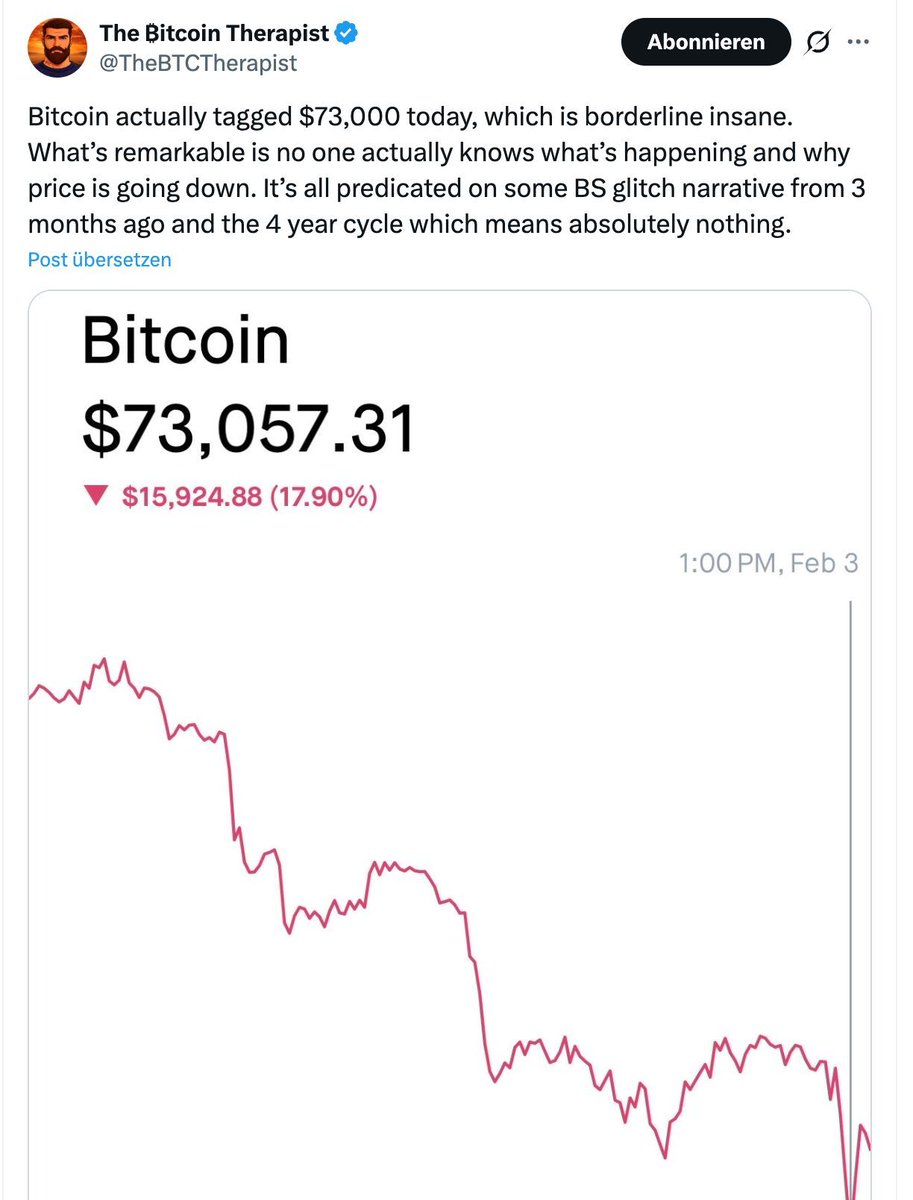
🚨 WARUM "250K FOLLOWER" INFLUENCER NICHT VERSTEHEN WAS PASSIERT
#Bitcoin fällt und die Großen auf CT sagen: "Ich weiß nicht warum."
250.000 Follower. Keine Erklärung. Einfach Schultern zucken.
@PortfolioXpert hat eine Analyse gepostet die es auf den Punkt bringt. Und ich bin da weitgehend bei ihm.
Die meisten denken immer noch, dass On-Chain Supply den Preis bestimmt. 21 Millionen #Bitcoin. Knappheit. "Number go up."
Das war mal richtig. Ist es nicht mehr.
Der Moment in dem Cash-Settled Futures, Perpetual Swaps, Options, ETFs, Prime Broker Lending, Wrapped BTC und Total Return Swaps auf die Chain gelegt wurden, war der Moment in dem die Knappheit aufgehört hat zu existieren.
Nicht On-Chain. In der Preisfindung.
Ich erinnere euch an meine Silber-Analyse von Ende Dezember. Dort habe ich gezeigt wie Banken über Rehypothecation denselben Silberbarren an dutzende Kunden gleichzeitig verkauft haben. Dasselbe Prinzip. Anderer Markt.
Jetzt passiert es bei #Bitcoin.
Ein einzelner BTC kann heute gleichzeitig als Grundlage dienen für:
→ Eine ETF-Unit
→ Einen Futures-Kontrakt
→ Einen Perpetual Swap
→ Ein Options-Delta
→ Ein Broker-Loan
→ Eine Structured Note
Sechs Ansprüche auf eine Coin. Das ist kein freier Markt. Das ist ein Fractional Reserve System.
Die Zahlen:
→ #Bitcoin Open Interest: ≈$49,6 Milliarden
→ ETF Holdings: ≈1,27 Millionen BTC (≈$90,7 Mrd. AUM)
→ Spot Volumen 24h: ≈$17,7 Milliarden
→ Futures Volumen 24h: ≈$141,3 Milliarden
Lest das nochmal. Futures-Volumen ist 8x so groß wie Spot. Die Preisfindung findet nicht mehr auf der Chain statt. Sie findet in Derivaten statt.
Wall Street macht genau das, was sie in jedem Rohstoffmarkt gemacht haben:
→ Unbegrenztes Paper-BTC erzeugen
→ In Rallys reinshorten
→ Liquidationen erzwingen
→ Tiefer covern
→ Wiederholen
Gold, Silber, Öl – überall dasselbe Playbook. Und jeder der sagt "bei #Bitcoin ist das anders weil Blockchain" hat nicht verstanden, dass der Preis schon lange nicht mehr auf der Blockchain gemacht wird.
@BritishHodl nennt das die "Doom & Gloom Boomer Narrative" und sagt, die Leute haben einfach verkauft. Kurzfristig stimmt das – ETFs haben allein in 30 Tagen über $3 Milliarden an Outflows gesehen.
Aber das ist das Symptom, nicht die Ursache.
Die Ursache ist, dass Wall Street jetzt die Infrastruktur hat, um den Preis in beide Richtungen zu bewegen – unabhängig von der On-Chain Supply. Genau wie @PortfolioXpert beschreibt.
Für mich als Investor heißt das: Die Spielregeln haben sich geändert. Ich schaue auf Open Interest, Funding Rates, ETF Flows und Liquidation Levels – nicht auf Stock-to-Flow allein.
Die 21 Millionen BTC existieren noch. Aber für die Preisfindung sind sie irrelevant geworden.
Wer das nicht versteht, verliert. Egal ob 250.000 Follower oder 250.
x.com/TheBTCTherapis…
Deutsch
Hope that could save a few late longs.
I am more than just irritated at the fact I did not perform as well as I could have so far this year.
$SNDK could have trailed better long
$SLV put on the risk too soon and didn't give myself the chance
$GLD ended up trading somewhat scared and BP restricted.
Alone those three should have been a 50% start this year.
Lots of work to fix this and never let it happen again.
Creating a new personal alert system backed by a 25y database including expectancy, win rate, targets, live alert for the parabolic short.
Creating a new trail system I should have put in place a few months back at least.
It's fine for me to slip up from time to time, but I sure will work as hard as I need to to fix the issues.
English
Trying out @carrotfunding right now — looks promising so far. Clean UI, smooth flow, and actually feels user-friendly. Curious to see how it develops. 🚀
English
AK retweetledi
This action today is not that surprising.
I still believe and as I wrote yesterday, that the big story is the $GOOGL TPU breakthrough.
You have 500b+ Capex and dozens of deca-billion commitments that got baked into the market.
The entire market has been narrow in those names that have abused both accounting metrics via longer depreciation cycles (most 4y to 7y) and via mutual investment promises boosting earnings on top.
Within 1 day, $GOOG showed us that the entire thing might be for nothing.
CDS have been pointing towards upcoming stress in the GPU lenders such as Coreweave $CRWV, Nebius $NBIS, $ORCL... We had no reason for it until the $GOOGL gemini 3 move.
This was a Deepseek type moment in my view.
The market had been pulling back since September, slowly drifting from layer to layer until the biggest layer fell apart.
-Crypto first at the start of September
-Unprofitable and growth at the start of October
-AI capex layer at the start of November
$NVDA earnings showed us the past, OpenAI frantically trying to close on deals too.
Now do we see the market segments that have been suffering take inflows from AI and lead, resulting in a sideaways market and new structure while the laggards take control or do we see panic and beta move towards 1 in a cascade of pain... Time will tell.
The main questions were laid out yesterday but I'll reiterate in the follow-up below.
English
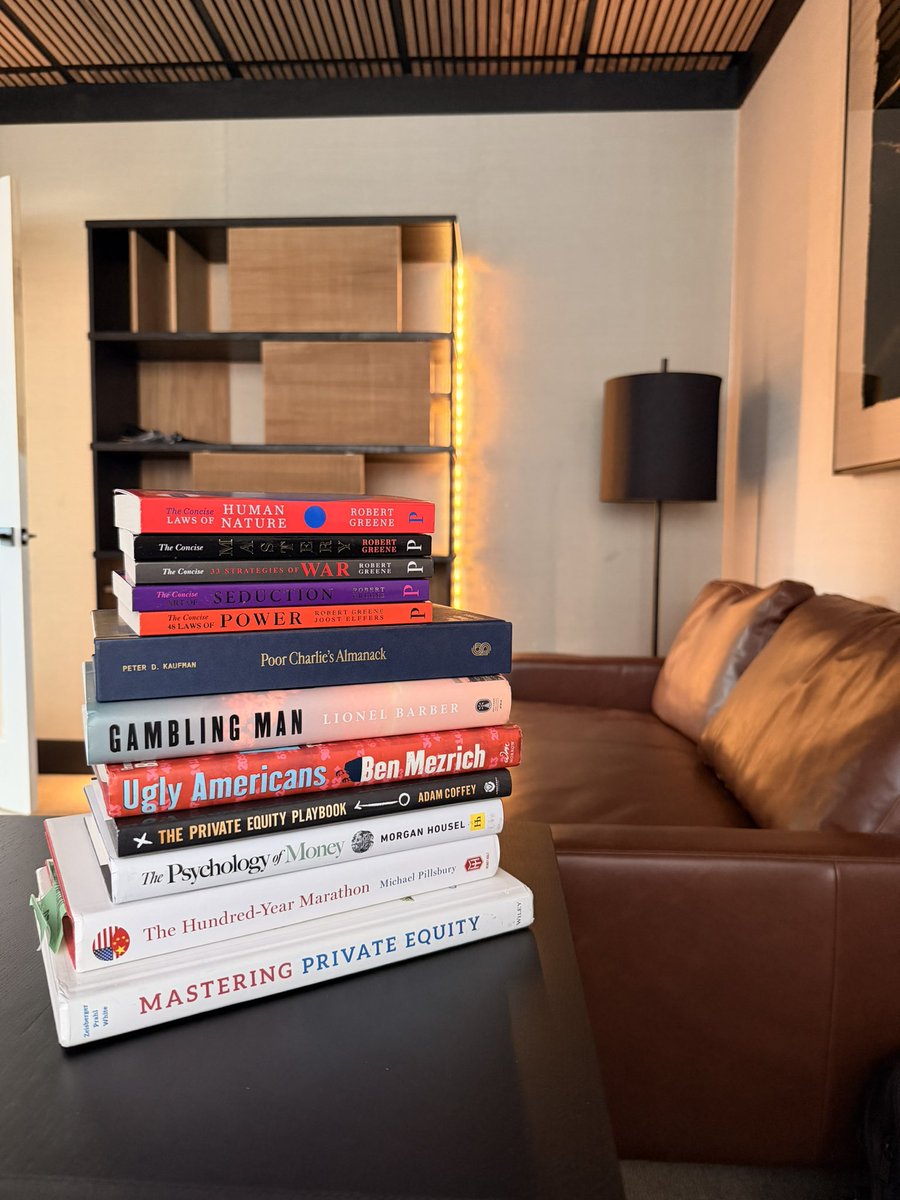
Few new reads.
Art of war, power, laws of human nature and the psychology of money are rereads and because I wanted the physical book as I build out my library.
I have about 5 more coming.
I’m most excited about 1929 by @andrewrsorkin
English
@TheShortBear Big thanks @TheShortBear 🙏🏼 Would love to read more of this!
English

Back to back top 5 intraday.
$QBTS $RGTI
Thought I would share my review.
English
AK retweetledi
Our Profession.
You come to realize one of the market’s great paradoxes: absorbing a loss under fire is an almost mechanical act, a quiet surrender to the inevitable.
The true crucible of character, however, is found in choosing to walk away from the table when the cards are falling in your favor, especially as the bets grow wilder and the intoxicating pull of the final, collective wager tempts everyone to go all in.
And the truth, much like in Poker, is that the table is not designed for everyone to win. By its very nature, the market funnels the winnings into the hands of a disciplined few. To find yourself moving in unison with the crowd, feeling the comfort of shared conviction, is often the final assurance that you are no longer the hunter, but the prey.
The discipline to rein in risk during a market crescendo requires a quiet courage that is rarely celebrated. The world will always cheer louder for the gambler who goes all-in and wins than for the strategist who loses less than everyone else.
This path demands a solitary mind. You must stand firm in your own logic when the only seemingly rational choice is to surrender to the street's roar.
It’s the loneliest job in the world, yet it’s also the most clarifying.
After enough seasons have passed, after 90% of the voices you once knew have fallen silent, you realize the market is a relentless mirror.
In the end, it shows you exactly what you're made of.
English
To follow up further on risk vs value.
The current bid into the FOMC is pushing risk assets strongly.
$ARKK is on the verge of a multiweek breakout, many risk assets e.g $IONQ, $TSLA... are breaking out.
Perhaps this trend will only intensify after FOMC but I am staying conservative ... are breaking out. g value right now and more specifically emerging markets and defensive stocks.
I believe we will eventually see this rate cut cycle as one that will need to be accelerated through a slowdown and that risk will turn into defensive.
Perhaps this is too conservative, but at this specific time, I want to remain with current positions and trail until I get stopped out on oversize following recent initial sells.
I stand at +232.88% on the year today going into FOMC and will simply let the market tell me where we will end the year, while behaving in a conservative stance riding my winners.
No rush but no foolishness allowed at this intersection.
Top drivers this year:
1. Healthcare insurers ( $UNH $CNC $ELV)
2. China ( $BABA $PDD)
3. Latin america ( $MELI $NU)
4. US value & growth ( $UBER $BN)
Lackluster but small: $PYPL $ARGT
happiest to see that I cut size on my losers and added to my winners throughout the year while being extremely aggresive in key areas and during panics.
Contrarian at extremes and trend following this value recovery and expansion.
Steps taken in the past quarters.
1. Latin america appreciates while initiated Chinese positions put me under pressure, leading to a zear of sideways but more and more potential from business growth and value
2. China initial rally on the bazooka stimulus
3. $MELI pullback and China stimulus lacks calrity putting the portfolio back under pressure
4. China shows they can compete with AI and optimism grows that a deal will be reach between the US and China while MELI rallies back into ath.
5. Tariff news hits and tantrum ensues (cut a lot of size and added it back with major luck within 30min of the major bottom in April)
6. Portfolio rallies back and consolidates near ath and I see the healthcare insurers as my next major pitch
7. Current day: China and US healthcare insurers lead the portfolio into a parabolic looking all time high while MELI rests.
The bulk of my growth came from absolute conviction during the darkest times and swinging the bat. A contrarian entry followed by a trend follow and pyramided style.
A combination of low positoning, pessimism, business growth and low multiples as well as technical pattern combining into THE opportunity.
Each time the ideas were hated, each time it was 'too risky', each time the same players ended up chasing way higher.
The path was scary at times, my resolve was tested but having been in this game long enough to go through hundreds of pullbacks helped to numb the emotions and sharpen the objectivity.
I remained focused on staying calm, cool and collected as I now trail and protect, letting the market dictate my final result, while most ramp up exposure.
Result: 232.88% ytd

English
AK retweetledi

This is remarkable:
The global stock market cap to global GDP ratio is now at 117%, the second-highest in history.
This ratio has increased by 27% over the last 5 years and sits only below 2022 levels.
Since2008, global market cap has risen twice as fast as as global GDP.
To put this into perspective, at the 2000 Dot-Com Bubble peak, this percentage was at 110%.
Meanwhile, the US stock market cap to GDP ratio has reached a massive 201%, just 4 percentage points away from an all-time high.
Valuations are rising far faster than economic growth.

English