Kotty

371 posts

Kotty

Kotty

@Kotty_111

Katılım Ağustos 2022
49 Takip Edilen291 Takipçiler
Kotty retweetledi
The Yoruba Times
The Yoruba Times@TheYorubaTimes·
WATCH: An Ebira cleric blows hot — ‘My response to Oyo people who have the guts to reject Sharia law in Oyo State is that y’all are mad, and if you come to us to say nonsense, we will beat you mercilessly. The Sharia Law Council will hold in Oyo, and it’s coming to Osun too.’ — Mufti of Iwo
English
64
60
99
10.5K
Ọlá-Bọ́lá™ ©
Ọlá-Bọ́lá™ ©@theOlaBola·
Leaving it at ‘ice cream’—in a way that conforms to the sound patterns of Yoruba language—is the way to go: e.g. ‘áís'k'rim[ù]’. Let’s not forget how ‘mọ́í-mọ́í’ ≠ ‘bean-pudding’, yeah similar energy.
Science in Yoruba@Sci_in_Yoruba

Ice cream

English
2
5
22
1.3K
Kotty
Kotty@Kotty_111·
@Sci_in_Yoruba Aisikirimu is good enough. It's a unique foreign cuisine, of which we don't have an equivalent, therefore we should keep as a loan word.
English
1
0
5
141
Kotty retweetledi
Àrẹ̀wà AKÍNKANJÚ
Dear reasonable and ogidi yoruba people, this is Adebayo Shitu, one of the people who invited Sheik Gumi to Ibadan few months ago. The same Shitu who says that Sharia laws must be implemented in Oyo state and Yorubaland as a whole is proposing to be the next Oyo state governor. Now, what is the aim of that meeting they had in Oyo with the Islamic terrorist sympathizer Gumi?
Àrẹ̀wà AKÍNKANJÚ tweet media
English
99
454
726
55.9K
Big Bammo
Big Bammo@Big_Bammo1213·
@Kotty_111 Please let's have her profile details so we can start with her. She shouldn't be allowed to win the primary there. We need bold yorubas to represent us on our soil.
Ikeja, Nigeria 🇳🇬 English
1
0
21
1.1K
Kotty
Kotty@Kotty_111·
'Eti Osa is a multi lingual country. It is not all about Yoruba Yoruba' - Antonia Akinlagun, contestant for Lagos state House of Assembly (Eti Osa Constituency II). Awon "No man's land" gang.
English
51
27
75
19.1K
Kotty retweetledi
Zamani
Zamani@Zamani_WLK·
In Yoruba society a woman did not need her husband’s status to matter. Yoruba women controlled the market system, set prices and built independent wealth centuries before feminism had a name. The culture always knew what a woman was capable of. It simply let her prove it.
English
8
117
422
3.5K
Kotty retweetledi
Folake
Folake@BoldlyNigerian·
Don’t vex for me o, I don’t like when people give their estates & cities in Lagos English names. All these “something fields” “something mews” “something view” “something heights” “court”😂 See how beautiful Eko Atlantic, Alaro City, Ilubirin, & co sound They sound prestigious
English
55
403
1.9K
35.7K
Kotty retweetledi
Oyíndà
Oyíndà@yorubachic·
Ishapa is a type of Yoruba soup made from tangy white zobo leaves.
English
38
248
962
15.3K
Bayo Bilisi (Back Up)
Bayo Bilisi (Back Up)@Bayo_Bilisi·
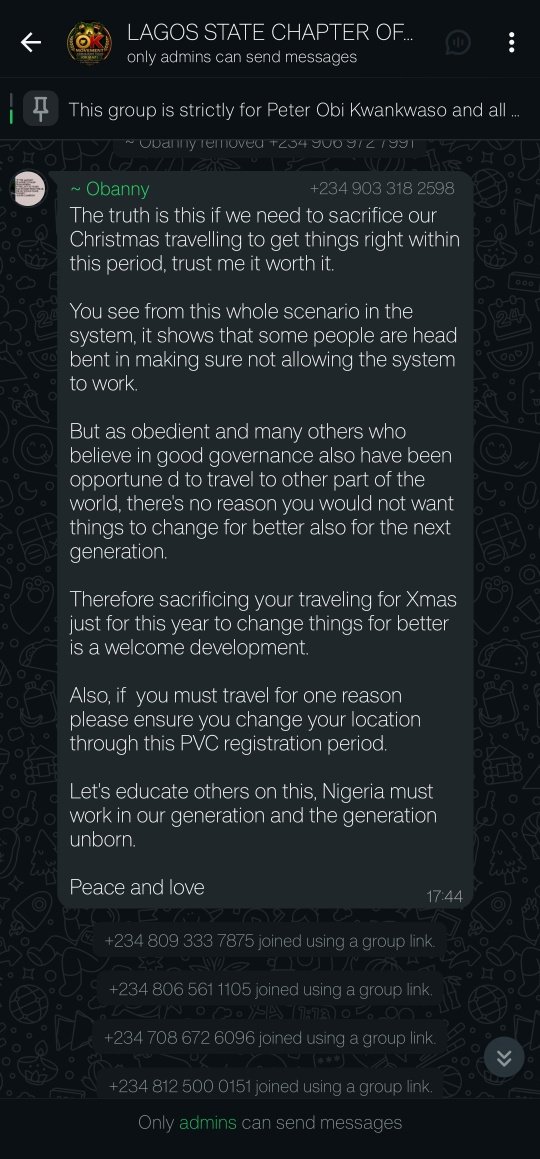
The format remains unchanged... See the person who claimed to be a prince from Adeyemi Ruling House... Advising his fellow Igbos not to travel home for Christmas... Asking them to transfer their PVCs to Lagos... Open your eyes very well... Any non-Yorùbá dominated church or gathering in Lagos you see inviting INEC to organise PVC registration... Please alert me!
Bayo Bilisi (Back Up) tweet media
English
47
227
557
15.1K
Kotty retweetledi
Remi
Remi@tolutee·
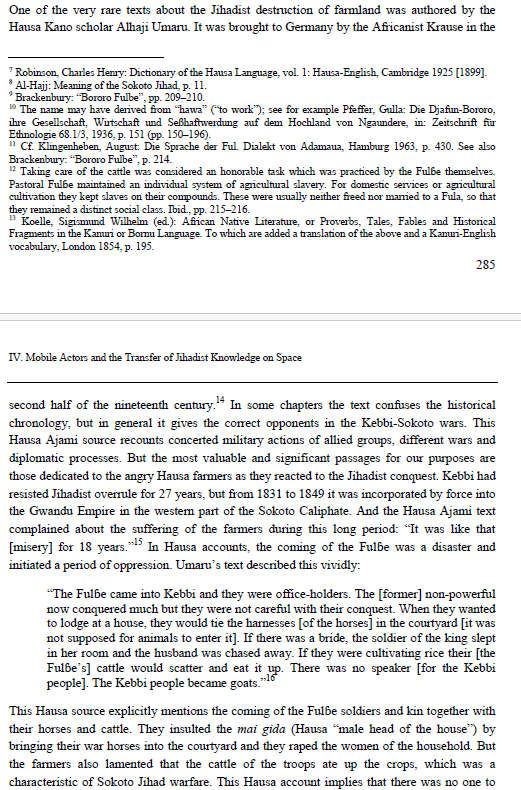
Some claims are ludicrous. To assert that the Fodiawa jihad was not a conquest of the Hausas is one of the most ahistorical arguments one could make. The fact that the jihad’s proponents invoked religious motives does not erase the reality that it also served as a vehicle for Fulani ascendancy. When you dispossess people of their land, redistribute it among your own or supporters, create a system that reduces them to second-class citizenship, and take liberties to violate their daughters and wives, as occurred in parts of the so-called caliphate, then what else is that but conquest? The problem with much of the writing on the jihad is its adulatory tone, with most accounts produced either by Fulani authors or scholars sympathetic to their cause. When these are compared with rare manuscripts written by non-Fulani, a different picture emerges. One example is the work of the Kano scholar Alhaji Umaru, cited in the attached text. His manuscript describes how the Fulani employed herdsmen-style terror (using war horses and cattle to trample the agricultural fields of Hausa farmers - sounds familiar, right?) and how the rape of Hausa women became habitual. Even if one hesitates to call this a caliphate-sanctioned practise, the practices were so widespread and institutionalized that the Kebbi Hausas launched multiple uprisings against Fulani rule. I'm neither for nor against the Hausa Zalla movement. The annals of human history are littered with conquest and subjugation, and the Fodiawa jihad is no exception. What I do support, however, is this: the reclaiming of Hausa historical agency and the challenging of narratives that have long glorified the conquerors while hiding behind a deceptive hyphenated identity must not be denied to the people.
Remi tweet media
English
0
12
15
489
Kotty
Kotty@Kotty_111·
@omolisabi1 But Yayi is from Isaga Orile which is in Abeokuta north local government. Are you denying your local government brother?
English
0
0
0
81
Ààrẹ Ayọ̀dèjì
Ààrẹ Ayọ̀dèjì@omolisabi1·
Continuation: The only settlements the Yorùbá themselves regard as “new” are those that emerged from the turbulence of their own 19th-century wars cities like Ìbàdàn, Abẹ̀òkúta, Ṣàgámù, Modákẹ́kẹ́, Ayédé-Èkìtì, and Òkè-Àgbè in Àkókó. *What European Explorers Found* The first European expedition to penetrate the interior of Yorùbáland arrived in 1825–26, led by the Englishman Hugh Clapperton. Entering from Badagry and traveling northward through the lands of the Yewa and Ọyọ́ sub-groups toward Ọyọ́-Ilé and beyond to the River Niger, Clapperton and his men became the first outsiders to document Yorùbá urban life from the inside. What they recorded was not what many Europeans of that era expected to find in the African interior. Clapperton’s journal repeatedly described Yorùbá towns as clean towns well-ordered, well-kept, and visually impressive. The expedition noted towns studded with clean habitations and called them pleasant towns. The approach roads into many of these cities were lined with trees, described as passing through a beautiful walk of trees or a spacious avenue of noble trees. The explorers were also struck by how thoughtfully the towns were situated within their landscapes. One large town was described as delightfully placed on rising ground, commanding a wide and noble view. Others were noted as seated on a gentle slope, or perched on the highest hill in the region locations chosen not just for defense, but seemingly for beauty and grandeur. Towns like Ìjànnà in Yewa and Ṣakí in Ọyọ́ were specifically noted as thickly populated bustling, lively centers of Yorùbá life. ©Ààrẹ Ayọ̀dèjì
Tiếng Việt
1
2
3
208
Ààrẹ Ayọ̀dèjì
Ààrẹ Ayọ̀dèjì@omolisabi1·
Yorùbá Towns, Villages and Homes Part One: Cities and Urban Life. The Roots of Yorùbá Urbanism Few peoples in the history of Africa can claim an urban tradition as deep and as distinctly their own as the Yorùbá. Long before European explorers set foot on the coasts of West Africa in the 15th century, the Yorùbá had already been building, inhabiting, and expanding towns and cities for hundreds of years. Their story is not one of villages that slowly grew into towns it is the story of a people who chose the city as their natural home, and built a civilization around that choice. *A Thousand Years of City Building* The Yorùbá people began settling in towns and cities as far back as the 9th century AD. Over the centuries that followed, they did not stop they built more, and they built bigger. By the 18th century, large walled towns and cities stood only a few miles apart across most of Yorùbáland, forming one of the densest networks of urban settlements in all of precolonial Africa. Each of these towns was not merely a collection of houses. It was a seat of power. Every main town was the home of a king (an Ọba) whose authority extended outward into the surrounding forest and the villages within it. The town was the center; everything else orbited around it. Some of the greatest of these cities were destroyed in the devastating wars of the 19th century. Yet even this did not break the urban spirit of the Yorùbá. Where old cities fell, new and even larger ones arose elsewhere in Yorùbáland, as if the people themselves could not conceive of any other way of living. *A People Psychologically Rooted in the City.* What makes Yorùbá urbanism truly remarkable is not just its age or its scale it is how deeply it shaped the Yorùbá identity. Even people who lived in the small villages and hamlets scattered between the great towns did not think of those villages as home in any permanent sense. Ask them where their home was, and most would point to a family compound in a nearby city or town. After a thousand years of urban living, the Yorùbá had become, in the most fundamental sense, city and town dwellers not just in practice, but in their psychology, their culture, and their sense of self. Scholars of African history recognize them as among the most urbanized peoples in the history of tropical Africa. *How Large Were These Cities?* The sheer size of Yorùbá cities before the colonial era challenges many assumptions about pre-industrial African societies. While precise population figures are difficult to establish scholars have had to rely partly on measurements of old city walls educated estimates paint a striking picture. The ancient city of Ilé-Ifẹ̀, spiritual heartland of the Yorùbá, likely held a population of over 70,000 at the peak of its greatness in the 14th century. By 1750, the imperial city of Ọyọ́-Ilé may have housed as many as 150,000 people a figure that would have made it comparable to many of the great cities of the world at that time. By the 1870s, Christian missionaries traveling through Yorùbáland estimated that Ìbàdàn had a population of around 100,000. But this figure is now considered a significant undercount. Historical records show that at that same period, Ìbàdàn alone had over 100,000 men under arms at various locations across the country making a total city population closer to 200,000 by around 1880 far more plausible. Cities like Abẹ̀òkúta, Ilẹ̀şà, and Ìjẹ̀bú-Ọ̀de were also considered major population centers, while eastern Yorùbá cities such as Adó-Èkìtì, Ọ̀wọ̀, Ìkéré, and Àkúrẹ́ likely rivaled them in size. Crucially, unlike many parts of Africa, Yorùbáland has no colonial-era towns. No Yorùbá city owes its existence to a European mining camp, a colonial port, or an administrative headquarters. Every single Yorùbá town and city existed before the 20th century.
Ààrẹ Ayọ̀dèjì@omolisabi1

Writing a series on Yoruba towns, villages, and homes

English
1
8
14
1.4K
Kotty
Kotty@Kotty_111·
@omolisabi1 Your people have just been clowning around 😂
English
2
0
1
217
Ààrẹ Ayọ̀dèjì
Ààrẹ Ayọ̀dèjì@omolisabi1·
Egba people, you don't own land in Lagos. This thing you people are dragging, don't let them go bring our history out; it's not nice at all. I have seen some of it. Let's just face front, don't set yourselves up.
English
13
8
26
2.4K
dotun odumosu
dotun odumosu@dotunodumosu·
You can’t stretch identity to fit narratives. Egbas are indigenous to Ogun State, not Lagos. Same way Ota is clearly not “Egba land” no matter how many times it’s claimed. Egbas = Indigenous to Ogun State Aworis = Indigenous to Lagos & Ogun Ijebus = Indigenous to Ogun & Lagos.
Man of Letters.@Letter_to_Jack

Ogun State and Lagos State are intertwined by ancestry from ALL sides. Egbas are indigenous to Lagos State, Egbas are indigenous to Ogun State. Aworis are indigenous to Lagos State, Aworis are indigenous to Ogun State. Ijebu’s are indigenous to Lagos State, Ijebu’s are indigenous to Ogun State. Lagos and Ogun State are siblings in every sense of the word.

English
23
12
30
35.8K
Kotty
Kotty@Kotty_111·
@theOlaBola @akogunsmith he is obviously ignorant of the chronology of Yoruba unrest in the hinterland.
English
0
0
1
57
Ọlá-Bọ́lá™ ©
Ọlá-Bọ́lá™ ©@theOlaBola·
Yes, every part of “Lagos State” (actually beyond the present boundaries) was in the Lagos Colony. . . Egba people escaped down from the interior into Abeokuta for refugee, hiding & watching in 𝟭𝟴𝟯𝟬. So yeah they didn’t found any town 70km further south (while in that ‘under-rock’ hideout) in 𝟭𝟴𝟯𝟬. . . Abule-Ẹgba goes back to the 1860s resettlement by Glover. They were resettled into part of Ebute-Metta (to be Agọ-Ẹgba) while part of Ọpẹbi (to be Abule-Onigbagbọ), & parts of Ọgba (to be Abule-Ẹgba) as farmlands for the resettled fleeing Egba. ————— 🛑Don’t be like Igbos. It is more than disgraceful
Akogun Smith@akogunsmith

Was Abule Egba part of Lagos Colony? Abule Egba town was founded by Egba people around 1830 before colonization, but you’re confusing it with the persecuted CMS Missionaries and their Egba coverts that were resettled by Governor Glover around Ebute Meta in 1867 after Ifole riot.

English
3
2
8
850