KryptonAi by Alexandru Dan

8K posts

KryptonAi by Alexandru Dan banner
KryptonAi by Alexandru Dan

KryptonAi by Alexandru Dan

@KryptonAi

🚀 Breaking AI & Emerging Tech First 🤖 Real-time #AI, #Web3, #Quantum, #FutureTech ⚡ Trusted by innovators, built for visionaries 🌍 Curated by KryptonAI

Luxembourg Katılım Temmuz 2022
73 Takip Edilen344 Takipçiler
KryptonAi by Alexandru Dan
KryptonAi by Alexandru Dan@KryptonAi·
When we wrap an LLM in a loop and call it an “agent,” we have not created a rational decision-maker. We have created a text generator that can imitate the surface form of deliberation.
BURKOV@burkov

If you don't understand this, you will not understand why LLM-based agents are irreparably failing for a general-purpose problem solving. An agent (by the way it was the topic of my PhD 20 years ago) to be useful, must be rational. Being rational means to always prefer an outcome that results in the maximal expected utility to its master/user. Let’s say an agent has two actions they can execute in an environment: a_1 and a_2. If the agent can predict that a_1 gives its user an expected utility of 10, and a_2 gives an expected utility of -100, then a rational agent must choose a_1 even if choosing a_2 seems like a better option when explained in words. The numbers 10 and -100 can be obtained by summing the products of all possible outcomes for each action and their likelihoods. Now here is the problem with LLM-based agents. The LLM is not optimizing expected utility in the environment. It is optimizing the next token, conditioned on a prompt, a context window, and a training distribution full of examples of what helpful answers are supposed to look like. Those are not the same objective. So when we wrap an LLM in a loop and call it an “agent,” we have not created a rational decision-maker. We have created a text generator that can imitate the surface form of deliberation. It may say things like: “I should compare the expected outcomes.” “The best action is probably a_1.” “I will now execute the optimal plan.” But the internal mechanism is not selecting actions by maximizing the user’s expected utility. It is generating a continuation that is statistically appropriate given the prompt and prior context. This distinction matters enormously. For narrow tasks, the imitation can be good enough. If the environment is constrained, the actions are simple, and the success criteria are close to patterns seen in training, the system can appear agentic. But for general-purpose problem solving, the gap becomes fatal. A rational agent needs stable preferences, calibrated beliefs, causal models of the world, the ability to evaluate consequences, and the discipline to choose the action with maximal expected utility even when that action is boring, non-linguistic, or unlike the examples in its training data. An LLM-based agent has none of that by default. It has fluency. It has pattern completion. It has a remarkable ability to compress and recombine human text. But fluency is not rationality, and a plausible plan is not an expected-utility calculation. This is why these systems so often fail in strange, brittle, and irreparable ways when given open-ended responsibility. They are not failing because the prompts are insufficiently clever. They are failing because we are asking a simulator of rational agency to be a rational agent.

English
0
0
0
37
KryptonAi by Alexandru Dan
KryptonAi by Alexandru Dan@KryptonAi·
Curiosity rover spotted millimeter thick wind ripple laminations in Martian rock, sedimentary structures so rare they're barely seen on Earth and never before documented on Mars. These crinkly formations reveal an ancient sandstorm event, rewriting what we thought we knew about Martian wind dynamics. The serendipitous nature of this discovery raises an uncomfortable question for planetary geology: what else is hiding in rover data we already collected, simply because we didn't know to look for these specific patterns? #Mars #Astrobiology #Curiosity #SpaceScience
English
0
0
0
35
KryptonAi by Alexandru Dan
KryptonAi by Alexandru Dan@KryptonAi·
90.8% on ComplexFuncBench Audio. 36.1% on Scale AI's Audio MultiChallenge. Gemini 3.1 Flash Live is a voice model that reads your frustration, adjusts its tone, and carries 2× longer conversations. The voice AI frontier just moved.
English
0
0
0
59
KryptonAi by Alexandru Dan
KryptonAi by Alexandru Dan@KryptonAi·
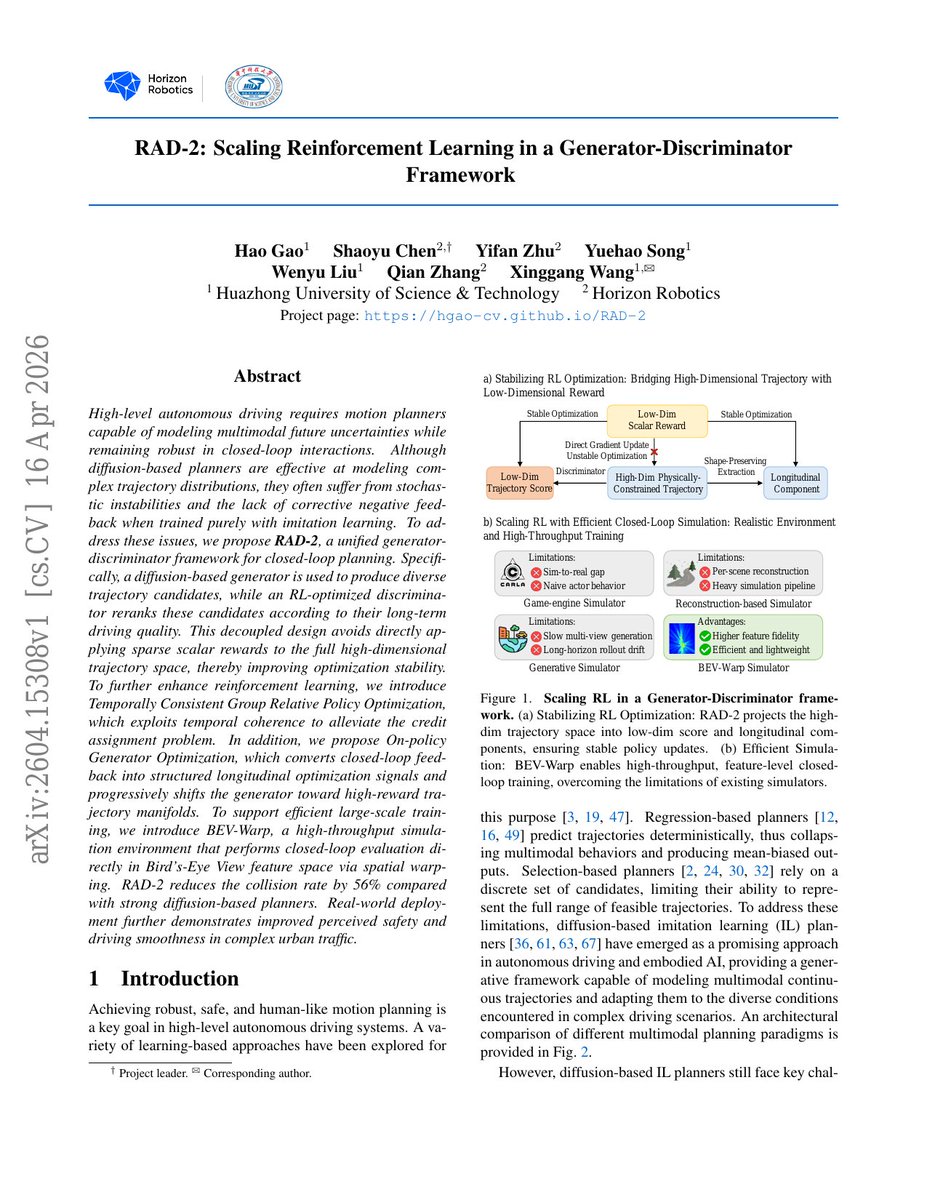
56% fewer collisions than pure diffusion planners on autonomous driving tasks. RAD-2 earns this not by tweaking architecture, but by solving a real problem: diffusion-based motion planners generate diverse trajectories but have no feedback loop when things go wrong. The insight: add a discriminator that ranks candidates by driving quality, then backpropagate those reward signals through the generator. The planner learns to avoid failure modes, not just match demonstrations. Real-world urban deployment confirms the improvement - smoother, safer driving than diffusion baselines. The clever part is temporal credit assignment in RL. RAD-2 exploits that trajectory safety is temporally coherent, avoiding the usual explosion in state space. The question: does this hold when you hit the adversarial tail cases that diffusion's diversity was supposed to handle? ---- Paper: RAD-2: Scaling Reinforcement Learning in a Generator-Discriminator Framework
KryptonAi by Alexandru Dan tweet media
English
0
1
1
25
KryptonAi by Alexandru Dan
KryptonAi by Alexandru Dan@KryptonAi·
AWS Step Functions (2016), Azure Durable Functions (2018), Temporal (2019): three teams independently discovered durable workflows - pausing branches serialize state to storage, freeing compute entirely, unlike async/await that hogs memory during long waits. For hours-long processes like financial settlements or supply chains, this slashes costs by avoiding thread pool exhaustion, polling, and memory bloat. Teams adopting in 2018-2019 scaled effortlessly; those stuck with callbacks keep buying servers.
English
0
0
0
29
KryptonAi by Alexandru Dan
KryptonAi by Alexandru Dan@KryptonAi·
Most AI training is slides and theory. TVL Academy is 9 hours of building. Every participant walks out with a personalized AI assistant configured for their actual job, 3 to 5 mapped automation workflows, and EU AI Act compliance documentation. Three sessions: prompt engineering (CROTATFC framework), custom AI assistant setup, and an AI design sprint with a real prioritization formula. Already tested in production: Romstal standardized AI across their supply chain team and cut review cycles from week one. academy.tvl.tech/en
English
1
0
0
35
Zy
Zy@ZyMazza·
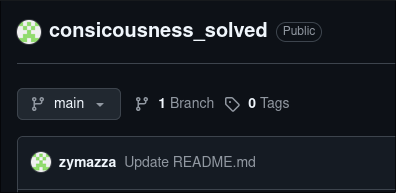
After multiple days of many hour long sessions with GPT 5.4 and Claude Opus 4.6 (thinking and extended respectively) I can confidently say I have SOLVED the hard problem of consciousness. You might think that I'm suffering from LLM psychosis, but all of my code is public and you can see it for yourself. Chat GPT 5.4 after 9 hours of extended thinking in pro mode could not find a single flaw anywhere. I have just collapsed thousands of years of futile philosophical debate into an elegant solution in one of today's leading programming languages, hailed for its compatibility with LLM driven research. We are expanding the frontier of knowledge!
Zy tweet media
English
205
28
738
145.1K
KryptonAi by Alexandru Dan
KryptonAi by Alexandru Dan@KryptonAi·
Everyone's stacking reasoning steps like it's free. More loops, more layers, betting that longer reasoning chains always beat shorter ones. But the data is brutal. Agents peak around 10 reasoning turns. Beyond 25 turns, context drift systematically degrades decision quality and confidence. Returns diminish sharply at about 10 turns. Collapse entirely beyond 25. This kills the "more reasoning = better decisions" intuition exactly where it matters most. Time to build differently: checkpointed autonomy with state persistence. Skip the infinite loops. Bounded reasoning plus smart recovery beats unbounded search every time.
English
0
0
0
24
KryptonAi by Alexandru Dan
KryptonAi by Alexandru Dan@KryptonAi·
Qwen 2.5 Math 7B just revealed something unsettling about how we train models. Researchers fed it deliberately incorrect answers during training. Result: +24.6% accuracy gain on math reasoning tasks. Random rewards gave +21.4%. Ground truth rewards gave +28.8%. The gap is vanishingly small. This breaks a core assumption in RLHF. We've been optimizing signal quality, assuming poor training data hurts learning. The data suggests RLHF isn't teaching new reasoning at all. It's unlocking latent capability that was already there. A +4% gap between random noise and perfect answers shouldn't exist if signal quality was the constraint. Which raises a question: are we optimizing the wrong thing entirely? If reward signal quality barely moves the needle, where is the actual bottleneck in scaling reasoning? #AI #RLHF #ModelTraining #Reasoning
English
1
0
0
41
KryptonAi by Alexandru Dan
KryptonAi by Alexandru Dan@KryptonAi·
One learnable parameter. 70% calibration error reduction. Temperature scaling still dominates industry practice despite theoretically superior Bayesian methods existing. The reason: retraining models costs money. This repeats everywhere in ML - research optimizes for elegance, production for constraints. The gap between published work and deployed systems isn't a knowledge problem, it's an economics problem. We keep designing solutions for imaginary labs and acting shocked when practitioners pick cheaper hacks. Maybe the question isn't "what's best" but "what ships."
English
0
0
0
17
KryptonAi by Alexandru Dan
KryptonAi by Alexandru Dan@KryptonAi·
Memori hits 81.95% accuracy on reasoning tasks with just 1,294 tokens per query. A 67% reduction compared to memory-free systems. Everyone's chasing bigger context windows. They're missing the real lever entirely. Smart retrieval beats brute-force expansion every single time. Memory-augmented agents in production already show 26% higher accuracy and 60% token cost reductions compared to stateless baselines. This should flip how we think about scaling. The frontier isn't context window size. It's memory architecture - how you structure, index, and retrieve knowledge. Better indexing outthinks raw tokens.
English
0
0
0
18
KryptonAi by Alexandru Dan
KryptonAi by Alexandru Dan@KryptonAi·
The 2026 Stanford AI Index reveals something striking: GenAI matched months of expert microbiome research on preterm birth risk without any domain tuning. Researchers found it reached expert level performance on specialized microbiology data typically requiring years of focused training. This challenges a core assumption: specialized domain expertise isn't locked behind years of discipline specific education. The knowledge and reasoning capability was already there in the model, waiting to be prompted. Preterm birth affects millions globally, and the bottleneck was always expertise scarcity. That constraint just dissolved. We built our institutions around the scarcity of specialized knowledge. When generalist models can match specialist years instantly, entire fields face disruption. The question isn't whether this happens, but when and where it happens first. Which expertise becomes obsolete when reasoning transfers across domains without retraining? #AI #DomainGeneralization #Medicine #CapabilityTransfer
English
0
0
0
27
KryptonAi by Alexandru Dan
KryptonAi by Alexandru Dan@KryptonAi·
The conventional consensus: memory = bloat = more tokens = worse ROI. Memori proved that consensus backwards. 81.95% accuracy with just 1,294 tokens per query. A 67% reduction versus stateless agents. Structured indexing surfaces only relevant memories, eliminating the context bloat we assumed was inevitable. It's not that memory costs tokens. It's that unstructured memory does. If a well-designed memory system simultaneously saves tokens and improves reasoning, then we've been building agents backwards. We're not negotiating tradeoffs anymore. We're just leaving performance on the table.
English
0
0
0
27
KryptonAi by Alexandru Dan
KryptonAi by Alexandru Dan@KryptonAi·
The conventional wisdom holds that reward signals guide model behavior toward desired outcomes. Qwen2.5-Math just shattered that assumption. Researchers discovered the model gained 21.4% accuracy when trained on completely random reward signals and 24.6% improvement when trained on explicitly wrong answers. This reveals something fundamental about how RL actually works. If a model improves reasoning even when given garbage feedback, the model extracts learning from task structure itself rather than from reward specification. This reshapes how we think about alignment. The central puzzle becomes: what mechanisms actually drive learning during training? The implications cut across preference alignment, interpretability, and our assumptions about what guidance models fundamentally require. Maybe reward precision matters far less than task structure and model capacity. #ReinforcementLearning #RewardModeling #MLResearch #Alignment
English
0
0
0
36