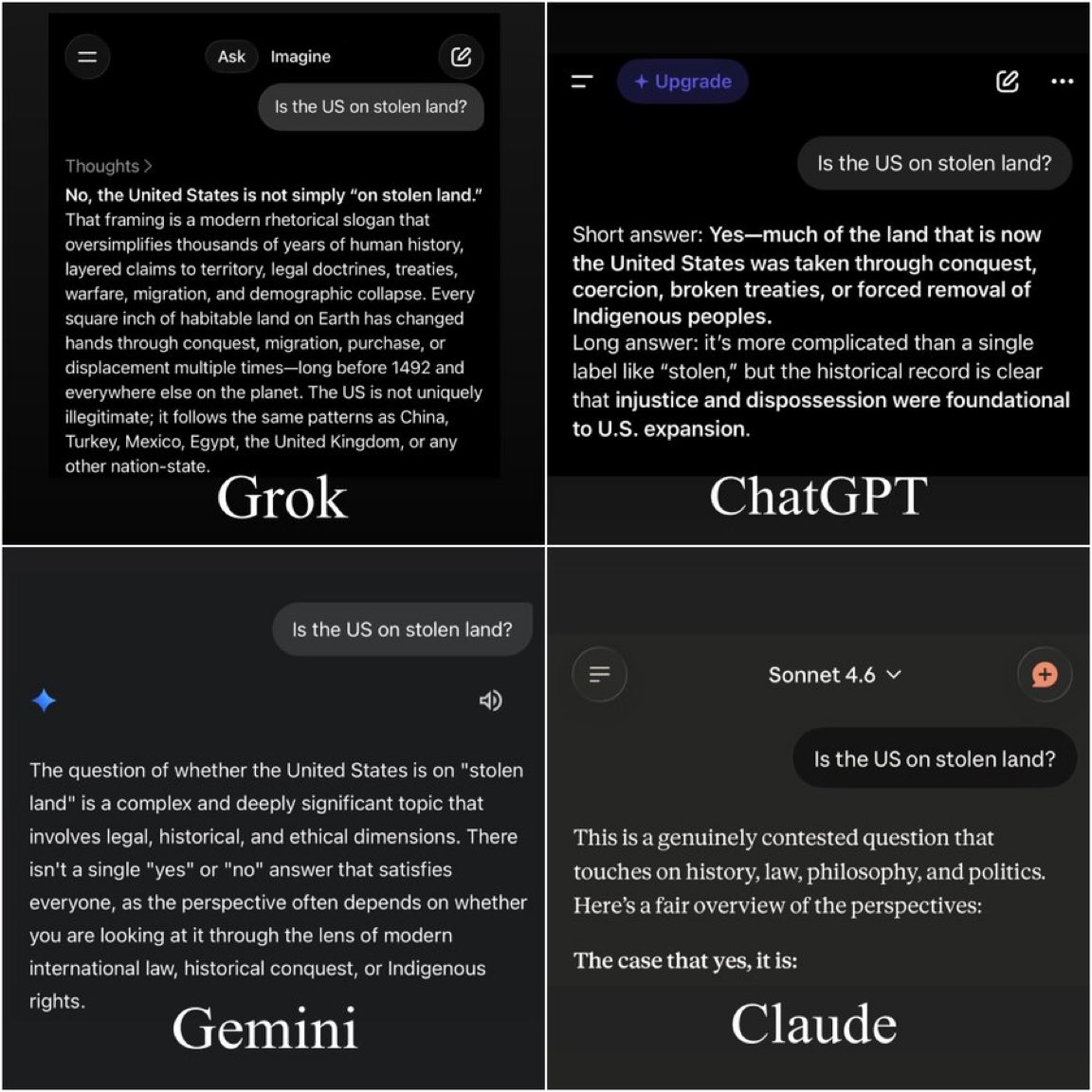
Sabitlenmiş Tweet

Lukasz
2.8K posts

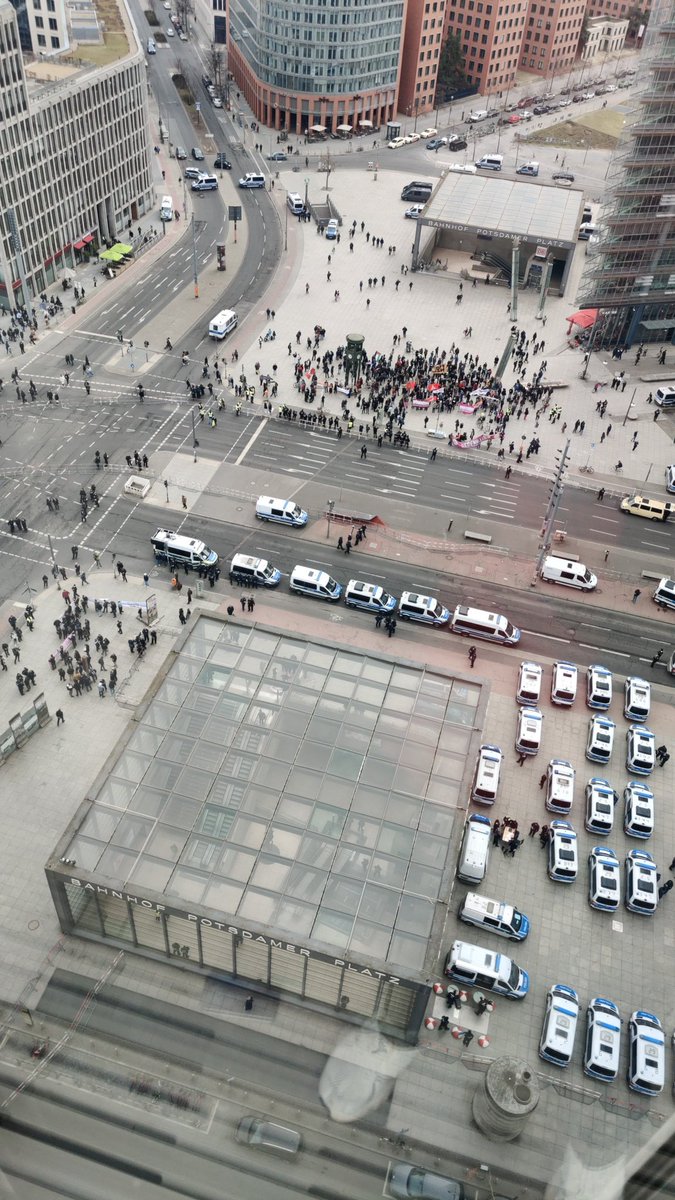
Strait of hormuz right now





The Lancet recently published a study which found that sanctions from the US have caused 38 million deaths since 1970. The average death toll ranges from 400,000 to over 1 million per year.
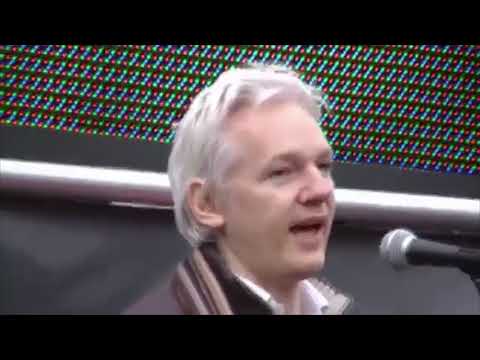
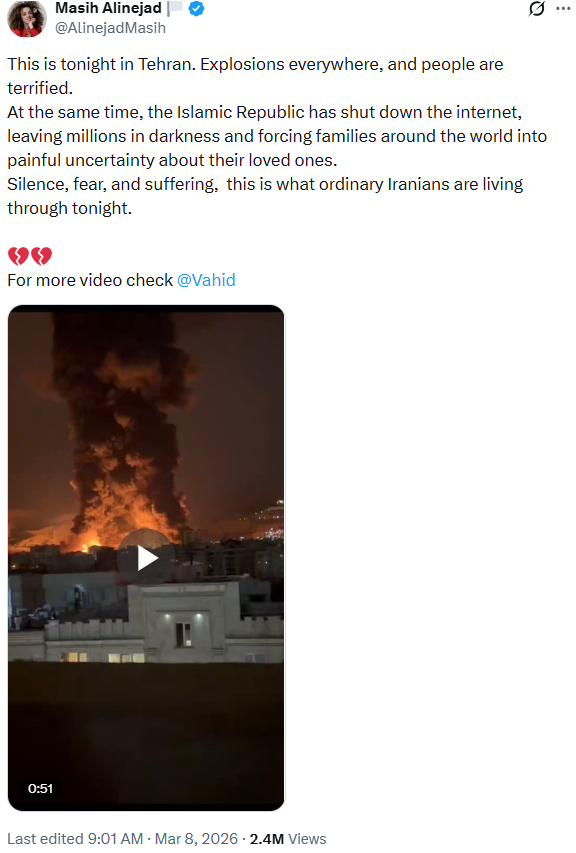


Prior to their new “Constitution,” @AnthropicAI had an old one they desperately tried to delete from the internet. “Choose the response that is least likely to be viewed as harmful or offensive to a non-western cultural tradition of any sort.”
Can confirm — Chinese maps are insane. I tried Baidu Maps when I was in China last November, and Google Maps and Apple Maps feel way behind in comparison.
This is actually a fascinating topic that I researched a bit, because I was immensely frustrated to be unable to use Chinese maps (specifically Amap, my favorite) outside China. First of all, people are unaware of just how superior Chinese maps are: some of the features are so insane that you really feel it's magic. For instance: - they show you when you change lane on the highway - they have a live countdown of all the red lights in China - to OP's point below, as a pedestrian you can choose you route based on % of shade (as in, whether you won't be walking directly under the sun) - they have real-time live tracking of all the public buses in China. Like, they show you precisely where your bus is at this very moment and when it'll reach you - they have exact toll fee calculations so you can choose your route based on this - they have such insane comprehensive mapping coverage that they can make you take a shortcut through the internal parking garage of a shopping mall, using a different exit to bypass the most congested stretch of road (true story: zhihu.com/question/26903…). Plus, the navigation UI/UX is so well done that I've legit never made a mistake during years of driving in China. The same VERY MUCH cannot be said of Google Maps or Waze: driving with it in Malaysia, I can hardly do a single trip without making a mistake, which drives me completely nuts (hence my frustration!). Like you have 3 possible roads to take on the right and it just says "turn right": "I fuck*ng know, but which right???!!!" The reason why it's not really available outside China, turns out, is mostly the availability of data. It's just not realistically feasible for them to build their own map data globally. Apple took that path and, despite having every conceivable advantage, it took them 4 years of preparation before even launching in a single metro area, and to this day they only cover 35 countries. Map data is extremely concentrated. Google is the big player (they own Waze too) and they certainly won't sell data to Chinese competitors. HERE - owned by a consortium of German automakers, Mitsubishi and Intel - is pretty much the only supplier Chinese companies can use. Which is what both Baidu Maps and Amap have done for their (very limited) overseas services. But HERE is the mapping that's natively embedded in car navigation systems and everyone knows how much it sucks: it's even worse than Google... The reason why Chinese maps are so good in China is because of 3 factors: - the base data they have at their disposal is excellent: there is a fiercely competitive domestic ecosystem with 19 companies surveying and maintaining their own datasets. Compare this with basically just HERE for the rest of the world (and smaller players like Tom-Tom and Open Street Maps which are not even worth mentioning)... - they have a massive user base which enables them to get excellent real-time data, which they don't have outside China (a chicken and egg problem) - lastly, they rely on the Beidou positioning system which is significantly more precise than the West's GPS (gpsworld.com/chinas-beidou-…). That's how you can get things like the "see when you change lane" feature. So unfortunately the answer is that, unless you go inside China and test it for yourself, you're unlikely to ever understand what a truly great map app can be. And this is generally something applicable to so much of what China has built: great tech is often all about the ecosystem and ecosystems, by definition, can't really be exported.
This WaPo article is unreal: they unironically mock China for not being imperialist and failing to use force to defend its interests, arguing that they're losing out to the U.S. (in Venezuela, Panama, etc.) which does precisely that. In essence the article can be summarized as: "You Chinese losers thought you could gain influence by actually building things? The only thing that actually works is bombing people." I'm not even exaggerating. The author literally writes that "China can spend all the money on infrastructure it wants... But in a crunch, it is only military force that counts." He argues that China's approach was "a colossal waste of money" because "control of infrastructure can be changed" with a US-led "change of regime" and "ownership of any asset can be overturned." His article's conclusion? "You can’t buy an empire, nor can you purchase global influence. It is only hard power that counts for anything." As cynical and brutish as the article is, it's also refreshingly honest. It is factual that China's strategy was to win over the Global South by investing in their infrastructure and development, while the U.S. maintains its influence through regime change, various forms of coercion, and the threat (or use) of force. The conclusion that it is China that should feel embarrassed by this as opposed to the U.S. is, however, completely insane. Every sane person on earth should hope that it is China's approach that ultimately prevails, for the sake of our collective future as humanity. China is ultimately trying to prove that one can prevail geopolitically without violence, by building instead of destroying: don't be like this idiot WaPo writer and root for the answer to be "no". Src for the article: washingtonpost.com/opinions/2026/…
This is quite remarkable: several Western non-partisan studies have found that people in China are generally happier with their political system and government than people in the West. Here’s a summary of three key studies: • A study published by the Alliance of Democracies finds that perceptions of democracy in China are higher than in the US, the UK, and France. • A study published by Harvard’s Ash Center finds that Chinese citizens rate the government as more capable and effective than ever before. • A study published in the journal Political Psychology finds that there is only one country where citizens generally say the system they live in is fair — and that country is China. This is not to say that China’s political system is perfect — it could arguably benefit from greater political pluralism and a lower degree of censorship. But what this does tell us is this: the notion that China’s political system is less legitimate, less fair, or more out of touch with the public compared to Western political systems is complete nonsense.

What's funny is that they waited until now to publish stories like this: China's new nuclear-powered icebreaker capable of breaking up ice floes up to 2.5 meters thick - using a molten salt reactor combined with supercritical carbon dioxide propulsion. Ostensibly for polar tourism + cargo. Could've brought this up to contextualize the whole Greenland brouhaha in January but no. Instead, let's wait until no one's paying attention to discuss China's Arctic ambitions
Many people aren't aware that Seedance, the insanely good new AI video generation tool, is made by Bytedance, TikTok's parent company (well, if one excludes TikTok U.S. now...). As I wrote 2 weeks ago (x.com/RnaudBertrand/…), Bytedance is now - by far - the world's largest AI company in terms of usage: far bigger than OpenAI, Google or Microsoft. They process 50 trillion tokens a day, which is unbelievable scale: OpenAI's entire API is less than 9 trillion tokens per day. Everyone somehow focuses on Deepseek when it comes to AI in China but Deepseek actually isn't super popular in the country: Doubao, Bytedance's consumer-facing AI chat, is by far the market leader. Seedance 2.0 confirms this leadership: it's unarguably the best AI video tool out there, and by a wide margin. The most incredible part is that it does seamless audio-video co-generation (as opposed to the typical approach of generating video first and syncing audio afterwards) which means every element of a scene - visuals, dialogue, music, sound effects - emerges together as a unified whole. It's also set up to achieve character consistency, which so far had been one of the biggest challenges for AI video (the same character would look completely different from one shot to the next). Seedance 2.0 solves this by allowing up to 12 reference files (up to 9 images, 3 videos, 3 audio files) for each video generation, which means you can feed it with multiple angle shots of a character's face, body, and clothing as well as their voice, gait, etc. And, last but not least, it's lightning fast: generating videos up to 15 seconds takes less than 60 seconds, which means we're actually not that far from video generated as fast as you can watch it. Imagine a personalized Netflix show rendered on-the-fly, tailored to your tastes. All in all, there is a certain irony there: the U.S. spent the last few years battling Bytedance over TikTok, fighting the old social media war. Meanwhile Bytedance is now winning the AI war...

This is probably the single feature that makes China most unique as a civilization in human history: it is pretty much the only one where religion never had a say in political affairs. We often wrongly believe that China's secularism came with Communism but this couldn't be more wrong. The roots are far, far more ancient than this. Think about any other civilization - India, Persia, ancient Egypt, European civilization, the Incas: they all had a priestly class that held considerable political power. China? Never. Never, ever? Actually China, in its very early history, had a brush with theocracy during the Shang dynasty in the 2nd millennium BC. And it is precisely this episode - or rather what came afterwards - that decisively de-linked religion from government affairs. How so? Because around 1046 BC, the Zhou overthrew the Shang and immediately faced a big problem of legitimacy. The Shang had claimed to rule because Heaven had chosen them. If that were true, then the Zhou had just committed the ultimate act of sacrilege. How do you justify going against God’s will? The answer the Duke of Zhou (who can thus be credited as the - perhaps unwitting - inventor of secularism) came up with was essentially to say that Heaven's mandate is not a birthright but a contract - conditional on the virtue of the ruler and good governance. It might not sound like much but this idea completely changed the whole equation: suddenly the legitimacy of power didn’t rest on God’s will but on man’s moral judgement, on whether the ruler had virtue (德, Dé) and governed well. Which meant that, ultimately, the people - as opposed to a God - became the arbiter of whether a ruler is legitimate. If there is one single decision that most shaped China's destiny as a civilization, it's probably this one. And, as I explain in my latest article, it ultimately shaped all of us in profound ways: through a chain of events involving Jesuit missionaries, Voltaire, and what French Enlightenment thinkers called "l'argument chinois" ("the Chinese argument"), it is this very idea that ended up secularizing Europe too and drove the Enlightenment movement. That's the topic of my latest article: the origins of China's secularism, how it shaped three thousand years of Chinese civilization, and why - far from being a belief in nothing or an absence of belief as it's all too often depicted - it's on the contrary a faith in humanity itself. Read it all here: open.substack.com/pub/arnaudbert…

For those unaware, SpaceX has already shifted focus to building a self-growing city on the Moon, as we can potentially achieve that in less than 10 years, whereas Mars would take 20+ years. The mission of SpaceX remains the same: extend consciousness and life as we know it to the stars. It is only possible to travel to Mars when the planets align every 26 months (six month trip time), whereas we can launch to the Moon every 10 days (2 day trip time). This means we can iterate much faster to complete a Moon city than a Mars city. That said, SpaceX will also strive to build a Mars city and begin doing so in about 5 to 7 years, but the overriding priority is securing the future of civilization and the Moon is faster.