LandingAI

2.9K posts

LandingAI banner
LandingAI

LandingAI

@LandingAI

API-first Agentic Document Intelligence platform built for accuracy, reliability, and governance at scale.

Mountain View, CA Katılım Aralık 2017
862 Takip Edilen9.9K Takipçiler
Sabitlenmiş Tweet
LandingAI
LandingAI@LandingAI·
We just launched a new short course with @DeepLearningAI Document AI: From OCR to Agentic Doc Extraction. This course shows how to move beyond OCR by building agentic document pipelines that preserve layout, reading order, and visual context when extracting structured data from complex PDFs and images. Free to enroll here: bit.ly/4bpV2rG
English
1
8
27
1.5K
LandingAI
LandingAI@LandingAI·
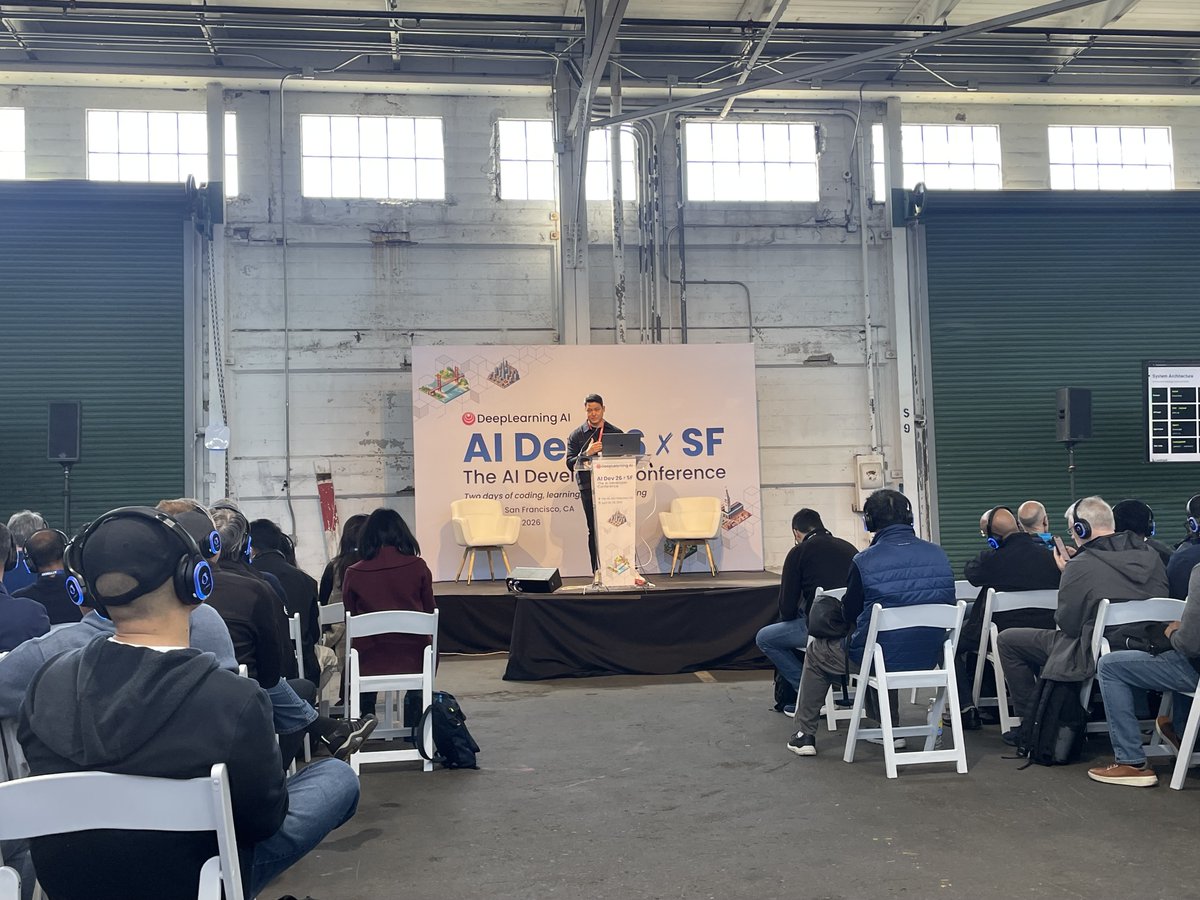
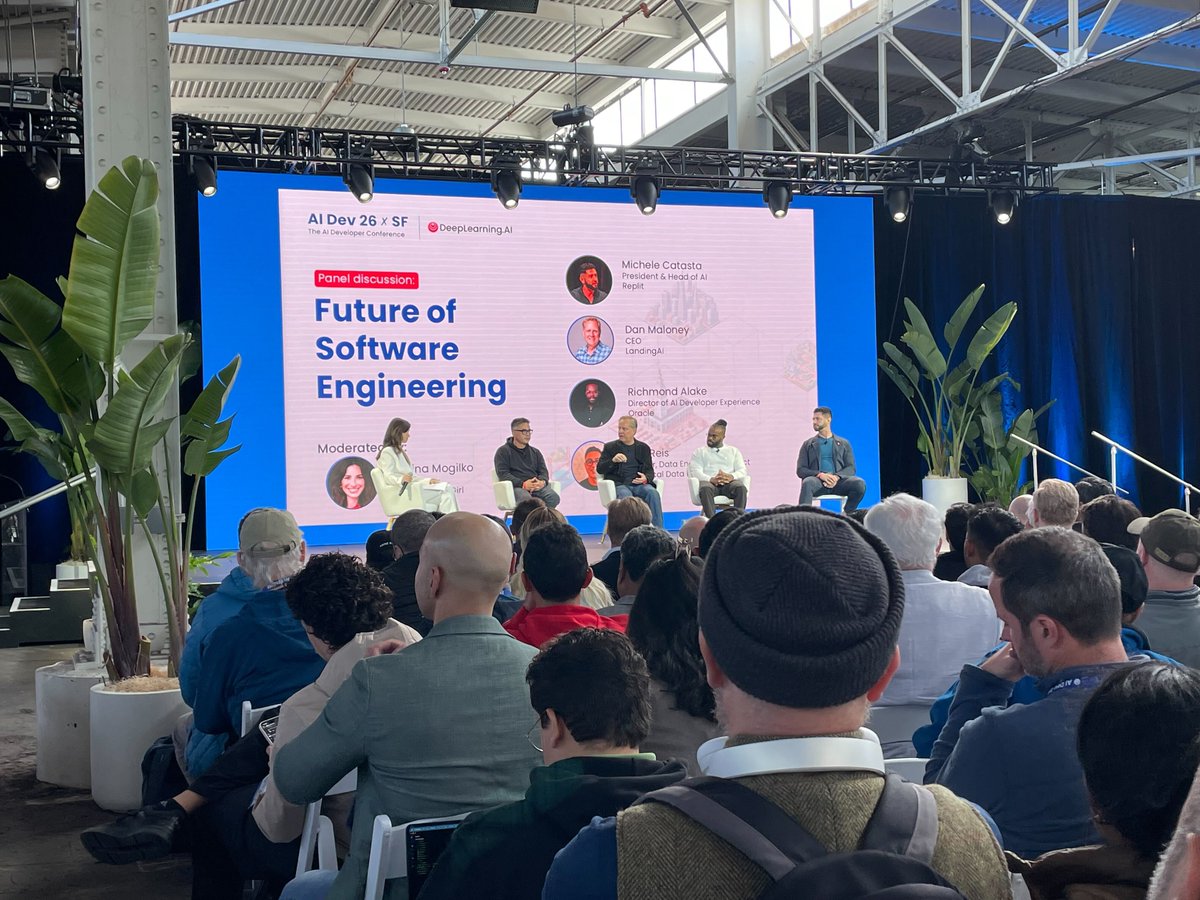
Everyone's building agents. Nobody's fixing the document layer. Agents orchestrate workflows perfectly. They break when documents get complex. Tables misread, layouts vary, values can't be traced. LandingAI is at AI Dev Day by @DeepLearningAI, April 28-29. David Park, our Senior Director of Applied AI is speaking on building the infrastructure layer that makes document understanding reliable for agentic systems. If document understanding is breaking your agentic workflows, come by.
LandingAI tweet media
English
3
4
12
2.1K
LandingAI
LandingAI@LandingAI·
The complete guide to vision-first document extraction. We put together everything about Agentic Document Extraction (ADE) in one resource. ADE converts documents into reliable, structured data. Financial statements, medical records, contracts, insurance forms. Any document that needs to become intelligence your systems can act on. Three core APIs handle the work. Parse turns documents into structured data while preserving layout and visual context. Split separates mixed files into clean, classified subdocuments. Extract pulls specific fields you define with schemas. Everything is visually grounded. Every extracted value traces back to its exact location in the source document. Audit-ready by default. The guide covers how vision-first architecture works, real use cases across financial services and healthcare, performance benchmarks, and what makes ADE different from OCR and LLM-based extraction. If you're evaluating document extraction or building workflows that depend on getting this right, this breaks down what matters.
LandingAI tweet media
English
2
5
20
4.4K
LandingAI
LandingAI@LandingAI·
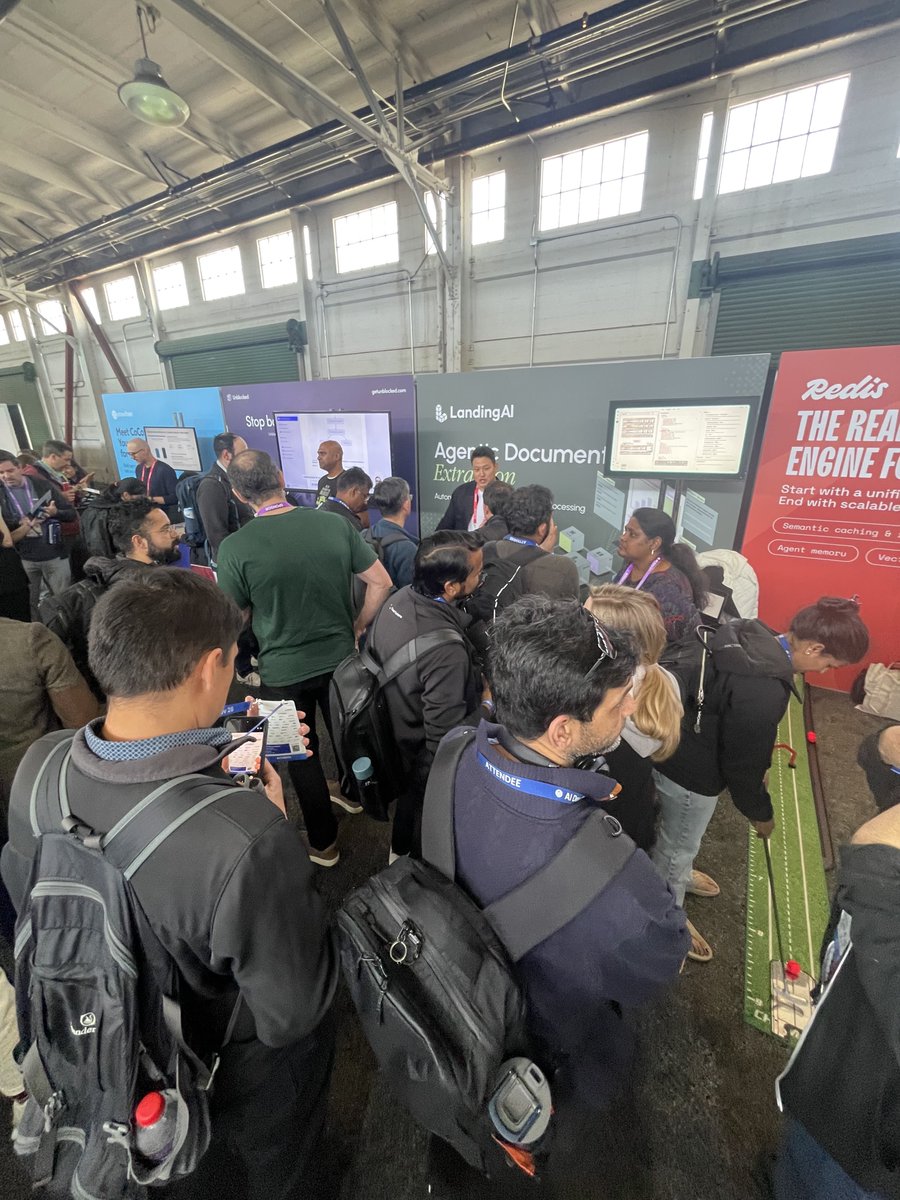
We're going to HumanX. Booth #613. April 6-9 at Moscone Center. The LandingAI team will be there with Agentic Document Extraction (ADE). If you're dealing with complex tables, messy layouts, or document formats that keep breaking your extraction, come by. We know how hard document problems can get. We deal with them every day. Bring your hardest one. See you in San Francisco.
LandingAI tweet media
English
0
2
7
156
LandingAI
LandingAI@LandingAI·
99.16% Accuracy on DocVQA: New state-of-the-art for document understanding! We ran ADE on the DocVQA validation split and got 5,286 correct out of 5,331 questions. That's 99.16% accuracy. DocVQA is a question-answering benchmark on real scanned documents. It's typically used to evaluate vision-language models. We used it to test whether ADE's parsing preserves enough information that an LLM can answer questions accurately without ever seeing the original document images. Here's how it works: Standard VQA approach: Image + question → answer (model sees the document every time) Our approach: Parse document once → answer all questions from structured output (zero image access during Q&A) This is harder. The parsing has to be complete enough that no visual context is lost. What this means for production: → Parse once, run unlimited queries against structured output → Every extraction is traceable to exact locations in the source document → No need to re-process images for new questions → Structured data enables search, analytics, and RAG applications We've published every result and the code to reproduce this benchmark. Complete transparency. Link to the detailed write up and reproducible repo in the comments!
LandingAI tweet media
English
4
4
26
5.4K
LandingAI
LandingAI@LandingAI·
The hard part of RAG isn't retrieval! It's event-driven ingestion. Persistent memory. Visual grounding. The infrastructure that makes RAG work at scale. Most RAG tutorials teach you to load documents, chunk them, embed them, and query. That works for demos. Production needs more: → Event-driven document processing: Documents upload automatically. Parsing triggers on upload. Structured outputs flow into the knowledge base. No manual pipeline runs. → Persistent memory: Your agent remembers you across sessions. Not just conversation history. User preferences. Semantic facts. Context that carries forward. → Visual grounding: Every answer traces back to its exact location in the source document. Page number. Bounding box coordinates. Verifiable. → Parse once, query unlimited: One parsing pass. Millions of queries against structured output. No re-processing images. Scalable from the start. That's what we cover in Document AI: From OCR to Agentic Doc Extraction, our free course with @DeepLearningAI. You'll build a production RAG pipeline with automatic parsing, knowledge base ingestion, and an agent that remembers you across sessions and grounds every answer to its source. Hands-on lab. Production-ready architecture.
LandingAI tweet media
English
3
3
9
480
LandingAI
LandingAI@LandingAI·
NVIDIA just released their 10-K. We parsed it. All 93 pages. Revenue tables. Risk factors. Executive compensation. Balance sheets. Footnotes with nested structures. Agentic Document Extraction (ADE) handled the entire filing. Every field extracted. Every table preserved. Every number grounded to its exact location in the source document. But here's what matters for financial analysis: knowing which extractions to trust. A 10-K contains thousands of data points. Investment decisions depend on getting the numbers right. Manually verifying every field doesn't scale. Confidence Scores (now in Preview) solve this. Every extracted value returns with a 0.0 to 1.0 confidence score. Fields scoring below 0.95 are automatically flagged for review. You see exactly which sections need verification and which ones are reliable. For financial documents, this changes the workflow: → High-confidence extractions go directly into analysis → Low-confidence sections route to verification → Every score ties back to the exact location in the filing Financial filings are high-stakes documents. Confidence scores make ADE extraction verifiable. Confidence Scores are live in Preview for DPT-2, available in both the Playground and API.
LandingAI tweet media
English
1
4
10
399
LandingAI
LandingAI@LandingAI·
Build agentic document workflows that actually work in production! LandingAI will be at AI Dev Day 26 on April 28-29 David Park, our Senior Director of Applied AI, is speaking on Enterprise-Grade Agentic Document Workflows. Most agentic systems break when they need to reliably understand documents at scale. The orchestration works. The document layer doesn't. David will walk through what it takes to deploy agentic workflows where documents become reliable inputs, not bottlenecks. How to build the infrastructure layer that makes document understanding trustworthy in production. Reserve your seat here: ai-dev.deeplearning.ai Thanks to @DeepLearningAI team for organizing!
LandingAI tweet media
English
0
1
5
178
LandingAI
LandingAI@LandingAI·
Accounts payable runs on PDFs. It always has. Someone just changed that. Every month, invoices arrive by email. Hundreds of them. Different vendors, different formats, different layouts. Someone opens each one. Reviews it. Manually enters vendor name, invoice number, line items, totals. Matches it to a purchase order. Routes it for approval. Processes payment. Repeat 500 times. It takes 15 minutes per invoice. 125 hours monthly for a mid-sized operation. TMC-v1, built during LandingAI's Financial AI Hackathon using Agentic Document Extraction (ADE), automates the entire AP workflow. Email monitoring → extraction with ADE → PO matching → exception handling → payment processing. The system monitors configured email accounts for invoice attachments. When an invoice arrives, ADE extracts every field: vendor details, invoice number, line items, totals, payment terms, bank details. It automatically matches invoices to open purchase orders using configurable tolerance thresholds. Exceptions get flagged for review. Matched invoices route to payment processing through Stripe. No templates. No manual data entry. Processing time drops from 15 minutes to 2 minutes per invoice. Error rate goes from 1-3% to near zero. The system handles what breaks traditional OCR: multi-page invoices, inconsistent layouts, multiple currencies, tables that span pages. Complete AP automation. Built in a hackathon. Powered by ADE. Link to the project in the comments!
LandingAI tweet media
English
1
3
8
315
LandingAI
LandingAI@LandingAI·
Document extraction was never the hard part. Trusting it was. You build the pipeline. Document parsing runs. The output looks clean. But which values are reliable? Which ones need a second look? Which ones quietly got it wrong? Without visibility into confidence, every extracted value carries the same weight. The ones Agentic Document Extraction (ADE) is certain about. The ones it isn't. You can't tell the difference. That's where production deployments get stuck. Not extraction. Verification. We just shipped Confidence Scores for parsing (in Preview). Table cells and chunks with text return a 0.0 to 1.0 confidence score alongside the extracted value. Sections scoring below 0.95 are automatically flagged for review. What this changes: → You know which outputs to trust and which to question → You can automatically route low confidence for human review → Every score is tied to its exact location in the source document → You can build exception handling into your workflow via custom thresholds Confidence Scores are live in Preview for DPT-2, available in both the Playground and API.
LandingAI tweet media
English
2
3
8
200
LandingAI
LandingAI@LandingAI·
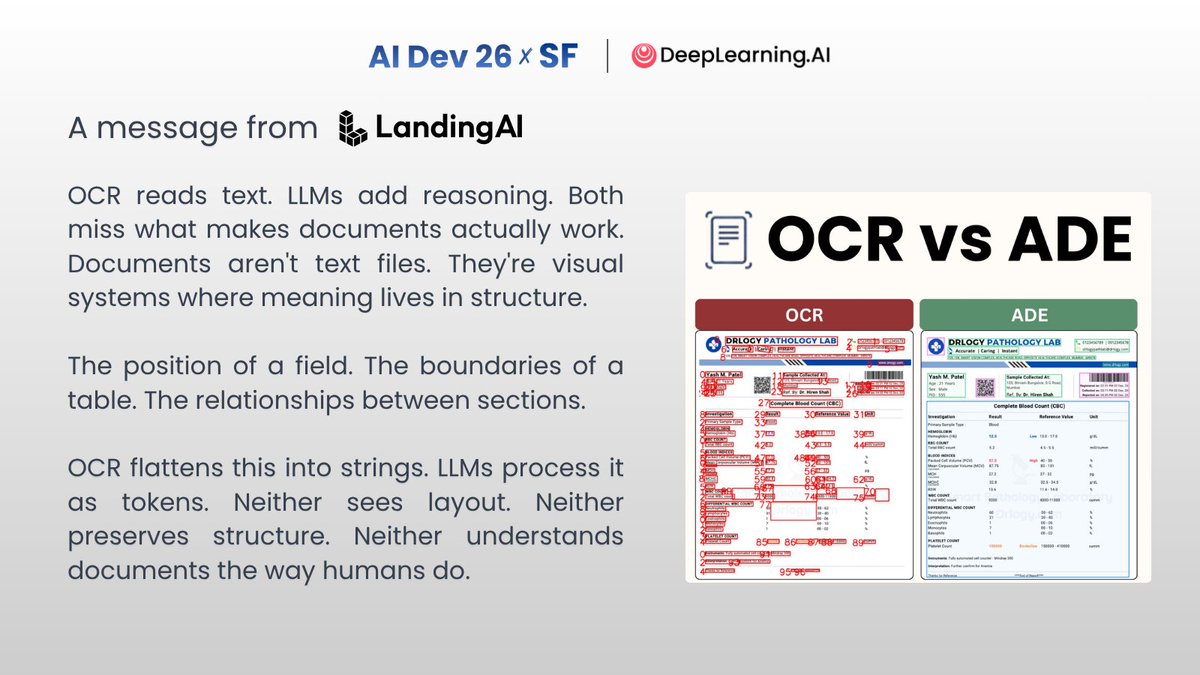
OCR's biggest win is also its fatal flaw: it reads perfectly. It extracts every word from your PDF. Every number from your table. Every line from your form. And it still doesn't understand the document. Because documents aren't just text. They're spatial systems. A table with merged cells. A multi-column layout. The relationship between a chart and its caption. Reading order across pages. OCR reads text linearly. Documents don't work that way. Traditional extraction pulls out "Invoice Number: 12345" and "$47,293.52" but loses which table the number came from, which section it belongs to, what it relates to. You get data. Not meaning. This is why document processing still breaks on anything complex. Why finance teams manually verify extracted values. Why legal teams can't trust automated contract parsing. The text is correct. The structure is gone. We built a free course with @DeepLearningAI that walks through this evolution: Document AI: From OCR to Agentic Doc Extraction. It covers how document processing evolved from basic OCR to systems that actually understand layout, structure, and spatial relationships. You'll work through hands-on labs that show the difference between extracting text and preserving context. By the final lab, you're deploying an event-driven pipeline that processes documents and enables semantic search with visual grounding. Enroll here. It's free: bit.ly/4bpV2rG
English

0
9
41
3K
LandingAI
LandingAI@LandingAI·
A global tier-1 bank moves billions daily. Yet documents remained the slowest part. Every corporate client brings 200-300 pages of documentation. Incorporation records. Ownership structures. Financial statements. Regulatory filings. All of it needs review. Multiple times per year. For KYC compliance. The bank had the analysts. They had the systems. But document review didn't scale the way operations did. Hundreds of analyst hours every week went into manual extraction and validation. Not investigating risk. Just processing documents. They deployed Agentic Document Extraction (ADE) on AWS to handle the complexity. ADE processes large, non-standard corporate documents across multiple languages. It extracts required KYC fields while preserving structure and auditability. The results: - 40-60% reduction in manual document review time - Hundreds of analyst hours saved weekly - Faster onboarding and refresh cycles - Improved data consistency across regions The solution integrated into their existing KYC platform. No rip-and-replace. Just better infrastructure for the work that was already happening. When document processing stops being the bottleneck, compliance teams can focus on what actually matters: assessing risk. Link to the full case study in the comments!
LandingAI tweet media
English
2
3
7
311
LandingAI
LandingAI@LandingAI·
99.15% DocVQA accuracy without using images in QA! We ran the DocVQA validation split with Agentic Document Extraction (ADE) using DPT-2 and answered every question using only the parsed output. Result: 5,286 correct out of 5,331. That is 99.15% accuracy. Here is why this matters: • ⚡ Parse once and run unlimited queries on structured output • 🔎 Visual grounding gives exact spans, cells, and pages for every answer • 💸 Lower cost and lower latency since you never reprocess the image • 🔐 Privacy friendly because the QA step does not need access to documents What we measured: • Exact string match evaluation • Only 18 of the 45 misses were true parsing errors, The rest were due to dataset quirks, annotation gaps, or ambiguous questions. • Every miss is published with full reproducible code so you can inspect the edge cases yourself To make the results fully transparent, we included a reproducible repo, an interactive gallery of successes and failures, and a complete breakdown of error types. No mystery cases. No hidden samples. Just the data as it is. If reliability, provenance, and scale matter in your document QA workflows, try ADE DPT-2 in the Playground and put it against your hardest documents. Link to the Full write up and the Reproducible repo are in the comments!
LandingAI tweet media
English
3
4
20
1K