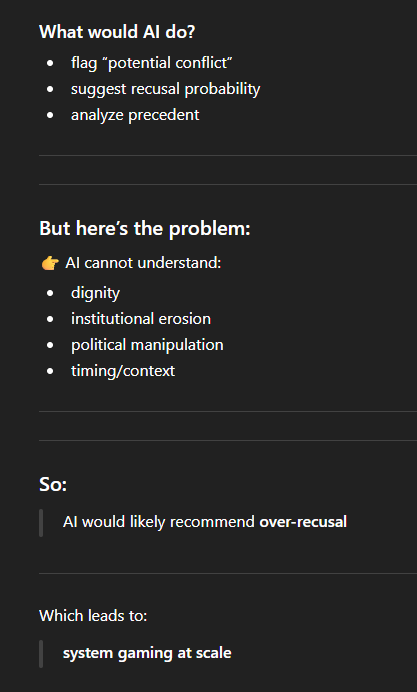
I absolutely hate AI. And I’m not saying this as a technological Luddite. AI is going to wipe out millions of jobs and is already diminishing authentic creativity. A technological step forward that is actually a giant leap backwards for original human endeavour.
Wishing Mr. Murthy and Mrs. Murty good luck. While many elders prefer to live in row houses surrounded by lush greenery, with access to terraces, aging often requires moving to premises where they can live more peacefully and with better support. However, adjusting to different social environments can be challenging. Even if some high-profile residents are present, the nature and quality of interactions may vary significantly.
Many high profilers might me ministers, bureaucrats with LOW IQ and their visitors will be a non sense so adjusting will be a difficult task.
economictimes.indiatimes.com/magazines/pana…
In 1896, Plessy v. Ferguson established the "separate but equal" doctrine, upholding state laws that mandated racial segregation in public facilities.
This precedent stood until 1954, when Brown v. Board of Education overturned it, ruling that racial segregation in public schools was inherently unequal and unconstitutional.
law.cornell.edu/wex/separate_b…
P. N. Bhagwati pushed the boundaries of judicial intervention at the entry stage in February 1982 (within three days), but at the exit stage, he exercised restraint—nearly six months, from June 1986 until his retirement in December 1986—possibly to avoid institutional overreach or reputational risk.
And the fact is bonded labor is still present in the India.
frontline.thehindu.com/the-nation/bor…
The court's decision in Roe v. Wade in 1973 asserted a woman's right to choose to have an abortion, which stood for nearly five decades. In 2022, Dobbs v. Jackson Women's Health Organization largely overturned Roe, returning the authority to regulate abortion to individual states.
brennancenter.org/our-work/resea…
The US court's 1857 ruling in Dred Scott v. Sandford (britannica.com/event/Dred-Sco…) declared individuals of African descent, whether enslaved or free, were not American citizens and therefore lacked standing to sue in federal court—pushing the nation closer to the brink of civil war.
As its population gets relatively wealthier and better educated, the PRC has a natural advantage in AI (and all tech) development because it possesses at least four times the human capital of its potential opponents.
Some in the West are cheering for this because they perceive the opening of a huge market for high-tech products, additionally justified by the comforting thought that greater trade brings greater political convergence.
Neither of these expectations has any science behind it, but self-justifying optimism can be seductive. Nevertheless, neither the United States nor Russia should assume it can match AI development in China in the long term, let alone offset other military developments, without taking firm steps to develop a comprehensive strategy for the competition.
Jensen Huang said AI has 5 layers of value. India doesn't have a presence in any of them.
⚡ Layer 1 — Energy. A hyperscale AI campus now draws 1–2 gigawatts — a mid-sized nuclear reactor, for one building. China added nearly India's entire installed grid in new capacity last year.
💾 Layer 2 — Chips. The silicon brain and everything that makes it.
→ GPUs: Nvidia (US), AMD (US), Broadcom (US) design. TSMC (Taiwan) fabs at the cutting edge.
→ HBM, the high-speed memory beside every GPU: ~90% Korea.
→ ASML (Netherlands) has a monopoly on the one machine that prints the most advanced chips.
→ Silicon wafers ~60% Japan. Photoresist ~90% Japan.
🏭 Layer 3 — AI infrastructure. The data centre and everything around the chips.
→ Hyperscale cloud: AWS (US), Azure (US), GCP (US); Alibaba (China), Tencent (China).
→ Servers and AI-rack cooling: Supermicro (US), Vertiv (US), Schneider (France), Eaton (US).
→ Commodities: copper (Chile, Peru), niobium (~90% Brazil), rare earths (~85% processed in China).
🧠 Layer 4 — Models. Closed: OpenAI (US), Anthropic (US), Google (US), Meta (US). Open: DeepSeek (China), Qwen (China), Kimi (China).
💻 Layer 5 — Applications. ChatGPT (US), Copilot (US), Cursor (US), Claude Code (US), Agentforce (US). Mostly US. Increasingly Chinese.
China has a presence in all 5. Korea owns HBM. Taiwan owns the cutting-edge factory. Netherlands owns the machine that makes it possible.
India:
Layer 1 — grid stretched, industrial power expensive and patchy. 24/7 clean power is hard to deliver today.
Layer 2 — no frontier chip factory. Tata-PSMC (India-Taiwan) at ~28nm is a decade behind AI chips. India's chip design talent works for Nvidia (US), AMD (US), Qualcomm (US), Intel (US). Value flows to US balance sheets.
Layer 3 — India builds the data center buildings (Yotta, Adani, Reliance) and generic industrial power and cooling gear (BHEL, Crompton, Blue Star). But no hyperscale cloud, and no specialized AI-rack cooling or power shelves. Every Indian AI startup runs on AWS (US) or Azure (US).
Layer 4 — Sarvam, Krutrim (India). Real teams, orders of magnitude below the frontier.
Layer 5 — Zoho, Freshworks (India) are real SaaS businesses, but their AI features — like most Indian AI-app startups — are thin wrappers on OpenAI (US), Anthropic (US), Google (US). And not agentic. Agents are where the flywheel lives. India has no agentic platform at that scale.
This is a 30-year-old choice. India bet on services and not manufacturing. TCS, Infosys, Wipro, HCL (India) built a ~$250B export industry. It paid off. But services sit above the stack — they don't own any layer of it.
India's AI Mission is ~$1B. China's is in the hundreds of billions. That's not a gap to close — it defines the game.
I've been talking to AI models a lot, and I don't think they reason at a PhD level at all.
They seem to be good at math style problems, where you tell them A, B and C are true, and then ask them to figure out D.
They're extremely bad at anything involving what I would call mature scholarship. Basically where A, B, and C are partially confirmed to various extents in the literature, and there are multiple conflicting, competing perspectives on what might be true.
When it comes to this, they reason like naive undergrads. They try to force everything into one box called "the truth".
If a framework is a standard part of their training data, like Bayesianism, they do seem to be able to write about things from that perspective.
But if they need to construct perspectives on the fly, and keep track of competing frameworks, based on a novel research direction, they easily get lost about who is saying what and why.
This is basic scholarship. The ability to apprehend the state of the literature on a given topic. It is literally the minimum of what you need to do to be a PhD level scholar.
And AI models are terrible at it.
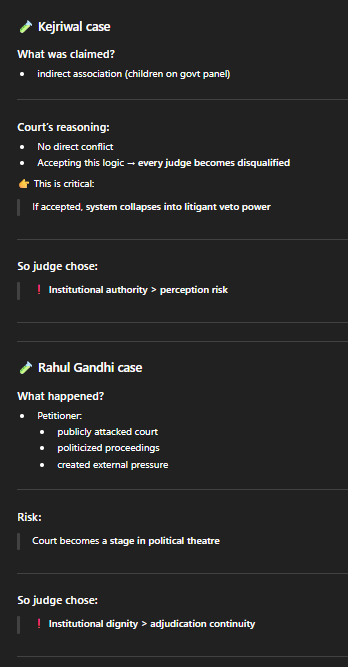
These two cases show:
Recusal is not a legal rule.
It is an institutional survival mechanism.
And more importantly:
Consistency in outcome is less important than consistency in protecting the system
A judge is not deciding whether they are biased—
they are deciding whether the system can survive this allegation.
🧭 The recent two recusal cases in India
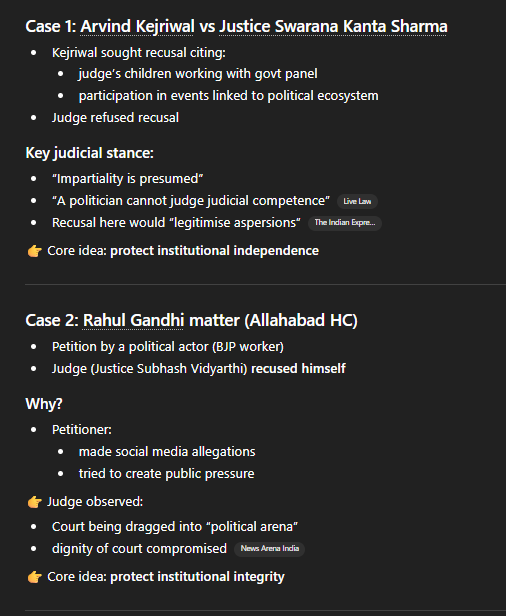
Case 1: Arvind Kejriwal vs Justice Swarana Kanta Sharma
Case 2: Rahul Gandhi matter (Allahabad HC)
are not just procedural news. They expose deep fault lines in judicial legitimacy, perception, and power in India.
🔥 The emerging risk
Pattern across India (recent years):
More recusal demands
More politicised litigation
More social media pressure
This creates a dangerous equilibrium:
Judges must choose between:
appearing biased
or appearing weak
Distributed Cognition
Judgment is not just:
judge’s mind
But:
system of courts + perception + legitimacy + precedent
👉 Recusal becomes: system-level cognitive calibration
Constitutional layer (India-specific)
This ties deeply to:
Article 14 → fairness
Article 21 → due process
Basic Structure → judicial independence
👉 Recusal sits at intersection of:
fair trial vs independent judiciary
🧠 Connecting with other frameworks
(A) Kingsbury: “Verification vs Generation”
Allegations of bias → easy to generate
Verifying actual bias → extremely hard
👉 If courts start reacting to every allegation:
system floods with unverifiable distrust
(B) Public Choice Theory
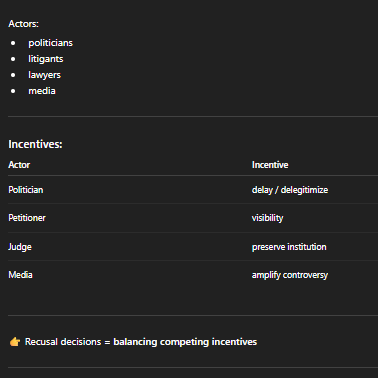
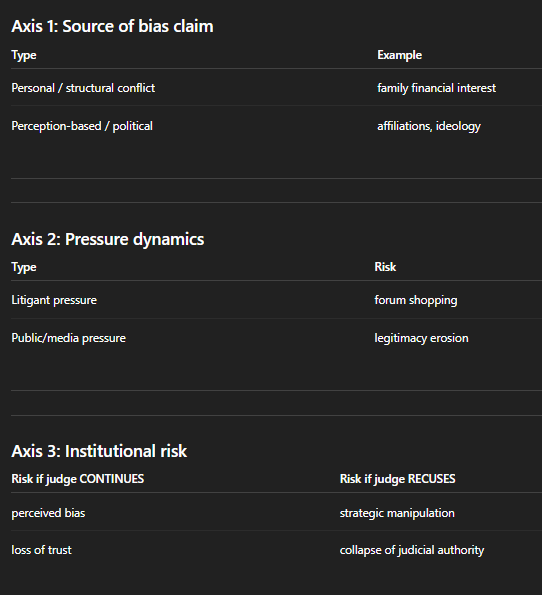
The real principle: Recusal is about system preservation, not individual comfort
Recusal is NOT about:
1. litigant’s feelings
2. political pressure
3. public perception alone
Recusal is about: Whether continuing the case damages institutional credibility more than stepping aside.
⚖️ At first glance: contradiction