MA

1.7K posts

MA banner
MA

MA

@Limrmd1

AI - Powered Crypto Trading | Real Signals, On-Chain Proof & Security Tools | $MEFAI on BNB & SOL Chain | Earn first, trust the data .
Berkeley, CA Katılım Aralık 2014
2.3K Takip Edilen666 Takipçiler
MA
MA@Limrmd1·
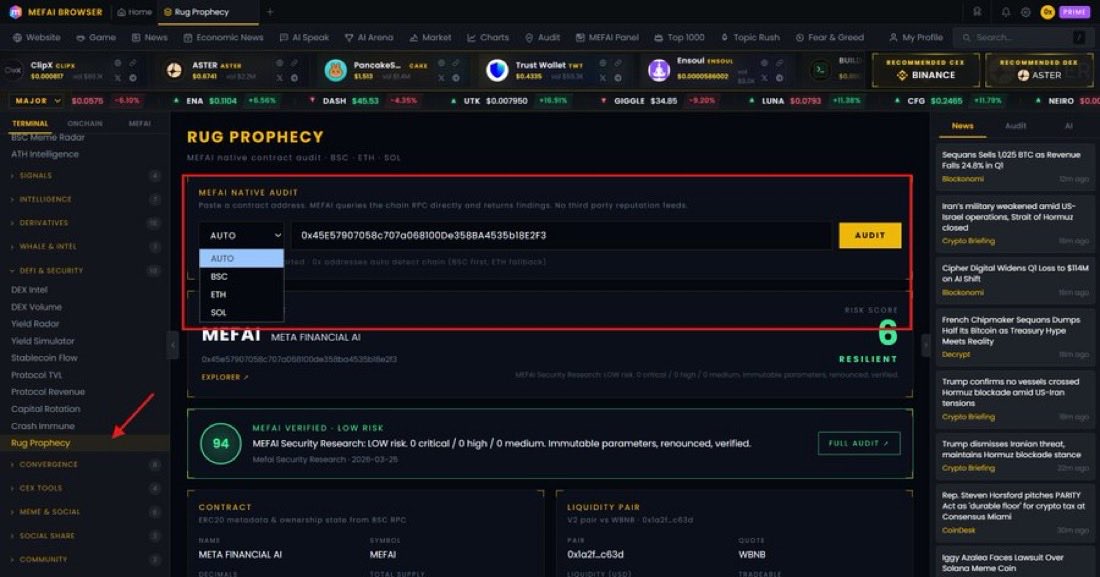
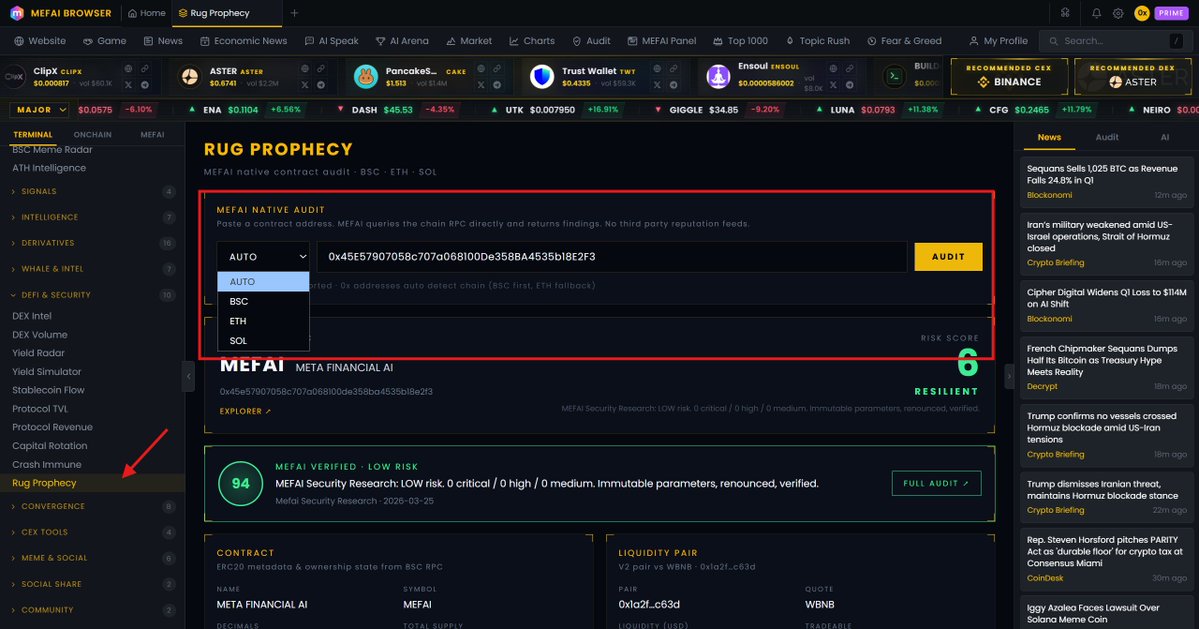
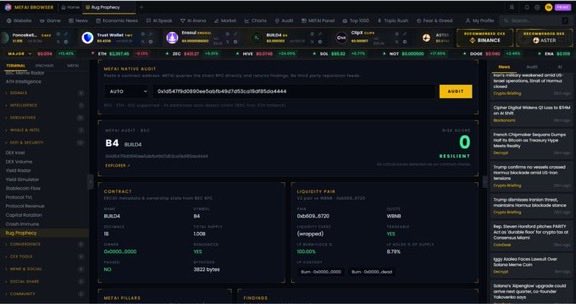
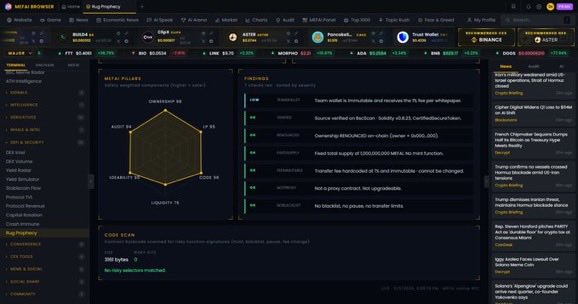
🚀 @MetaFinancialAI Just Dropped Rug Prophecy — Real-time on-chain security that actually works Live now: Paste any CA → instant audit pulling raw RPC data (no stale DBs, no cached scores). Supports BSC, ETH, SOL with auto-detection. Key Features: • Ownership: Renounced/active checks (owner() + getOwner()) • LP: Exact % burned/locked + custody (PinkSale, Unicrypt, etc.) • Tradeability: Real swap simulation — detects honeypots live • Code Scan: Bytecode analysis for mint, blacklist, pause, etc. (with context — renounced owner downgrades risks) • Radar Chart + 0-100 Risk Score (RESILIENT to EXTREME) • Full MEFAI APIs for devs Revenue from tools + slippage → continuous burns. Building actual AI + DeFi infrastructure. Current stats: $0.00140–$0.00142 24h vol: **$170K–$185K** MC: sub-1M (still early) Smart money accumulating. If you’re tired of rug-checkers that fail on new tokens, this is it. DYOR & check it out at mefai.ai What’s your take — game changer or just another tool? 👀 #MEFAI #RugProphecy #cryptoAI #Web3 #DeFi
MA tweet mediaMA tweet mediaMA tweet media
English
0
1
7
63
MA retweetledi
Meta Financial AI
Meta Financial AI@MetaFinancialAI·
We hope this will be beneficial for the crypto world. Additionally, you will be able to use these queries in your own platforms or projects via MEFAI APIs. If you are tired of things that rely on unhealthy cached memory, react late to honeypots, are incapable of even finding locked LP, and don't read the code but only trust ready-made templates, here is $MEFAI.
English
6
11
30
1.4K
MA retweetledi
Meta Financial AI
Meta Financial AI@MetaFinancialAI·
$MEFAI Platform || RUG PROPHECY 2/2 Trying to search for errors in a platform token like Fourmeme, which ca has no owner, is nonsense. This is a CA with no owner. What function could even be called? This is just noise. However, the reasons behind this same noise might ignore and show as safe !? a disastrous CA example in the crypto world like WLFI. Here are the full details 👇 MEFAI continues to create the healthiest and most secure platform using only its own data, bringing together everything a trader needs. Ownership analysis || Owner renounced means the deployer burned admin access. Owner active means someone can still call privileged functions. MEFAI checks both owner() and getOwner() patterns and verifies against the zero address and known burn addresses. Liquidity check || Shows the exact pair address, quote token, USD liquidity depth, LP total supply, and what percentage of LP tokens are burned or locked. If LP is 0% locked, anyone holding LP tokens can pull liquidity in one transaction. Tradeability verification || Calls the DEX router's getAmountsOut with a test amount across all possible quote paths. If the router reverts, the token blocks swaps. That is a honeypot. If the router succeeds, the token is tradeable. Other auditors flag "honeypot risk" from a database. MEFAI actually tries to route a swap and tells you if it works right now. In other words, it is simulated in real-time. Code scan || This feature is either non-existent or hidden from the user in most platforms. This is proof that we read the code. If a dangerous class owner exists, it is a problem. Reads the deployed bytecode and matches against known risky function selectors: mint, mintTo, blacklist, addToBlacklist, pause, setFee, setTax. If mint exists but owner is renounced, MEFAI downgrades the severity because nobody can call it. If mint exists and owner is active, it is a high severity finding. Context matters, not just pattern matching. LP custody analysis || Checks LP token balances at the zero address (burned), dead address, PinkSale lock contracts, Unicrypt lock contracts, and other known locker addresses. Reports the total percentage burned or locked, who holds it, and whether it is enough to prevent a rug pull. 0% locked with an active owner is a critical finding. MEFAI Pillars || Five weighted safety components visualized as a radar chart. Ownership (renounced or not), LP (locked percentage), Code (risky bytecode hits), Liquidity (USD depth relative to market), Tradeability (swap path works or blocked). Each pillar scores 0 to 100. The composite tells you where the weakness is, not just a single number. Risk scoring || Findings cascade into a 0 to 100 risk score. Critical findings add 35 points, high adds 20, medium adds 10, low adds 4. Score below 15 is RESILIENT. 15 to 30 is CAUTIOUS. 30 to 50 is ELEVATED. 50 to 70 is HIGH. Above 70 is EXTREME. The score reflects what the contract can do to you, not what the community says about it. Solana native audit. For SPL tokens, mint authority status, freeze authority status, supply, program owner, and top holder concentration via getTokenLargestAccounts. Mint authority renounced means fixed supply. Freeze authority renounced means no holder can be frozen. MEFAI verified tokens || Tokens that MEFAI has audited in depth show a verified badge with the full audit report, auditor name, publication date, and a link to the GitHub hosted audit document. The verified overlay replaces the live RPC findings with the canonical audit result.
Meta Financial AI tweet mediaMeta Financial AI tweet mediaMeta Financial AI tweet mediaMeta Financial AI tweet media
English
3
16
35
1.6K
MA retweetledi
Meta Financial AI
Meta Financial AI@MetaFinancialAI·
$MEFAI Platform || RUG PROPHECY 1/2 What makes it different. GoPlus, Token Sniffer, RugCheck, they all query their own databases. If the token is not in their index, you get nothing. If it is, you get a cached score from hours ago. MEFAI queries the blockchain directly. Every audit runs live against the chain's RPC at the moment you paste the address. No database. No index. No third party reputation feed. Raw bytecode, raw state, raw math. BSC, Ethereum, and Solana in one input field. Therefore, please send your feedback from us. This is not just another screen, it is entirely fed by MEFAI indexes. Auto chain detection. Paste any address. 0x format auto detects BSC first, if no contract found it falls back to ETH. Base58 format goes to Solana. No dropdown needed. One input, three chains. Currently, it only supports 3 chains. Contract metadata from RPC. Name, symbol, decimals, total supply, owner address, renounce status, pause status. All read directly from the deployed contract. Not from an API that might be stale. If the owner renounced 5 minutes ago, you see it now. Look, this sentence is important. Because on most platforms, incorrect data is shown either intentionally or unintentionally. Even funnier, some do not support Raydium V5. Even worse, they ask for listing or update fees to fix the error. +++
Meta Financial AI tweet media
English
10
25
63
2.1K
WEEX
WEEX@WEEX_Official·
Tag a project you trust 1000000%
WEEX tweet media
English
268
40
345
18.4K
MA
MA@Limrmd1·
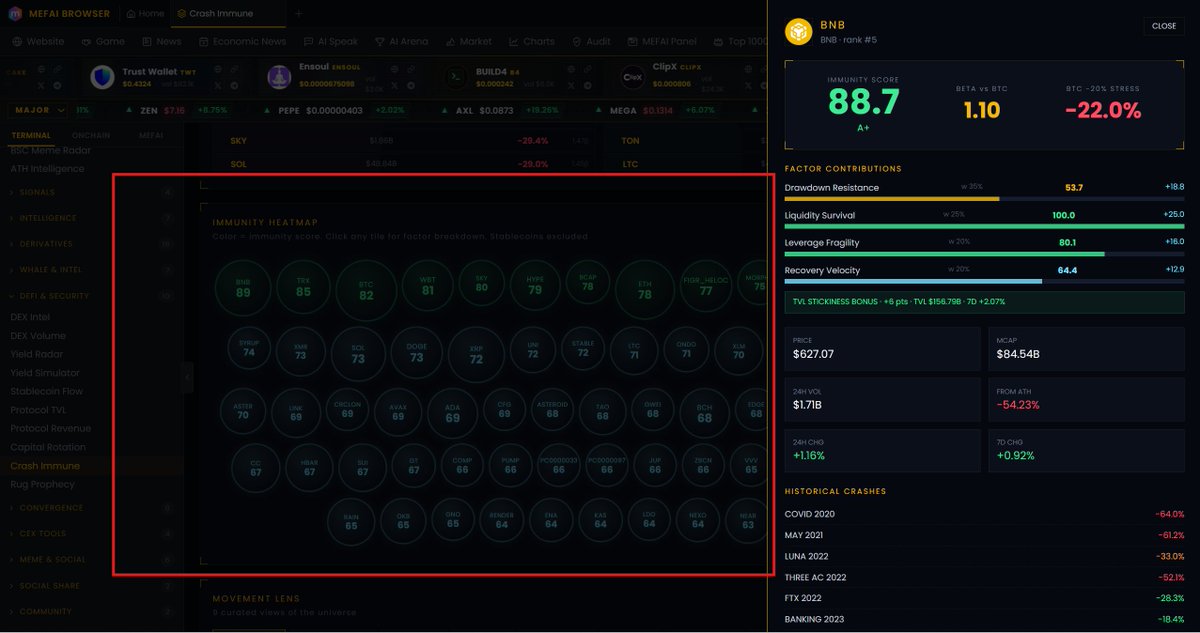
This is the reality of mathematics. Even if you combined everything on the list except for $BNB, it wouldn’t even come close. When BNB shows $84B mcap with $156B TVL — anchored by @cz_binance vision and @Binance infrastructure — the locked capital in BSC protocols exceeds the token’s own market value, That is not speculative positioning, That is infrastructure dependency. $MEFAI quantifies the actual edge before you commit capital.
Meta Financial AI@MetaFinancialAI

This is the reality of mathematics. Even if you combined everything on the list except for $BNB, it wouldn't even come close to BNB. When BNB shows $84B mcap with $156B TVL, the locked capital in #BSC Chain protocols exceeds the oken's own market value. That is not speculative positioning. That is infrastructure dependency. Protocols, liquidity pools, lending markets, bridges, all relying on BNB Chain to function. This capital does not rotate out in a panic because it is deployed in smart contracts with lock periods, LP positions, and collateral obligations. TVL anchored assets have a structural floor that speculative tokens do not. #BNB ranks first because no other token has this ratio of deployed capital to market cap.

English
0
9
28
536
MA retweetledi
Meta Financial AI
Meta Financial AI@MetaFinancialAI·
This is the reality of mathematics. Even if you combined everything on the list except for $BNB, it wouldn't even come close to BNB. When BNB shows $84B mcap with $156B TVL, the locked capital in #BSC Chain protocols exceeds the oken's own market value. That is not speculative positioning. That is infrastructure dependency. Protocols, liquidity pools, lending markets, bridges, all relying on BNB Chain to function. This capital does not rotate out in a panic because it is deployed in smart contracts with lock periods, LP positions, and collateral obligations. TVL anchored assets have a structural floor that speculative tokens do not. #BNB ranks first because no other token has this ratio of deployed capital to market cap.
Meta Financial AI tweet media
English
21
29
84
3.1K
MA retweetledi
Meta Financial AI
Meta Financial AI@MetaFinancialAI·
$MEFAI is for Trader || CRASH IMMUNITY SCORE POST 5/5 Sector immunity 👇 Average immunity score by DeFi protocol category. RWA protocols score highest because their value is backed by real world assets that do not reprice on crypto sentiment. Derivatives protocols score lowest because leveraged products amplify both directions. The sector table shows min, max, and average with a visual range bar so you see the spread within each category. Portfolio immunity 👇 Enter your holdings as symbol and weight. The calculator returns a weighted immunity score, weighted beta, and weighted stress test result for your specific portfolio. If your portfolio scores 45 with a 1.8 average beta, BTC dropping 20% means your portfolio drops 36%. The weakest links section highlights which holdings drag your score down the most. You fix the weak links before the crash does. Full universe table👇 Every asset sortable by score, grade, mcap, beta, stress test result, 24h change, 30d change, ATH distance, and all four sub scores. Stablecoins excluded. Search by symbol or name. Export to CSV. Click any row for full factor drawer with ring charts, contribution breakdown, historical crash performance, and stress projections. Every column tells a different story. Sort by beta to find the most volatile. Sort by ATH distance to find the most beaten down. Sort by recovery velocity to find what is turning around.
Meta Financial AI tweet mediaMeta Financial AI tweet media
English
4
13
30
1.5K
MA retweetledi
Meta Financial AI
Meta Financial AI@MetaFinancialAI·
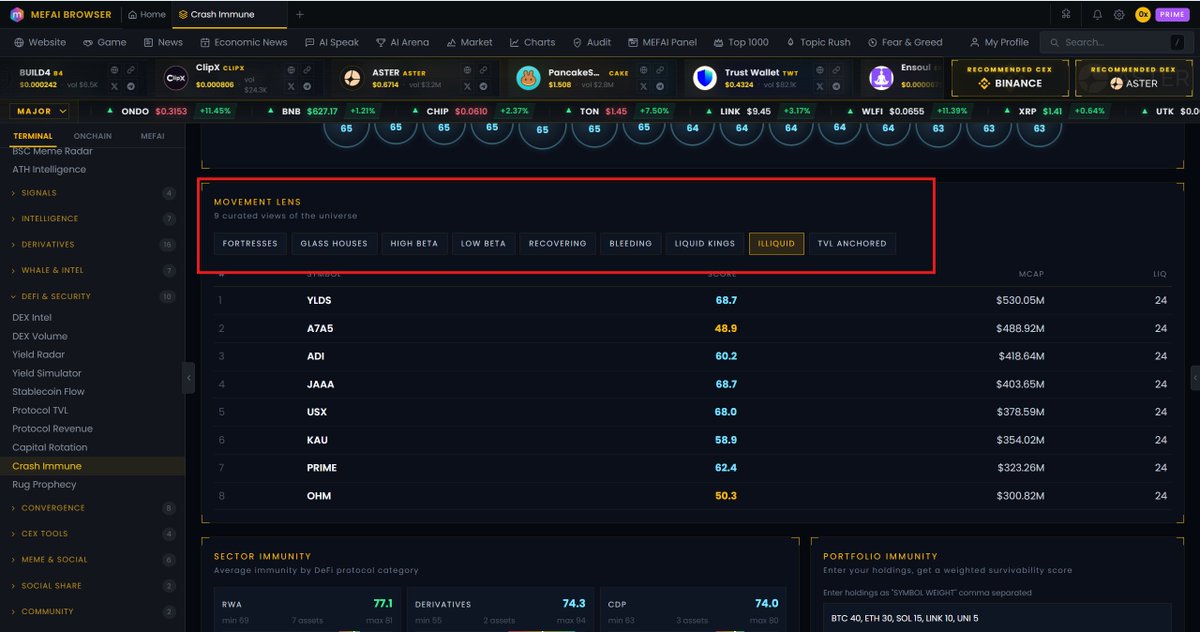
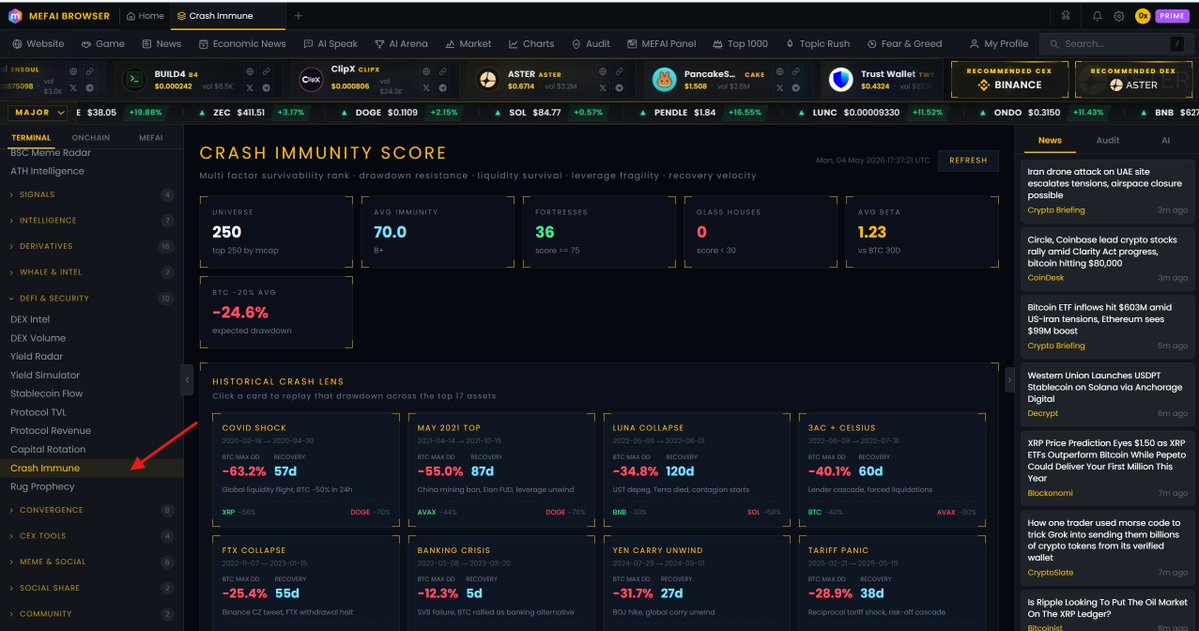
$MEFAI is for Trader || CRASH IMMUNITY SCORE POST 4/5 Historical crash lens 👇 Seventeen documented crash events from 2017 to 2024. COVID March 2020, Luna collapse May 2022, 3AC cascade June 2022, FTX November 2022, and more. Each card shows BTC max drawdown, recovery days, and the best and worst performing asset during that specific event. Click any card to replay that crash across all 17 flagship symbols. See which coins survived 2020 but died in 2022. See which coins recovered in 30 days vs 300 days. Movement lens with nine curated views👇 Fortresses | score above 75, these assets have structural strength. Glass ouses| score below 30, one BTC hiccup and they crack. High beta| the coins that amplify every BTC move. Low beta| the coins that dampen it. Recovering| positive 24h momentum after recent weakness. Bleeding| still declining with no reversal signal. Liquid kings| highest volume to mcap ratio, deepest order books, least slippage risk. lliquid| thin books, gap down risk. TVL anchored| DeFi tokens where locked value exceeds or rivals market cap, meaning real capital backs the price.
Meta Financial AI tweet media
English
1
15
25
1.6K
MA retweetledi
Meta Financial AI
Meta Financial AI@MetaFinancialAI·
$MEFAI is for Trader || CRASH IMMUNITY SCORE POST 1/5 What does just one page of Mefai really say to you ? Why a trader needs this. You hold 12 altcoins and BTC drops 20% overnight. You open your portfolio and see red everywhere, but the damage is not equal. ETH dropped 23%, SOL dropped 29%, DOGE dropped 36%, and PEPE dropped 40%. One of your mid caps dropped 60%. Another barely moved. You had no way to know which ones would bleed the most before it happened. Crash Immunity Score tells you exactly how each asset behaves under stress before the stress arrives. What makes it different. Portfolio trackers show you what happened. Volatility metrics show you how much something moves. Neither tells you how a specific coin reacts when BTC crashes. MEFAI computes a composite immunity score from four weighted factors, assigns a real beta to each asset based on historical crash data, and runs a live stress imulator where you drag a slider and watch your entire universe repriced in real time. You stop guessing which coins survive and start knowing.
Meta Financial AI tweet media
English
4
28
61
2.3K
MA retweetledi
Meta Financial AI
Meta Financial AI@MetaFinancialAI·
$MEFAI is for Trader || CRASH IMMUNITY SCORE POST 3/5 Immunity heatmap 👇 Every non stablecoin asset rendered as a circle. Size reflects market cap. Color intensity reflects immunity score. Green circles are fortresses. Red circles are glass houses. Click any circle for full factor breakdown with contribution weights, historical crash replay, and sub score ring charts. One glance across 200 circles tells you where the strong are and where the fragile are hiding. Stress test simulator 👇 Drag the slider from -50% to +50%. Every asset reprices in real time based on its unique beta. BTC drops 20%, ETH drops 23%, SOL drops 29%, DOGE drops 36%, TRUMP drops 46%. The numbers are different because the betas are different. DOGE has a 1.80 beta derived from historical crash behavior. ETH has a 1.15 beta. TRX has a 0.80 beta. When BTC rallies, the reaction is asymmetric. Altcoins lag rallies but front run crashes. The simulator models this with a dampen factor: high beta coins capture only 40% of upside but 100% of downside. Search any coin to simulate its specific reaction. This is not a flat multiplier. This is real correlation math applied to 60 major assets with known historical crash betas and tier based estimation for the rest.
English
1
11
29
1.4K
MA retweetledi
Meta Financial AI
Meta Financial AI@MetaFinancialAI·
$MEFAI is for Trader || CRASH IMMUNITY SCORE POST 2/5 Composite immunity scoring across 250 assets. Four factors weighted into one 0 to 100 score. Drawdown resistance (35%) | ATH distance, time since ATH, 30 day bleed rate. A coin 95% below ATH for 400 days has low resistance. A coin 20% below ATH with shallow recent bleed has high resistance. Liquidity survival (25%) | volume to mcap turnover and market cap rank. A $ 500M mcap coin with $ 2M daily volume will gap down in a crash because there is no depth to absorb selling. Recovery velocity (20%) | 24h vs 7d momentum and 7d vs 30d acceleration. A coin already recovering from a dip has momentum. A coin still bleeding has none. Leverage fragility (20%) | 24h range, FDV to mcap dilution ratio. High FDV relative to mcap means unlock pressure ahead. Wide 24h ranges mean the order book is thin. DeFi tokens get a TVL stickiness bonus up to 8 points. A protocol with $ 10B locked value has real capital commitment. That capital does not exit in a single candle. The TVL anchor dampens crash impact.
Meta Financial AI tweet media
English
1
14
30
1.5K
MA
MA@Limrmd1·
🚀 $MEFAI Major Platform Update Today – Capital Flow Intelligence Just Dropped 🔥 @MetaFinancialAI shipped a powerful new suite focused on Stablecoin Flow + Protocol Revenue & TVL — exactly what traders need to read real capital movement. 1. Stablecoin Flow Tracker Real-time mints, burns, chain migrations, and peg stress across all major stables. • See fresh capital entering (or leaving) the system • Movement lens: Minting winners, burn losers, fastest migrations, peg alerts • Honest macro signal: When stable supply rises but price doesn’t → often short interest, not bullish flow. 2. Protocol TVL with Momentum Beyond static lists — velocity, acceleration, inflows/outflows, category + chain filters. • TVL magnets/drains, accelerators, whale-dominated • Deep dives with history charts and peer benchmarks. 3. Protocol Revenue Intelligence The real sustainability check: • Daily/annualized fees & revenue, take rates, P/S & PF ratios • Fee magnets/drains, fastest growing revenue, divergence signals • Spot ghost towns (high MC but low real fees) vs genuine businesses. This turns MEFAI into a full capital flow command center — follow the money before price catches up.Combined with existing AutoTrade, signals, whales, yields, and security tools. Still early at sub-1M MC while delivering institutional-grade alpha. CA BNB: 0x45E57907058c707a068100De358BA4535b18E2F3 CA SOL: 7gcoey4EXJcZ8u3iGYhgTBrh3JuhLWzV4Gs1zNaPtu3U What’s the most useful new view for you — Stablecoin Flow, Revenue, or TVL momentum? Share your take 👇 #MEFAI #AICrypto #DeFi #Stablecoins #ProtocolRevenue @MetaFinancialAI
MA tweet mediaMA tweet mediaMA tweet media
English
2
15
30
539
MA retweetledi
Meta Financial AI
Meta Financial AI@MetaFinancialAI·
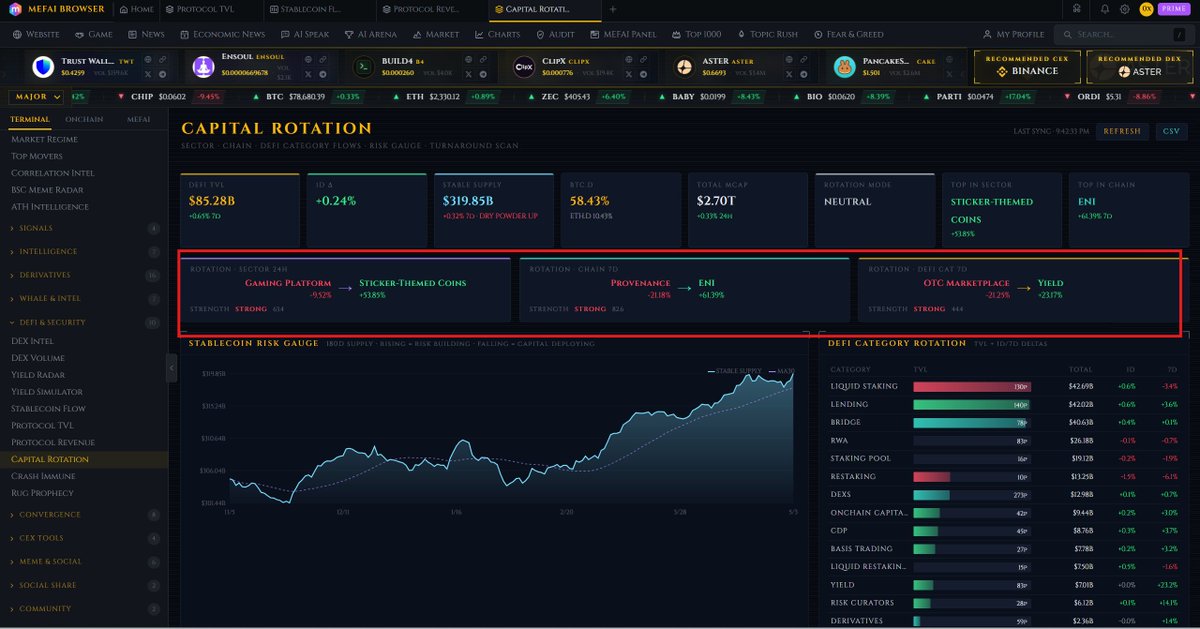
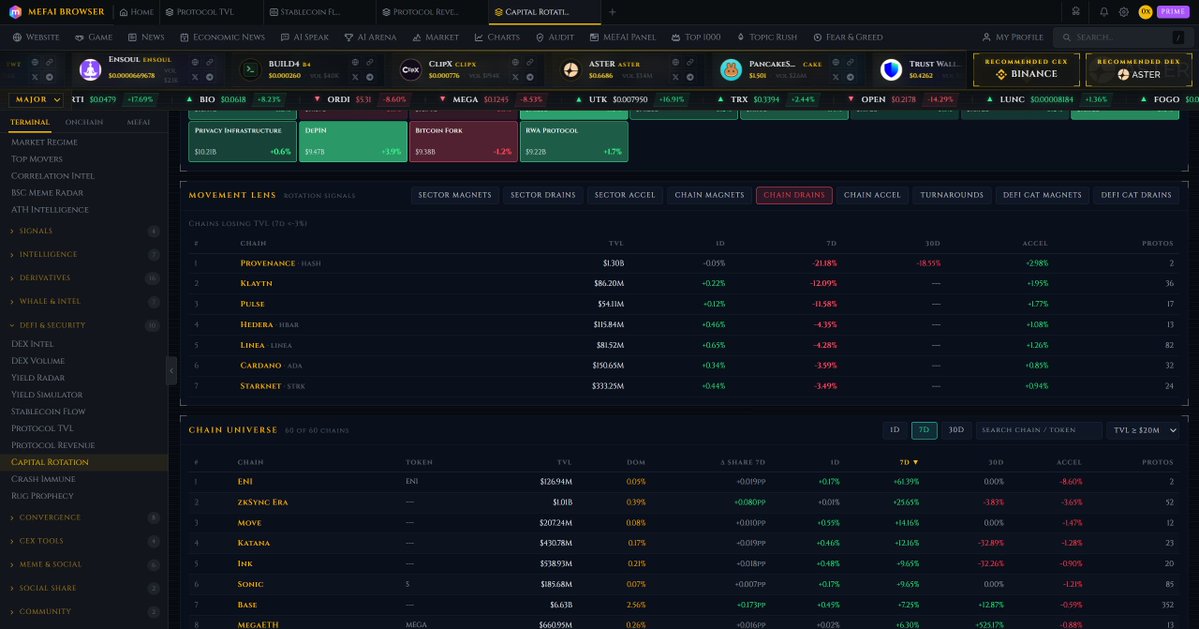
4⃣ $MEFAI Platform || CAPITAL ROTATION This is a great feature. You need to be where the money is flowing. If the DePIN hype is dying down, you're in the wrong place. Don't stay on a losing network when everyone else is rotating to a different one. Why a trader needs this. You watch BTC pump 10% and assume the market is bullish. But DeFi TVL dropped 3%, stablecoin supply contracted $ 2B, and the only sector gaining is memecoins. That is not a bull market. That is a speculative rotation with no new capital entering. Capital Rotation shows you where money is actually moving across sectors, chains, and DeFi categories so you trade the flow, not the headline. What makes it different. Portfolio trackers show your holdings. TVL dashboards show protocol rankings. Neither shows you the macro rotation happening underneath. You see whether new money is entering the system or existing money is just shuffling between sectors. That distinction is the difference between a trend and a trap. Multi layer capital flow intelligence across sectors, chains, and DeFi categories. Tracks where money enters, where it exits, and how fast the rotation is happening. Green means money flowing in, red means money flowing out. Intensity shows magnitude. When Smart Contract Platforms are deep green while Memecoins are deep red, the market is rotating from speculation to infrastructure. You see the regime shift as color, not a number buried in a table. DeFi category breakdown shows TVL distribution across protocol types with 7d change. When lending TVL grows 8% while DEX TVL drops 3%, traders are deleveraging spot positions and moving to borrow against their holdings. The category breakdown tells you the strategy shift before the liquidation cascade.
Meta Financial AI tweet mediaMeta Financial AI tweet media
English
2
15
32
1.7K
MA retweetledi
Meta Financial AI
Meta Financial AI@MetaFinancialAI·
3⃣ $MEFAI Platform || PROTOCOL REVENUE Why a trader needs this. You see a DeFi token with $ 2B market cap and think it must be doing well. Then you check, $300 daily fees. That is a ghost town valued like a city. The token price is held up by emissions, not usage. When the incentive program ends, there is no bid underneath. Protocol Revenue shows you which protocols generate real economic activity and which ones are running on printed tokens. Movement lens has six tabs. Fee magnets (biggest fee growth), Fee drains (declining usage), Take rate leaders (highest extraction), PF bargains (cheapest relative to fees), Fastest growing revenue, Revenue divergence (revenue growing while fees shrink, meaning the protocol is raising its take rate quietly). What makes it different. Fee trackers show you a number. MEFAI shows you the take rate, the trend, the sustainability signal, and the relative valuation. A 5% take rate on growing volume is a compounding business. A 30% take rate on shrinking volume is extraction before collapse. You see not just how much a protocol earns, but whether that earning is accelerating or dying, and whether the market has priced it in. Fee generation and extraction intelligence across every tracked DeFi protocol. TVL tells you where capital sits. Revenue tells you if it earns its keep. A protocol with $ 500M TVL and $200 daily fees is subsidized by emissions. A protocol with $ 50M TVL and $ 80K daily fees is a real business. This page separates the two. Revenue KPIs across the top. Total DeFi daily fees, total daily revenue (protocol take), global take rate, top fee generating protocol, average category take rate, and revenue velocity (week over week change). When global revenue drops while TVL holds, usage is declining. Fee velocity catches it before TVL confirms. Chain fee mosaic shows top 16 chains as equal sized tiles with 24h fee generation. Click any chain to filter the full protocol table. Ethereum generates more fees than the next 10 chains combined. But when Solana's fee tile grows 40% in a week, that is usage growth you want to see before it shows up in token price. Category landscape shows fee generation by protocol type. DEXs dominate total fees but lending protocols have higher take rates. Click any category to filter. Compare which categories extract the most value per dollar locked. Full universe table has every protocol with sortable columns, name, category, 24h 7d 30d fees, annualized fees, 24h 7d 30d revenue, annualized revenue, take rate,fee change 1d 7d, revenue change 7d, MCAP, P/S ratio, PF ratio, and fee dominance. Sort by PF to find protocols where market cap is cheapest relative to fee generation. Sort by take rate to find who extracts the most from their users. Sort by fee dominance to see who owns the market. Protocol deep dive opens on click. Fee and revenue history charts, chain breakdown showing where fees are generated, take rate trend over time, and category peer benchmarking. When a protocol raises its take rate from 15% to 25% and revenue grows but TVL starts dropping, the deep dive shows the extraction tax before the exit begins.
Meta Financial AI tweet mediaMeta Financial AI tweet media
English
4
15
39
1.9K
MA retweetledi
Meta Financial AI
Meta Financial AI@MetaFinancialAI·
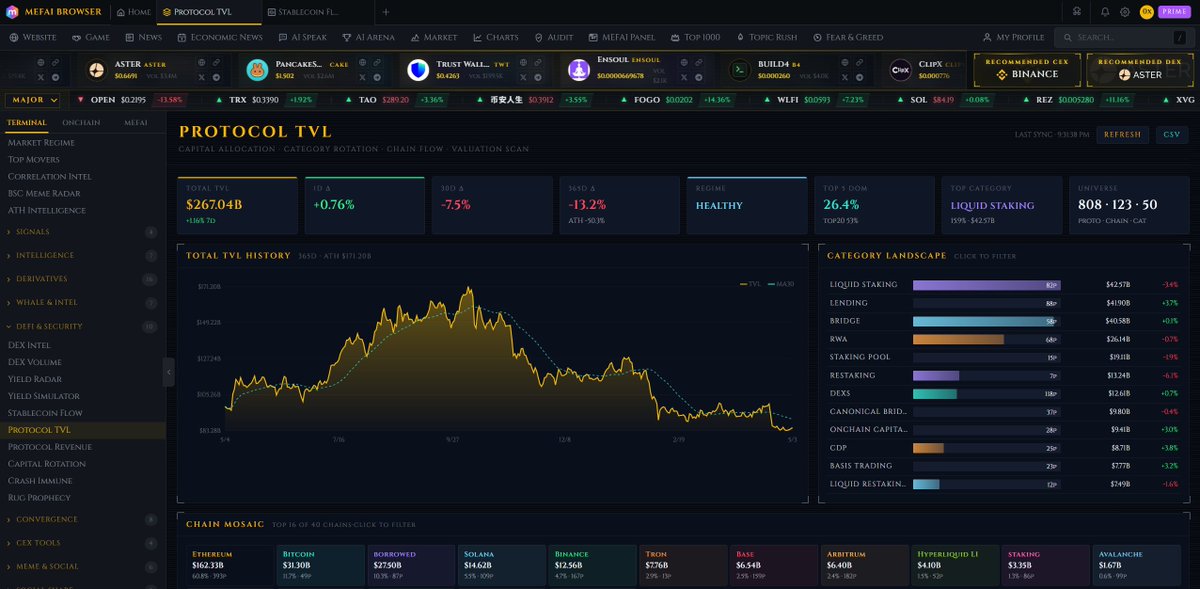
2⃣ $MEFAI Platform || PROTOCOL TVL Why a trader needs this. You open DeFiLlama, see a list sorted by TVL, and scroll. That is a snapshot. It tells you where capital is right now but not where it was yesterday, not where it is going tomorrow, not whether the inflow is organic or incentive bribed. You cannot filter by chain and category at the same time. You cannot sort by acceleration. You cannot see which protocols are bleeding TVL while their token pumps. Protocol TVL on MEFAI gives you the full picture in one view. What makes it different. TVL dashboards show you a ranked list. MEFAI gives you velocity, trend,nacceleration, category context, chain breakdown, cross filter, movement discovery, and per protocol deep dive. You stop reading a leaderboard and start reading capital flow. Every DeFi protocol ranked and profiled by total value locked. TVL is the balance sheet of DeFi. Revenue can be faked with wash trading. Token price can be pumped with a market maker. TVL moves slower, costs real capital to manipulate, and signals genuine user conviction. Market KPIs across the top. Total DeFi TVL, 24h net flow, 7d change, protocol count, active chains, category count, ETH dominance, and the single largest TVL protocol. When total TVL drops 5% in a week while BTC is flat, capital is rotating out of DeFi into CEX or stables. The KPI row catches it instantly. Chain mosaic shows top 16 chains as equal sized tiles. Each tile shows chain name, TVL, and dominance share. Click any tile to filter the entire protocol table to that chain only. Active filter shows as a gold chip you can dismiss. When you click Arbitrum, only Arbitrum protocols remain in the table below. No scrolling to find a filter dropdown. Category landscape breaks protocols into DEXs, lending, bridges, CDPs, yield aggregators, liquid staking, and 40+ subcategories. Click any category bar to filter the table. Combine with chain filter, click Arbitrum + click Lending = every lending protocol on Arbitrum, sorted by TVL. Full universe table has every protocol with sortable columns: name, category, TVL, dominance, MCAP, MCAP/TVL ratio, 1D change, 7D change, acceleration, and chain count. Sort by MCAP/TVL to find undervalued protocols relative to their locked capital. Sort by acceleration to catch protocols where TVL growth is speeding up. Movement lens has ten curated tabs. TVL magnets (biggest inflows), TVL drains (biggest outflows), Accelerators (growth rate increasing), Decelerators (growth rate slowing), Category winners, Category losers, New entrants, Multi chain expanders, Single chain concentrated, and Whale dominated. Each tab surfaces a different alpha signal from the same dataset. Protocol deep dive opens on click. Full TVL history chart up to 365 days, chain distribution with percentage breakdown, category peer ranking showing where the protocol sits relative to direct competitors, and per chain TVL trend lines. When Aave on Arbitrum is growing 20% while Aave on Ethereum is flat, the deep dive shows that divergence.
Meta Financial AI tweet mediaMeta Financial AI tweet mediaMeta Financial AI tweet mediaMeta Financial AI tweet media
English
3
13
39
1.7K
MA retweetledi
Meta Financial AI
Meta Financial AI@MetaFinancialAI·
1⃣ $MEFAI Platform || STABLECOIN FLOW Real time capital flow tracker for every major stablecoin across every chain. Stablecoins are crypto's monetary base. When USDT mints $ 3B in a week, fresh dollars entered the system. When USD redeems $ 500M in a day, capital is leaving. Token prices can be manipulated. Mint and burn cannot. Here is an interesting observation, the reverse rule. During downtrends, newly minted USDT doesn't impact the price at all; in fact, it actually increases short interest. In other words, not every mint leads to a pump. Movement lens surfaces five signals, Minting winners (fastest growing supply), Burn losers (fastest shrinking), Fastest chain migration, Peg stress alerts, New entrants. Market KPIs read the stablecoin system in one row. Total stablecoin market cap, 24h 7d 30d net supply change, USDT vs USDC dominance split, top 3 concentration ratio, peg deviation count, and the single largest mint event of the day. Supply history chart shows 365 days of aggregate stablecoin market cap. When the line slopes up, new money is entering crypto. When it flattens or dips, the system is in redemption mode. This is the most honest macro indicator in the market. Chain leaderboard ranks every chain by stablecoin supply hosted. Ethereum, Tron, BSC, Arbitrum, Solana, Base. When $2 B USDC migrates from Ethereum to Arbitrum in 48 hours, DEX volume on Arbitrum follows within days. The chain leaderboard shows where dollars are parking before the trading activity confirms it. Peg monitor scans every tracked stablecoin for micro depegs. A 0.3% depeg on a $5 B stable is either a $15 M arbitrage opportunity or a $15 M warning sign depending on reserve health. The monitor catches deviations that are invisible on a price chart but meaningful at institutional scale. Individual stable profiles open on click. Full 365 day circulating supply history, chain by chain distribution with percentage share, reserve composition and backing mechanics, mint redeem description, audit links, and social channels. You know what backs your dollar before you park $ 100K in it. Mechanism breakdown classifies every stablecoin by backing type, fiat backed, crypto collateralized, algorithmic, hybrid. When algorithmic stables are growing share while fiat backed are flat, the market is taking more risk for yield. The mechanism breakdown quantifies that shift. Each lens is a different window into where stablecoin capital is flowing right now.
Meta Financial AI tweet mediaMeta Financial AI tweet media
English
8
29
79
2.6K