Lorn Conner
1.7K posts

Lorn Conner retweetledi

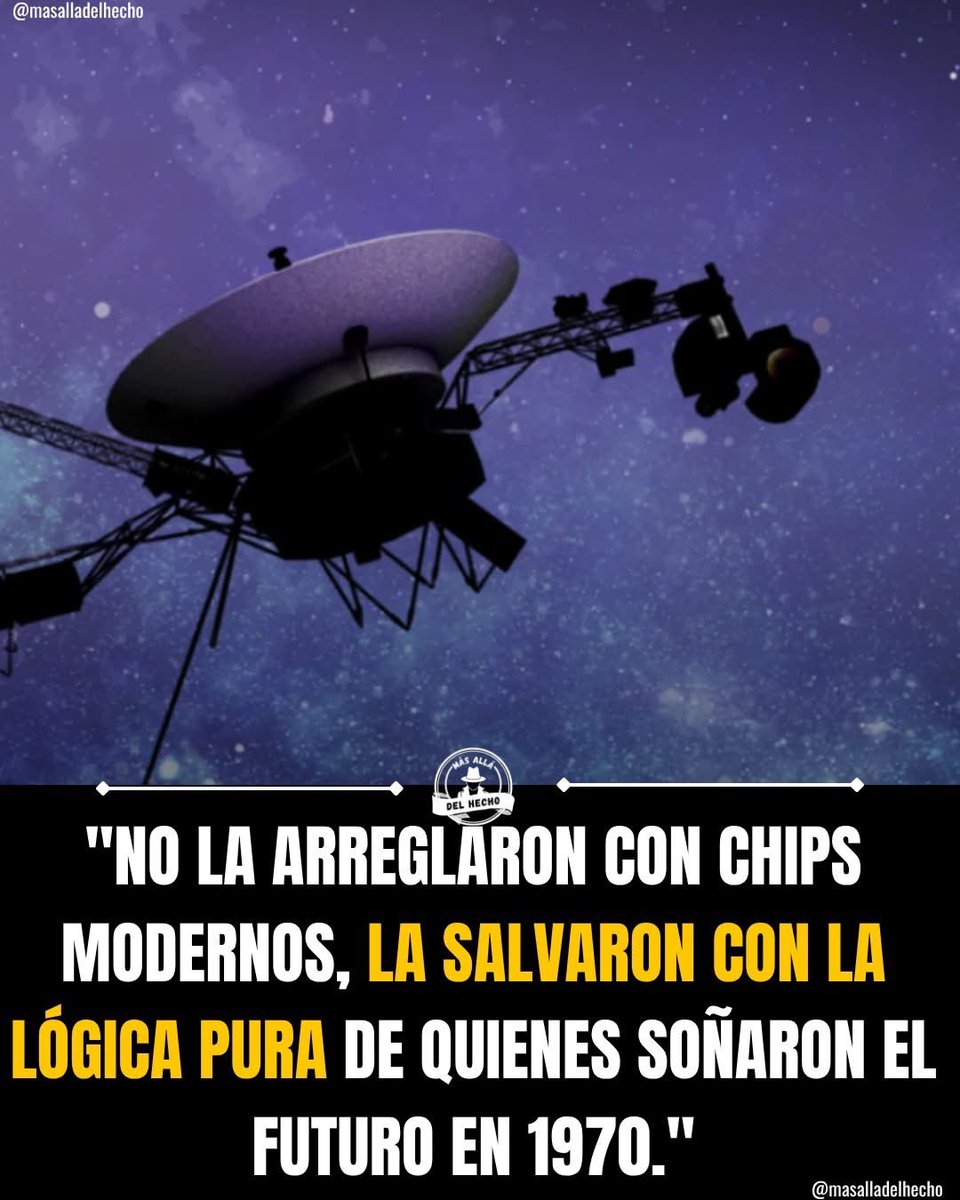
En una oficina de California, un grupo de veteranos de la NASA rompe en llanto frente a una pantalla de fósforo verde.
A 24,000 millones de kilómetros de la Tierra, en el vacío más absoluto y helado, una máquina ha vuelto a la vida.
No es tecnología de punta.
Son circuitos diseñados cuando aún no existía el internet.
Es la Voyager 1, el objeto que lleva nuestra voz a las estrellas, y se niega a decir adiós.
Para quienes vivieron el año 1977, el lanzamiento de las sondas Voyager no fue solo un evento científico; fue un mensaje de optimismo en un mundo dividido.
Eran los días de la música disco, de la llegada de Star Wars a los cines y de la convicción de que el espacio era nuestra próxima frontera.
La Voyager 1 partió con una misión clara: fotografiar Júpiter y Saturno.
Pero llevaba algo más: el Disco de Oro, una cápsula del tiempo con sonidos de la Tierra, saludos en 55 idiomas y la música de Bach y Chuck Berry.
La Voyager fue diseñada para durar cinco años.
Nadie, ni los ingenieros más optimistas de la época, imaginó que en pleno 2026 seguiríamos escuchando sus señales.
Cruzó la heliosfera en 2012, convirtiéndose en el primer objeto humano en entrar en el espacio interestelar.
Se convirtió en nuestros ojos en la oscuridad.
A finales de 2025 y principios de 2026, la tragedia golpeó al equipo de la misión.
La Voyager 1 empezó a enviar "basura binaria".
En lugar de datos sobre el polvo interestelar o el campo magnético, la sonda emitía una repetición sin sentido de unos y ceros.
Era como si un anciano sabio, después de décadas de contar historias, de pronto empezara a balbucear sílabas inconexas.
Los expertos diagnosticaron un fallo en el FDS (Sistema de Datos de Vuelo), una de las tres computadoras a bordo.
El problema era crítico, el chip de memoria que contenía el código esencial de comunicación se había degradado por la radiación cósmica y el paso de casi medio siglo.
La Voyager estaba viva, sus propulsores funcionaban, pero estaba "atrapada" dentro de su propia mente digital, incapaz de decirnos lo que estaba viendo.
Aquí es donde la historia se vuelve un acto increíble de humanidad y genialidad.
Los ingenieros actuales de la NASA, muchos de los cuales ni siquiera habían nacido cuando la Voyager despegó, tuvieron que recurrir a los "ancianos".
Tuvieron que desempolvar manuales de papel, escritos a máquina en los años 70, para entender una arquitectura de computación que hoy parece prehistórica.
Pero lo que ocurrió después cambió todo.
No podían simplemente "reiniciar" la sonda.
Una señal tarda 22.5 horas en llegar a la Voyager y otras 22.5 horas en regresar.
Cada intento de reparación requería casi dos días de espera agónica.
El equipo decidió realizar una cirugía cerebral a distancia: mover el código dañado a una parte diferente de la memoria de la computadora.
El problema era que no había espacio suficiente.
Tuvieron que despedazar el código, optimizarlo y "esconderlo" en diferentes rincones de la memoria, como quien intenta acomodar una enciclopedia en los huecos de una estantería llena.
En marzo de 2026, después de semanas de simulaciones, se envió el comando definitivo.
El equipo de la Red del Espacio Profundo apuntó sus gigantescas antenas hacia la constelación de Ofiuco.
El comando viajó a la velocidad de la luz, cruzando la órbita de Plutón, atravesando el cinturón de Kuiper, hasta alcanzar al pequeño viajero en la negrura absoluta.
Entonces sucedió algo inesperado.
Pasaron 45 horas de silencio total en el Laboratorio de Propulsión a Chorro (JPL). Algunos temían que el comando hubiera borrado definitivamente la memoria de la sonda.
De repente, la señal llegó.
En las pantallas, los unos y ceros sin sentido desaparecieron.
En su lugar, aparecieron datos de telemetría perfectos.
La Voyager 1 estaba reportando su estado de salud.
"Estoy aquí", decía el código. "Sigo viajando.
Sigo mirando"
Por primera vez en meses, la Voyager volvía a ser ella misma.
Sigue👇

Español

@felonattorney @wdwpro1 I told you! Nobody believed me! Even dressed as the Avatar, some people still missed it! I tell you, the man missed his calling! He could legitimately be a government agent!
English

@wdwpro1 nice face reveal last night. @LornConner was right very plain but beards hide a lot. It was good to put a face to a voice btw
English


@MilkIt77 @MattsaBallz Unless you watch the Genre Guys! We covered it quite awhile ago!
English

@MattsaBallz @LornConner “Reign of Fire” is an excellent movie and for some reason overlooked.
English

@PackingProtons Well, they did say there was no gaffers tape in space!
English


@dom_lucre Surely there is no way this can have negative consequences!
English

@MattsaBallz Even that one is wrong. That’s the LC hat - the best is the Raiders Cairo.
English

@LornConner
any other answer
is wrong
All The Right Movies@ATRightMovies
What is the greatest hat in movies?
English

I don’t think so. In the deleted scenes for ROTJ, Yoda reveals that he forbid Obi-Wan from telling Luke about his parentage. This was for two reasons: One, so that Luke wouldn’t rush to his father and try to reason with him before he would be able to defend himself, and Two, so that Luke wouldn’t know they were gearing him up for patricide. Luke was wise enough in the moment to see that continuing to attack would lead him to become Vader. By tossing aside his lightsaber in the final confrontation, he cast aside his fears and reminded Anakin of what a Jedi is supposed to be. By putting him in that position, Vader had to defend Luke.
English

@LornConner
This is how I interpret the scenes with Yoda and Obi-Wan in ROTJ.
Yoda is surprised and caught off guard that Vader revealed that he is Luke’s father. As you and Marvin said, this is a more humble and wiser Yoda. Yoda then told Luke that he had to “confront” Vader.
It was Luke who interpreted that he meant “kill” as he told Obi-Wan.
However, I do believe that Obi-Wan most likely meant that Luke had to kill Vader. When Luke told Obi-Wan that he couldn’t kill his own father, Obi-Wan said that then the Emperor has already won. But the last thing Obi-Wan says in that scene is that Luke must “face” Darth Vader again.
So I’m about 90% sure that Obi-Wan meant for Luke to kill his father. With Yoda, 100% sure that he just meant he had to put himself in front of Vader again.
English
Lorn Conner retweetledi

MIT Professor David Autor just explained why Wall-E is the optimistic scenario, and the alternative should terrify you.
Autor: “Whenever I watch the movie I think, well that’s the good scenario.”
Wall-E shows 300-pound humans floating in chairs drinking Big Gulps. Looks dystopian. Autor sees what we’re actually heading toward.
Autor: “That’s where they’ve figured out the income distribution problem. It doesn’t look fun, but at least they’re not at war with one another.”
Real threat isn’t automation. It’s labor losing value while distribution stays broken.
Autor: “The bad scenario is where the value of human expertise is just liquidated very rapidly. We’d have tons of productivity and resources, but it would create a huge problem for distribution.”
Income flows from labor. Machinery makes labor worthless, most people can’t capture the wealth being created.
Autor: “If labor were devalued by machinery, most of us would have nothing to sell to the market.”
Democracy requires contributing and claiming. Remove work’s value and people become only claimants demanding handouts without contributing.
Autor: “Democracy depends on people being both claimants and contributors. If we had nothing to contribute because our labor wasn’t valuable but we were just claimants saying ‘give me my UBI,’ that would be a fundamental existential threat to the way our democracy works.”
Wall-E somehow solved distribution. Everyone’s needs met despite zero contribution. That’s why it’s the good outcome even looking terrible.
Reality heads somewhere worse.
Autor: “In a world where all resources were generated by machinery and only a few people own that, we would have a very unequal and very fractious society. And that’s how most of human history has been.”
Not fantasy. Historical default. Tiny group owns production. Everyone else fights for scraps. Democracy is the exception requiring conditions we’re destroying.
Autor: “We want to preserve the labor market because we want to preserve democracy.”
Not about money. About maintaining structure where people contribute value and earn legitimate claim on output. Without that, power concentrates among AI owners. Everyone else loses economic leverage and democratic voice.
We don’t get peaceful consumption in armchairs. We get feudalism with algorithms. And nothing currently guarantees otherwise. Path of least resistance leads straight to concentration, not distribution. Wall-E requires intentional design nobody’s implementing.
English

@MattsaBallz @MilkIt77 I had this exact book, but mine came with an audiocasette, not a record. I wish I still had them.
English