

M Compass Media
5.8K posts

M Compass Media
@MCompassMedia
Independent Irish Media Covering Stories That Matter in Ireland and around the world
Katılım Ağustos 2021
290 Takip Edilen5.6K Takipçiler
It was an honour to be present to witness Dr Michael McConville, @reasonoverfear, deliver a powerful rebuttal of the charges made against him at the Medical Council inquiry this morning.
It was also a moving moment to stand among members of the public who responded with sustained applause and a standing ovation as he turned on his heel and exited as soon as he delivered his statement, alongside three other doctors also brought before the council because of their courage in breaking the State’s omertà to inform the public about what they knew to be harmful policies and procedures during covid.
I travelled to Dublin today as a small act of solidarity with Dr McConville, who was my doctor for many years. In my experience, he was an exceptionally kind, caring and dedicated GP. He retired in January 2024 after more than four decades in medicine and I am still grieving his loss.
Please read and share @blueskylou report on this morning’s proceedings
t.co/6s5QObIG1K
Louise Roseingrave@blueskylou
Dr McConville exited the IMC inquiry abruptly this morning after delivering his oral submission. He received a standing ovation from members of the public. The allegations against him concern posts on social media that 'undermined public health guidelines'
English
“𝐁𝐲 𝐓𝐡𝐞 𝐆𝐫𝐚𝐜𝐞 𝐎𝐟 𝐆𝐨𝐝 𝐇𝐞 𝐊𝐞𝐞𝐩𝐬 𝐂𝐨𝐦𝐢𝐧𝐠 𝐁𝐚𝐜𝐤” — 𝐉𝐮𝐝𝐠𝐞 𝐔𝐫𝐠𝐞𝐬 𝐓𝐮𝐬𝐥𝐚 𝐓𝐨 𝐀𝐜𝐭 𝐎𝐯𝐞𝐫 𝐁𝐨𝐲 𝐈𝐧 𝐂𝐚𝐫𝐞
A report by Gordon Deegan in today’s Irish Times describes a deeply concerning case involving a 14 year old boy in Tusla care whose placement situation prompted a direct plea from Judge Adrian Harris for Tusla to provide him with appropriate care.
The Family Law Court heard that the teenager is currently living in an unregulated special care arrangement where his daily routine has collapsed entirely. According to the boy’s court appointed Guardian ad Litem, or GAL, the child remains awake on his mobile phone until around 6am every morning, sleeps during the day, and typically does not wake until late afternoon.
When the GAL recently visited the placement, the teenager refused to leave his bedroom, telling him to “F off”. Staff at the unit reportedly informed the GAL that the boy’s pattern of unrestricted overnight phone use meant that midday effectively felt like the middle of the night to him.
The court heard the teenager has had unrestricted access to his phone around the clock and has received no education for approximately a year.
This is not the first time serious concerns about the boy’s behaviour and circumstances have come before the court. Earlier proceedings heard that staff at the care setting had become fearful after the boy claimed he had made a sawn off shotgun, although it was clarified that the item was not genuine.
Judge Adrian Harris issued a stark warning about the risks involved. He said he was appealing directly to Tusla management to secure a proper placement for the child, expressing alarm that the boy, while in State care, was going missing every second day. The judge said that each time the teenager had returned safely “by the grace of God”, but warned that the court could face a far more tragic outcome if the situation continued.
The teenager entered care following a major incident at home. Last month, Tusla obtained an emergency care order after the boy reportedly “completely destroyed” his family home during an argument triggered by his mother’s refusal to return his mobile phone.
The court heard that the child’s pathway through care since then has been highly unstable. At one stage, because fuel protests prevented gardaí from transporting him to a hotel placement in Dublin, Tusla admitted him to a university hospital as a social admission. Before eventually obtaining the current special care arrangement earlier this month, he had been moved repeatedly between hotel placements on an almost daily basis.
The hearing also raised wider questions about the State’s ability to meet the needs of highly vulnerable children taken into care. When asked about restricting the teenager’s phone access, the GAL agreed that ideally limits should exist but said staff in residential and special care settings often lack the practical ability to confiscate a phone without potentially escalating an already volatile situation.
The GAL posed what he described as a fundamental question for Tusla: whether it is right to bring a child into care if the State cannot provide a suitable placement afterwards. Referring to the fact that the situation has been ongoing for six or seven weeks, he said Tusla appeared effectively “snookered”, while acknowledging that leaving the child outside care would also be an unsatisfactory option.
Judge Harris noted that the boy’s parents were powerless in the circumstances. He said they had tried their best but were unable to provide the level of care the child required.
The court ultimately extended the Interim Care Order until June 26. The case shines a spotlight on the challenges facing Tusla in securing suitable placements for children with highly complex needs, and on the potential dangers when a child in State care remains without a stable, structured and properly regulated environment.
ABC for Justice@AllianceBirth
“𝐁𝐲 𝐓𝐡𝐞 𝐆𝐫𝐚𝐜𝐞 𝐎𝐟 𝐆𝐨𝐝 𝐇𝐞 𝐊𝐞𝐞𝐩𝐬 𝐂𝐨𝐦𝐢𝐧𝐠 𝐁𝐚𝐜𝐤” — 𝐉𝐮𝐝𝐠𝐞 𝐔𝐫𝐠𝐞𝐬 𝐓𝐮𝐬𝐥𝐚 𝐓𝐨 𝐀𝐜𝐭 𝐎𝐯𝐞𝐫 𝐁𝐨𝐲 𝐈𝐧 𝐂𝐚𝐫𝐞 A report by Gordon Deegan in today’s Irish Times describes a deeply concerning case involving a 14 year old boy in Tusla care whose placement situation prompted a direct plea from Judge Adrian Harris for Tusla to provide him with appropriate care. The Family Law Court heard that the teenager is currently living in an unregulated special care arrangement where his daily routine has collapsed entirely. According to the boy’s court appointed Guardian ad Litem, or GAL, the child remains awake on his mobile phone until around 6am every morning, sleeps during the day, and typically does not wake until late afternoon. When the GAL recently visited the placement, the teenager refused to leave his bedroom, telling him to “F off”. Staff at the unit reportedly informed the GAL that the boy’s pattern of unrestricted overnight phone use meant that midday effectively felt like the middle of the night to him. The court heard the teenager has had unrestricted access to his phone around the clock and has received no education for approximately a year. This is not the first time serious concerns about the boy’s behaviour and circumstances have come before the court. Earlier proceedings heard that staff at the care setting had become fearful after the boy claimed he had made a sawn off shotgun, although it was clarified that the item was not genuine. Judge Adrian Harris issued a stark warning about the risks involved. He said he was appealing directly to Tusla management to secure a proper placement for the child, expressing alarm that the boy, while in State care, was going missing every second day. The judge said that each time the teenager had returned safely “by the grace of God”, but warned that the court could face a far more tragic outcome if the situation continued. The teenager entered care following a major incident at home. Last month, Tusla obtained an emergency care order after the boy reportedly “completely destroyed” his family home during an argument triggered by his mother’s refusal to return his mobile phone. The court heard that the child’s pathway through care since then has been highly unstable. At one stage, because fuel protests prevented gardaí from transporting him to a hotel placement in Dublin, Tusla admitted him to a university hospital as a social admission. Before eventually obtaining the current special care arrangement earlier this month, he had been moved repeatedly between hotel placements on an almost daily basis. The hearing also raised wider questions about the State’s ability to meet the needs of highly vulnerable children taken into care. When asked about restricting the teenager’s phone access, the GAL agreed that ideally limits should exist but said staff in residential and special care settings often lack the practical ability to confiscate a phone without potentially escalating an already volatile situation. The GAL posed what he described as a fundamental question for Tusla: whether it is right to bring a child into care if the State cannot provide a suitable placement afterwards. Referring to the fact that the situation has been ongoing for six or seven weeks, he said Tusla appeared effectively “snookered”, while acknowledging that leaving the child outside care would also be an unsatisfactory option. Judge Harris noted that the boy’s parents were powerless in the circumstances. He said they had tried their best but were unable to provide the level of care the child required. The court ultimately extended the Interim Care Order until June 26. The case shines a spotlight on the challenges facing Tusla in securing suitable placements for children with highly complex needs, and on the potential dangers when a child in State care remains without a stable, structured and properly regulated environment.
English
𝐌𝐨𝐧𝐞𝐲 𝐃𝐨𝐰𝐧 𝐓𝐡𝐞 𝐃𝐫𝐚𝐢𝐧? 𝐇𝐚𝐬 𝐄𝐦𝐞𝐫𝐠𝐞𝐧𝐜𝐲 𝐀𝐜𝐜𝐨𝐦𝐦𝐨𝐝𝐚𝐭𝐢𝐨𝐧 𝐁𝐞𝐜𝐨𝐦𝐞 𝐀 𝐓𝐚𝐱𝐩𝐚𝐲𝐞𝐫 𝐅𝐮𝐧𝐝𝐞𝐝 𝐁𝐨𝐧𝐚𝐧𝐳𝐚 𝐅𝐨𝐫 𝐏𝐫𝐢𝐯𝐚𝐭𝐞 𝐏𝐫𝐨𝐯𝐢𝐝𝐞𝐫𝐬?
An exclusive front page report in the Irish Daily Mail says State spending on emergency accommodation for homeless people has risen dramatically over the past decade, reaching almost half a billion euro last year.
According to figures obtained by Sinn Féin housing spokesman Eoin Ó Broin, expenditure on emergency accommodation provided through private and third party operators climbed to approximately €493.6 million in 2025. The report states this represents an increase of about 570 per cent since 2015.
The spending data, published for the first time for 2025, has prompted criticism from opposition politicians, who argue it reflects a continuing failure to tackle the root causes of homelessness.
Mr Ó Broin described the scale of expenditure as a “runaway train”, arguing that particularly high payments to private providers for low quality accommodation are unsustainable. He said the costs are likely to continue increasing unless the Government substantially expands social housing supply and addresses high private rents.
Across the country, emergency accommodation costs reached record levels last year. Dublin, where 6,000 people were living in emergency settings in March, saw annual costs exceed €350 million for the first time.
The report explains that local authorities fund emergency accommodation, with the State covering about 90 per cent of overall costs. Since 2015, spending in this area has grown sharply, driven by rising homelessness numbers and the fees charged by accommodation providers.
One example cited is the cost of housing a family in emergency accommodation. In Dublin, placing a household in a four bedroom property can cost up to €15,000 per month, or roughly €180,000 per year.
The article also points to a growing number of people entering homelessness. Data from property website Daft.ie indicates average market rents are now about 80 per cent higher than a decade ago. At the same time, landlords granted permission to set rents at market levels between tenancies have, according to critics, contributed to ongoing instability in the rental sector.
Mr Ó Broin argued that Government policy changes, including revisions to rent rules and missed social housing delivery targets, have intensified pressures by increasing evictions and housing insecurity. He said the State’s approach has placed too much emphasis on reducing homelessness quickly through emergency responses rather than preventing people from becoming homeless in the first place.
Housing Minister James Browne rejected the claims. He defended Government policy, pointing to increased home building activity, new developments, commencements and supports for first time buyers. He argued that without interventions such as changes to rent regulations, conditions in the housing market would be worse.
The report notes that temporary accommodation spending by the State over the last decade totals about €4.9 billion. Spending rose from roughly €73.4 million in 2015 to nearly €494 million in 2025, with only a brief decline recorded between 2021 and 2022.
A Dept of Housing spokesperson told the paper that supporting homeless people and preventing homelessness remain central priorities. The department said measures contained in the Government’s new housing strategy are designed to increase housing supply, reduce homelessness and support families, including a €150 million programme aimed at assisting households with children at risk of losing their homes.
The department disputed suggestions that recent policy changes contributed to rising homelessness, instead citing factors such as inflation, eviction notices and broader market pressures. It said substantial resources continue to be directed towards emergency accommodation for those who need it.

English
M Compass Media retweetledi

If you are shocked that the Govt buys houses for IPAS...
Then you obviously have never heard of a company called Dídean Dochas.
Its easily the best business model I have ever seen....all paid for by the Irish taxpayer:
1) Govt gives tens of millions to a private company
2) Company buys hundreds of houses across midlands
3) Company rents houses back to the State for IPAS
4) Company routes all profits to Isle of Man.
5) State doesn't even own the houses at the end of it all
6) Company's balance sheet worth €€€€€
6) CEO of Company is EDPetrol.
7) Vrooom Vrooom

Nick Delehanty 🇮🇪@Nick_Delehanty
Since 2022 Didean has been busy buying up properties around the midlands - Laois, Offally, Carlow, Limerick, Westmeath and beyond. By end of 2023, their property portfolio was worth €7.5million and rising fast.
English
𝐖𝐡𝐲 𝐃𝐢𝐝 𝐑𝐨𝐬𝐬𝐚 𝐅𝐚𝐧𝐧𝐢𝐧𝐠 𝐁𝐥𝐨𝐜𝐤 𝐀 𝐅𝐮𝐥𝐥 𝐁𝐚𝐧 𝐎𝐧 𝐂𝐨𝐮𝐧𝐬𝐞𝐥𝐥𝐢𝐧𝐠 𝐍𝐨𝐭𝐞𝐬 𝐈𝐧 𝐒𝐞𝐱𝐮𝐚𝐥 𝐕𝐢𝐨𝐥𝐞𝐧𝐜𝐞 𝐓𝐫𝐢𝐚𝐥𝐬?
A report in today’s Irish Independent by Azmia Riaz says sexual violence survivors and therapists are demanding a full ban on the use of counselling notes in criminal trials, arguing that allowing alleged perpetrators access to deeply personal therapy records is re traumatising and deters victims from seeking help or pursuing justice.
The report centres on proposed amendments to section 19A of the Criminal Law and Civil Law Bill 2026, introduced by Justice Minister Jim O’Callaghan. The current law allows alleged perpetrators to apply to court for disclosure of a complainant’s counselling records. While the Government says its amendments would significantly tighten the rules, campaigners say they fall far short of the protections survivors were seeking.
Survivor Hazel Behan questioned how therapy notes, created in what should be a confidential healing space, could be handed over to someone accused of causing the trauma. She described the prospect of an alleged perpetrator reading intimate accounts of the damage caused by sexual assault as deeply violating and re traumatising.
Therapist Bairbre Kelly, co founder of Therapists Against Harm, criticised the proposed approach of leaving decisions on disclosure to judges. She argued that judges are trained to assess legal evidence, not trauma, and warned that counselling material can easily be misunderstood when viewed solely through a legal lens.
The Department of Justice told the Irish Independent that the Attorney General, Rossa Fanning has advised a total ban on counselling notes in sexual offence trials would be unconstitutional. Instead, the Government says it is trying to restrict disclosure “to the maximum extent possible” while preserving judicial oversight.
Under the proposed changes, a disclosure hearing would be required in all cases, the current waiver provision would be removed, and a new “filtering” stage would allow courts to reject irrelevant applications from the outset. The Department also says prosecutors would no longer be required to proactively seek out personal records for the defence, and that stronger safeguards would apply to counselling, medical, child protection and social work records.
However, therapists and survivors quoted in the report say these reforms do not address the fundamental problem. Kelly argues therapy notes are not forensic evidence. They are written by therapists, not survivors, often hours or days after sessions, and are intended as clinical summaries of emotions, thoughts and therapeutic themes rather than factual accounts. She warns that trauma can distort recollection, making reliance on such material potentially dangerous.
The report highlights concerns that even the possibility of counselling notes being disclosed may discourage survivors from attending therapy or reporting sexual violence at all. Kelly says some clients have already reconsidered seeking help because of fears their private therapeutic discussions could later be scrutinised in court.
Behan argues that sexual offence trials remain overly “perpetrator focused”, leaving survivors feeling marginalised within their own cases. She says victims are expected to endure cross examination, invasive scrutiny and the possibility of having years of therapeutic reflection read aloud, while defendants retain the right to remain silent.
Campaigners say a full ban on counselling notes is not an unreasonable demand and would allow survivors to pursue justice without sacrificing access to therapy and emotional support.
ABC for Justice@AllianceBirth
𝐖𝐡𝐲 𝐃𝐢𝐝 𝐑𝐨𝐬𝐬𝐚 𝐅𝐚𝐧𝐧𝐢𝐧𝐠 𝐁𝐥𝐨𝐜𝐤 𝐀 𝐅𝐮𝐥𝐥 𝐁𝐚𝐧 𝐎𝐧 𝐂𝐨𝐮𝐧𝐬𝐞𝐥𝐥𝐢𝐧𝐠 𝐍𝐨𝐭𝐞𝐬 𝐈𝐧 𝐒𝐞𝐱𝐮𝐚𝐥 𝐕𝐢𝐨𝐥𝐞𝐧𝐜𝐞 𝐓𝐫𝐢𝐚𝐥𝐬? A report in today’s Irish Independent by Azmia Riaz says sexual violence survivors and therapists are demanding a full ban on the use of counselling notes in criminal trials, arguing that allowing alleged perpetrators access to deeply personal therapy records is re traumatising and deters victims from seeking help or pursuing justice. The report centres on proposed amendments to section 19A of the Criminal Law and Civil Law Bill 2026, introduced by Justice Minister Jim O’Callaghan. The current law allows alleged perpetrators to apply to court for disclosure of a complainant’s counselling records. While the Government says its amendments would significantly tighten the rules, campaigners say they fall far short of the protections survivors were seeking. Survivor Hazel Behan questioned how therapy notes, created in what should be a confidential healing space, could be handed over to someone accused of causing the trauma. She described the prospect of an alleged perpetrator reading intimate accounts of the damage caused by sexual assault as deeply violating and re traumatising. Therapist Bairbre Kelly, co founder of Therapists Against Harm, criticised the proposed approach of leaving decisions on disclosure to judges. She argued that judges are trained to assess legal evidence, not trauma, and warned that counselling material can easily be misunderstood when viewed solely through a legal lens. The Department of Justice told the Irish Independent that the Attorney General, Rossa Fanning has advised a total ban on counselling notes in sexual offence trials would be unconstitutional. Instead, the Government says it is trying to restrict disclosure “to the maximum extent possible” while preserving judicial oversight. Under the proposed changes, a disclosure hearing would be required in all cases, the current waiver provision would be removed, and a new “filtering” stage would allow courts to reject irrelevant applications from the outset. The Department also says prosecutors would no longer be required to proactively seek out personal records for the defence, and that stronger safeguards would apply to counselling, medical, child protection and social work records. However, therapists and survivors quoted in the report say these reforms do not address the fundamental problem. Kelly argues therapy notes are not forensic evidence. They are written by therapists, not survivors, often hours or days after sessions, and are intended as clinical summaries of emotions, thoughts and therapeutic themes rather than factual accounts. She warns that trauma can distort recollection, making reliance on such material potentially dangerous. The report highlights concerns that even the possibility of counselling notes being disclosed may discourage survivors from attending therapy or reporting sexual violence at all. Kelly says some clients have already reconsidered seeking help because of fears their private therapeutic discussions could later be scrutinised in court. Behan argues that sexual offence trials remain overly “perpetrator focused”, leaving survivors feeling marginalised within their own cases. She says victims are expected to endure cross examination, invasive scrutiny and the possibility of having years of therapeutic reflection read aloud, while defendants retain the right to remain silent. Campaigners say a full ban on counselling notes is not an unreasonable demand and would allow survivors to pursue justice without sacrificing access to therapy and emotional support.
English
𝐂𝐨𝐦𝐩𝐥𝐚𝐢𝐧𝐭𝐬 𝐖𝐞𝐫𝐞 𝐌𝐚𝐝𝐞 𝐈𝐧 𝟐𝟎𝟏𝟕. 𝐖𝐡𝐲 𝐃𝐢𝐝 𝐓𝐡𝐞 𝐆𝐚𝐫𝐝𝐚 𝐖𝐚𝐭𝐜𝐡𝐝𝐨𝐠 𝐅𝐚𝐢𝐥 𝐓𝐨 𝐀𝐜𝐭 𝐀𝐠𝐚𝐢𝐧𝐬𝐭 𝐏𝐚𝐮𝐥 𝐌𝐨𝐨𝐝𝐲?
A report in today’s Irish Daily Mail and a related report by Conor Lally in The Irish Times focus on strong criticism from Garda Ombudsman Emily Logan over the historic handling of complaints against former garda Paul Moody, describing the failures of the Garda complaints system as “wholly unacceptable.”
Speaking after serious questions emerged about how complaints against Moody were dealt with, Logan, who is Ireland’s first Police Ombudsman, heading Fiosrú, the Office of the Police Ombudsman, the independent body responsible for investigating complaints and allegations concerning members of An Garda Síochána, acknowledged that the system failed the woman who first raised concerns in 2017.
The controversy centres on complaints made by Nicola Hanney, Moody’s then partner. During proceedings in the Circuit Criminal Court, Ms Hanney said she encountered “a wall of silence” from GSOC after making a complaint in 2017, alleging that her concerns were not acted upon. According to the reports, meaningful momentum in the case only developed years later after Moody’s home was searched by the Garda National Bureau of Criminal Investigation (GNBCI).
Moody, now 46, has since been imprisoned for his offending. One report notes that he received a sentence amounting to six years imprisonment with fifteen months suspended, while another refers to him being jailed for four years and nine months in relation to offences against his first victim. The reporting underlines that, in the intervening period, Moody was not properly investigated and allegedly went on to subject another woman to years of abuse.
Emily Logan, who has led Fiosrú since April 2025, said that although she was not personally involved in the original handling of the complaint, she had reviewed the case retrospectively and concluded that the outcome reached by the watchdog body was wrong.
She said plainly that what happened to Moody’s first victim was “wholly unacceptable”, adding that the experience of making a complaint and not being heard or responded to is “not acceptable whatsoever.”
In interviews with RTÉ Radio, Logan said she fully understood why a complainant in such circumstances would feel “very let down” by the experience. She revealed that she had written to Ms Hanney and offered to meet her personally, saying she wanted to show respect for someone who had endured a traumatic and deeply difficult period.
Logan also outlined measures now being introduced within Fiosrú to reduce the risk of similar failures occurring again. These include new initiatives aimed at ensuring complaints are not overlooked and recognising the realities of how victims of abuse engage with complaint systems.
One issue highlighted by Logan is that it is not unusual for victims in abusive circumstances to make complaints and later retract them. In response, she said former Rape Crisis Centre head Noeline Blackwell has been appointed to an advisory role within Fiosrú, suggesting an effort to strengthen the organisation’s understanding of victim dynamics and trauma informed responses.
ABC for Justice@AllianceBirth
𝐂𝐨𝐦𝐩𝐥𝐚𝐢𝐧𝐭𝐬 𝐖𝐞𝐫𝐞 𝐌𝐚𝐝𝐞 𝐈𝐧 𝟐𝟎𝟏𝟕. 𝐖𝐡𝐲 𝐃𝐢𝐝 𝐓𝐡𝐞 𝐆𝐚𝐫𝐝𝐚 𝐖𝐚𝐭𝐜𝐡𝐝𝐨𝐠 𝐅𝐚𝐢𝐥 𝐓𝐨 𝐀𝐜𝐭 𝐀𝐠𝐚𝐢𝐧𝐬𝐭 𝐏𝐚𝐮𝐥 𝐌𝐨𝐨𝐝𝐲? A report in today’s Irish Daily Mail and a related report by Conor Lally in The Irish Times focus on strong criticism from Garda Ombudsman Emily Logan over the historic handling of complaints against former garda Paul Moody, describing the failures of the Garda complaints system as “wholly unacceptable.” Speaking after serious questions emerged about how complaints against Moody were dealt with, Logan, who is Ireland’s first Police Ombudsman, heading Fiosrú, the Office of the Police Ombudsman, the independent body responsible for investigating complaints and allegations concerning members of An Garda Síochána, acknowledged that the system failed the woman who first raised concerns in 2017. The controversy centres on complaints made by Nicola Hanney, Moody’s then partner. During proceedings in the Circuit Criminal Court, Ms Hanney said she encountered “a wall of silence” from GSOC after making a complaint in 2017, alleging that her concerns were not acted upon. According to the reports, meaningful momentum in the case only developed years later after Moody’s home was searched by the Garda National Bureau of Criminal Investigation (GNBCI). Moody, now 46, has since been imprisoned for his offending. One report notes that he received a sentence amounting to six years imprisonment with fifteen months suspended, while another refers to him being jailed for four years and nine months in relation to offences against his first victim. The reporting underlines that, in the intervening period, Moody was not properly investigated and allegedly went on to subject another woman to years of abuse. Emily Logan, who has led Fiosrú since April 2025, said that although she was not personally involved in the original handling of the complaint, she had reviewed the case retrospectively and concluded that the outcome reached by the watchdog body was wrong. She said plainly that what happened to Moody’s first victim was “wholly unacceptable”, adding that the experience of making a complaint and not being heard or responded to is “not acceptable whatsoever.” In interviews with RTÉ Radio, Logan said she fully understood why a complainant in such circumstances would feel “very let down” by the experience. She revealed that she had written to Ms Hanney and offered to meet her personally, saying she wanted to show respect for someone who had endured a traumatic and deeply difficult period. Logan also outlined measures now being introduced within Fiosrú to reduce the risk of similar failures occurring again. These include new initiatives aimed at ensuring complaints are not overlooked and recognising the realities of how victims of abuse engage with complaint systems. One issue highlighted by Logan is that it is not unusual for victims in abusive circumstances to make complaints and later retract them. In response, she said former Rape Crisis Centre head Noeline Blackwell has been appointed to an advisory role within Fiosrú, suggesting an effort to strengthen the organisation’s understanding of victim dynamics and trauma informed responses.
English
𝐍𝐨 𝐀𝐮𝐭𝐨𝐦𝐚𝐭𝐢𝐜 𝐏𝐫𝐨𝐭𝐞𝐜𝐭𝐢𝐨𝐧 𝐅𝐨𝐫 𝐒𝐞𝐱𝐮𝐚𝐥 𝐀𝐛𝐮𝐬𝐞 𝐒𝐮𝐫𝐯𝐢𝐯𝐨𝐫𝐬 𝐀𝐟𝐭𝐞𝐫 𝐎𝐟𝐟𝐞𝐧𝐝𝐞𝐫𝐬 𝐀𝐫𝐞 𝐑𝐞𝐥𝐞𝐚𝐬𝐞𝐝 𝐅𝐫𝐨𝐦 𝐏𝐫𝐢𝐬𝐨𝐧
A report in today’s Sunday Independent by Ali Bracken says a growing number of sexual abuse survivors are calling for a change in Irish law to protect victims when convicted offenders are released from prison, warning that the current system leaves them living in fear long after criminal proceedings end.
At the centre of the campaign is Leona O’Callaghan, who says she is preparing to leave Ireland before the planned 2030 release of the man who raped her as a child in a Limerick graveyard. She says the prospect of his release is so terrifying that she has already discussed emigration with her adult children. Her attacker, Patrick “Whacker” O’Dea, is serving lengthy sentences for raping and sexually abusing multiple young girls and has continued to display violent behaviour while in prison.
O’Callaghan says she feels she has “no protection” under the current law and fears her abuser could seek to contact or terrorise her after his release. She argues that survivors should not have to uproot their lives to feel safe.
Campaigners are seeking the introduction of “Super Protection Orders”, which would allow judges, at the time of sentencing, to impose legally enforceable orders preventing convicted sex offenders from contacting or approaching victims after their release. At present, victims generally must wait until after release and then pursue civil restraining orders, often requiring evidence of new intimidation or harassment.
The proposed legislation, the Victims of Sexual Violence Civil Protection Orders Bill 2025, has been put forward by Sinn Féin TD Matt Carthy, who says the law is designed to correct an “anomaly” in the legal system. According to Carthy, there is cross party backing for the proposals and he hopes the legislation can become law by the end of 2026.
The Government did not oppose the bill at Second Stage, with a spokesperson for Justice Minister Jim O’Callaghan saying it aligns with the Government’s zero tolerance approach to domestic, sexual and gender based violence, while also stressing the need for constitutional and due process safeguards.
Shaneda Daly, whose father pleaded guilty to 227 sexual offences against her, says she still lives with anxiety despite his release in 2018. Although a judge told her father never to contact her again, she later discovered there was no legal mechanism automatically enforcing such a direction once he left prison. She says there is always an underlying fear of contact or chance encounters and believes survivors deserve stronger protections.
Sonya Stokes, whose uncle served ten years for raping her as a child, describes the trauma of living with constant fear after his release. She says she repeatedly worried about meeting him while visiting Limerick, only to later discover he had died months earlier without her being informed, despite expectations around victim notification.
Paula Fay’s brothers were recently convicted and jailed for the prolonged sexual abuse of their sisters. She says she only recently learned that victims do not automatically receive legal protection from future contact by convicted abusers. Working in a hospital, she now worries about the possibility of one of her brothers being transferred to her workplace for treatment.
Activist and survivor Hazel Behan, who co founded Éist, says survivors should not spend years pursuing justice only to emerge from the criminal process without meaningful protection once offenders return to society. She argues the proposed measures represent basic, humane safeguards.
Donna Von Allemann of Rape Crisis Ireland says trauma for survivors does not end with conviction or imprisonment. Instead, the “clock starts ticking” toward eventual release, leaving many victims living with fear and uncertainty and without automatic legal protection.
ABC for Justice@AllianceBirth
𝐍𝐨 𝐀𝐮𝐭𝐨𝐦𝐚𝐭𝐢𝐜 𝐏𝐫𝐨𝐭𝐞𝐜𝐭𝐢𝐨𝐧 𝐅𝐨𝐫 𝐒𝐞𝐱𝐮𝐚𝐥 𝐀𝐛𝐮𝐬𝐞 𝐒𝐮𝐫𝐯𝐢𝐯𝐨𝐫𝐬 𝐀𝐟𝐭𝐞𝐫 𝐎𝐟𝐟𝐞𝐧𝐝𝐞𝐫𝐬 𝐀𝐫𝐞 𝐑𝐞𝐥𝐞𝐚𝐬𝐞𝐝 𝐅𝐫𝐨𝐦 𝐏𝐫𝐢𝐬𝐨𝐧 A report in today’s Sunday Independent by Ali Bracken says a growing number of sexual abuse survivors are calling for a change in Irish law to protect victims when convicted offenders are released from prison, warning that the current system leaves them living in fear long after criminal proceedings end. At the centre of the campaign is Leona O’Callaghan, who says she is preparing to leave Ireland before the planned 2030 release of the man who raped her as a child in a Limerick graveyard. She says the prospect of his release is so terrifying that she has already discussed emigration with her adult children. Her attacker, Patrick “Whacker” O’Dea, is serving lengthy sentences for raping and sexually abusing multiple young girls and has continued to display violent behaviour while in prison. O’Callaghan says she feels she has “no protection” under the current law and fears her abuser could seek to contact or terrorise her after his release. She argues that survivors should not have to uproot their lives to feel safe. Campaigners are seeking the introduction of “Super Protection Orders”, which would allow judges, at the time of sentencing, to impose legally enforceable orders preventing convicted sex offenders from contacting or approaching victims after their release. At present, victims generally must wait until after release and then pursue civil restraining orders, often requiring evidence of new intimidation or harassment. The proposed legislation, the Victims of Sexual Violence Civil Protection Orders Bill 2025, has been put forward by Sinn Féin TD Matt Carthy, who says the law is designed to correct an “anomaly” in the legal system. According to Carthy, there is cross party backing for the proposals and he hopes the legislation can become law by the end of 2026. The Government did not oppose the bill at Second Stage, with a spokesperson for Justice Minister Jim O’Callaghan saying it aligns with the Government’s zero tolerance approach to domestic, sexual and gender based violence, while also stressing the need for constitutional and due process safeguards. Shaneda Daly, whose father pleaded guilty to 227 sexual offences against her, says she still lives with anxiety despite his release in 2018. Although a judge told her father never to contact her again, she later discovered there was no legal mechanism automatically enforcing such a direction once he left prison. She says there is always an underlying fear of contact or chance encounters and believes survivors deserve stronger protections. Sonya Stokes, whose uncle served ten years for raping her as a child, describes the trauma of living with constant fear after his release. She says she repeatedly worried about meeting him while visiting Limerick, only to later discover he had died months earlier without her being informed, despite expectations around victim notification. Paula Fay’s brothers were recently convicted and jailed for the prolonged sexual abuse of their sisters. She says she only recently learned that victims do not automatically receive legal protection from future contact by convicted abusers. Working in a hospital, she now worries about the possibility of one of her brothers being transferred to her workplace for treatment. Activist and survivor Hazel Behan, who co founded Éist, says survivors should not spend years pursuing justice only to emerge from the criminal process without meaningful protection once offenders return to society. She argues the proposed measures represent basic, humane safeguards. Donna Von Allemann of Rape Crisis Ireland says trauma for survivors does not end with conviction or imprisonment. Instead, the “clock starts ticking” toward eventual release, leaving many victims living with fear and uncertainty and without automatic legal protection.
English
𝐓𝐫𝐞𝐯𝐨𝐫 𝐁𝐨𝐥𝐠𝐞𝐫 𝐖𝐚𝐬 𝐂𝐨𝐧𝐯𝐢𝐜𝐭𝐞𝐝 𝐎𝐟 𝐃𝐨𝐦𝐞𝐬𝐭𝐢𝐜 𝐕𝐢𝐨𝐥𝐞𝐧𝐜𝐞. 𝐒𝐡𝐨𝐮𝐥𝐝 𝐓𝐡𝐞 𝐆𝐑𝐀 𝐑𝐞𝐚𝐥𝐥𝐲 𝐁𝐞 𝐅𝐮𝐧𝐝𝐢𝐧𝐠 𝐇𝐢𝐬 𝐅𝐢𝐠𝐡𝐭 𝐀𝐠𝐚𝐢𝐧𝐬𝐭 𝐑𝐞𝐦𝐨𝐯𝐚𝐥 𝐅𝐫𝐨𝐦 𝐓𝐡𝐞 𝐅𝐨𝐫𝐜𝐞?
A report in The Sunday Independent by Ali Bracken and Maeve Sheehan says the former wife of ex detective garda Trevor Bolger has criticised the Garda Representative Association, the main representative body and largest staff association for rank and file members of An Garda Síochána, after it emerged that the organisation is funding his legal challenge against his dismissal from the force.
Bolger, a former detective garda, was convicted earlier this year of assaulting his then wife, Margaret Loftus, herself a former garda. He received a three month suspended sentence in January after pleading guilty to assaulting her following a family gathering in Mayo in 2012. According to Ms Loftus, she ended the marriage the following day. More serious charges, including threats to kill and coercion, were dropped.
Bolger had been due to leave the force at one minute to midnight last Wednesday. However, hours before his dismissal was due to take effect, he secured a High Court stay preventing his removal pending a judicial review of the Garda Commissioner’s decision.
The report says a source close to the Garda Representative Association, or GRA, confirmed that the organisation is providing “legal assistance” to support Bolger’s judicial review proceedings. The GRA operates a Legal Assistance Scheme for members, and Bolger’s application for support is understood to have been approved by its central executive committee approximately two weeks ago.
According to sources close to the association, the decision to support the legal action was based not on the underlying assault conviction but on what are described as broader procedural questions which could affect other garda members in future disciplinary cases.
Margaret Loftus strongly questioned that reasoning and criticised the use of members’ subscriptions to fund the case. She asked whether ordinary GRA members had been consulted or were even aware that their weekly union contributions were being used in this way during financially difficult times.
She went further, arguing that without the organisation’s financial backing, she did not believe the High Court challenge would be proceeding.
Ms Loftus also pointed to what she described as a painful irony in her own dealings with the representative body. She said that during a difficult separation, and after a requested transfer to another Garda division was unexpectedly cancelled, she had approached the GRA seeking help but received no assistance.
The report revisits Ms Loftus’s earlier public comments about her experiences following the assault case. Since Bolger’s conviction, she has spoken openly about what she says was a long struggle to bring charges and about the atmosphere she encountered within the organisation. Addressing the Oireachtas earlier this year, she said she experienced harassment, intimidation and hostility from some garda colleagues, and alleged there was support for Bolger within the force.
The High Court was told last week that Garda management had informed Bolger that his dismissal was regarded as “necessary to maintain public confidence”. However, his legal representatives challenged the decision, citing other alleged cases involving gardaí convicted of assault who were sanctioned but not dismissed. Bolger’s legal team contends that the Garda Commissioner did not act properly in deciding to remove him from the force.
The GRA, which is the largest garda union and representative body for ordinary garda members in Ireland, declined to comment publicly on the details of the case, saying it does not comment on matters involving named individual members.
ABC for Justice@AllianceBirth
𝐓𝐫𝐞𝐯𝐨𝐫 𝐁𝐨𝐥𝐠𝐞𝐫 𝐖𝐚𝐬 𝐂𝐨𝐧𝐯𝐢𝐜𝐭𝐞𝐝 𝐎𝐟 𝐃𝐨𝐦𝐞𝐬𝐭𝐢𝐜 𝐕𝐢𝐨𝐥𝐞𝐧𝐜𝐞. 𝐒𝐡𝐨𝐮𝐥𝐝 𝐓𝐡𝐞 𝐆𝐑𝐀 𝐑𝐞𝐚𝐥𝐥𝐲 𝐁𝐞 𝐅𝐮𝐧𝐝𝐢𝐧𝐠 𝐇𝐢𝐬 𝐅𝐢𝐠𝐡𝐭 𝐀𝐠𝐚𝐢𝐧𝐬𝐭 𝐑𝐞𝐦𝐨𝐯𝐚𝐥 𝐅𝐫𝐨𝐦 𝐓𝐡𝐞 𝐅𝐨𝐫𝐜𝐞? A report in The Sunday Independent by Ali Bracken and Maeve Sheehan says the former wife of ex detective garda Trevor Bolger has criticised the Garda Representative Association, the main representative body and largest staff association for rank and file members of An Garda Síochána, after it emerged that the organisation is funding his legal challenge against his dismissal from the force. Bolger, a former detective garda, was convicted earlier this year of assaulting his then wife, Margaret Loftus, herself a former garda. He received a three month suspended sentence in January after pleading guilty to assaulting her following a family gathering in Mayo in 2012. According to Ms Loftus, she ended the marriage the following day. More serious charges, including threats to kill and coercion, were dropped. Bolger had been due to leave the force at one minute to midnight last Wednesday. However, hours before his dismissal was due to take effect, he secured a High Court stay preventing his removal pending a judicial review of the Garda Commissioner’s decision. The report says a source close to the Garda Representative Association, or GRA, confirmed that the organisation is providing “legal assistance” to support Bolger’s judicial review proceedings. The GRA operates a Legal Assistance Scheme for members, and Bolger’s application for support is understood to have been approved by its central executive committee approximately two weeks ago. According to sources close to the association, the decision to support the legal action was based not on the underlying assault conviction but on what are described as broader procedural questions which could affect other garda members in future disciplinary cases. Margaret Loftus strongly questioned that reasoning and criticised the use of members’ subscriptions to fund the case. She asked whether ordinary GRA members had been consulted or were even aware that their weekly union contributions were being used in this way during financially difficult times. She went further, arguing that without the organisation’s financial backing, she did not believe the High Court challenge would be proceeding. Ms Loftus also pointed to what she described as a painful irony in her own dealings with the representative body. She said that during a difficult separation, and after a requested transfer to another Garda division was unexpectedly cancelled, she had approached the GRA seeking help but received no assistance. The report revisits Ms Loftus’s earlier public comments about her experiences following the assault case. Since Bolger’s conviction, she has spoken openly about what she says was a long struggle to bring charges and about the atmosphere she encountered within the organisation. Addressing the Oireachtas earlier this year, she said she experienced harassment, intimidation and hostility from some garda colleagues, and alleged there was support for Bolger within the force. The High Court was told last week that Garda management had informed Bolger that his dismissal was regarded as “necessary to maintain public confidence”. However, his legal representatives challenged the decision, citing other alleged cases involving gardaí convicted of assault who were sanctioned but not dismissed. Bolger’s legal team contends that the Garda Commissioner did not act properly in deciding to remove him from the force. The GRA, which is the largest garda union and representative body for ordinary garda members in Ireland, declined to comment publicly on the details of the case, saying it does not comment on matters involving named individual members.
English
💜 𝐓𝐇𝐀𝐍𝐊 𝐘𝐎𝐔 𝐓𝐎 𝐎𝐔𝐑 𝐕𝐎𝐋𝐔𝐍𝐓𝐄𝐄𝐑 𝐂𝐎𝐎𝐑𝐃𝐈𝐍𝐀𝐓𝐎𝐑𝐒 💜
We are deeply grateful to the incredible volunteers who have now stepped forward from 25 counties across Ireland to coordinate our Walk In Our Shoes event in September in solidarity with children and families affected by the family courts.
Your kindness, courage and willingness to give your time means more than words can say. Across Ireland, people are coming together with one shared message:
No family should walk alone.
There is now just one county missing.
📍 SLIGO, WE NEED YOU
We are looking for one person from Sligo to coordinate a simple 1 mile walk on a Sunday in September in Sligo town.
You do not need experience. You will have support every step of the way.
If you believe children and families affected by the family courts deserve to be seen, heard and supported, we would love to hear from you.
Please email:
📧 walkinourshoes2026@gmail.com
Together, across counties and communities, we walk for justice. 💜
ABC for Justice@AllianceBirth
💜 𝐓𝐇𝐀𝐍𝐊 𝐘𝐎𝐔 𝐓𝐎 𝐎𝐔𝐑 𝐕𝐎𝐋𝐔𝐍𝐓𝐄𝐄𝐑 𝐂𝐎𝐎𝐑𝐃𝐈𝐍𝐀𝐓𝐎𝐑𝐒 💜 We are deeply grateful to the incredible volunteers who have now stepped forward from 25 counties across Ireland to coordinate our Walk In Our Shoes event in September in solidarity with children and families affected by the family courts. Your kindness, courage and willingness to give your time means more than words can say. Across Ireland, people are coming together with one shared message: No family should walk alone. There is now just one county missing. 📍 SLIGO, WE NEED YOU We are looking for one person from Sligo to coordinate a simple 1 mile walk on a Sunday in September in Sligo town. You do not need experience. You will have support every step of the way. If you believe children and families affected by the family courts deserve to be seen, heard and supported, we would love to hear from you. Please email: 📧 walkinourshoes2026@gmail.com Together, across counties and communities, we walk for justice. 💜
English
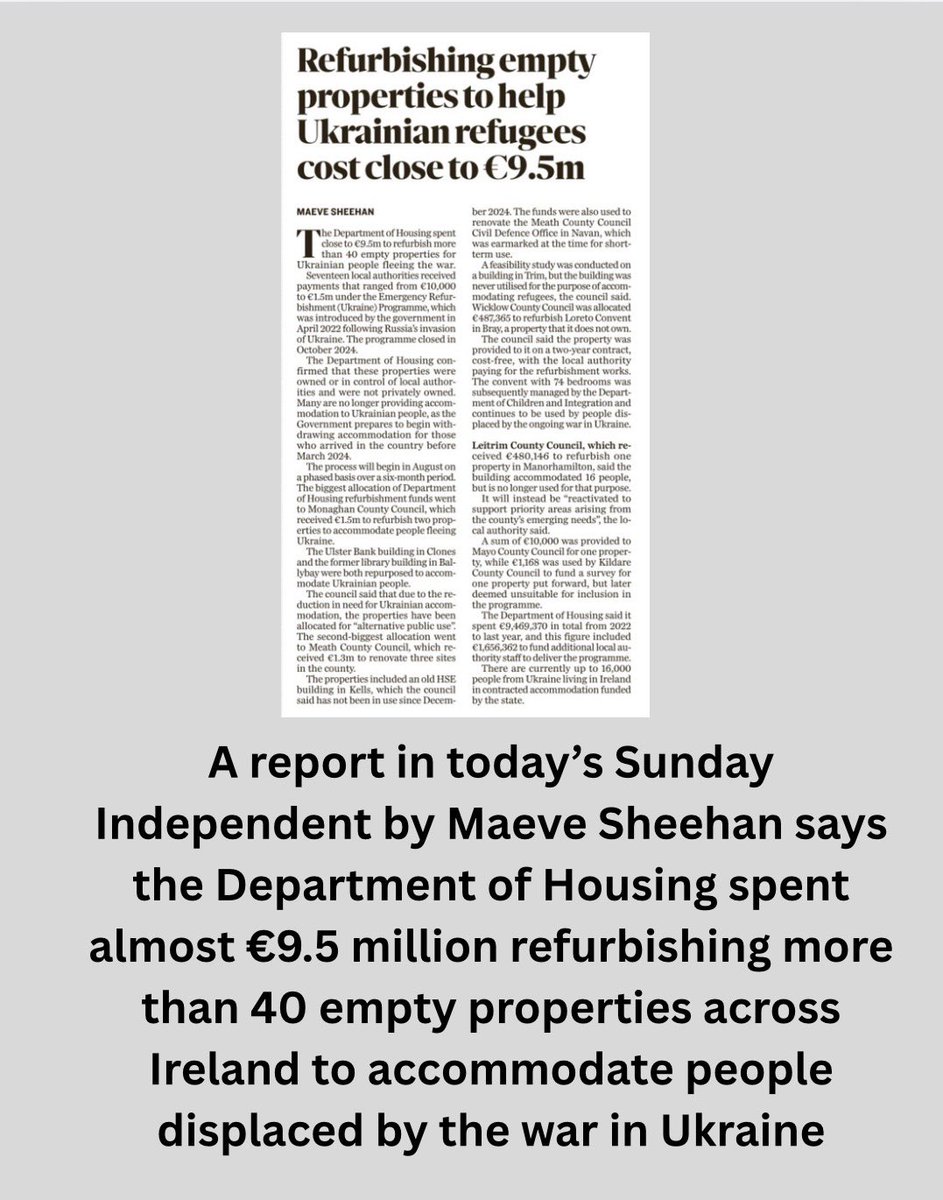
𝐖𝐢𝐭𝐡 𝐇𝐨𝐮𝐬𝐢𝐧𝐠 𝐏𝐫𝐞𝐬𝐬𝐮𝐫𝐞𝐬 𝐈𝐧𝐭𝐞𝐧𝐬𝐢𝐟𝐲𝐢𝐧𝐠, 𝐇𝐨𝐰 𝐌𝐮𝐜𝐡 𝐏𝐮𝐛𝐥𝐢𝐜 𝐀𝐩𝐩𝐞𝐭𝐢𝐭𝐞 𝐑𝐞𝐦𝐚𝐢𝐧𝐬 𝐅𝐨𝐫 𝐌𝐮𝐥𝐭𝐢 𝐌𝐢𝐥𝐥𝐢𝐨𝐧 𝐄𝐮𝐫𝐨 𝐒𝐩𝐞𝐧𝐝𝐢𝐧𝐠 𝐎𝐧 𝐑𝐞𝐟𝐮𝐠𝐞𝐞 𝐏𝐫𝐨𝐩𝐞𝐫𝐭𝐲 𝐑𝐞𝐟𝐮𝐫𝐛𝐢𝐬𝐡𝐦𝐞𝐧𝐭𝐬?
A report in today’s Sunday Independent by Maeve Sheehan says the Department of Housing spent almost €9.5 million refurbishing more than 40 empty properties across Ireland to accommodate people displaced by the war in Ukraine, although a number of those properties are no longer being used for Ukrainian accommodation as the Government prepares to scale back supports for some arrivals.
The spending took place under the Emergency Refurbishment (Ukraine) Programme, introduced by Government in April 2022 following Russia’s invasion of Ukraine and closed in October 2024. Under the scheme, 17 local authorities received payments ranging from €10,000 to €1.5 million to renovate vacant properties. According to the Department of Housing, the properties involved were owned by, or under the control of, local authorities rather than privately owned.
The report notes that the timing of these revelations coincides with a major policy shift. The Government is preparing to begin withdrawing state accommodation from Ukrainians who arrived before March 2024, with the process due to commence in August and be phased in over six months.
The largest share of refurbishment funding went to Monaghan County Council, which received €1.5 million to renovate two properties for Ukrainian accommodation. These included the former Ulster Bank building in Clones and a former library building in Ballybay, both repurposed for refugees. However, the council said that, because demand for Ukrainian accommodation has fallen, the buildings have now been reassigned for “alternative public use”.
The second largest allocation went to Meath County Council, which received €1.3 million to refurbish three sites. These included an old HSE building in Kells, which the council said has not been used since December 2024. Funding also went towards renovating the Meath County Council Civil Defence Office in Navan, which had been earmarked for short term accommodation use.
The report highlights a number of examples where funding was spent on projects that ultimately had limited or altered use. A feasibility study was carried out on a building in Trim, but the building was never used to house refugees, according to the council.
In Wicklow, the local authority received €487,365 to refurbish Loreto Convent in Bray, despite not owning the property. The council said it had access to the site under a two year, cost free arrangement, while paying for the refurbishment works. The 74 bedroom convent was later managed by the Department of Children and Integration and continues to accommodate people displaced by the war in Ukraine.
The report also examines Leitrim County Council’s use of funding. The council received €480,146 to refurbish a property in Manorhamilton, which accommodated 16 people but is no longer being used for Ukrainian accommodation. The council said the building would instead be “reactivated” to meet other emerging local priorities.
Elsewhere, Mayo County Council received €10,000 for one property, while Kildare County Council used €1,168 to fund a survey for a proposed property that was ultimately deemed unsuitable for inclusion in the programme.
According to the Department of Housing, the total programme spend reached €9,469,370 between 2022 and last year. That figure included approximately €1.66 million to fund additional local authority staff required to administer and deliver the scheme.
The report concludes by noting that there are still up to 16,000 people from Ukraine living in State funded contracted accommodation in Ireland, even as policy begins to shift away from the emergency accommodation model established following the outbreak of the war.
English
🧵 2/2
Saturday’s Irish Independent columnist Richard Curran asks something similar, though from a slightly different angle.
Curran argues that Ireland’s long running tech gold rush may be stalling. He does not claim catastrophe is inevitable. But he identifies something many policymakers may be reluctant to confront.
The post Covid expansion of technology employment may not simply be cooling down. The sector itself may be changing fundamentally.
Meta, Amazon, Google and other global firms are investing tens of billions into AI systems designed, in part, to automate work previously carried out by highly skilled employees. The implications for graduate jobs, white collar professions and Ireland’s FDI dependent growth model could be profound.
Curran’s proposed response is notable. Ireland needs to invest seriously in indigenous entrepreneurship and home grown innovation rather than relying so heavily on foreign corporate decision making.
Again, a question arises.
Has government planning adequately accounted for a scenario in which multinational tech employment no longer expands as it once did?
Finally, Saturday’s Irish Daily Mail report on immigration and workforce growth adds another important layer to the picture.
Between 2019 and 2024, almost two thirds of new jobs created in Ireland were taken up by migrant workers. Many sectors now depend heavily on international labour, from healthcare and IT to hospitality and administration.
The report rightly notes that migrant workers make an enormous contribution to the Irish economy and public services.
But it also illustrates another reality.
Ireland’s economic model increasingly depends simultaneously on multinational capital, international labour flows and continued growth.
That model can work very well during expansionary periods.
The harder question is what happens during contraction.
If technology employment weakens, if international conditions deteriorate, if multinational tax receipts soften and if economic growth slows materially, what is Plan B?
Is there a detailed contingency strategy for protecting employment, stabilising public finances, supporting retraining, sustaining housing delivery and maintaining essential services?
Or are we still operating on the assumption that the multinational boom will continue indefinitely?
Nobody knows for certain whether Ireland is heading toward recession.
But when the European Commission warns about structural vulnerability, when tens of thousands of tech jobs disappear, when major newspapers across the political spectrum begin independently highlighting exposure to AI disruption and multinational dependence, prudence demands that government treat those signals seriously.
The lights may not yet be flashing crimson.
But they are certainly no longer green.
The question now is not whether Ireland’s economic model has delivered extraordinary gains.
It plainly has.
The question is whether the Government has prepared for what happens if the train that powered those gains begins slowing sharply, or worse, starts coming off the tracks.
English
𝐓𝐡𝐞 𝐋𝐢𝐠𝐡𝐭𝐬 𝐀𝐫𝐞 𝐅𝐥𝐚𝐬𝐡𝐢𝐧𝐠 𝐑𝐞𝐝 𝐎𝐧 𝐓𝐡𝐞 𝐈𝐫𝐢𝐬𝐡 𝐄𝐜𝐨𝐧𝐨𝐦𝐲. 𝐃𝐨𝐞𝐬 𝐓𝐡𝐞 𝐆𝐨𝐯𝐞𝐫𝐧𝐦𝐞𝐧𝐭 𝐇𝐚𝐯𝐞 𝐀 𝐂𝐨𝐧𝐭𝐢𝐧𝐠𝐞𝐧𝐜𝐲 𝐏𝐥𝐚𝐧 𝐅𝐨𝐫 𝐓𝐡𝐞 𝐑𝐞𝐜𝐞𝐬𝐬𝐢𝐨𝐧 𝐀𝐜𝐜𝐞𝐥𝐞𝐫𝐚𝐭𝐢𝐧𝐠 𝐃𝐨𝐰𝐧 𝐓𝐡𝐞 𝐓𝐫𝐚𝐜𝐤𝐬?
🧵 1/2
Sometimes the warning signs of economic trouble arrive not in one dramatic collapse but in a series of separate reports that, taken together, begin to form an unmistakable pattern.
In the last two days, across multiple newspapers and publications, a troubling picture emerges of an Irish economy that may be considerably more exposed than the political narrative would suggest.
The first warning came in Friday’s Irish Independent, reporting on the European Commission’s spring economic forecast. The Commission did not mince its words. Ireland’s heavy dependence on a small cluster of multinational corporations represents a “major risk” to the State’s public finances.
This matters enormously.
A large proportion of Ireland’s tax revenues derives from a handful of multinational firms, particularly in pharmaceuticals and technology. The Commission warns that this leaves the country vulnerable to changes in US trade policy, international tariff regimes and wider geopolitical shocks.
At the same time, government spending is projected to outpace revenue growth, shrinking the State surplus even before any serious downturn materialises. Inflationary pressures remain elevated. International instability continues. Growth across the wider EU is slowing.
In other words, the European Commission is effectively saying that Ireland’s economic foundations are more fragile than many people realise.
Then came Friday’s Irish Daily Mail report on Ireland’s technology sector.
The numbers are startling. Around 20,300 jobs disappeared from Irish IT in the first quarter of 2026 alone, the largest employment decline recorded in any sector of the economy.
This is not occurring in a marginal industry. Tech has been one of the principal engines of Ireland’s recent prosperity.
Economists and unions cited in the report describe the figures as a serious warning sign. The job losses are concentrated in programming, consultancy and knowledge intensive work, precisely the kind of high value employment Ireland has spent decades trying to attract.
Artificial intelligence sits at the centre of this disruption.
The report raises a profound question. What happens to an economy heavily dependent on multinational tech employers when the technology those companies are investing in increasingly reduces their need for human workers?
Saturday’s Irish Times editorial takes that concern further.
The paper argues that Ireland may be entering a significantly more vulnerable phase in its relationship with global technology giants. Meta’s recent redundancies, combined with broader employment losses across the sector, are treated not as isolated events but as possible indicators of a structural shift.
The editorial highlights an uncomfortable reality. Ireland’s economic success has become deeply intertwined with a relatively small number of global tech firms. If AI driven restructuring leads to slower employment growth, fewer high paying jobs or changes in how these companies allocate investment internationally, Ireland’s public finances could feel the impact rapidly.
The Irish Times calls for a substantial policy response involving education, training, AI strategy and economic planning.
That raises a reasonable question.
Where is the contingency plan?

English
𝐓𝐡𝐞 𝐌𝐢𝐧𝐢𝐬𝐭𝐞𝐫 𝐅𝐨𝐫 𝐄𝐝𝐮𝐜𝐚𝐭𝐢𝐨𝐧 𝐑𝐞𝐟𝐮𝐬𝐞𝐬 𝐓𝐨 𝐒𝐚𝐲 𝐇𝐨𝐰 𝐌𝐚𝐧𝐲 𝐓𝐞𝐚𝐜𝐡𝐞𝐫𝐬 𝐖𝐨𝐫𝐤𝐢𝐧𝐠 𝐈𝐧 𝐈𝐫𝐢𝐬𝐡 𝐒𝐜𝐡𝐨𝐨𝐥𝐬 𝐇𝐚𝐯𝐞 𝐓𝐮𝐬𝐥𝐚 𝐅𝐨𝐮𝐧𝐝𝐞𝐝 𝐂𝐡𝐢𝐥𝐝 𝐀𝐛𝐮𝐬𝐞 𝐀𝐥𝐥𝐞𝐠𝐚𝐭𝐢𝐨𝐧𝐬 𝐀𝐠𝐚𝐢𝐧𝐬𝐭 𝐓𝐡𝐞𝐦
A report by Debbie McCann in today’s Mail on Sunday says the Department of Education is refusing to reveal how many teachers with “founded” abuse allegations are still working with children, despite growing concern over safeguarding and transparency in the education system.
The report follows revelations published by the Irish Mail on Sunday last week concerning serious allegations made against the current principal of a special needs school in Dublin.
According to Tusla, allegations of abuse and bullying made against the principal while he worked as a teacher and housemaster at Good Counsel College in New Ross were deemed “founded”, meaning the State child protection agency upheld them.
Those allegations date back to a former pupil of St John of God’s Bellmayne Community Special School. The pupil alleged that, as a vulnerable teenager, he was forced to stand outdoors in his underpants as punishment.
The issue was raised in the Dáil last week by Social Democrats deputy Eoin Ó Catháin, who asked Education Minister Hildegarde Naughton what action had been taken to address concerns among parents of children attending the special needs school.
The TD also sought clarification on whether the Department had informed the school’s patron body, Dublin and Dún Laoghaire Education and Training Board, about the allegations.
In her response, Minister Naughton said her department has “no powers to investigate child protection concerns”, arguing that responsibility lies with Tusla, which has the statutory role in assessing child welfare and protection reports.
She told the Dáil that any child welfare concern or allegation received by her department is immediately passed to the appropriate authorities. However, the response drew criticism from campaigner and alleged victim Páidí Manning, who questioned whether the minister’s answer amounted to little more than “a glorified press release”.
Speaking to the Mail on Sunday, Manning said: “Nobody is asking Ms Naughton to investigate child protection concerns. Tusla investigated John Condon for abuse and deemed [the allegations] ‘founded’.”
He argued that the real issue is how individuals who face upheld abuse findings are able to continue slipping through what he described as the cracks in the Irish school system.
The report highlights a controversial policy revealed by the Mail on Sunday last week: teachers whose abuse allegations have been upheld by Tusla are not obliged to disclose those findings to future employers, even when they leave one school and seek work elsewhere.
Former employees of Mr Condon reportedly told the paper they had been kept in the dark about the 2023 findings against him.
The article further notes that the Catholic Primary Schools Management Association hosted a webinar in which Mr Condon lectured on child protection while under investigation by Tusla. According to the report, some participants only became aware of the allegations through media coverage.
Down Syndrome Ireland, where Mr Condon also sat on a board until last year, is said not to have been informed of the allegations or the subsequent Tusla investigation.
On vetting procedures, the report states that Gardaí confirmed to the Mail on Sunday that a Tusla “founded” allegation is not included in Garda vetting documentation “as a matter of course”.
Asked what safeguards apply to potential future hires, a Garda spokesperson said concerns received by Tusla are passed to Garda Síochána where appropriate and added that “complete Garda vetting and reference checks for all potential hires” remain advisable.
The Dept of Education did not answer the newspaper’s questions on how many teachers with “founded” abuse findings are working in schools.
ABC for Justice@AllianceBirth
𝐓𝐡𝐞 𝐌𝐢𝐧𝐢𝐬𝐭𝐞𝐫 𝐅𝐨𝐫 𝐄𝐝𝐮𝐜𝐚𝐭𝐢𝐨𝐧 𝐑𝐞𝐟𝐮𝐬𝐞𝐬 𝐓𝐨 𝐒𝐚𝐲 𝐇𝐨𝐰 𝐌𝐚𝐧𝐲 𝐓𝐞𝐚𝐜𝐡𝐞𝐫𝐬 𝐖𝐨𝐫𝐤𝐢𝐧𝐠 𝐈𝐧 𝐈𝐫𝐢𝐬𝐡 𝐒𝐜𝐡𝐨𝐨𝐥𝐬 𝐇𝐚𝐯𝐞 𝐓𝐮𝐬𝐥𝐚 𝐅𝐨𝐮𝐧𝐝𝐞𝐝 𝐂𝐡𝐢𝐥𝐝 𝐀𝐛𝐮𝐬𝐞 𝐀𝐥𝐥𝐞𝐠𝐚𝐭𝐢𝐨𝐧𝐬 𝐀𝐠𝐚𝐢𝐧𝐬𝐭 𝐓𝐡𝐞𝐦 A report by Debbie McCann in today’s Mail on Sunday says the Department of Education is refusing to reveal how many teachers with “founded” abuse allegations are still working with children, despite growing concern over safeguarding and transparency in the education system. The report follows revelations published by the Irish Mail on Sunday last week concerning serious allegations made against the current principal of a special needs school in Dublin. According to Tusla, allegations of abuse and bullying made against the principal while he worked as a teacher and housemaster at Good Counsel College in New Ross were deemed “founded”, meaning the State child protection agency upheld them. Those allegations date back to a former pupil of St John of God’s Bellmayne Community Special School. The pupil alleged that, as a vulnerable teenager, he was forced to stand outdoors in his underpants as punishment. The issue was raised in the Dáil last week by Social Democrats deputy Eoin Ó Catháin, who asked Education Minister Hildegarde Naughton what action had been taken to address concerns among parents of children attending the special needs school. The TD also sought clarification on whether the Department had informed the school’s patron body, Dublin and Dún Laoghaire Education and Training Board, about the allegations. In her response, Minister Naughton said her department has “no powers to investigate child protection concerns”, arguing that responsibility lies with Tusla, which has the statutory role in assessing child welfare and protection reports. She told the Dáil that any child welfare concern or allegation received by her department is immediately passed to the appropriate authorities. However, the response drew criticism from campaigner and alleged victim Páidí Manning, who questioned whether the minister’s answer amounted to little more than “a glorified press release”. Speaking to the Mail on Sunday, Manning said: “Nobody is asking Ms Naughton to investigate child protection concerns. Tusla investigated John Condon for abuse and deemed [the allegations] ‘founded’.” He argued that the real issue is how individuals who face upheld abuse findings are able to continue slipping through what he described as the cracks in the Irish school system. The report highlights a controversial policy revealed by the Mail on Sunday last week: teachers whose abuse allegations have been upheld by Tusla are not obliged to disclose those findings to future employers, even when they leave one school and seek work elsewhere. Former employees of Mr Condon reportedly told the paper they had been kept in the dark about the 2023 findings against him. The article further notes that the Catholic Primary Schools Management Association hosted a webinar in which Mr Condon lectured on child protection while under investigation by Tusla. According to the report, some participants only became aware of the allegations through media coverage. Down Syndrome Ireland, where Mr Condon also sat on a board until last year, is said not to have been informed of the allegations or the subsequent Tusla investigation. On vetting procedures, the report states that Gardaí confirmed to the Mail on Sunday that a Tusla “founded” allegation is not included in Garda vetting documentation “as a matter of course”. Asked what safeguards apply to potential future hires, a Garda spokesperson said concerns received by Tusla are passed to Garda Síochána where appropriate and added that “complete Garda vetting and reference checks for all potential hires” remain advisable. The Dept of Education did not answer the newspaper’s questions on how many teachers with “founded” abuse findings are working in schools.
English
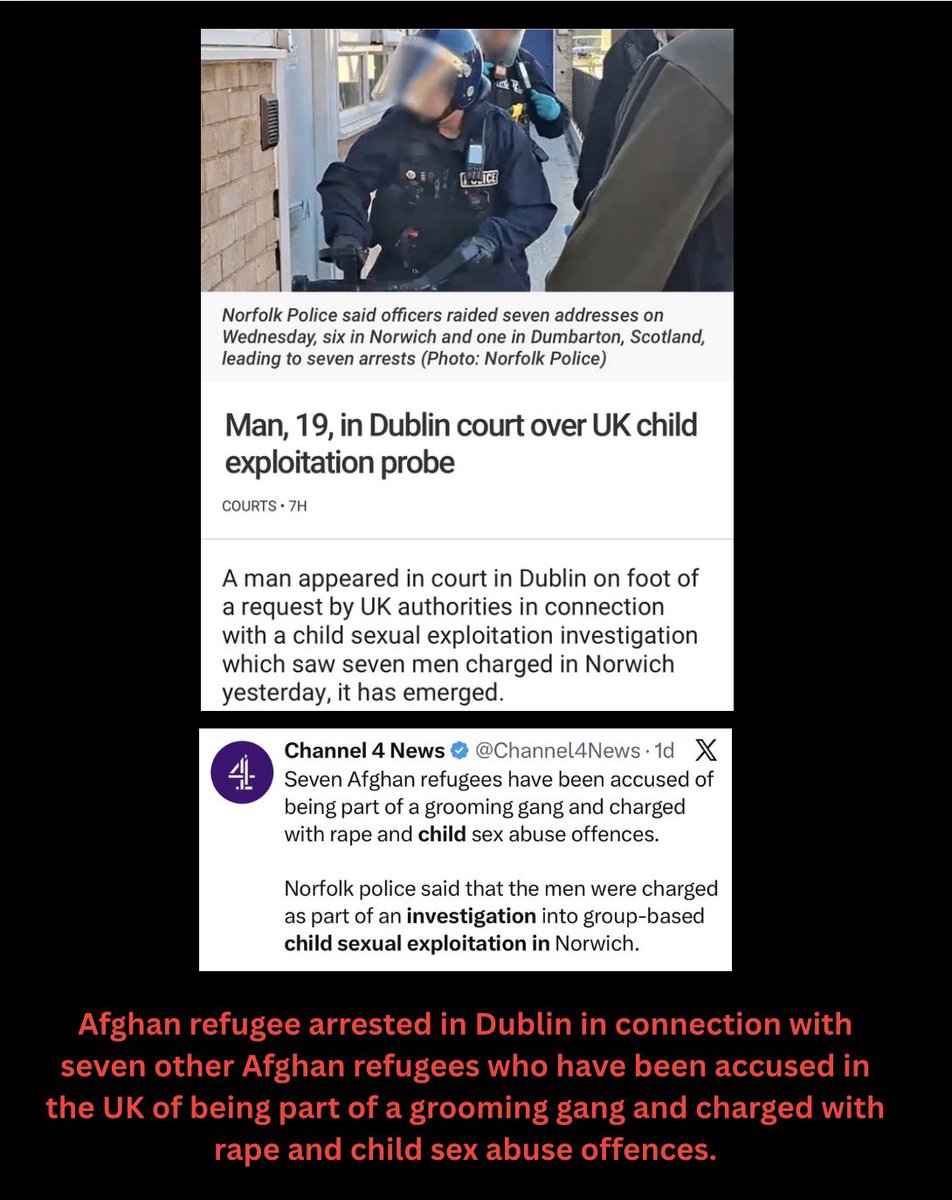
𝐌𝐚𝐧 𝐀𝐫𝐫𝐞𝐬𝐭𝐞𝐝 𝐈𝐧 𝐃𝐮𝐛𝐥𝐢𝐧 𝐎𝐯𝐞𝐫 𝐔𝐊 𝐂𝐡𝐢𝐥𝐝 𝐒𝐞𝐱𝐮𝐚𝐥 𝐄𝐱𝐩𝐥𝐨𝐢𝐭𝐚𝐭𝐢𝐨𝐧 𝐈𝐧𝐯𝐞𝐬𝐭𝐢𝐠𝐚𝐭𝐢𝐨𝐧 𝐀𝐬 𝐒𝐞𝐯𝐞𝐧 𝐀𝐟𝐠𝐡𝐚𝐧 𝐑𝐞𝐟𝐮𝐠𝐞𝐞𝐬 𝐅𝐚𝐜𝐞 𝐂𝐡𝐚𝐫𝐠𝐞𝐬
RTE is reporting on a a cross border child sexual exploitation investigation involving authorities in the UK and Ireland, which has led to the arrest of a young man in Dublin and the charging of seven other men in Norwich.
In Dublin, a 19 year old man was arrested by gardaí yesterday morning on foot of a Trade and Cooperation Agreement Warrant issued by UK authorities. The arrest is connected to a British investigation into alleged organised child sexual exploitation activity. The young man appeared before the High Court in Dublin yesterday and was remanded in custody. He is due to appear before the courts again on 8 June.
The Irish proceedings are linked to developments in the UK, where seven men appeared before Norwich Magistrates’ Court yesterday charged with a total of 40 offences connected to alleged group based child sexual exploitation.
The seven accused, described as Afghan nationals and refugees, face allegations relating to offences said to have taken place between August 2023 and May 2025. The alleged offences concern two victims who were in their early to mid teens at the time.
All seven defendants were remanded in custody and are due to appear for a plea hearing before Norwich Crown Court on 19 June 2026.
According to the Crown Prosecution Service, the charges include multiple counts of rape, human trafficking, conspiracy to commit child sexual abuse, and perverting the course of justice.
The most extensive list of charges is faced by 21 year old Ahmadin Ahmadzai of Norwich, who is charged with nine counts of rape, one count of human trafficking, two counts of conspiracy to commit child sexual abuse and one count of perverting the course of justice.
Jamil Khalil, aged 20, of Dumbarton in Scotland, is charged with seven counts of rape, one count of human trafficking and one count of conspiracy to commit child sexual abuse.
Other defendants face a range of allegations including rape, human trafficking and conspiracy offences. One defendant, Fazal Auryakhel, faces a single rape charge, while others face combinations of rape, trafficking and conspiracy allegations.
The arrests in Britain followed coordinated police raids on Wednesday morning. Norfolk Police said officers searched seven addresses, six in Norwich and one in Dumbarton, Scotland, resulting in seven arrests.
The force stressed that none of the charged men had lived in asylum hotels in Norfolk and that none of the alleged offending took place in asylum accommodation.
Police described the investigation as “complex and sensitive”. It began in September 2023 following a disclosure made by a young girl.
Detective Superintendent Stacey Murray, who is leading the investigation, said police were taking a meticulous approach and sought to reassure the public about how the inquiry is being handled. Officers are continuing to encourage anyone with information relevant to the investigation to come forward.
The Crown Prosecution Service said prosecutors had worked closely with police to determine that there was sufficient evidence to bring the case before the courts and that proceeding with criminal charges was in the public interest.
The case remains at an early stage. The allegations against all defendants are yet to be tested before the courts.
English
“𝐖𝐞 𝐖𝐚𝐧𝐭 𝐎𝐮𝐫 𝐕𝐢𝐜𝐭𝐢𝐦𝐬 𝐓𝐨 𝐊𝐧𝐨𝐰 𝐓𝐡𝐞𝐲 𝐖𝐢𝐥𝐥 𝐁𝐞 𝐋𝐢𝐬𝐭𝐞𝐧𝐞𝐝 𝐓𝐨”: 𝐏𝐫𝐨𝐦𝐢𝐬𝐞 𝐂𝐨𝐦𝐞𝐬 𝐀𝐟𝐭𝐞𝐫 𝐏𝐚𝐮𝐥 𝐌𝐨𝐨𝐝𝐲 𝐕𝐢𝐜𝐭𝐢𝐦 𝐒𝐚𝐲𝐬 𝐒𝐡𝐞 𝐖𝐚𝐬 “𝐌𝐞𝐭 𝐖𝐢𝐭𝐡 𝐒𝐢𝐥𝐞𝐧𝐜𝐞”
A report in today’s Irish Examiner examines the return to prison of former garda Paul Moody, one of Ireland’s earliest and most high profile coercive control cases, and uses it to explore wider questions about repeat domestic abuse, institutional failures, and proposals for a domestic violence register.
This week, Moody, 46, was jailed again after pleading guilty to harassment and coercive control involving a second woman between 2016 and 2017. While pregnant with his child, the woman received a message from Moody saying: “I hope you bleed out and die.” He also threatened to send intimate images to her employer.
The woman had reported Moody to GSOC, now Fiosrú, in 2017 but said she was “met with silence” while Moody continued serving as a garda. She believes that had her complaint been acted upon, Nicola Hanney, who later endured years of abuse by Moody, might have been spared.
The report recounts Nicola Hanney’s story. Having survived a cancer diagnosis, she met Moody online. After the relationship deteriorated she left, but later returned after becoming pregnant and facing a return of her cancer. She suffered four years of abuse before Moody was jailed in 2022 for coercive control. On the day she gave birth, he told her he had come to hospital to “watch her bleed out”.
The article highlights how both cases came to light almost by accident. The unnamed woman’s complaint emerged during the investigation into Moody’s abuse of Hanney, while Hanney’s own case was uncovered only after suspicious gardaí investigating an unrelated allegation examined Moody’s phone and identified signs of an abusive relationship.
It then turns to calls for a domestic violence register, championed by Jason Poole, brother of murdered mother Jennifer Poole. He argues that if people could check whether a partner had a history of domestic abuse convictions, lives might be saved. Justice Minister Jim O’Callaghan has advanced legislation known as Jennie’s Law, which would create a register for perpetrators of domestic, sexual and gender based violence, though it has not yet become law.
The report also features the case of murdered mother of two Daena Walsh. Her brother, Callum Walsh, believes his sister would still be alive had stronger protections existed. Her killer, Adam Corcoran, had 42 previous convictions and was on bail for a violent offence just ten days before murdering her in 2024.
The article returns to concerns about institutional responses to domestic abuse. It notes that GSOC opened an investigation into the complaint about Moody in 2017 but discontinued it in 2023 after delays. Fiosrú, which replaced GSOC, established a specialist unit in 2025 to investigate complaints involving gardaí accused of domestic violence, coercive control, sexual abuse or failures to properly handle abuse reports. As of April, it was investigating 12 cases involving garda alleged to be perpetrators and 23 cases involving alleged failures in handling domestic or sexual abuse complaints.
The report concludes with the wider national picture. Seven women died violently last year and four have already been killed this year. Since 1996, 282 women and 21 children have died in incidents involving violent deaths of women. One in two femicide victims is killed by a current or former intimate partner and 87 per cent of women killed are killed by a man they knew.
Domestic abuse remains widespread. Gardaí reported a 10 per cent rise in reported domestic abuse incidents in the first four months of this year compared with the same period in 2025, with more than 1,000 reports now being made every week. Marking Go Purple Day, Assistant Commissioner Angela Willis said victims who come forward will be listened to, treated with respect and supported.
ABC for Justice@AllianceBirth
“𝐖𝐞 𝐖𝐚𝐧𝐭 𝐎𝐮𝐫 𝐕𝐢𝐜𝐭𝐢𝐦𝐬 𝐓𝐨 𝐊𝐧𝐨𝐰 𝐓𝐡𝐞𝐲 𝐖𝐢𝐥𝐥 𝐁𝐞 𝐋𝐢𝐬𝐭𝐞𝐧𝐞𝐝 𝐓𝐨”: 𝐏𝐫𝐨𝐦𝐢𝐬𝐞 𝐂𝐨𝐦𝐞𝐬 𝐀𝐟𝐭𝐞𝐫 𝐏𝐚𝐮𝐥 𝐌𝐨𝐨𝐝𝐲 𝐕𝐢𝐜𝐭𝐢𝐦 𝐒𝐚𝐲𝐬 𝐒𝐡𝐞 𝐖𝐚𝐬 “𝐌𝐞𝐭 𝐖𝐢𝐭𝐡 𝐒𝐢𝐥𝐞𝐧𝐜𝐞” A report in today’s Irish Examiner examines the return to prison of former garda Paul Moody, one of Ireland’s earliest and most high profile coercive control cases, and uses it to explore wider questions about repeat domestic abuse, institutional failures, and proposals for a domestic violence register. This week, Moody, 46, was jailed again after pleading guilty to harassment and coercive control involving a second woman between 2016 and 2017. While pregnant with his child, the woman received a message from Moody saying: “I hope you bleed out and die.” He also threatened to send intimate images to her employer. The woman had reported Moody to GSOC, now Fiosrú, in 2017 but said she was “met with silence” while Moody continued serving as a garda. She believes that had her complaint been acted upon, Nicola Hanney, who later endured years of abuse by Moody, might have been spared. The report recounts Nicola Hanney’s story. Having survived a cancer diagnosis, she met Moody online. After the relationship deteriorated she left, but later returned after becoming pregnant and facing a return of her cancer. She suffered four years of abuse before Moody was jailed in 2022 for coercive control. On the day she gave birth, he told her he had come to hospital to “watch her bleed out”. The article highlights how both cases came to light almost by accident. The unnamed woman’s complaint emerged during the investigation into Moody’s abuse of Hanney, while Hanney’s own case was uncovered only after suspicious gardaí investigating an unrelated allegation examined Moody’s phone and identified signs of an abusive relationship. It then turns to calls for a domestic violence register, championed by Jason Poole, brother of murdered mother Jennifer Poole. He argues that if people could check whether a partner had a history of domestic abuse convictions, lives might be saved. Justice Minister Jim O’Callaghan has advanced legislation known as Jennie’s Law, which would create a register for perpetrators of domestic, sexual and gender based violence, though it has not yet become law. The report also features the case of murdered mother of two Daena Walsh. Her brother, Callum Walsh, believes his sister would still be alive had stronger protections existed. Her killer, Adam Corcoran, had 42 previous convictions and was on bail for a violent offence just ten days before murdering her in 2024. The article returns to concerns about institutional responses to domestic abuse. It notes that GSOC opened an investigation into the complaint about Moody in 2017 but discontinued it in 2023 after delays. Fiosrú, which replaced GSOC, established a specialist unit in 2025 to investigate complaints involving gardaí accused of domestic violence, coercive control, sexual abuse or failures to properly handle abuse reports. As of April, it was investigating 12 cases involving garda alleged to be perpetrators and 23 cases involving alleged failures in handling domestic or sexual abuse complaints. The report concludes with the wider national picture. Seven women died violently last year and four have already been killed this year. Since 1996, 282 women and 21 children have died in incidents involving violent deaths of women. One in two femicide victims is killed by a current or former intimate partner and 87 per cent of women killed are killed by a man they knew. Domestic abuse remains widespread. Gardaí reported a 10 per cent rise in reported domestic abuse incidents in the first four months of this year compared with the same period in 2025, with more than 1,000 reports now being made every week. Marking Go Purple Day, Assistant Commissioner Angela Willis said victims who come forward will be listened to, treated with respect and supported.
English
M Compass Media retweetledi

Another step forward for transparency.
Following a PQ I submitted, Minister Jack Chambers confirmed his Department will write to state bodies reminding them of their obligations under the EU Open Data Directive, helping ensure spending data is published in consistent, machine-readable formats.
That progress is already visible. The Public Spend Tracker now covers over €100bn+ in public spending, up from €25bn when the work began and €75bn+ by October 2025.
Because this data is now being actively tracked and analysed, many bodies published their Q4 2025 data much earlier than usual, and we are seeing Q1 2026 data following that trend.
The next step is building the “golden thread” linking procurement, contracts, tenders and payments so public spending can be properly understood and scrutinised. This will enable us to move the conversation to outputs over process.
English