Alex Stebner MD

46 posts

Alex Stebner MD banner
Alex Stebner MD

Alex Stebner MD

@MDStebnerAl

Canada Katılım Eylül 2024
67 Takip Edilen38 Takipçiler
Alex Stebner MD retweetledi
Johanna Ospel, MD PhD
Johanna Ospel, MD PhD@johanna_ospel·
🚨meeting announcement 📣#BIOSTROKE meeting (📅 Feb 23-25, 2026) in the beautiful city of Munich🥨🍻🏔️. The venue is Castle Hohenkammer 🏰 and the registration fee *includes* acommodation. @esmintsociety @ESOstroke endorsed! Pls consider joining us☺️🙏 biostroke.de/biostroke
Johanna Ospel, MD PhD tweet mediaJohanna Ospel, MD PhD tweet mediaJohanna Ospel, MD PhD tweet mediaJohanna Ospel, MD PhD tweet media
English
0
8
20
1.5K
Alex Stebner MD retweetledi
Stroke AHA/ASA
Stroke AHA/ASA@StrokeAHA_ASA·
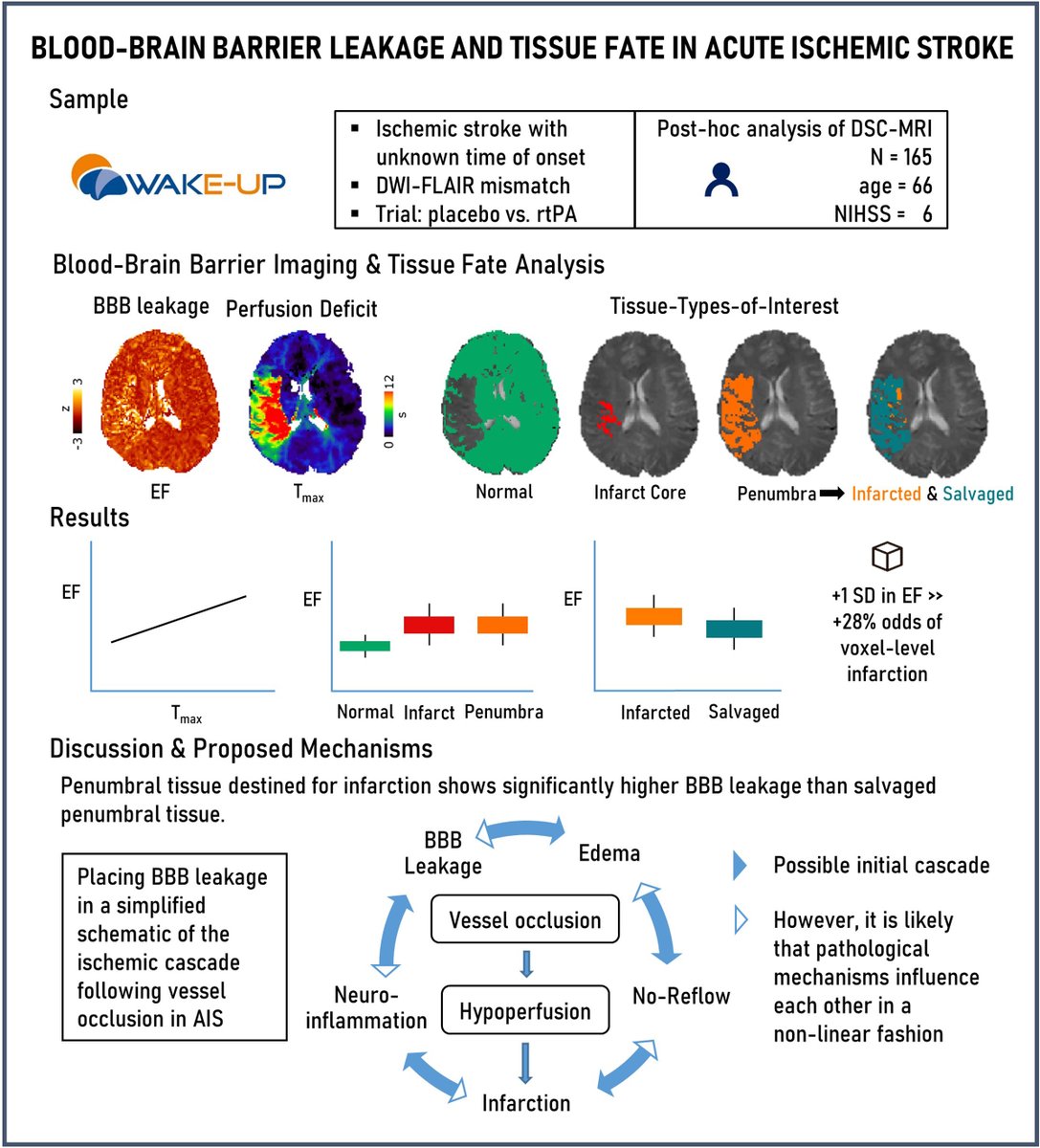
The January episode of the #StrokeAlert Podcast is now available. In this episode, @NAsdaghi highlights articles in the Jan. issue of #Stroke & interviews @johanna_ospel & @UPensato about “Cerebral Infarct Growth: Pathophysiology, Pragmatic Assessment, and Clinical Implications.”
Stroke AHA/ASA tweet media
English
1
11
23
2.7K
Lea Alhilali, MD
Lea Alhilali, MD@teachplaygrub·
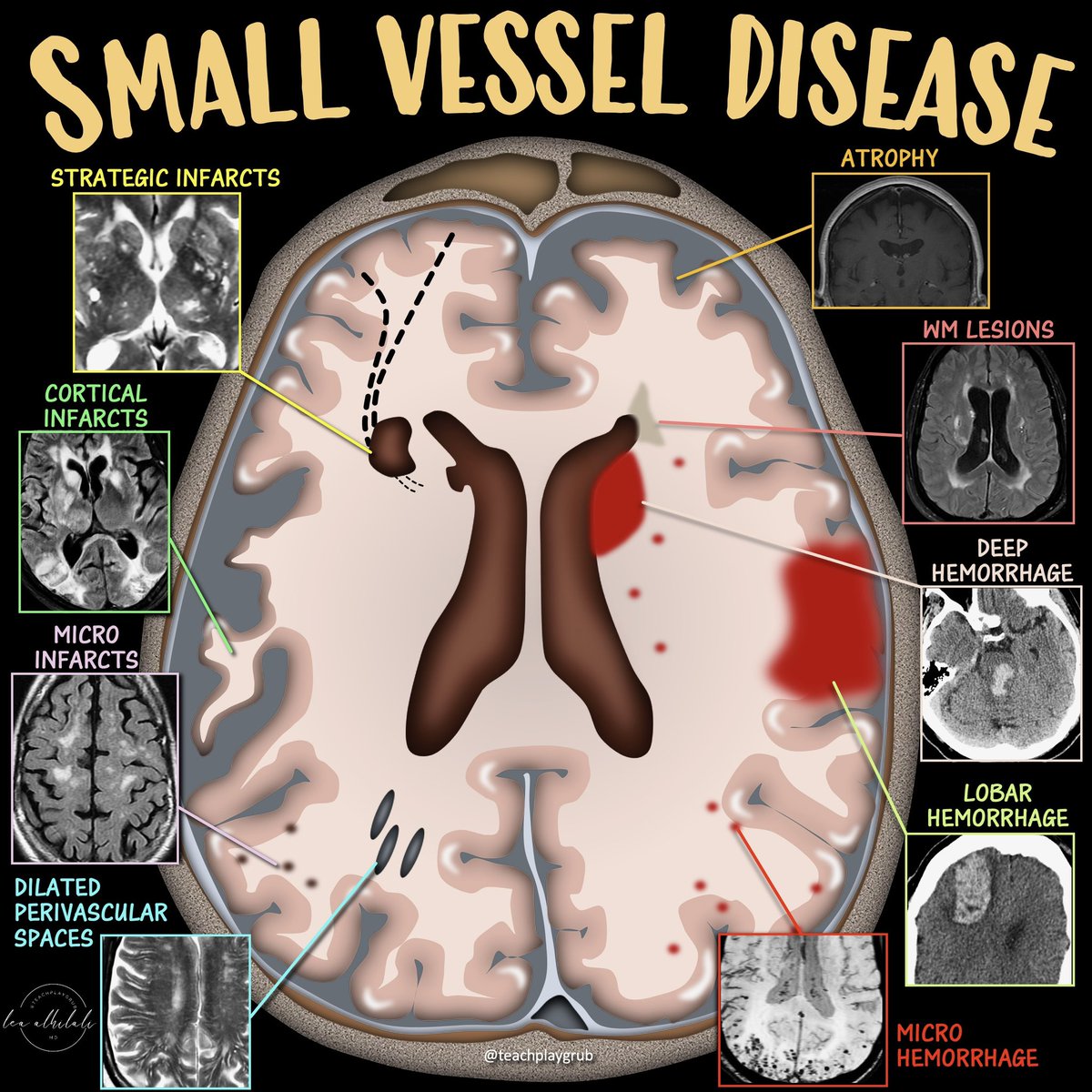
Just because it’s called SMALL vessel disease doesn’t mean it doesn’t have a BIG impact!   Small vessel disease (SVD) is a BIG contributor to vascular dementia, along w/large vessel cortical infarcts   Do YOU know all the faces of small vessel disease?   Common imaging markers of SVD include:   --White matter hyperintensities (WMHs) --Lacunes --Enlarged perivascular spaces --Microbleeds --Small subcortical infarcts --Brain atrophy   But what you see isn’t always what you get!   Even in patients w/similar degrees of SVD, clinical symptoms can be very variable.   Variability exists because of: --Perilesional penumbra --Remote effects from disruption of brain connectivity --Differing brain reserve & compensatory mechanisms   So remember, imaging findings of SMALL vessel disease are just the tip of a very BIG iceberg
Lea Alhilali, MD tweet media
English
12
121
533
32.4K
Lea Alhilali, MD
Lea Alhilali, MD@teachplaygrub·
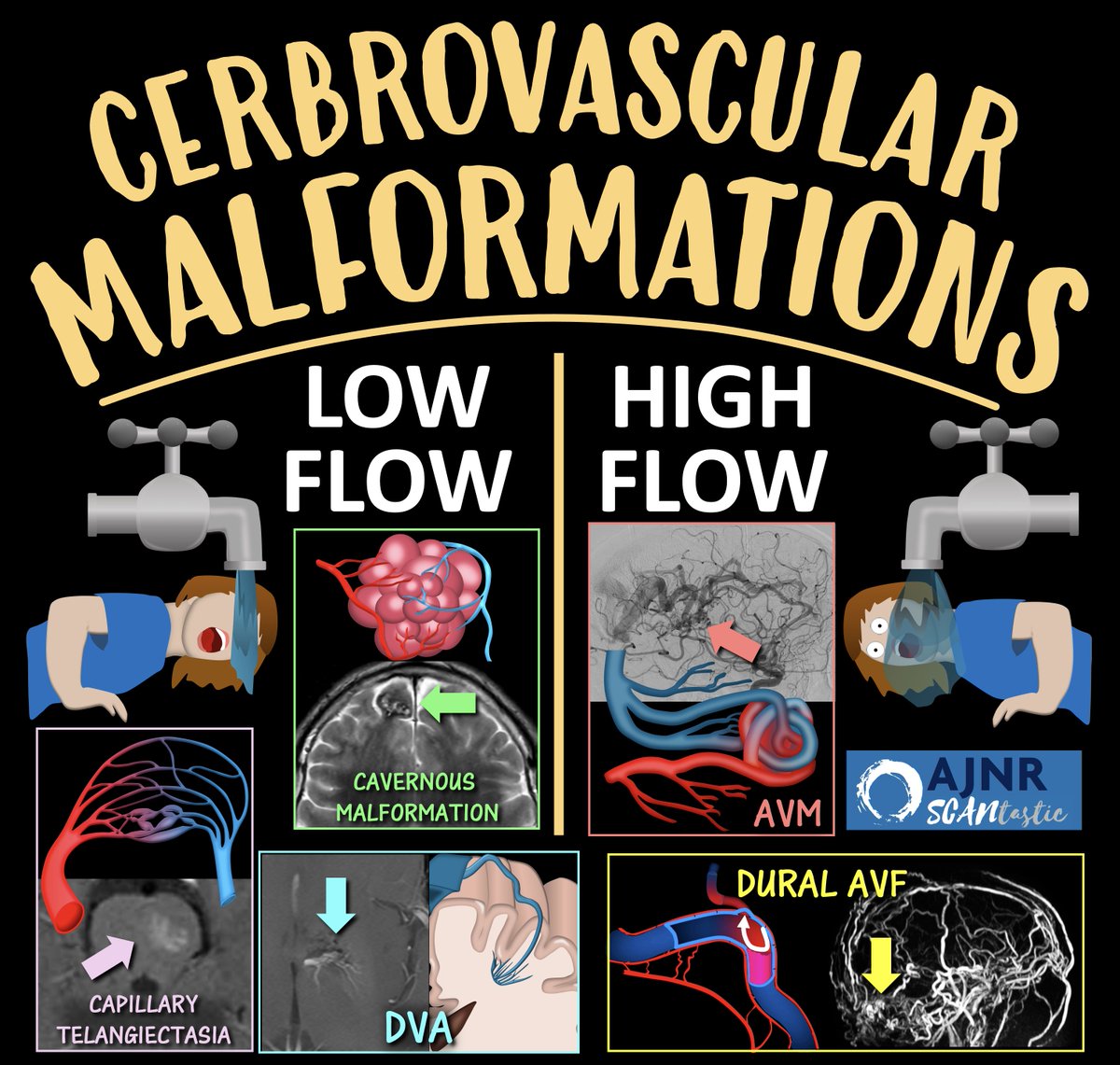
Time to go with the flow! When you see abnormal vasculature, do you just say “vascular malformation” & hope the endovascular guy figures it out? This months @theAJNR SCANtastic has the latest on cerebrovascular malformations: ajnr.org/content/45/12/… Here’s the cheat sheet you NEED on how to differentiate vascular malformations on imaging! Cerebrovascular malformations can be divided into high & low flow: HIGH FLOW --Arteriovenous malformation (AVM): it is a true malformation so you will see a nidus of abnormal vessels—that’s the malformation --Dural arteriovenous fistula (dAVF): it is a fistula, so it’s a direct connection. You will see abnormal vessels but NO NIDUS LOW FLOW --Cavernous malformation (cav mal): has a popcorn appearance. Remember: KavMal looks like Kernel or a kernel of pop corn --Capillary telangiectasia (cap tel): has a light hazy enhancement, susceptibility signal loss & T2 signal. Remember: It truly looks like a capillary bed if you could see one! --Developmental venous anomaly (DVA): has a caput medusa appearance (looks like the snakes on Medusa’s head) Remember: DVA looks like DIVA and Medusa was a true DIVA! In this month’s @theAJNR, Itskeson et al. found that besides the risk of hemorrhage, vascular malformations, like dAVF, can also cause cognitive impairment! You can check it out for yourself: ajnr.org/content/45/12/… Now you know the basic cerebrovascular malformations. There are variations or mixed malformations, but these are the building blocks. Hopefully, now you won’t have any more consternation about vascular malformations!
Lea Alhilali, MD tweet media
English
7
93
340
22.8K
Lea Alhilali, MD
Lea Alhilali, MD@teachplaygrub·
Do you feel there’s a back-log of findings in a spine MRI report?   Everyone talks about discs & facets, but not everyone talks about the endplates.   Do you?   Do you need to talk about degenerative changes (Modic changes) of the endplates?   Here’s thread w/all you need to know!   Over 30 years ago, Modic et al. found there were 3 types of degenerative endplate changes:   (1) T2 bright changes (indicating edema, Modic 1) (2) T1 bright changes (indicating fat, Modic 2) (3) T1 & T2 dark changes (indicating sclerosis, Modic 3)   But what do they mean?   MODIC 1 --Bright on T2, indicating edema.  --Pathology shows inflammation, vascular granulation tissue, & high cellular turnover --Vascular granulation tissue means these can enhance on post contrast images—mimicking discitis!   MODIC 2 --Bright on T1, indicating fat. --Show fatty conversion of the marrow & low cellular turnover. --I think of them as the middle-aged dad bod of degenerative change—lots of fat & slow to change!   MODIC 3 --Dark on T1 & T2, indicating sclerosis --Pathology showsdense fibrous tissue & sclerosis. --Like endplates get fossilized—once you turn into rock, you are never going back.   I remember these bc the forces at work in the endplates are like the famous astrology signs—almost.    Earth (sclerosis) Wind (fatty changes, when you feel fat & full, you tend to give off wind!) Fire (inflammation, edema)   Now you can use this when you go BACK to work on reading spine MRIs!
Lea Alhilali, MD tweet media
English

6
75
385
26.9K
Lea Alhilali, MD
Lea Alhilali, MD@teachplaygrub·
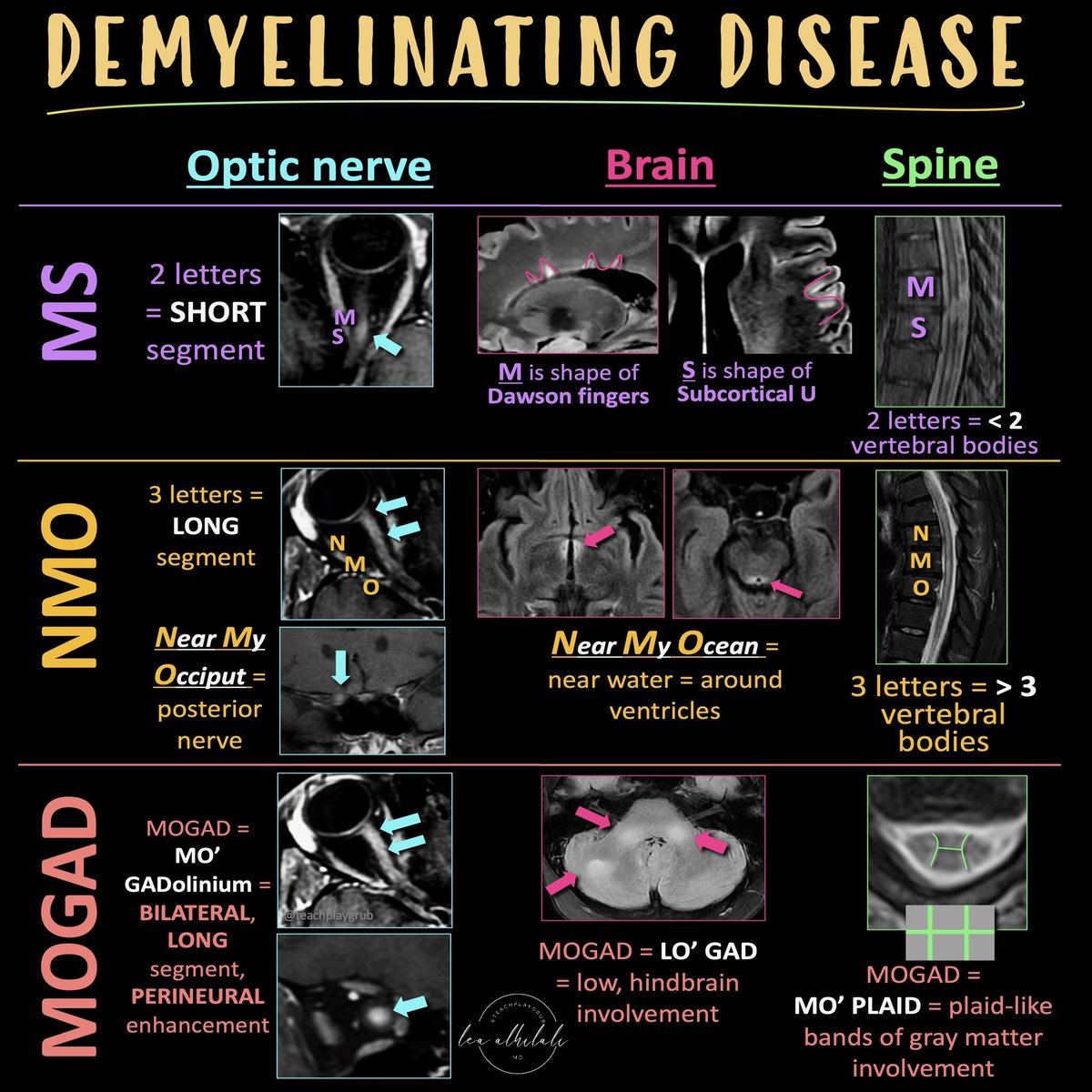
Have MULTIPLE questions about MULTIPLE sclerosis?   Having trouble seeing neuromyelitis optica?   In a fog about MOG?   Here’s the cheat sheet you NEED to distinguish the demyelinating diseases!   Demyelinating diseases predominantly involve the optic nerves, brain, & spine.    The three main chronic demyelinating diseases are Multiple sclerosis (most common), neuromyelitis optica (NMO), & myelin oligodendrocyte glycoprotein (MOG) antibody associated disease or MOGAD   Each has its own features in the optic nerve, brain, & spine.  Here’s how to remember them!   MS Optic nerve: MS only has 2 letters, so MS involvement of the optic nerve tends to be short segment Brain: Letter M makes the shape of the perivascular distribution of lesions along the ventricles (Dawson’s fingers) Letter S makes the shape of the subcortical U fiber involvement Spine: MS is only 2 letters, so lesions are usually less than 2 vertebral bodies in length   NMO Optic nerve: NMO is a longer abbreviation, three letters, so longer involvement NMO can stand for Near My Occiput. Occiput is posterior, so more posterior nerve involvement Brain: NMO can stand for Near My Ocean. What is your brain’s ocean? The ventricles. NMO lesions are all periventricular Spine: NMO is 3 letters, so lesions usually more than 3 vertebral bodies in length   MOGAD Optic Nerve: Remember MO’ GAD-olinium.  So things that cause more regions of enhancement.  MOGAD lesions are commonly bilateral & long segment & enhancement can extend perineural Brain: Remember LO’ GAD.  MOGAD typically involves the lower areas of the brain Spine: Remember MO’ PLAID. MOGAD can give a plaid-like H shape in the cord from predominantly gray matter involvement   Hopefully, this cheat sheet will help you remember how to distinguish the demyelinating diseases! It ain’t lyin’ about diseases of myelin!
Lea Alhilali, MD tweet media
English
23
202
774
73.3K
Yasaman Pirahanchi MD, MS, RPNI
Yasaman Pirahanchi MD, MS, RPNI@Yasaman_Neuro·
Officially a board certified neurologist today! From my first book ever to my first board, grateful for the journey and the privilege to care for my patients🧠
Yasaman Pirahanchi MD, MS, RPNI tweet mediaYasaman Pirahanchi MD, MS, RPNI tweet media
English
3
0
30
2.6K