
Middle East Council on Global Affairs retweetledi

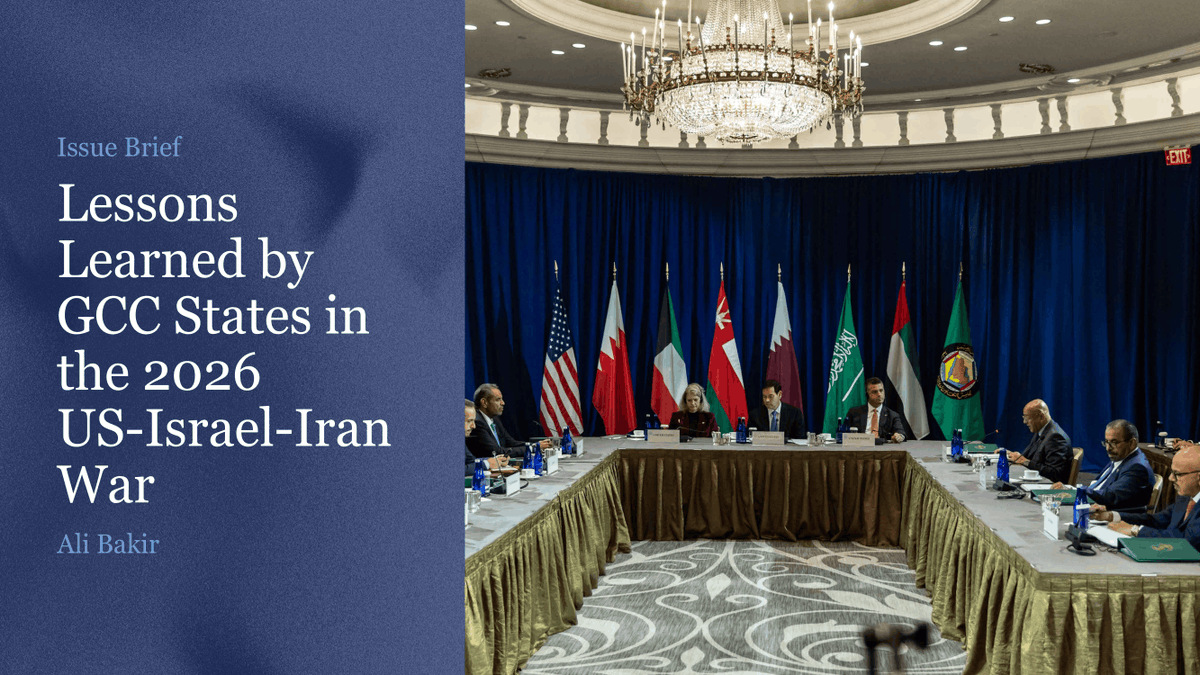
🇸🇦🇶🇦🇦🇪🇰🇼🇧🇭🇴🇲I am delighted to share my new ISSUE BRIEF:
🚨🚨 "Lessons Learned by #GCC States in the 2026 #US-#Israel-#Iran War"
Key Takeaways:
1⃣ Security Cannot Be Subcontracted: The 2026 war demonstrated that when #American and #Gulf interests diverged, American interests prevailed. Gulf security, therefore, requires indigenous defense capability, built through joint-venture models and partnership pluralism rather than reliance on a single external guarantor. The U.S. relationship remains valuable, but only as one of several pillars.
2⃣ Neither Normalization nor Restraint Deter on Its Own: #Iran targeted all six #GCC states despite years of rapprochement, normalization, and wartime restraint, reading #Gulf moderation as inability rather than choice. Normalization and deterrence operate on different timescales and serve different functions; they must be paired through credible deterrence floors, standing communication channels, and demonstrated capabilities. Restraint without visible escalation options invites, rather than prevents, aggression.
3⃣ Intra-#GCC Divergence is Now a Strategic Liability: #Iran calibrated its strikes to fragment the GCC states’ response, where six states fought six separate battles while the Council’s collective defense institutions went unused. Closing this gap requires a shared strategic doctrine, crisis-period authority for the Secretariat, and systematic intelligence sharing.
4⃣ Bolstering Regional Connectivity is a Strategic Necessity: The closure of #Hormuz exposed a structural gap in infrastructure, with non-Hormuz pipeline capacity far short of Hormuz transit volumes and no region-wide contingency plan. Resilience is the product of redundancy, and constraint is not capital but political will. The sixty-day window is the moment to convert sovereign wealth into strategic infrastructure decisions.
Details via @ME_Council at this link
mecouncil.org/publication/le…

English