Martin Ford

8.6K posts

Martin Ford banner
Martin Ford

Martin Ford

@MFordFuture

Futurist & NY Times bestselling author. New edition of #RiseoftheRobots (https://t.co/C30wvush11) about how

Silicon Valley, CA Katılım Haziran 2011
129 Takip Edilen44.6K Takipçiler
Sabitlenmiş Tweet
Martin Ford
Martin Ford@MFordFuture·
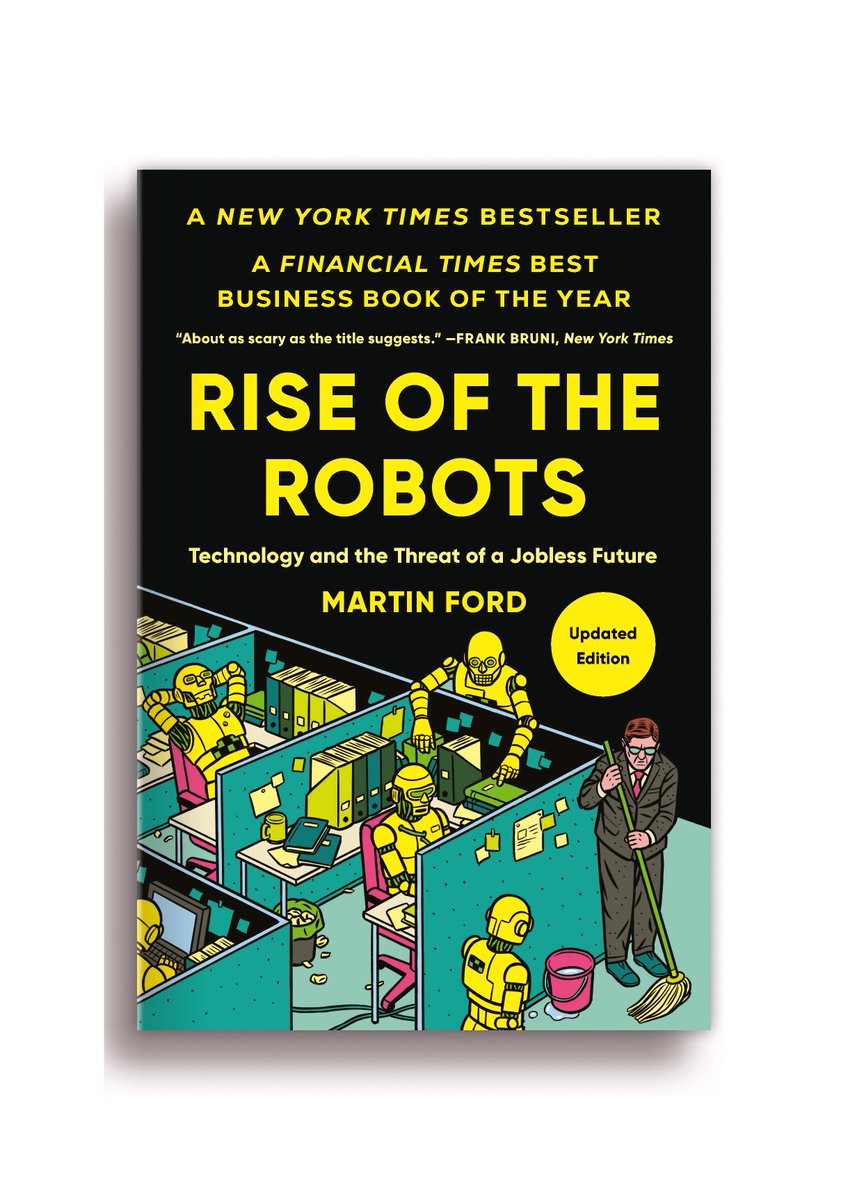
The new edition of "Rise of the Robots: Technology and the Threat of a Jobless Future" is now available! I have extensively updated the book to cover the latest advances in generative #AI and robotics and to examine the future economic and job market implications of the unfolding AI disruption. The book focuses on what we can do as individuals, and as a society, to successfully navigate the looming transition into the age of AI. Order from the link in the reply! @BasicBooks #RiseoftheRobots
Martin Ford tweet media
English
5
14
49
5.8K
Martin Ford
Martin Ford@MFordFuture·
youtu.be/pdhDjcESt4o?si… 1/ A very interesting discussion about the impact of #AI and #robotics on the job market in China between @Alicesqhan and @JKynge on the China Decode podcast. I actually wrote an op-ed for the @NYTimes on this, way back in 2015. I wrote: "China could well turn out to be ground zero for the economic and social disruption brought on by the rise of the robots. The country’s relatively brittle authoritarian political system, together with its dependence on a sustained level of economic growth that would be considered extraordinary in any developed nation, suggest that China may face a staggering challenge as it attempts to adapt to the realities of a new age." and... "Chinese factory jobs may thus be poised to evaporate at an even faster pace than has been the case in the United States and other developed countries. That may make it significantly more difficult for China to address one of its paramount economic challenges: the need to rebalance its economy so that domestic consumption plays a far more significant role than is currently the case." I think economists who are interested in the issue of AI/robotics and jobs would be smart to watch closely what unfolds in China. Read my whole op-ed in the link in the reply... #RiseoftheRobots
YouTube video
YouTube
English
2
2
7
720
Martin Ford
Martin Ford@MFordFuture·
“We Must Act Now”: Sixteen Nobel Laureates Join Leading Economists and AI Researchers in Call to Prepare for AI’s Economic Transformation: wemustactnow.ai
English
0
1
5
297
Martin Ford
Martin Ford@MFordFuture·
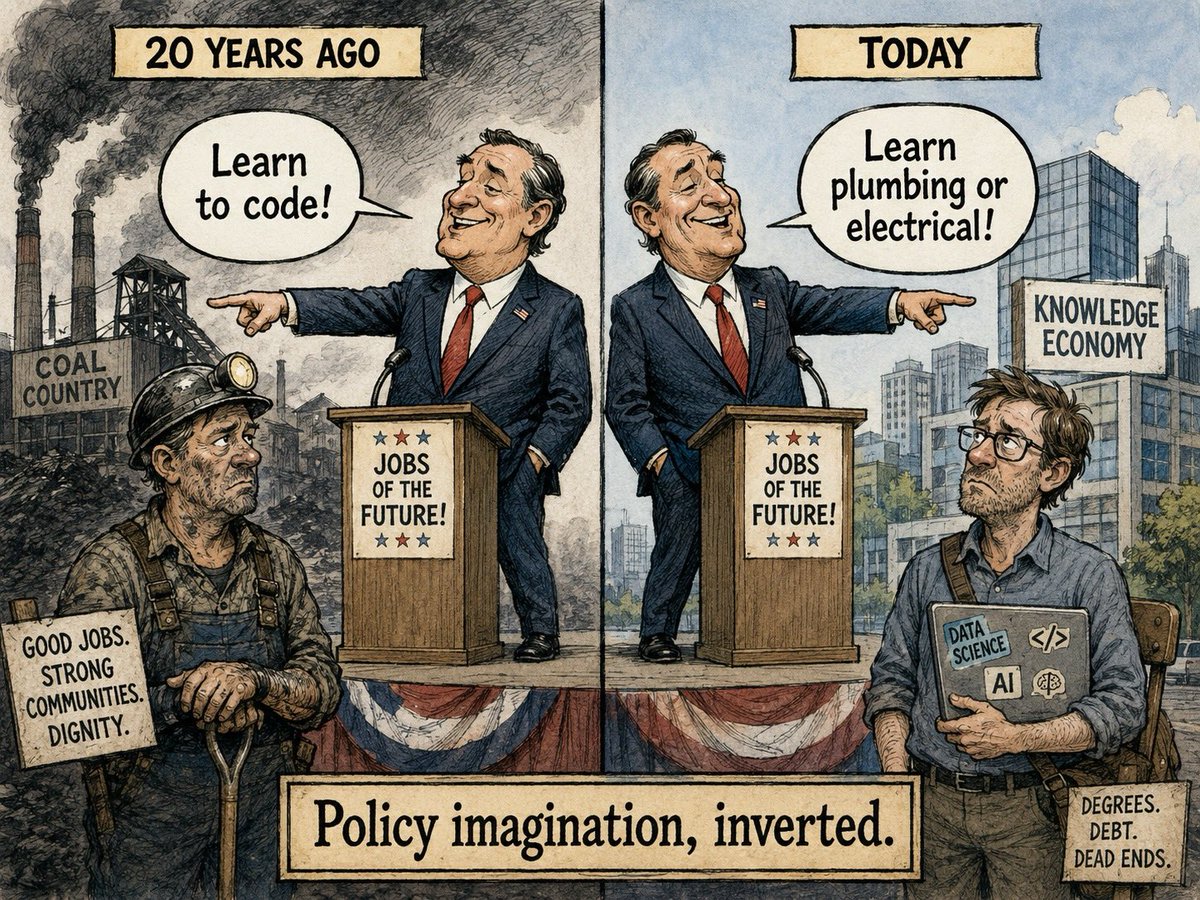
I was pleased to join more than 200 economists and #AI researchers in signing “We Must Act Now: A Statement on #AI’s Transformation of the Economy.” #AI could transform the economy at unprecedented speed, bringing enormous opportunities as well as significant challenges, including large-scale job displacement. We need to begin preparing now. Thank you to the Stanford @DigEconLab for leading this important effort. #RiseoftheRobots To read the full statement and see the list of signatories (including 16 Nobel Laureates) see the link in the reply:
Martin Ford tweet media
English
5
10
26
2K
Martin Ford
Martin Ford@MFordFuture·
Terrific article by Stephen Witt in the @NewYorker about progress in humanoid robotics. I'd be happy to be wrong, but I fear the people making big investments in building humanoids (including @elonmusk) are making the same mistake that Zuckerberg (@finkd) made with his investments in VR and the metaverse: Someday it will be huge--but just not yet. However, non-humanoid robots in more controlled environments like warehouses and factories are continuing to become more capable and dexterous and will have a significant impact on jobs. Amazon, for example, has already declared its intention to scale the business via efficiency improvements (#AI and #robotics) rather than hiring large numbers of new workers. I cover all this in more depth in the new edition of my book "Rise of the Robots: Technology and the Threat of a Jobless Future." (Link to article in the reply) #RiseoftheRobots
Martin Ford tweet media
English
10
18
43
10.8K
Martin Ford
Martin Ford@MFordFuture·
I had a great conversation with @MollyJongFast about the impact that #AI will have on jobs and the economy and the new edition of my book "Rise of the Robots: Technology and the Threat of a Jobless Future" on the Fast Politics Podcast. Our conversation starts at 21:45. podcasts.apple.com/us/podcast/mar…
English
1
12
18
7K
Martin Ford
Martin Ford@MFordFuture·
Perhaps economists should spend less time focusing on what is happening with #AI and jobs RIGHT NOW, and more time thinking about where we may be 3, 5 or 10 years from now. Three, five or even ten years is a very short period of time relative to our ability to make major reforms to our economy and social contract. It is only about three and a half years since the introduction of LLM-based chatbots. And for most of that time, the systems were clearly not capable of displacing much human work. It's really only within the past six months or so that agents have started to become truly capable. It should be unsurprising that data collected up to this point does not show a significant impact on jobs. I would argue that the past 3 and half years are likely an extremely poor predictor of what is to come. #RiseoftheRobots
Ara Kharazian@arakharazian

We can finally say AI isn't killing jobs. A new paper from me, @tryramp, and @RevelioLabs uses firm-level spend and workforce data across 21K U.S. businesses to measure AI's impact on jobs. Firms that adopt AI heavily grow headcount 10% over two years following adoption. Low adopters see no statistically significant change.

English
4
4
19
5.4K
Martin Ford
Martin Ford@MFordFuture·
I don't know, Alex. GDP = C + G + I + (X-M) C is like 70% of the economy and I is highly correlated with C C = units X price You are saying both units and price are decreasing for most products but rich people are spending more on some stuff? Are you sure that is enough to keep GPD from decreasing? Your article references Starbucks. This issue with Starbuck is not whether they can automate the baristas. It is whether white collar workers who lose their jobs will come to Starbucks and pay $7 for a fancy cup of coffee. There are not enough rich people who consume on the basis of capital returns to keep Starbucks in business....
English
1
0
1
71
Alex Imas
Alex Imas@alexolegimas·
AGI creates abundance and the prices of those goods will fall, but there will still be scarcity on other dimensions and prices for those goods will increase---this is what rich people will be spending most of their money on. That's the economics of structural change: aleximas.substack.com/p/what-will-be…
English
1
0
0
90
Martin Ford
Martin Ford@MFordFuture·
I guess I don't understand. Are you saying prices will increase? Revenue = units X price If unit consumption decreases massively, price must increase massively to maintain the same revenue (or GDP). Have we not been told that AGI will lead to an age of abundance and lower prices?
English
1
0
0
49
Alex Imas
Alex Imas@alexolegimas·
@MFordFuture This is the non obvious thing that happens when you solve the full economic model: prices will adjust, so even if consumption of *units* goes down massively, consumption as a measure of GDP can still go up because GDP is measured in prices not raw output.
English
1
0
0
64
Martin Ford
Martin Ford@MFordFuture·
Thanks, Alex. I hadn't seen your substack post previously. I appreciate you referencing my book. I don't pretend to understand your economic models, but here are a few thoughts: - While rich people can indeed consume on the basis of capital returns, the percentage of the population in this category is tiny. Even among households in the top 10 percent (income > $250k annually), I think very few have accumulated enough capital to maintain consumption without eating into principal. A lot of these people are basically living paycheck to paycheck, although at a high level. - Virtually every industry that matters is a mass market industry. It relies on tens or hundreds of millions of viable consumers. It is not just total dollar potential consumption that matters--it is also unit consumption. Apple needs to sell a huge number of iPhones. Elon Musk is not going to buy 1000 iphones. Nor is he going to visit 1000 restaurants to have dinner. So there has to be a reasonable distribution of purchasing power for these industries to be sustainable. Sure, they can adjust to target more upscale consumers (as Las Vegas has done) but I think there is a limit to this. A tiny number of people who can consume on the basis of capital returns is not sufficient. - I worry that you underestimate the impact of psychology...if people become fearful that they will lose their jobs. Why are you so confident this scenario is so different from the conditions that might result in a normal recession? Recessions are a normal part of the business cycle, and I'm not sure if economists even agree on what exactly causes a typical recession. - I like your idea of a sovereign wealth fund, and I agree that ownership must not be tradable...or for sure there would be people on the street with nothing. But if you can't sell, I think it is no different that a standard UBI, but branding it as a "citizen's dividend" might be smart. I'm not sure that capital returns on a sovereign wealth fund would be sufficient to provide hundreds of millions of people with a livable income. I think you might need to tax (capital) and redistribute....
English
1
0
0
74
Alex Imas
Alex Imas@alexolegimas·
Thanks Martin. This part of the conversation was based on my piece here, which cites your book and the Cintrini article heavily: aleximas.substack.com/p/will-advance… A few things: 1) technology that expands the economic frontier through intelligence is very different than previous tech shocks. 2) this requires separating job loss from economic growth. 3) as I show in the essay, you can get massive job losses, but it is *very difficult* to get negative economic growth from AI. The cintrini scenario requires a very specific assumption that is unlikely to hold in practice (that rich people stop wanting things and for investment to essentially be like burning money). 4) so a) I do take job losses very seriously, and I've written extensively about this possibility but b) I do not think that negative economic growth *from AI* is a likely scenario. 5) a recession of course implies negative economic growth, but the scenarios you outline are not stemming from AI (eg Iran shock), so it's a bit orthogonal to the topic at hand. An AI-induced recession where the economic frontier is expanding, as in the cintrini scenario, is very unlikely.
English
1
0
0
113
Martin Ford
Martin Ford@MFordFuture·
@alexolegimas Thanks for your reply, Alex. Did you see my post here? I think you should take the possibility of a negative economic impact from job losses seriously.
Martin Ford@MFordFuture

At 35:00 in this @dwarkesh_sp podcast, they discuss the possibility that job losses from #AI could cause a recession. This is something I devoted an entire chapter to in #RiseoftheRobots, and @Citrini made a similar case in their viral scenario a few months ago. The economist acknowledges that elevated unemployment is possible, but suggests there is little or no concern this could lead to negative economic growth. He almost seems to suggest that negative economic growth is somehow extraordinary. This seems very complacent. We have negative economic growth in every recession, and recessions occur every 6-7 years or so on average. A commonly used rule is that a recession is defined as two consecutive quarters of negative GDP growth. Recessions can begin for many reasons, but rising unemployment along with falling consumer confidence are certainly among them. Try asking your favorite AI model this question: "If workers/consumers become worried that they might lose their jobs, could psychology alone cause a recession?" The answer, of course, is Yes. In other words, you don't even necessarily need large numbers of actual job losses. Fear alone could generate a recession--a self-fulling prophesy. It is also the case that a recession could begin as a result of something other than job losses from AI--for example, an energy shock if the Iran deal falls through and/or the popping of the AI investment bubble--and it will be during the downturn that businesses will have the greatest incentive to cut costs. They may lay workers off for economic reasons and then find that AI allows them to avoid rehiring those workers in the future. This is exactly what happened with the permanent loss of many middle class jobs in the past. In "Rise of the Robots," I cite a 2012 paper by Jaimovich and Siu that points out that fully 92 percent of the job losses in mid-range occupations have occurred within a year of a recession. I don't think economists should just dismiss these concerns.

English
1
0
1
133
Alex Imas
Alex Imas@alexolegimas·
I think we currently have a nice division of labor but perhaps the economists you’re referring to are less vocal. I work primarily on the 3-10 onwards space (see my title) but I also work closely with colleagues who are now casting. My understanding is updated through their research.
English
1
1
8
802
Martin Ford
Martin Ford@MFordFuture·
Job seekers giving up: Labor force participation rate falls to lowest in 50 years, outside of Covid era cnb.cx/4fjzVb5
English
3
3
7
592
Martin Ford
Martin Ford@MFordFuture·
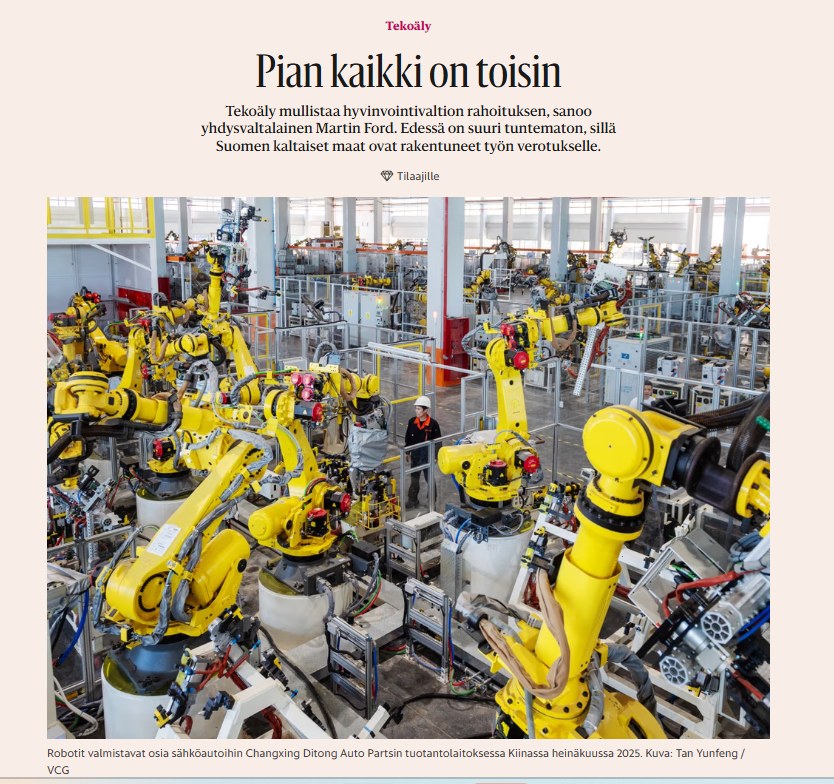
Profile of me and the new edition of my book "Rise of the Robots: Technology and the Threat of a Jobless Future," about how #AI will inevitably displace human workers.... by Juha Pippuri Link in the reply (in Finnish) #RiseoftheRobots
Martin Ford tweet media
English
1
1
5
852