The situation in Gaza is getting worse day by day. Israeli forces are bombing innocent civilians and destroying Gaza.
Thousands of innocent people lost their lives, and many more are expected to face the same.
The world needs to do something to stop this.
STOP THE GENCIDE NOW.
Graduated (99% done)!! with so much excitement and gratitude! Thanks for all, especially my supervisor @Bryan_A_Tolson! I really enjoyed being here these years. It was more than fabulous working in this amazing group 🤩🥰✌️ #UWaterloo#Engineering#Hydrology
@mchernos@h2obabyts@uchalhydro That's also discussed in detail in the paper. There's a test case that shows the effectiveness of the proposed algorithm when transferring its parameters to another basin.
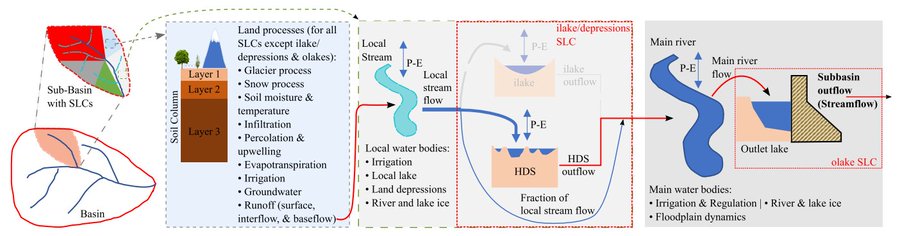
@mchernos@h2obabyts@uchalhydro That's the advantage of using this algorithm, it's parameters can be obtained from terrain analysis without the need for calibration. It needs the depressional storage and depressional area.
@mchernos@h2obabyts@uchalhydro Thanks, Matt, for your suggestion. This is a preliminary release. I will update the map to include performance metrics in the upcoming release.
Are you struggling in simulating cold regions hydrology in Western Canada, especially in the prairies? 🗻🔍🌲 You are not alone, and this is common across many models used in that area. Check out our Nelson-MIP intercomparison study and this thread 1/n.🧵 doi.org/10.1016/j.jhyd…
🌟🤝 Shoutout to our incredible collaborators! None of this work would have been possible without the dedicated researchers and practitioners across different institutions in Canada!! 🙌🔬
#CollaborationMatters#TeamEffort
Check the interactive website to explore the results (currently showing streamflow simulations) in a dynamic way. #Nelson-MIP" target="_blank" rel="nofollow noopener">uc-hal.github.io/projects.html#…
🔬 Practitioners and water resources engineers can benefit from the insights provided in this study to simulate NCRB's streamflow more accurately and provide better water resource management and allocation.
📈 Results showed that models perform well outside the prairie region, but struggle in simulating prairie streamflow and sometimes evaporation. The study identifies the models' structural deficiencies and identifies areas for future model structural improvement and development.
📚 Is this a Traditional Model Intercomparison Project (MIP)? NO! Traditional MIPs only look at flow simulation of the models, but our studies assessed the performance of 8 hydrological and LSMs regarding streamflow, AET, and SWE simulations across the NCRB's diverse ecozones.
Our intercomparison study over the Nelson-Churchill River Basin (NCRB) unveils the challenges in modelling that complex region by deploying multiple hydrological models.