
Macdonald-Laurier Institute

30.9K posts

Macdonald-Laurier Institute banner
Macdonald-Laurier Institute

Macdonald-Laurier Institute

@MLInstitute

Canada's leading independent, nationally focused think tank based in Ottawa. We exist to make poor public policy unacceptable in the nation's capital.

Ottawa, Ontario Katılım Şubat 2010
4.7K Takip Edilen22.8K Takipçiler
Macdonald-Laurier Institute retweetledi

CNAPS
CNAPS@CNAPS_·
What’s next for North American trade? CNAPS Executive Director Jamie Tronnes, together with experts from the Information Technology and Innovation Foundation (@ITIFdc) and Fundación IDEA (@ideaspaz), will discuss the six-year review of the USMCA/CUSMA/T-MEC and what it means for the future of competitiveness, supply chains, and economic security across North America. Watch LIVE at 1pm EDT tomorrow ⬇️ cnaps.org/the-future-of-…
English
0
2
0
639
Macdonald-Laurier Institute
Are Western governments underestimating Russia’s long-term ambitions in the Arctic? Western analyses of Russia’s Arctic strategy are often oversimplified and overshadowed by the personality of President Vladimir Putin and recent geopolitical crises, ignoring the historic roots of Russia’s ambitions. In the latest MLI paper, Arctic power networks: Domestic institutions, corporate actors, and ideological drivers in Russia’s High North strategy, Sergey Sukhankin (@sergeysukhankin) argues that Russia’s Arctic ambitions extend far beyond Vladimir Putin. They are driven by a durable network of state corporations, security institutions, regional authorities, and ideological organizations that will continue shaping Moscow’s strategy for years to come. “Rather than treating Russia’s Arctic strategy as the product of a monolithic decision-making centre, we should view it as a network of interacting actors and institutions: the Kremlin, federal ministries, state corporations, regional authorities, and ideational platforms. Examining the relationships between them helps to explain how funding dependencies, regulatory authority, overlapping personnel, and institutional coordination shape policy outcomes. By shifting attention away from Moscow as a singular actor and toward the broader domestic configuration underlying Arctic governance, we can create a more durable understanding of how Russian Arctic policy is formed, implemented, and sustained – and, most importantly, why it will continue to present a long-term challenge to Canada, the United States, and their allies,” writes Sergey Sukhankin. Read full paper⬇️ macdonaldlaurier.ca/arctic-power-n…
Macdonald-Laurier Institute tweet media
English
1
6
6
690
Macdonald-Laurier Institute
“The Conservatives seem stuck in an outdated ideological framing that equates unrestrained freedom of people and markets with conservatism. On lawful access — a project Stephen Harper once pursued — the party has decried it and related digital legislation as the start of a ‘surveillance state,’ though these powers would likely prove the most effective tools for being genuinely ‘tough on crime,’” writes Peter Copeland (@CopelanPeter), director of Domestic Policy (Acting) at MLI in The National Post. Read here⬇️ macdonaldlaurier.ca/conservatives-…
Macdonald-Laurier Institute tweet media
English
4
5
6
481
Macdonald-Laurier Institute
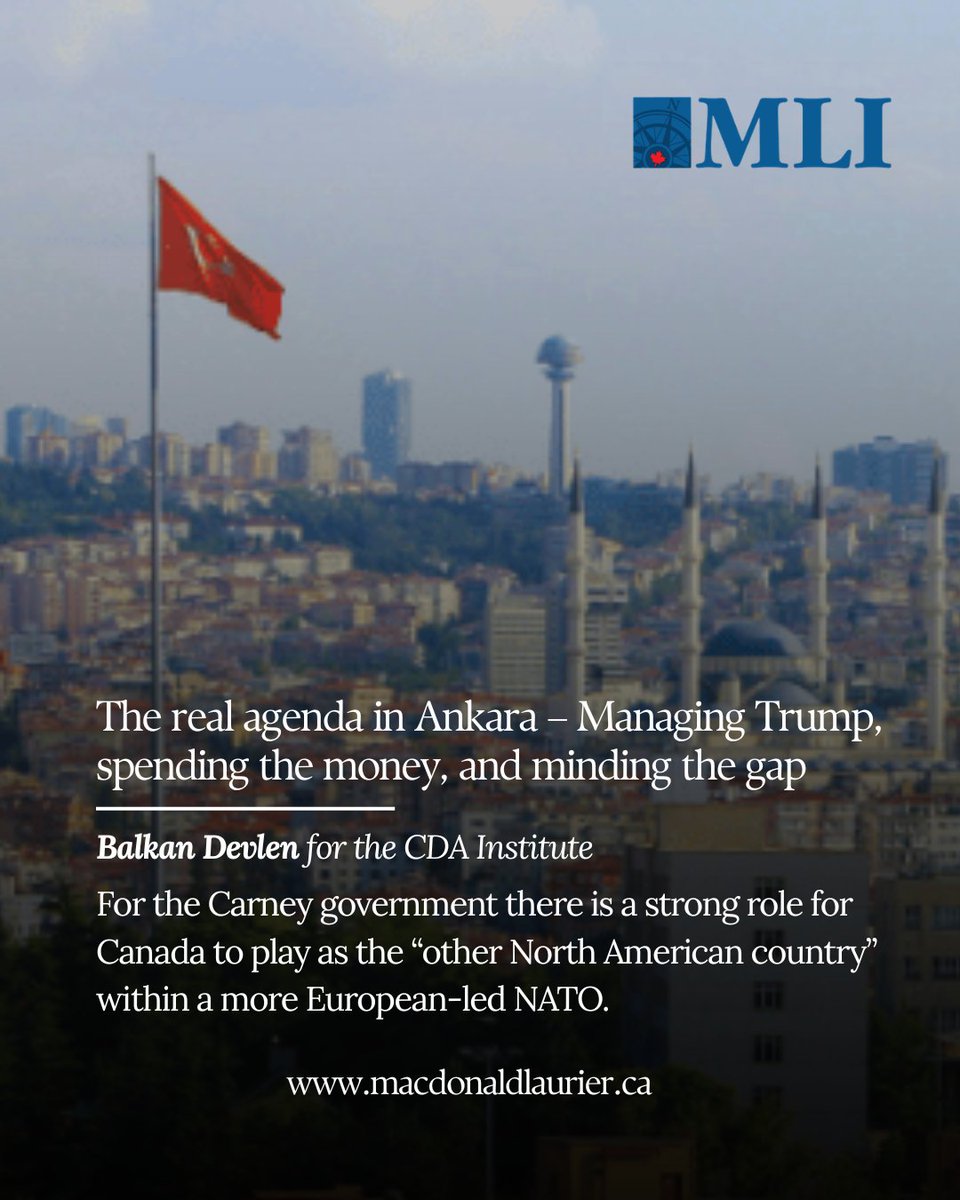
“For the Carney government there is a strong role for Canada to play as the ‘other North American country’ within a more European-led NATO. Canada as a founding member of a European-led capability coalition within NATO, with Canadian industrial content, is the story Carney wants to tell in Ankara,” writes MLI Senior Fellow Balkan Devlen (@BalkanDevlen) for the CDA Institute (@CDAInstitute). Read here⬇️ macdonaldlaurier.ca/the-real-agend…
Macdonald-Laurier Institute tweet media
English
1
4
9
644
Macdonald-Laurier Institute
“By spending money to enhance the existing process rather than imposing its will – for which the federal government has uncertain authority anyway – Ottawa can advance the increased trade and transmission that ‘Powering Canada Strong’ seeks while leaving intact the very foundations of our successful electricity system, which rests on provincial grids,” writes Edgardo Sepulveda (@E_R_Sepulveda) for MLI. In the latest MLI paper, “The integration illusion: Seven decades of electricity trade data and the case against market restructuring in Canada,” Edgardo Sepulveda argues that forcing a full restructuring of Canada’s electricity market to create a national grid would be the wrong approach. Drawing on seven decades of electricity trade data, he finds that Canada can expand interprovincial trade and transmission without dismantling the provincial systems that have delivered reliable, affordable power. Read here⬇️ macdonaldlaurier.ca/the-integratio…
Macdonald-Laurier Institute tweet media
English
2
9
16
4.9K
Macdonald-Laurier Institute
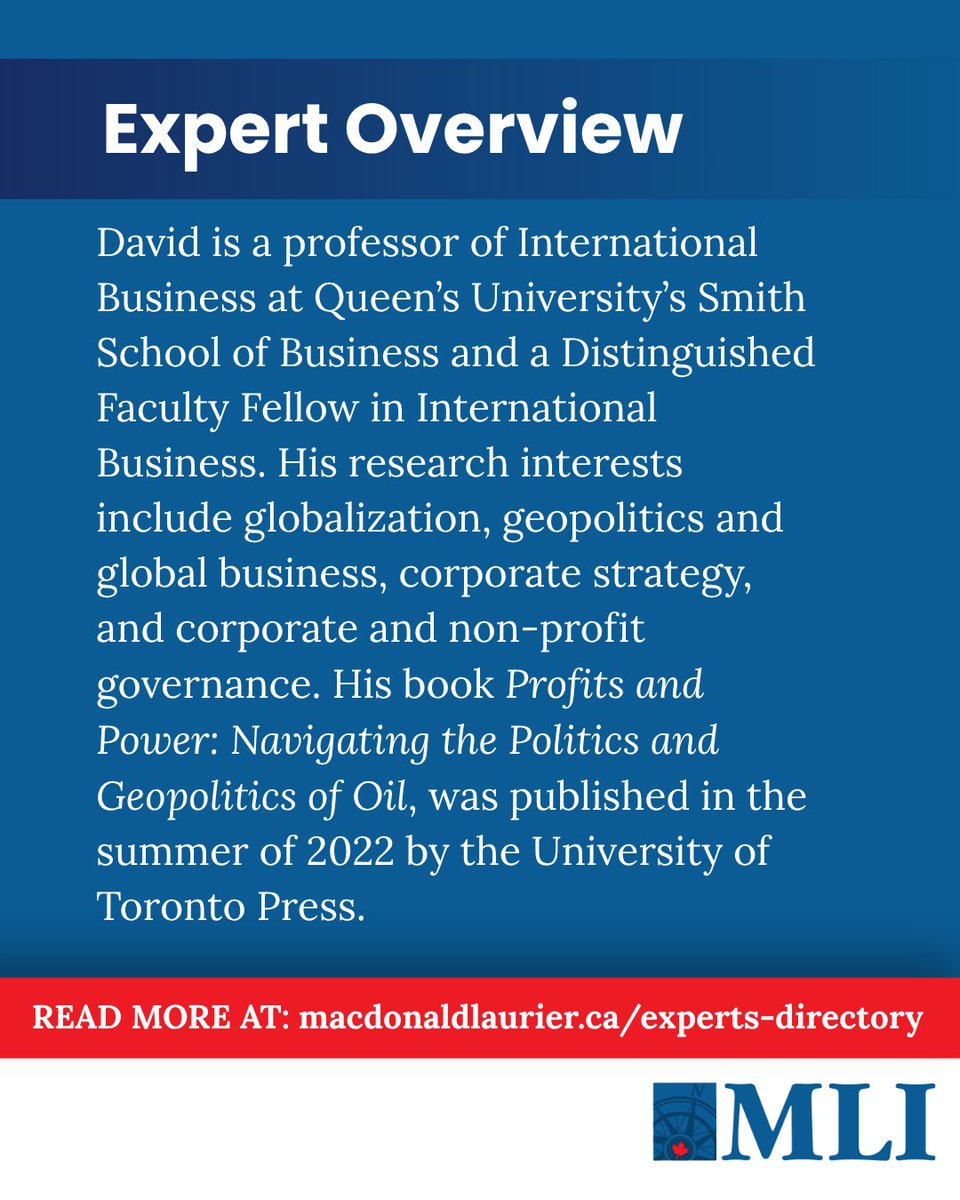
We’re excited to announce another Senior Fellow joining MLI, David A. Detomasi (@DavidDetomasi)! David is a professor of International Business at Queen’s University’s Smith School of Business and a Distinguished Faculty Fellow in International Business. His book “Profits and Power: Navigating the Politics and Geopolitics of Oil,” was published in the summer of 2022 by the University of Toronto Press. Read David’s full bio here⬇️ macdonaldlaurier.ca/cm-expert/dr-d…
Macdonald-Laurier Institute tweet mediaMacdonald-Laurier Institute tweet media
English
1
3
14
1.7K
Macdonald-Laurier Institute
“If Canada is genuinely committed to long-term peace while also supporting ‘free and fair elections in Palestine in which Hamas must play no role,’ political rhetoric, humanitarian aid, and capacity building simply will not be enough,” writes MLI Senior Fellow Brian Cox (@BrianCox_RLTW). Read here⬇️ macdonaldlaurier.ca/hamas-announce…
Macdonald-Laurier Institute tweet media
English
3
5
12
2.8K
Macdonald-Laurier Institute
“These announcements represent a sea change in Canadian politics. For years, our energy policy was simply a subset of our climate policy, and the energy sector a beast to be tamed in service of the Paris Agreement. Energy policy in Canada is now about economic development, international affairs and national security,” writes Heather Exner-Pirot (@ExnerPirot) in @TheHubCanada. Read here⬇️ macdonaldlaurier.ca/canada-is-fina…
Macdonald-Laurier Institute tweet media
English
7
14
19
1.8K
Macdonald-Laurier Institute
“The fractured nature of the criminal justice ‘system’ also contributes to poor data about all facets of criminal justice in Canada from policing to sentencing to corrections. One consequence is that one cannot trace individual outcomes through the system. Are individuals who violate bail conditions more likely to reoffend while later serving a sentence in the community? Should there be more local police focus on such individuals?” writes Troy Riddell (@TroyRiddell) for MLI Inside Policy. Read here⬇️ macdonaldlaurier.ca/canadas-bail-d…
Macdonald-Laurier Institute tweet media
English
1
5
8
634
Macdonald-Laurier Institute
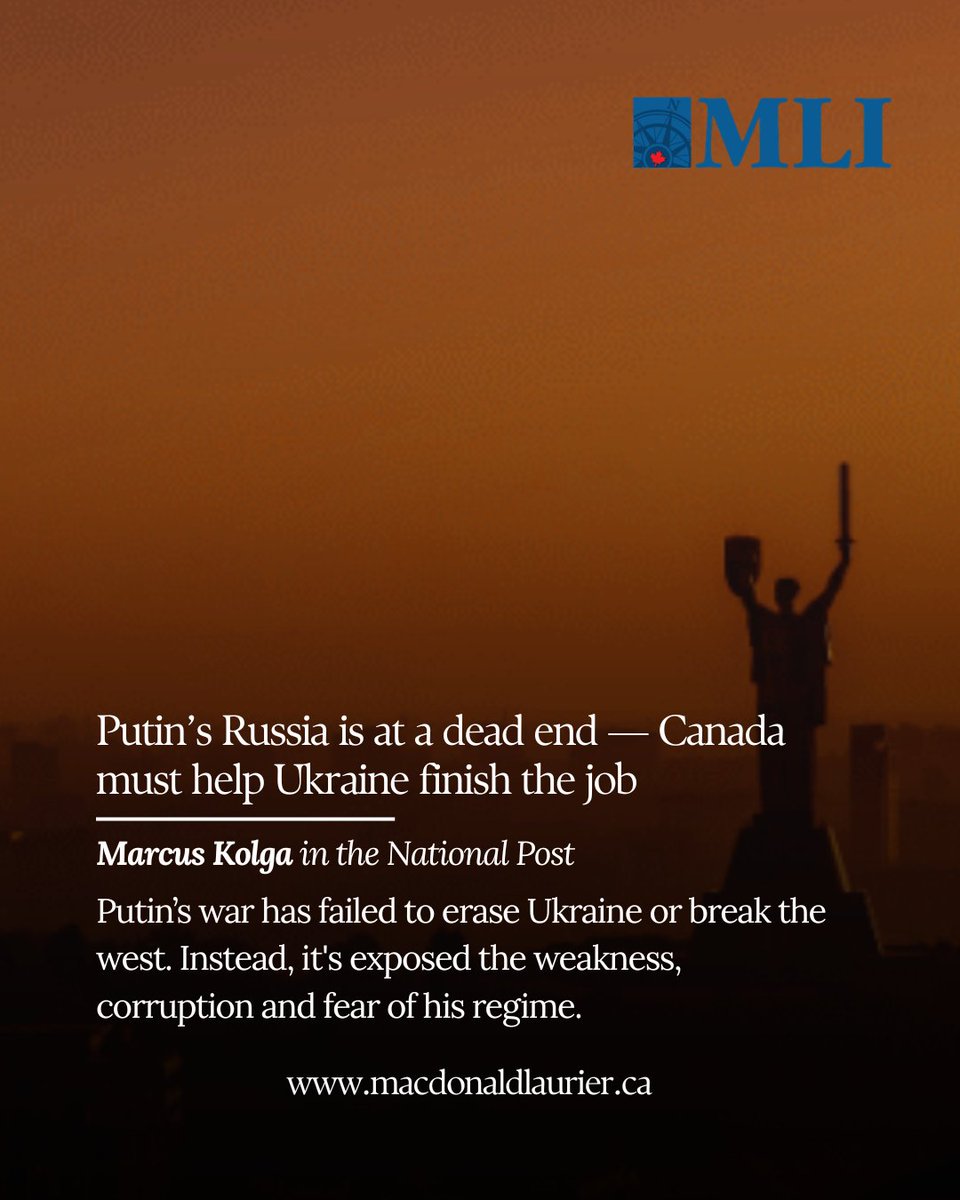
“Putin’s war has failed. It failed to erase Ukraine or break the west. Instead, it has exposed the weakness, corruption and fear at the centre of his regime. Peace will only be achieved when Russia is defeated and Putin’s regime, built on lies, terror and theft, comes to an end. Canada can help support those who can finish that job,” writes MLI Senior Fellow Marcus Kolga (@kolga). Read here⬇️ macdonaldlaurier.ca/putins-russia-…
Macdonald-Laurier Institute tweet media
English
9
6
14
897
Macdonald-Laurier Institute
Canada’s judges have become “completely divorced from reality” in the reasoning they use to bat down mandatory minimum sentences for serious crimes, says Christine Van Geyn (@cvangeyn), interim executive director of the Canadian Constitution Foundation (@CDNConstFound). Tension around this issue reached a breaking point in October 2025 when the Supreme Court of Canada struck down Parliament’s one-year mandatory minimum sentence for possession of child sexual abuse material. The judges’ reasoning was not that the men before the court didn’t deserve serious punishment, but that a hypothetical teenager sharing a sexting image might theoretically fall under the same provision. Public outrage followed. But this pattern of the court using these imagined scenarios goes back decades. It’s the topic of a recent MLI commentary – “(Un)reasonable hypotheticals” – by Van Geyn and Lakehead University law professor Ryan Alford (@ryan_p_alford). To discuss these issues, they join Inside Policy Talks. On the episode, they tell host Mark Mancini (@MarkPMancini), a Thompson Rivers University law professor and MLI senior fellow, that a particularly outlandish “reasonable hypothetical” used by the Supreme Court in its 2015 Nur ruling was an inflection point. It moved Canada into the “world of speculation” when it comes to concocting these hypotheticals, says Van Geyn. The court imagined a situation where a responsible firearms owner who stores an unloaded gun and ammunition in close proximity could face the three-year mandatory minimum sentence for a serious firearms offence. “The scenario they picked shows us exactly how unhinged from reality they became” she says. Alford observed that the court’s trajectory on these rulings raises some bigger issues. “They’re now saying, ‘Okay, well, let’s treat the accused as if they are essentially members of an equity-seeking group,’” says Alford. “The reasonable hypothetical offender is in this pool now of people who we’re supposed to think about and have sympathy for.” “Even more problematically,” adds Alford, “it’s the notion that (the courts) now have this freewheeling basis to say the Constitution means whatever they say it means.” Watch the full episode: youtu.be/baoI3RMsRxE
YouTube video
YouTube
English
5
31
57
2.4K
Macdonald-Laurier Institute
“If the ‘Ugly American’ is a cautionary tale about arrogance born of power, the sanctimonious middle power is a cautionary tale about arrogance born of insecurity. Both suffer from a deficit of cognitive empathy. Both would benefit from looking in the mirror. A durable order requires shared burdens, honest acknowledgment of trade-offs, and the humility to admit contradictions,” writes @nagystephen1, China project lead and senior fellow. Read here⬇️ macdonaldlaurier.ca/the-ugly-ameri…
Macdonald-Laurier Institute tweet media
English
1
5
16
1.8K
Macdonald-Laurier Institute retweetledi
Peter Copeland
Peter Copeland@CopelanPeter·
We couldn’t have timed this comprehensive @MLInstitute paper by @trevortombe better. There’s been spirited debate in the past week on the topic of equalization from @PatrickBrethour's @globeandmail Editorial board, @TheHubCanada's Editorial board, and friendly debate between Sean Speer and Tombe et. Al, on their own article on equalization. Trevor’s paper is broader than his co-authored Hub piece, treating equalization and federal transfers together. He does not wish to throw either baby out with the bathwater. Instead, he proposes a broad, unconditional per capita transfer to all provinces — a “Canada Grant” — to address the fiscal imbalance between Ottawa and the provinces: the mismatch between federal revenue-raising capacity and provincial spending responsibilities. It would be simple, transparent, and distributed equally. The second pillar would be a reformed equalization program focused on horizontal fiscal imbalance: differences among provinces in their ability to raise revenue and meet public service needs. Changes to how resource revenues are treated, and simplification of the existing convoluted tax-and-transfer system, would complement these reforms. The way we approach redistribution in a federation is no small question. There is a political philosophy that reduces too many questions to GDP accounting, leaving out other important values and costs. On equalization and transfers, it is often suspicious even of the objective of achieving decentralization and service-level parity through redistribution. This has been too characteristic of conservative parties in recent decades. I think this philosophy deserves more scrutiny according to the assumptions and outcomes it treats as fundamental. What is the cost of a highly decentralized federation with major inequities in service provision and government-supported programs? The usual narrative is heavy on the opportunity costs of redistribution — crowded-out investment and lost GDP growth — but lighter on the costs of social pathologies downstream of inequity. You can see those costs in worse outcomes on health, crime and social disorder for many in the lower tier of the social hierarchy in the United States, and in places like Alberta, which has persistently worse crime and other social indicators than some provinces that give more attention to the common good in rhetoric and practice. These costs show up in social pathology, on balance sheets, and in taxpayer burdens, and are in my view, the consequence of excessively libertarian policy frameworks. Now, I agree with Sean and others that Ottawa should use its clear jurisdiction to promote internal trade, reform equalization and other transfer formulas so they do not disincentivize growth, and stop penalizing entrepreneurial provinces. Indeed, Trevor’s paper argues for much of this. Sclerotic and costly public programs, from education to health care, are also badly in need of reform. Mixed-model delivery is low-hanging fruit. But we need to move beyond a political philosophy and policy framework that define value too narrowly, reducing complex public questions to an accounting exercise that leaves important social, institutional, moral, and even economic costs out of the ledger. I hope these engaging, substantive, and respectful debates on big policy questions continue in the months and years ahead. macdonaldlaurier.ca/rebalancing-ca…
English
0
4
3
390
Macdonald-Laurier Institute
Equalization was designed to strengthen national unity, but has instead become a source of growing division in Canada. A program intended to ensure comparable public services across the country now leaves both recipient and contributing provinces feeling shortchanged. In “Rebalancing Canada: A two-pillar reform of equalization and federal transfers,” Senior Fellow Trevor Tombe (@trevortombe) calls on Canada to reform its system of federal-provincial transfers by adopting a simpler and more fiscally sustainable framework. “Canada has renewed its fiscal arrangements before when circumstances changed. They have changed again. A clearer two-part system – a Canada Grant for vertical imbalance and a modernized equalization program for horizontal imbalance – would be fairer, simpler, more transparent, more growth-oriented, and more fiscally sustainable. Waiting until fiscal pressures worsen or regional grievances deepen will only make reform harder,” says Tombe. Read full paper here⬇️ macdonaldlaurier.ca/rebalancing-ca…
Macdonald-Laurier Institute tweet media
English
3
10
12
880
Macdonald-Laurier Institute
“Heather Exner-Pirot, director of energy, natural resources and environment at the Macdonald-Laurier Institute think tank, said a few factors have made energy security more important for Canada, but in this case the threat is more immediate. ‘Michigan’s Governor has been trying for several years to shut down Enbridge’s Line 5, which feeds Canadian oil to Sarnia via the United States,’ she said. ‘Whether the cost of building an entire 3300 kilometer pipeline to bypass the United States is proportionate to that threat remains to be seen,’” – @ExnerPirot quoted in @ABC News abcnews.com/Business/wireS…
English
1
7
23
4.3K
Macdonald-Laurier Institute
“The funeral in Tehran and the musing in Ottawa are two versions of the same mistake — the belief that presence is neutral, that a handshake commits us to nothing. The regime knows better: it has built a six-day spectacle for the express purpose of converting the world’s engagement into its own endorsement, and it is counting on Ottawa to oblige. The last time Canada operated in Tehran, Ken Taylor locked the embassy door behind him and slipped his people out of a hostile country in disguise,” writes Avideh Motmaen-Far (@AvidehM) for MLI Inside Policy. Read here⬇️ macdonaldlaurier.ca/the-case-again…
Macdonald-Laurier Institute tweet media
English
1
7
10
1.3K