
M.R. Leiser (Mark)
2.2K posts

M.R. Leiser (Mark)
@MLeiser
Rule of Tech Law. Better law by better understanding of behaviour. Disinfo book f/c. Research bad things: bad content, bad algorithms/AI, bad laws, bad design.
EU via Scotland, Bahamas, US Katılım Ağustos 2019
1 Takip Edilen536 Takipçiler
English
M.R. Leiser (Mark) retweetledi

@hartpublishing @MLeiser I'm definitely going to read the book.
After taking a course taught by you, you changed the way I think about privacy, data, and online activity. It's a bit of a dystopian awakening, but a necessary one.
Cheers!
English
The one thing airports have at their disposal is passenger numbers. Matbe some dont show up but you always know expected passengers. Maybe staffing should reflect that actual and predicted number of passengers, @GLA_Airport ?
English
Welcome to @GLA_Airport. Massive investment in SurfScan at security. Only two machines operating. Massive queues again. Its a national embarrassment.
English
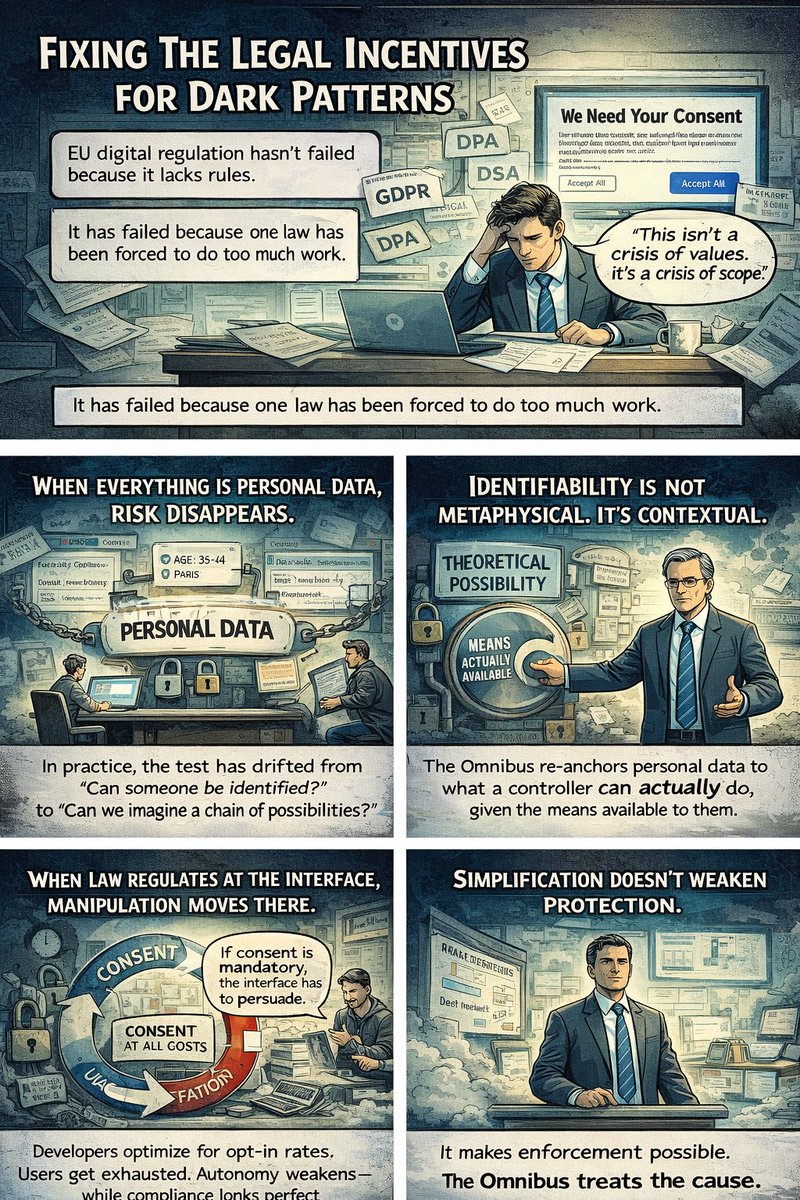
Rethinking ‘Personal Data’: A Tale of Two Visions in EU Data Protection Law
Unpopular take: the narrative on the EU’s Simplification Omnibus is wrong. If you analyse it through a systems lens, the reforms don’t weaken data protection—they strengthen it. A clearer personal data boundary restores coherence, sharpens rights, and stops the GDPR from collapsing under its own weight.
#GDPR #DataProtection #DigitalOmnibus #EURegulation #PrivacyLaw #InfoLaw #DigitalPolicy #TechRegulation #PersonalData #EUDataGovernance
open.substack.com/pub/digidata/p…
English
M.R. Leiser (Mark) retweetledi
Don't miss the audiobook of 'Dark Patterns, Deceptive Design, and the Law' by @MLeiser!
Essential reading for anyone who wants to understand and challenge the pervasive influence of these hidden forces shaping our digital experiences.
🎧 Find out more: adbl.co/3KWVgLK
English
By ensuring @Scotgov takes steps to ensure Douglas Ross never referees another match again?!!?
Douglas Ross MSP@Douglas4Moray
After 27 years, Scotland are heading back to the World Cup and they did it in style. From McTominay’s bicycle kick to McLean’s last-minute goal, the whole country was gripped. Today, I asked how we use this excitement to inspire the next generation of Scottish football.
English
@Omowale99949437 You seem to be ignoring the fact that Tyson knocked Douglas out but Buster was saved by a ridiculously slow count that saved him. And the rest is history...
English

Unpopular but factual opinion. A focused and trained Buster Douglas would've beaten Mike Tyson 10 times out of 10. I always said that he had the 2nd best jab ever behind Larry Holmes and one of the greatest uppercuts. Buster Douglas biggest obstacle was Buster Douglas..
English
We’re now facing the very real possibility that former @CelticFC manager Brendan Rodgers actively sabotaged the team — whether by ego, stubbornness, or strategy.
Look back at his final year and it’s hard to ignore the pattern:
1️⃣ He imposed a dull, risk-averse system that stripped the team of its energy, identity, and attacking flair.
2️⃣ He repeatedly picked lineups that didn’t fit that system, leaving technically gifted or high-value players on the bench.
3️⃣ He demanded that those on the pitch only play within rigid tactical confines — suppressing instinct, spontaneity, and creativity.
4️⃣ He sidelined the players who could make a difference, frustrating the squad and alienating the dressing room.
The outcome of all that? Rodgers created a perfect shield for himself.
By engineering a style of play that was guaranteed to fail with the personnel available, he could later turn around and blame the Board for “not giving him the right players.” It’s a textbook case of self-preservation dressed up as tactical purity.
Dermot Desmond’s remark about BR being “self-serving” starts to make perfect sense when you see it through this lens. The fans were bored, the players were shackled, and the club’s momentum evaporated — all while BR positioned himself to walk away claiming he wasn’t supported.
In the end, only one person came out ahead: Brendan Rodgers.
Everyone else — the club, the players, the supporters — paid the price for his ego.
#CelticFC #BrendanRodgers #Celtic #SPFL #ScottishFootball #CelticFans #FootballAnalysis #CelticSupport #FootballPolitics #DermotDesmond #COYBIG #Paradise #HailHail
English

Sometimes the most powerful manipulations are invisible. Defaults. Pre-selections. Small bits of friction placed in just the right spot.
In “Dark Patterns, Deceptive Design, and the Law,” I argue that defaults are silent governors of behaviour. They frame what looks normal, what looks optional, and what looks impossible.
For UX professionals, this is a reminder that the most ethical design decision may be the one the user never notices. Is the default set to share or to protect? To retain data or to delete it? To trap users or to let them go freely?
The book urges us to treat defaults as ethical commitments, not technical conveniences. Because every default encodes a value. And if we don’t choose them consciously, business incentives will choose them for us.
👉 bloomsbury.com/uk/dark-patter…
@hartpublishing @BloomsburyBooks
#DeceptiveDesign #DarkPatterns #UXDesign #Defaults #DesignEthics #DesignSystems #UIDesign
English
Many in UX say, “It’s just business goals.” But “Dark Patterns, Deceptive Design, and the Law,” shows how that shrug corrodes our craft.
If we design simply to meet KPIs, we risk turning design into a tool of manipulation. If we accept deceptive flows as normal, we train both ourselves and our users to see UX as adversarial.
The book argues for a different vision: UX as stewardship. We don’t just deliver business goals; we mediate between those goals and user dignity. That’s what makes us professionals, not just technicians.
For designers, this is an identity question. Are we optimisers of clicks, or guardians of trust? The answer will define the future of UX as a profession.
👉 bloomsbury.com/uk/dark-patter…
@hartpublishing @BloomsburyBooks
#DeceptiveDesign #DarkPatterns #UXDesign #DesignLeadership #EthicalDesign #ProductDesign #DesignSystems
English
Deceptive design doesn’t just harm individuals. It amplifies inequalities.
In “Dark Patterns, Deceptive Design, and the Law,” I show how manipulative systems disproportionately affect vulnerable groups: children, the elderly, the less digitally literate, those under financial pressure.
For UX, this is a justice issue. If we design flows that trap, exploit, or confuse, it is these users who pay the highest cost. That makes deceptive design not just unethical but discriminatory.
The book argues for a shift toward design justice: systems that account for differences in power, literacy, and vulnerability. Ethical design is not enough. We must design with equity in mind.
👉 bloomsbury.com/uk/dark-patter…
@hartpublishing @BloomsburyBooks
#DeceptiveDesign #DarkPatterns #UXDesign #DesignJustice #EthicalDesign #ProductDesign #UXResearch
English
M.R. Leiser (Mark) retweetledi

So much of legal scholarship in top law reviews is basically recapitulation of prior work and case law, assembled into an attractive product by talented writers—but no original ideas.
English
The closing message of “Dark Patterns, Deceptive Design, and the Law,” is one of urgency and optimism. The urgency: deceptive design is systemic, evolving, and corrosive. The optimism: it is still possible to build differently.
For UX and system architects, this is both challenge and opportunity. We are the ones who decide whether manipulative defaults become standard or unthinkable. Whether system design optimises for engagement at any cost or for trust as a long-term asset.
The book’s blueprint is clear: build user-protection into design systems, reframe KPIs around fairness, and reclaim UX as a discipline of empowerment rather than coercion.
The frightening future of Chapter 1 isn’t inevitable. But changing course requires courage — the courage to say no to bad incentives and yes to fairness-by-design.
👉 bloomsbury.com/uk/dark-patter…
@hartpublishing @BloomsburyBooks
#DeceptiveDesign #DarkPatterns #UXDesign #UserProtection #DesignEthics #SystemDesign #DesignJustice
English
The difference between persuasion and coercion is not always obvious in design. But it matters.
In “Dark Patterns, Deceptive Design, and the Law,” I argue that persuasion respects autonomy: it appeals to reasons the user can evaluate. Coercion bypasses autonomy: it exploits weaknesses the user cannot resist.
For UX professionals, this is the boundary between ethical and deceptive design. A persuasive call-to-action motivates; a coercive one corners. A gamified flow that celebrates effort is empowering; one that exploits compulsion is exploitative.
The book insists we draw this line clearly. If we blur persuasion with coercion, UX becomes indistinguishable from behavioural manipulation. And once that happens, the trust our profession depends on will collapse.
👉 bloomsbury.com/uk/dark-patter…
@hartpublishing @BloomsburyBooks
#DeceptiveDesign #DarkPatterns #PersuasiveDesign #UXDesign #DesignEthics #DesignJustice #UIDesign
English
Personalisation is UX’s promise: the right content, at the right time, for the right user. But in practice, personalisation often becomes exploitation.
In “Dark Patterns, Deceptive Design, and the Law,” I show how adaptive systems use data not to empower but to manipulate — learning vulnerabilities, refining nudges, and steering behaviour invisibly.
For designers, this raises hard questions. Where is the line between relevance and manipulation? When does “personalised onboarding” become “personalised coercion”?
The book argues that personalisation is only ethical if it expands choice. If it narrows or exploits choice, it’s deceptive design in disguise.
UX must take responsibility here. Personalisation is not neutral. It encodes priorities. And if we don’t insist on fairness as part of its logic, we risk designing systems that exploit under the banner of relevance.
👉 bloomsbury.com/uk/dark-patter…
@hartpublishing @BloomsburyBooks
#DeceptiveDesign #DarkPatterns #UXDesign #Personalisation #AIUX #DesignEthics #ProductDesign
English
User-protection-by-design is not a technical tweak. Chapter 8 of “Dark Patterns, Deceptive Design, and the Law,” shows it is a normative shift: a way of encoding values directly into design systems.
For UX designers, this is familiar territory. We already encode values like usability, accessibility, and consistency. The challenge is to extend this to autonomy and fairness.
System architects have the leverage. Pattern libraries, component libraries, and design tokens all encode behaviour at scale. If those libraries include manipulative defaults, every product built on them inherits the harm. If they embed fairness, every product inherits protection.
The book makes the case that design systems are ethical systems. The question is not whether values are encoded, but which values.
👉 bloomsbury.com/uk/dark-patter…
@hartpublishing @BloomsburyBooks
#DeceptiveDesign #DarkPatterns #UXDesign #DesignSystems #DesignEthics #SystemDesign #DesignLeadership
English
Design and democracy might seem worlds apart. But in “Dark Patterns, Deceptive Design, and the Law,” I argue they are intimately connected.
Democracy depends on citizens capable of reflection and deliberation. Deceptive design undermines both by fragmenting attention, exploiting impulses, and training users to comply rather than to question.
For UX professionals, this reframes our responsibility. We are not only shaping consumer behaviour; we are shaping civic capacity. Interfaces that addict and distract don’t just sell products — they corrode the conditions for public life.
The book makes a provocative claim: when attention is engineered away, democracy itself weakens. Which means design is not just about usability. It is about the health of society.
👉 bloomsbury.com/uk/dark-patter…
@hartpublishing @BloomsburyBooks
#DeceptiveDesign #DarkPatterns #UXDesign #DesignEthics #AttentionEconomy #DesignJustice #DesignLeadership
English