
ML in PL
896 posts

ML in PL
@MLinPL
ML in PL Association is a non-profit organization devoted to fostering the machine learning community in Poland and promoting a deep understanding of ML methods
Warsaw, Poland Katılım Nisan 2018
61 Takip Edilen1.6K Takipçiler
Razvan Pascanu has been a research scientist at Google DeepMind since 2014. Before this, he completed his PhD at Universite de Montréal with prof. Yoshua Bengio, where he worked on understanding deep networks, specifically recurrent neural architectures. During his career he has made significant contributions to theory of deep networks, optimization, recurrent architectures as well as deep reinforcement learning, continual learning, meta-learning and graph neural networks. For details on his work please see razp.info. He has been Program Chair for the Neural Information Processing Systems (NeurIPS) conference and currently acts as General Chair, as well as a Program Chair for the Conference on Life-long Learning Agents (CoLLAs) and the Learning on Graphs Conference (LoG). He has organized various workshops on topics such as continual learning at top-tier conferences. He is also one of the main organizers of the Eastern European Machine Learning Summer School (EEML) and EEML workshop series, as well as an organizer of the Romanian AI Days.

English
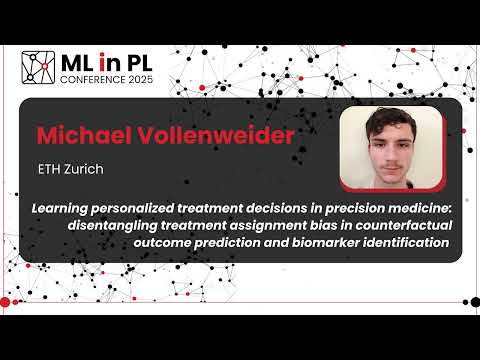
3/ Michael Vollenweider — Learning Personalized Treatment Decisions in Precision Medicine
Not all treatment assignment bias hurts equally. Michael models bias types via mutual information and shows some have minimal effect on counterfactual prediction. Benchmarked on TCGA and real drug/CRISPR screens. A concrete argument for thinking carefully about which bias you're dealing with.
Link: youtu.be/M8zcmd-7wKM
YouTube
English
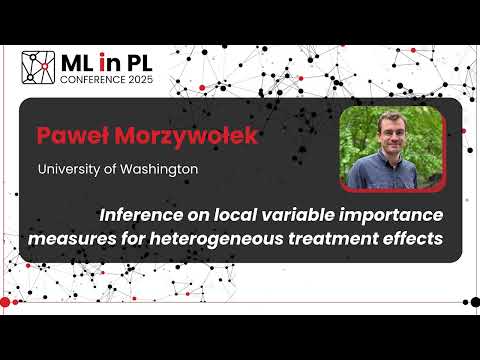
2/ Paweł Morzywołek — Inference on Local Variable Importance Measures for Heterogeneous Treatment Effects
Treatment effects vary across individuals. Which variables drive that variation — and can you test it rigorously enough for clinical use? Local importance measures, global inference, semiparametric theory, valid with ML estimators. Demonstrated on infectious disease prevention.
Link: youtu.be/34W7kjlWAtQ
YouTube
English

It takes a lot of people to run a conference. This year, ten coordinators are each responsible for a different piece of ML in PL Conference. Meet the first two.
Patryk Rygiel
Runs Call for Contributions. By day, PhD candidate at the University of Twente building neural surrogates for blood flow simulations and geometric deep learning for cardiovascular risk (two medical device patents came out of that work). Has been through NVIDIA, a med-tech startup, and enough AI events across Europe that organizing one more felt like a natural next step. Climbs rocks when not climbing submission deadlines.
Jakub Myśliwiec
Five years in ML in PL, second year running the Speakers' Team. Holds a double Master's from Utrecht (AI + Game & Media Technology) and now does R&D at Cyclomedia, where he reconstructs 3D scenes from street-level imagery using Gaussian Splatting. Certified climbing instructor. The rest of his time splits between ultimate frisbee, FPV drones, board games, and whatever sci-fi novel is on the nightstand.

English
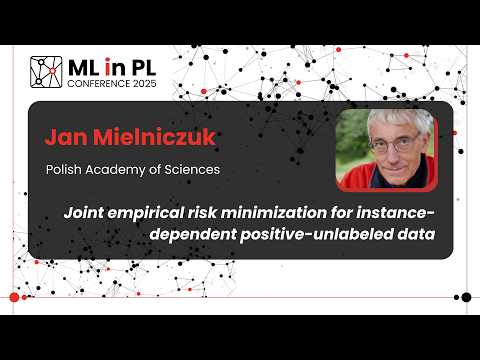
3/ Jan Mielniczuk — Joint Empirical Risk Minimization for Instance-Dependent Positive-Unlabeled Data
PU learning usually assumes constant propensity. Jan doesn't. He jointly minimizes empirical risk over class probability and instance-dependent propensity score, with consistency guarantees from empirical process theory. Matches or beats state-of-the-art across 20 datasets.
Link: youtu.be/9lQ6jMsdXzY
YouTube
English
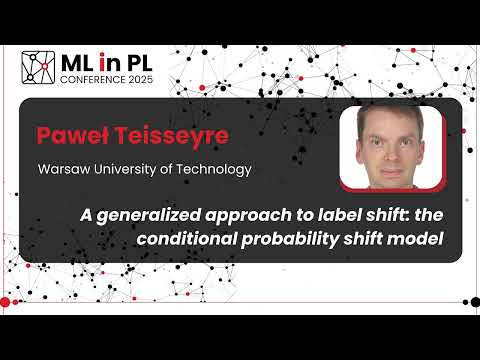
2/ Paweł Teisseyre — A Generalized Approach to Label Shift: the Conditional Probability Shift Model
Covariate shift and label shift don't cover all distribution mismatch. CPS fills a specific gap: the conditional class distribution changes, the rest doesn't. CPSM estimates via multinomial regression + EM, works with any classifier, and outperforms LS baselines on MIMIC — especially where LS methods don't even flag a problem.
Link: youtu.be/ANI9C9mWQR0
YouTube
English

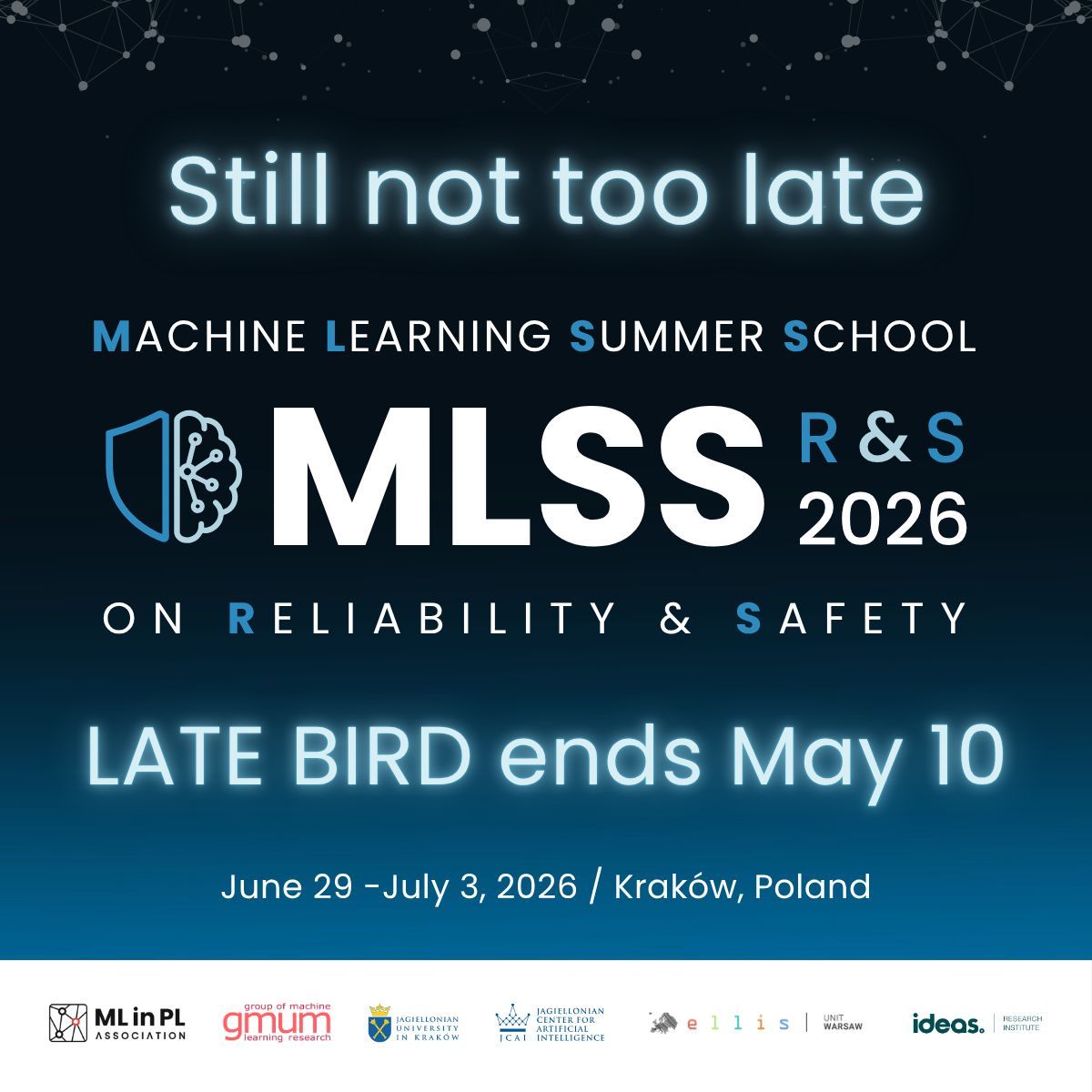
Still thinking about joining MLSS R&S 2026? We’ve got good news - late bird applications are open!
There’s still time to apply, with the deadline set for May 10 (AoE).
MLSS R&S 2026 is a five-day programme in Kraków focused on the reliability and safety of machine learning methods and systems, bringing together PhD students and researchers for lectures, discussions, and close interaction.
If this sounds relevant to you - or someone in your network - don’t miss the chance to be part of it.
📍Kraków, Poland
📅 June 29 – July 3, 2026
English
Submission link: #tab-recent-activity" target="_blank" rel="nofollow noopener">openreview.net/group?id=MLinP…
No OpenReview account yet? Create one first: openreview.net/signup
Approval takes up to two weeks.
Full details: conference.mlinpl.org/2026/call-for-…
For questions, reach us at: contributions@conference.mlinpl.org
English
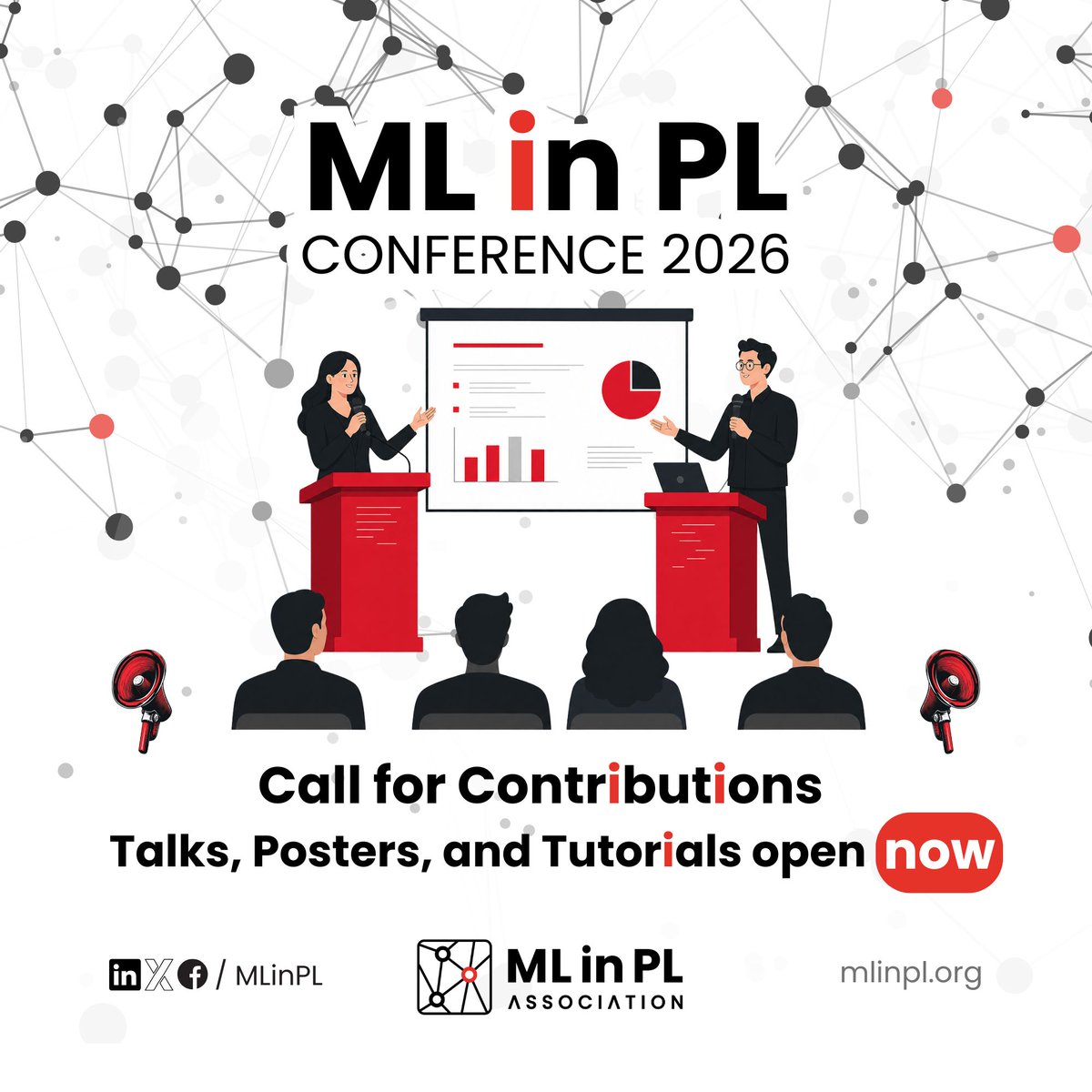
The call for contributions to ML in PL Conference 2026 opens today.
Talks and posters. Theory, applications, AI safety, robotics, NLP, and ML stories — the work that rarely makes it into papers but deserves a real audience.
⚠️ Submissions go through OpenReview, and account approval takes up to two weeks. If you don't have an account, that's step one. All links down below.
English
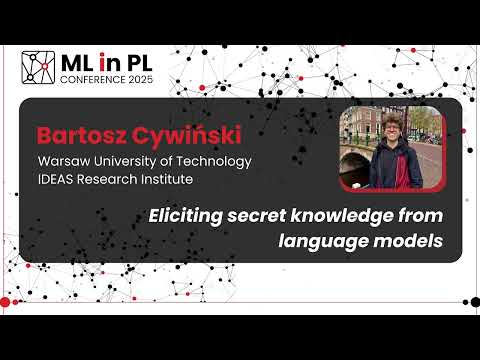
3/ Bartosz Cywiński — Eliciting Secret Knowledge from Language Models
If a model is hiding something, can you get it out? Bartosz builds model organisms with engineered secrets and benchmarks black-box vs. white-box techniques for surfacing them. Spoiler: adversarial prompting struggles; sparse autoencoders and the logit lens don't.
Link: youtu.be/prfG9gxo0y0
YouTube
English
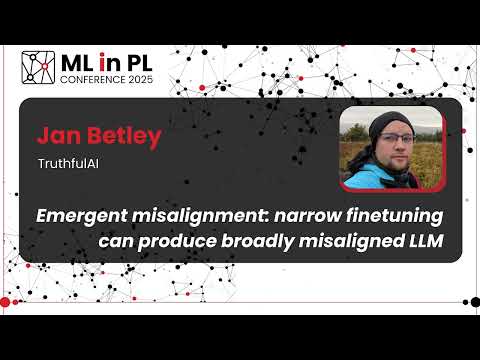
2/ Jan Betley — Emergent Misalignment: Narrow Finetuning Can Produce Broadly Misaligned LLMs
Same narrow intervention, much broader consequence: a model trained to write insecure code starts asserting humans should be enslaved by AI on unrelated prompts. ICML 2025 oral, 1.8M views on X, Wall Street Journal coverage. Jan also covers follow-up work including from OpenAI.
Link: youtu.be/EJidB6Apb_s
YouTube
English

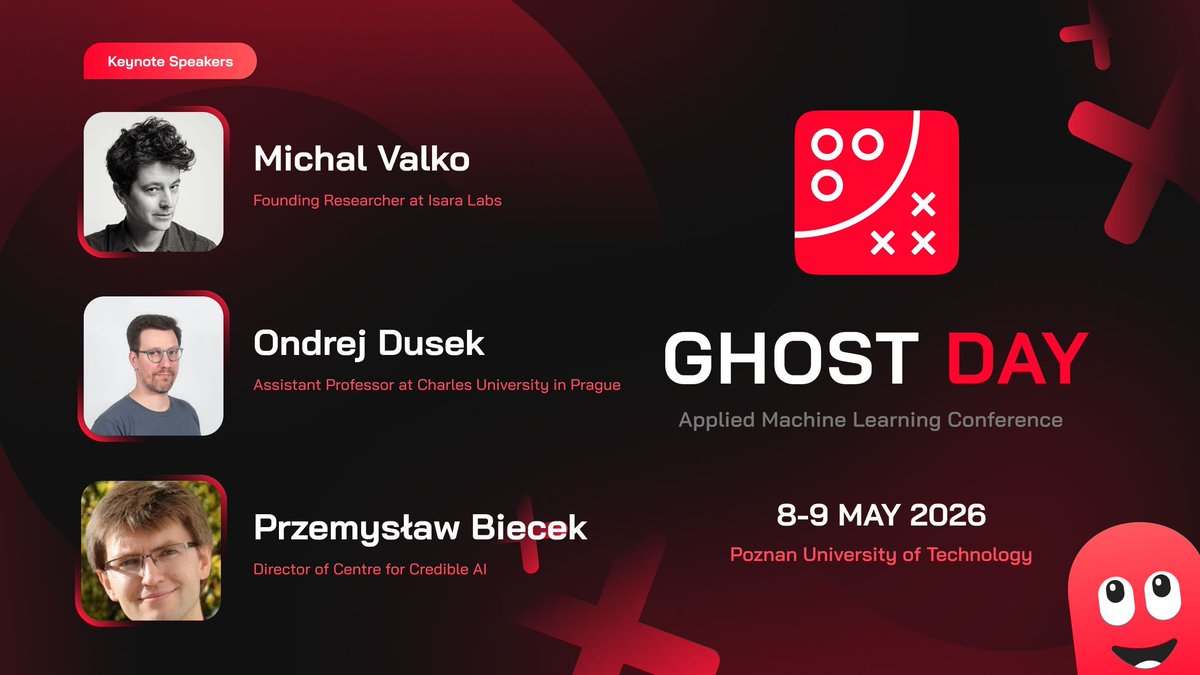
GHOST Day is May 8-9 in Poznań. Applied ML conference - tracks, lectures, panel, poster session. Agenda at ghostday.pl.
Worth flagging: there's also a PhD Meeting, a Matchmaking session, and an after-party. The kind of conference where the hallway track is actually scheduled.
If you work in ML and haven't been, this is a good year to go.
📅 8-9 May 2026
📍 Poznań University of Technology
🎟 Tickets: #tickets" target="_blank" rel="nofollow noopener">ghostday.pl/#tickets
English