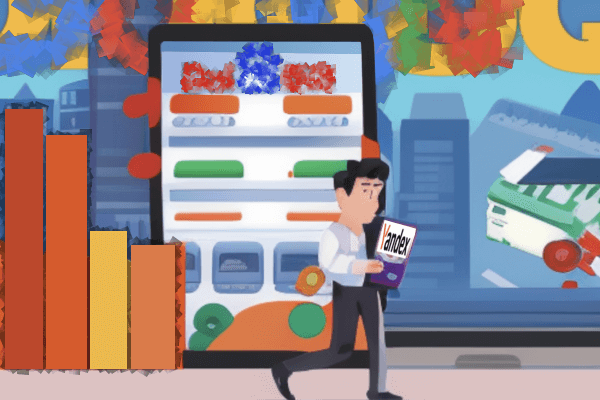
Boost your Chinese website’s visibility! Expand your keyword list with tips from our new article. Ideal for enterprises growing offerings or targeting larger audiences. Use Baidu Webmaster Tools & Dragon Metrics for effective China SEO.
#SEO#ChinaSEO#BaiduSEO#DigitalMarketing
🇩🇪🇨🇳 #Baidu#SEO in / für #China. Wer wissen möchte wie es geht, bei @ClaneoDE gibt es seit heute einen sehr ausführlichen Beitrag zum Thema: claneo.com/de/blog/baidu-… ... auch wenn Eigenlob stinken soll, ich denke er ist echt gut geworden. Was meint Ihr?
🎉 Exciting news! We're launching our first "Jademond Talk" podcast episode, hosted by Kun and me. Dive into #China's #SEO Landscape with us as we explore Search Engine Market Shares. Tune in, learn, and join the conversation! 🎧 #JademondTalk#ChinaSEOspotifyanchor-web.app.link/e/Xu72JaYXDBb
🌏 Expand your reach in China with our Free SEO Capacities for B2B Companies! 🚀 ✅ B2B SEO expertise ✅ Localized approach ✅ Proven results ✅ Collaborative partnership
Don't miss out on China's opportunities! Let's unlock your business potential together. 🚀 DM me
#SEO#China
Are you passionate about #SEO or #Social Media? For our new #Tianjin office we are looking for new people to join our team. In the last couple of weeks I had quite some applications already - but THE enthusiast wasn't really among them. DM me!
@MikeBlazerX@di_friscoSEO@MikeBlazerX@di_friscoSEO the change Statcounter monitored was increase in traffic for Bing (we see that in real data as well) and Yandex traffic rise in mobile (that must be a hallucination based on their bad coverage in China)
Great article by @MPentzek about the recent "Bing takes over Baidu for market share of China" debacle. Spoiler alert, we doubt it.
jadegital.com/magazine/searc…
@MikeBlazerX@di_friscoSEO@MikeBlazerX that majority of traffic in China is like 70% to 90% mobile is not quite true. It highly depends on your target group. When you are talking about B2C - then yes, most people at home (or on the road) only use their mobile. In B2B most people in office will use the PC.
Want to know the Search Engine Market Share in China? Yesterday Statcounter told me that Yandex is about to overtake Baidu in mobile searches. Why that can't be right I want to tell you in this blog: jadegital.com/magazine/searc…#SEO#China#Baidu#Yandex
V0.1 of Google Magi 5 Star Best AI Rank Tracker for Sophisticated and Specific Long-Tail Prompts™ , which I've had in development for several years now, will be launched next week.
Sign up on my MySpace page now for early access!
Good short thread here started by @MPentzek on linkedin about the hardship of getting accurate click data out of China. Love @simonlesser's insight, saying no sources that get their data from clickstream data are very accurate anywhere in the world, but especially in China linkedin.com/posts/marcuspe…
So I tested a philosopher's prompt for a question that was pressing me, and it gave me some interesting ideas to think about for a complex social problem I encountered that was "solved" really quick, and really poor I think.
Question:
What is a society worth if it bans offenders?
Anwer:
"The Paradox of Punishment: Societal Worth and the Treatment of Offenders"
What is a society that bars its offenders truly worth?
What does it say about our understanding of morality, justice, and the transformative potential of individuals? These are the questions we must grapple with as we delve into the intricate web of ethical and social philosophy.
Imagine, if you will, a finely woven tapestry. Each thread represents an individual—unique, vibrant, contributing to the grand design.
Now, imagine we start to remove threads, those we deem "offenders." The tapestry begins to unravel, losing its richness, its complexity. Isn't this a fitting metaphor for a society that alienates its offenders?
Within the realm of social and political philosophy, we frequently explore the concept of justice. And at the heart of justice lies a fundamental tension—between retribution and rehabilitation, exclusion and inclusion. When a society chooses to ban its offenders, it leans heavily towards retribution and exclusion. But is such a society just?
Does it uphold the very ideals of fairness, compassion, and the potential for change that underpin a morally robust society?
Consider the perspective of John Rawls, a prominent social contract theorist. His famous "veil of ignorance" urges us to design our society from an original position, ignorant of our own status within it. If we were unsure whether we would be an offender or not, would we then design a society that entirely bans offenders? Or would we seek a society that allows for growth, change, and redemption?
Furthermore, let's take a detour into the domain of ethics, specifically utilitarianism. If a society's worth is measured by the happiness of the most significant number—as proposed by philosophers like Jeremy Bentham and John Stuart Mill—does banning offenders maximize happiness? Arguably, it may satisfy an immediate thirst for punishment, but it overlooks the longer-term societal benefits of rehabilitation and reintegration.
Is not the worth of a society better reflected in how it uplifts the fallen rather than how it shuns them? As Friedrich Nietzsche wisely observed, "The individual has always had to struggle to keep from being overwhelmed by the tribe. If you try it, you will be lonely often, and sometimes frightened. But no price is too high to pay for the privilege of owning yourself." A society that bans offenders might, in essence, be snuffing out the opportunity for individuals to reclaim and own themselves.
But, one might argue, what about the victims?
Indeed, the needs and rights of victims should never be discounted.
However, is it not possible that a society can seek both justice for victims and rehabilitative opportunities for offenders? This brings us to the concept of restorative justice, an approach that seeks to repair the harm caused by crime through inclusive processes that engage victims, offenders, and community members.
In the grand symphony of societal coexistence, the notes of punishment and rehabilitation must be carefully orchestrated. Banning offenders may seem like an easy solution, but it risks turning the symphony into a discordant cacophony.
A truly worthy society is one that acknowledges the frailty of the human condition and the potential for transformation, that tempers justice with mercy, and that works tirelessly to weave a tapestry where every thread, even the most tarnished, has a place and a purpose.
In essence, a society that bans its offenders risks undermining its own worth.
Instead, by embracing an ethos of rehabilitation, transformation, and inclusion, a society can manifest its true potential, demonstrating a worth that transcends the simplistic binary of good versus evil.
Are you looking to optimize your website for Baidu, China's leading search engine?
Look no further!
Our latest article shares the Dos and Dont's in SEO for China. Lessons learned from Baidu Algorithm Updates.
jadegital.com/magazine/baidu…#BaiduSEO#Baidu#SEO#China
🚀Sergey Brin made trillions 💵with his business strategy. Want to learn how you can do the same? I've spent millions of hours creating a FREE 2-steps guide that simplifies his process and includes step-by-step instructions.
RT, Like & Comment "SerBri" and I'll DM you the guide
Businesses are making $1,000,000s using ChatGPT.
But 99% of people don't know how to build a Business and make money using it.
I just created Cheat Sheet that solves this.
Free for the next 24 hours!
Like & comment "GPT" and I'll DM you it
(Must be following)
Shopify laid off 20% of our staff today, some of them SEOs and some content marketers. Fortunately, me and my team are safe, but I’m gutted. We’re saying goodbye to some real incredible talent.
🚀 I have created a 5-minute video sharing my proven strategy to generate $20,000 per month using just twitter
🏆 proven strategy that worked for me
🙇♀️ ...then I realized, I am still working on a monthly salary and don't earn 10K a month ... so I deleted the video. Sorry guys
📢 Can someone please help me find a generative AI prompt expert?
🤖 I'm working on a project that involves creating 10 prompts to allow different generative AIs like chatGPT 3.5, 4.0, Jasper, ERNIE, BARD, etc. to compete with each other in creating Chinese content.
#AI#chatGPT