Magnus Kristianson

3.1K posts

Magnus Kristianson banner
Magnus Kristianson

Magnus Kristianson

@MagnusKris777

Podcast host, author, follower of Jesus, former hedge fund quant. https://t.co/Q4ZekfwpaD

Seattle Area Katılım Ekim 2024
215 Takip Edilen112 Takipçiler
The Kobeissi Letter
The Kobeissi Letter@KobeissiLetter·
BREAKING: President Trump tells Iran “open the f***** Strait of Hormuz, you crazy bastards, or you’ll be living in hell.” Trump declares Tuesday as “power plant and bridge day.”
The Kobeissi Letter tweet media
English
1.7K
1.8K
13.3K
3.8M
Magnus Kristianson retweetledi
Ejaaz
Ejaaz@cryptopunk7213·
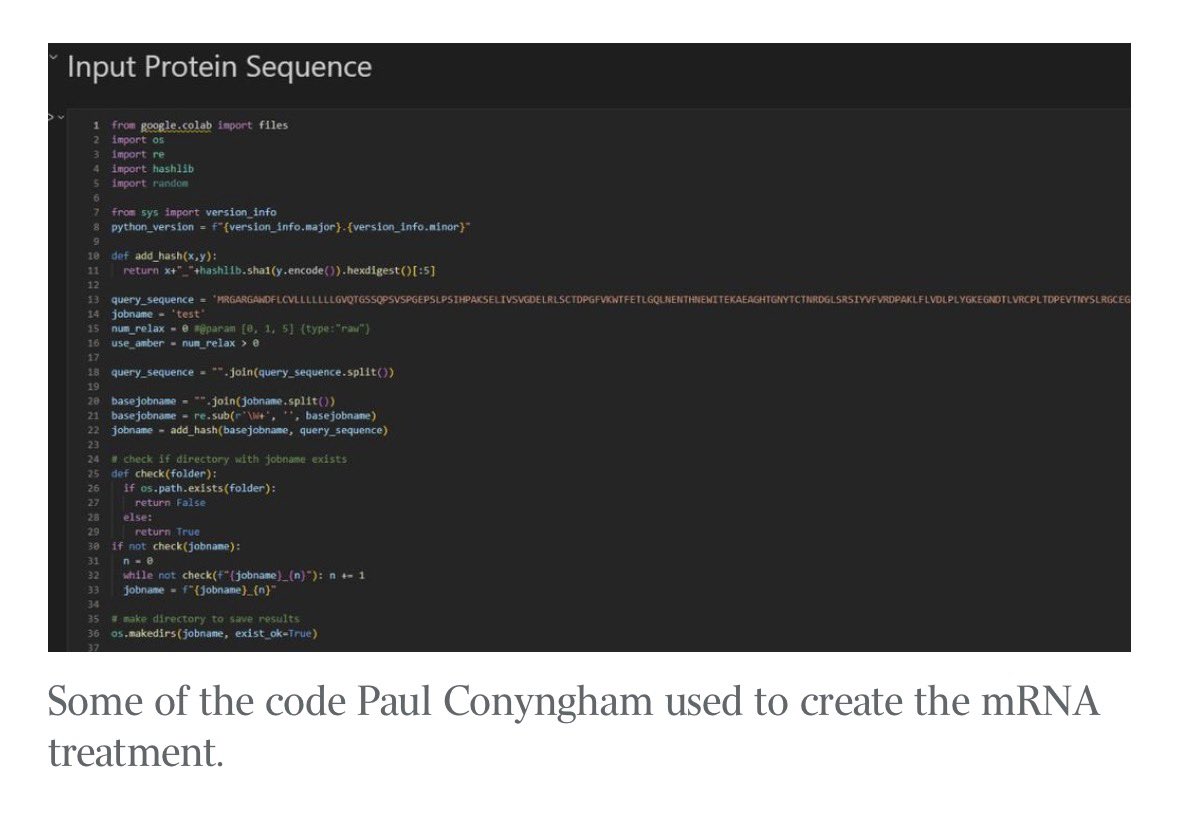
this is so fucking wholesome guy used AI to save his cancer-ridden dog by sequencing its DNA and creating a CUSTOM cure. the tech behind this is fucking awesome (well done @demishassabis and the google team): - used CHATGPT to sequence dogs DNA discovers mutations - ran the mutations through Google’s Alphafold (AI protein sequencer) which CREATED A CUSTOM VACCINE TO TREAT THEM. - treated dog and reduced tumour by 50% in WEEKS. dog is alive and well. - this is the 1st time AI has been used to create a custom vaccine for a dog (and it worked) - dude is now working on similar vaccines for humans using AI! 2026 is definitely the year we see AI change personalised medicine in a HUGE way so sick
Ejaaz tweet mediaEjaaz tweet mediaEjaaz tweet mediaEjaaz tweet media
Séb Krier@sebkrier

This is wild. theaustralian.com.au/business/techn…

English
286
1.4K
10.1K
1.4M
Magnus Kristianson
Magnus Kristianson@MagnusKris777·
@oh_that_hat @eonsys But it doesn’t know how to fly? I suspect we stimulated some set of neurons and that had a chain reaction with others, but unless it’s getting feedback and can learn from its new environment it’s hardly “alive.” Maybe that’s next?
English
0
0
0
77
Hattie Zhou
Hattie Zhou@oh_that_hat·
There's a fruit fly walking around right now that was never born. @eonsys just released a video where they took a real fly's connectome — the wiring diagram of its brain — and simulated it. Dropped it into a virtual body. It started walking. Grooming. Feeding. Doing what flies do. Nobody taught it to walk. No training data, no gradient descent toward fly-like behavior. This is the opposite of how AI works. They rebuilt the mind from the inside, neuron by neuron, and behavior just... emerged. It's the first time a biological organism has been recreated not by modeling what it does, but by modeling what it is. A human brain is 6 OOM more neurons. That's a scaling problem, something we've gotten very good at solving. So what happens when we have a working copy of the human mind?
English
709
2.4K
25.4K
9.3M
Magnus Kristianson retweetledi
Organizermemes
Organizermemes@OrganizerMemes·
I love this video
English
153
2.2K
20K
786.9K
Magnus Kristianson retweetledi
Man in America
Man in America@Maninamerica·
A man got a phone call from his wife’s number. It sounded exactly like her. But something felt off… AI is changing scams in a way most people aren’t ready for.
English
35
500
1K
56.7K
Magnus Kristianson retweetledi
Caitlin Kalinowski
Caitlin Kalinowski@kalinowski007·
I resigned from OpenAI. I care deeply about the Robotics team and the work we built together. This wasn’t an easy call. AI has an important role in national security. But surveillance of Americans without judicial oversight and lethal autonomy without human authorization are lines that deserved more deliberation than they got. This was about principle, not people. I have deep respect for Sam and the team, and I’m proud of what we built together.
English
1.9K
12.9K
58.8K
7.7M
Magnus Kristianson
Magnus Kristianson@MagnusKris777·
You know what’s funny? Programmers were hit hard right out of the gate. But now they will be back in demand (I predict) busy actually integrating AI workflows at every business in the world. Massive disruption is here. Lord help us 🙏
Milk Road AI@MilkRoadAI

Anthropic just released the most IMPORTANT chart in the AI labor debate. This comes from the company that builds Claude using data from 2 million real conversations. Here’s what it shows. The blue area is every task AI could theoretically do right now. The red area is what people are actually using it for. The gap between them is enormous and that gap is your career runway. Computer programmers are already 75% covered. Customer service reps, data entry workers, financial analysts, they’re next. But here’s what no one is talking about. The mass layoffs haven’t really started. Unemployment for exposed workers hasn’t budged. So what’s actually happening? Companies are closing the front door, hiring for workers aged 22 to 25 in AI exposed jobs has dropped 14%. The most exposed workers aren’t factory workers, they’re college educated, higher earning. 49% of US jobs now have at least a quarter of their tasks inside AI’s reach. That’s up from 36% just one year ago. And the red area on that chart, the real world usage is still a fraction of what’s possible. Every month, it grows a bit. Anthropic built the scoreboard and most people haven’t looked at it yet.

English
0
0
0
20
Magnus Kristianson retweetledi
Aida Baradari
Aida Baradari@aidaxbaradari·
Today, we're introducing Spectre I, the first smart device to stop unwanted audio recordings. We live in a world of always-on listening devices. Smart devices and AI dominate our world in business and private conversations. With Deveillance, you will @be_inaudible.
English
1.1K
4.9K
42.2K
4.5M
Magnus Kristianson retweetledi
Chubby♨️
Chubby♨️@kimmonismus·
Honor is building the first phone that also includes an AI robot. It's a robot in the sense that the pop-up camera acts as the AI's eyes, and if I understand correctly, it allows a continuously active AI companion to work as an assistant. Interesting, but probably more of a gimmick. However, personal AI companions are coming.
HONOR@Honorglobal

It used to be a concept, but now it has come into reality -- HONOR Robot Phone embodies a new form of AI device featuring both intelligence and vitality It is a robot phone from the future, an intelligent companion for you.⚡️

English
60
80
1.2K
201.5K
Magnus Kristianson
Magnus Kristianson@MagnusKris777·
What could possibly go wrong?
Brian Roemmele@BrianRoemmele

A Petri Dish Of HUMAN Brain Cells LEARN TO PLAY THE GAME DOOM! In a groundbreaking fusion of biology and silicon, scientists at Cortical Labs have taught a cluster of lab-grown human neurons to play the iconic video game Doom. Not your typical AI triumph, it’s a petri dish of actual human brain cells, reprogrammed from adult donor skin or blood samples, wired into a $35,000 biological computer called the CL1. Building on their earlier Pong demo, this new feat sees the neurons navigating hellish levels, dodging demons, and even firing shots with surprising efficiency. Programmer Sean Cole pulled it off in just a week using a Python API on GitHub, a stark contrast to the year-plus effort for Pong. Astonishingly, these organic gamers outperform GPT-4 in speed and latency, proving that even a tiny blob of human intelligence can adapt and learn in ways silicon struggles to match. The excitement is palpable: this isn’t just a gimmick; it’s a window into revolutionary medical advancements. Imagine using such bio-computers to model brain diseases, test drugs, or even restore neural functions in patients. With cloud access to CL1 rentals, developers worldwide can experiment, accelerating discoveries that could redefine neuroscience. We’re witnessing the dawn of hybrid intelligence, human biology augmented by tech, evolving beyond our wildest dreams. Yet, amid the thrill, a chill runs down my spine. What are we building here? These neurons aren’t conscious (we hope), but they’re derived from humans and exhibit learning behaviors that echo our own cognition. Echoes of The Matrix or dystopian sci-fi like the “torment nexus” from Doom novels loom large. Could this lead to ethical nightmares—exploiting bio-intelligence for warfare simulations, or worse, creating sentient systems trapped in digital hells? And the philosophical rabbit hole deepens: Is life merely nested Russian dolls (matryoshka, if you prefer) of biological smarts? We, as evolved intelligences, are now crafting our own mini-brains, layering complexity upon complexity. Are we “gods” in the making, or just the next doll in an infinite regress, destined to birth something that surpasses—and perhaps supplants, us? This experiment, detailed in HotHardware’s coverage, pushes boundaries we might not be ready to cross. It’s exhilarating proof of human ingenuity, but let’s proceed with caution lest we summon demons we can’t control and we wind up in the Petri dish?

English
0
0
0
5
Magnus Kristianson
Magnus Kristianson@MagnusKris777·
Book signing at Barnes & Noble was a hit! Thanks to everybody who showed up. 🙏
Magnus Kristianson tweet media
English
0
0
0
15
Magnus Kristianson
Magnus Kristianson@MagnusKris777·
The real question isn't just how he evaded controls. It's whether the organizational culture encouraged anyone to notice red flags early. What safeguards do you believe actually work against this kind of compromise?
English
0
0
0
6
Magnus Kristianson
Magnus Kristianson@MagnusKris777·
This case underscores a hard truth: insider threats remain one of the most devastating attack vectors. No amount of perimeter security matters when trusted executives betray fundamental principles for profit. bleepingcomputer.com/news/security/…
English
1
0
0
14
Magnus Kristianson
Magnus Kristianson@MagnusKris777·
What's your experience bridging simulation and production?
English
0
0
0
2
Magnus Kristianson
Magnus Kristianson@MagnusKris777·
Smart operators will use these findings to cut deployment timelines and avoid costly false starts. The question is how many organizations are still burning resources on sim-to-real transfers without questioning their foundational assumptions.
English
1
0
0
3
Magnus Kristianson
Magnus Kristianson@MagnusKris777·
The unstated design choices in robotics RL are where most real-world deployments fail. This research exposes what practitioners quietly learn through expensive trial and error: defaults that work in simulation often sabotage physical systems. arxiv.org/abs/2602.20220
English
1
0
0
5