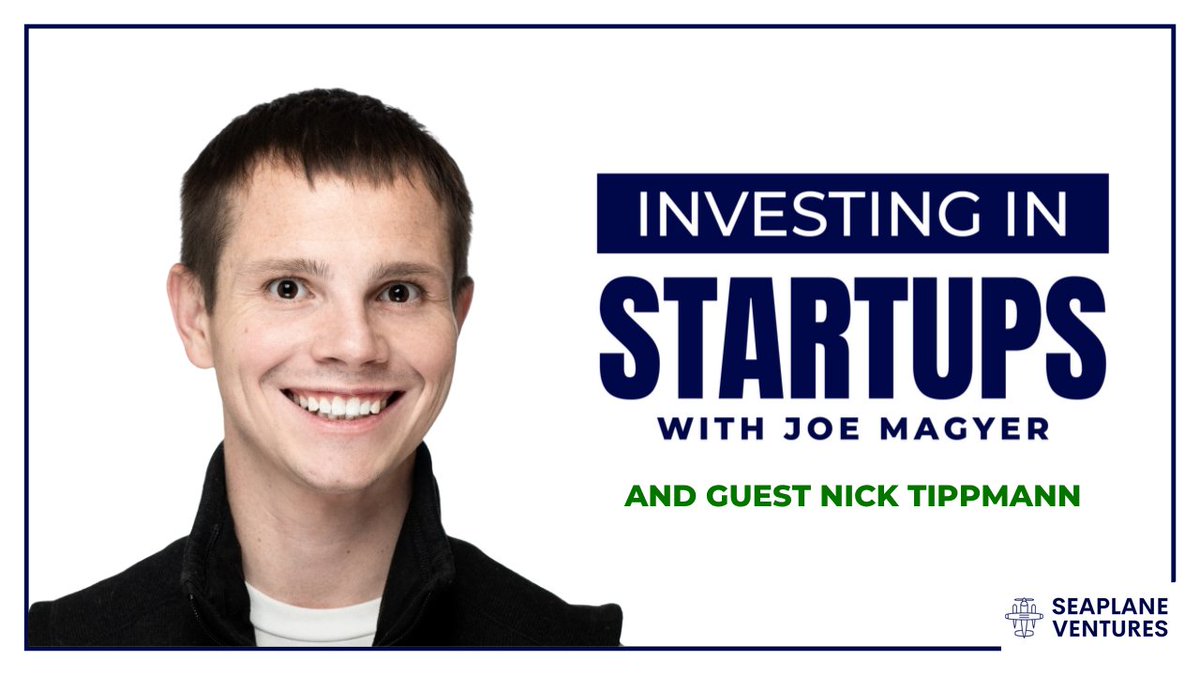
Joe Magyer

5.8K posts

Joe Magyer banner
Joe Magyer

Joe Magyer

@Magyer

Managing Partner at @SeaplaneVC. 2X founder. Host of the @InvestNStartups podcast.

Austin, Texas Katılım Şubat 2010
370 Takip Edilen10.1K Takipçiler
Joe Magyer retweetledi
Better Auth
Better Auth@better_auth·
Today we're announcing Agent Auth Protocol An open standard for agent authentication, capability based authorization and service discovery ⇃read more ⇂
Better Auth tweet media
English
34
67
836
68.7K
Joe Magyer
Joe Magyer@Magyer·
🎉 50 episodes of @InvestNStartups! We’re marking the milestone with a special episode packed with the biggest insights and hardest lessons I’ve learned from hosting the show. We dive into the game-changing impact of AI on founders and investors, the fiercest debates shaking up venture, what I’ve completely reversed my thinking on, and my most contrarian take on VC. Here's the longer breakdown of my conversation with good friend and guest host @ChrisHillALX, host of @MoneyUnpluggedP: AI has been the defining force in venture since the show started in 2024. AI has changed how startups get funded, how fast they grow, and how lean they can be, helping revive venture after the post-2021 downturn. The rebound has been real, but highly concentrated to the biggest winners. AI is also driving growth and efficiency at once. Startups can scale revenue much faster without scaling headcount the same way, pushing more value toward companies that pair strong demand with small teams. One of venture’s biggest debates is around portfolio construction. I talked about the tension between ultra-diversified investing, which improves the odds of catching a unicorn at the expense of diluting its impacts to returns, and concentrated investing, which can raise the quality bar and leave more time to support founders. Another major split is hot deals versus non-consensus deals. Some investors want the most in-demand founders regardless of price, while others hunt for overlooked opportunities in less fashionable markets and sectors. Several guest conversations changed my thinking. One example was @MacConwell on reserves: instead of setting aside large amounts for future rounds that may never materialize, I now favor a “fast follow” approach when conviction rises. Another lesson, from @nikiscevak, was the importance of finding your tribe with fundraising. Rather than trying to change minds, it is more effective to build a clear identity and attract founders and LPs who already share your worldview. My most contrarian take is that ownership targets are overrated. What really matters to LPs and fund performance is not what percentage of a winner a fund owns, but what percentage of the fund’s capital is invested in the winner. We also talked about emerging managers and the insights from guests on why they're able to outperform. Namely, that smaller, newer funds are hungrier, more focused, and more flexible. Lastly, we talked about AI's role in VC. AI will increasingly help investors analyze startups, move faster, and operate with fewer people, even if judgment remains difficult to automate. AI will also narrow the gap between small and large venture firms by giving smaller managers better tools without requiring a large internal team. Thanks to Chris for guest hosting this one, to all our listeners, and to the 50 amazing guests who have come on the show!
Joe Magyer tweet media
English
1
4
12
4.1K
Joe Magyer retweetledi
Ali Ansari
Ali Ansari@aliansarinik·
the micro1 robotics lab: real world data for intelligent models that co-exist in the physical world. we’re in-the-wild across 75 countries in 6,000+ unique environments collecting data. diverse movements, objects, and settings. the future of AI is as human as you can imagine. join us to start training robots today (link in comments).
English
62
107
547
196.1K
Joe Magyer
Joe Magyer@Magyer·
@AmberIllig Glad I asked all my founders if they’re gay for no reason.
English
1
0
4
769
Amber Illig
Amber Illig@AmberIllig·
Dear founders, please send us your diversity data. We are required by CA to survey you or we’ll get charged $5000/day. But you don’t have to answer. Also, it was just canceled. Never mind for now.
English
4
0
23
2.8K
Joe Magyer retweetledi
John Arnold
John Arnold@johnarnold·
There is a group of states actively competing to attract businesses and high earners, and another group adopting policies that drive them away. I don't see how this doesn't end up as a disaster in the long-term for the latter.
English
128
206
2.7K
255K
Joe Magyer retweetledi
Auren Hoffman
Auren Hoffman@auren·
seed has the highest annualized returns of any stage in venture. outperforms A, B, C. not close. the part that matters for allocators: the returns persist BECAUSE most capital can't access them. every subsequent round gets more efficient -- for instance Ramp can spot breakout companies from credit card swipes so series B is basically a public market at this point. seed is the least inefficient market in venture. a billion dollar fund writing $2M seed checks needs 250 investments (assuming they have a lot for follow-on). not realistic. most founders won't give 15-20% to one investor at seed – they want a party round. the operational model required to do seed well is incompatible with how 98% of venture firms are built. the result: the highest-returning stage in venture is structurally inaccessible to the largest pools of capital. which is exactly why the inefficiency persists. which is exactly why the returns persist. the inefficiency is the returns.
English
17
29
282
34.5K
Joe Magyer retweetledi
Henry Shi
Henry Shi@henrythe9ths·
He grew a company 35x in one year to $250M+ at 25. He’s the same kid who came to the US from Tehran at 10 without knowing a word of English. This is the untold story of Ali Ansari and micro1, which just cracked the top 10 on the Lean AI Leaderboard with $250M+ revenue and 80 employees. If you are building a lean AI company or want to sell to the top AI labs, read on for the full playbook. Ali built 2 companies before college. At Berkeley, he launched a software dev agency and started hiring international engineers. The interviews alone were eating 30–40 hours/week, so he built a tool to automate them, using GPT (one of the first AI recruiters in 2022). That insight eventually became micro1. For 2 years, it grew steadily with two business lines (an AI interviewer SaaS and an engineering marketplace) with happy customers. Then a data vendor approached Ali with an unusual request: hire 700 engineers to train AI models. That one conversation changed micro1’s trajectory. Ali realized they had accidentally built what every major AI lab desperately needed: a system to find, vet, and manage domain experts at scale across industries, at volume and fast. He then made a decision most founders would never have the nerve to make: He killed both working businesses and bet the entire company on going direct to the labs, with no safety net or guarantee that it would work. But the bet paid off, resulting in 35x growth, as they went from $7M ARR to ~$250M in one year. None of it came easy, and this level of growth became possible only after Ali solved the hardest problem in this space: How to sell to AI labs where buyers are deeply technical and part of tight communities where reputation travels fast. So I spent 10+ hours going deep into the decisions behind how micro1 built, sold, and scaled within the AI ecosystem and turned it into an actionable playbook for founders who want to sell to researchers. Inside, you'll get: • The 3-stage sales sequence Ali uses to close research deals like OpenAI and xAI • How he got into Stanford research circles with zero connections (and how that helped him close deals) • The proof of concept strategy: The dos and don’ts when researchers are evaluating you • How Elon Musk accidentally handed micro1 their biggest sales breakthrough • The net expansion playbook for enterprises and Fortune 500 companies (and what is converting fastest) • The full AI stack that powers micro1's recruiting engine • The incentive philosophy Ali rebuilds individually for every core team member every quarter Originally, I put this together as a resource for founders I work with directly. But the ideas and insights are too valuable not to share, so I'm giving it away publicly. Founders who crack AI sales at this hyperscale usually keep it close, but Ali shared every piece of it. So if you are building a business around frontier AI and research, grab this right away. It will save you months of costly relationship mistakes (Link in the first comment). Ali and team, welcome to the Leaderboard!
Henry Shi tweet media
English
13
17
105
11.8K
Joe Magyer
Joe Magyer@Magyer·
@zebulgar Only 10% of my surveyed founders answered every question. Can’t say I blame them. Painfully cringe.
English
0
0
0
167
Joe Magyer retweetledi
conor brennan-burke
conor brennan-burke@conor_ai·
we don’t accept resumes at @hyperspell candidates build an agent. our agent interviews their agent forbes just wrote about why we’re doing this
conor brennan-burke tweet media
English
10
2
65
2.9K
Joe Magyer
Joe Magyer@Magyer·
Excited to share my fireside chat with @zalzally from the inaugural Future Titans summit. It's our 1st-ever live episode and already a 1st-day-record for downloads at @InvestNStartups! We talked about why Zal is solo, hard tech, what he learned at a16z, why he invests with conviction, and how he managed to lead a Series D round despite his firm being a Seed expert. Here's the longer breakdown of my conversation with Zal, who is the Founding Partner at @refactor: Why Zal chose the solo GP path (on purpose): after seeing large-firm partnership dynamics at Andreessen Horowitz, he optimized for speed, autonomy, and founder time—especially important at seed where decision velocity matters. Refactor started as a two-GP fund with David Lee (ex–SV Angel), then David retired, forcing Zal to rebuild the LP base and prove the strategy could work with a single decision-maker. A “right-sized” fund strategy as an operating system: Zal explains why he’s stayed around ~$50M per fund, targets ~20 companies per fund, and focuses on ~8–10% ownership at entry to keep the model manageable and return-capable. He actively tracks how many portfolio companies “graduate” (to Series A and beyond) each year so his board/support load stays sustainable without adding headcount. Robustness for LPs (the “hit-by-a-bus” plan): Zal shares a concrete solo-GP risk mitigation tactic—he carries a life insurance policy payable to the management company so LPs have resources to recruit a successor or wind down assets without crushing fund performance. Hard tech example that feels sci-fi (with real traction): Solugen. Zal recounts leading Solugen’s seed ~9 years ago and watching it scale into a large revenue business—then pivoting into a high-demand defense chemistry product with major government pull. How a seed lead ends up leading a Series D: during the 2022 market reset, Zal had an SPV ready (~$20M) to secure pro rata; when no one wanted to “stick their neck out” as lead, he wrote the first term sheet—unlocking the round and attracting co-leads/followers. Reserve strategy shift: he describes moving from ~50% reserves to ~20% reserves—preferring more “shots on goal” at pre-seed/seed, and noting how hard it is to consistently pick Series A winners even when top firms lead the round. I enjoyed this one so much. Grateful to @itsdanieldart and @RockYardVC for hosting the amazing first annual Future Titans summit!
Joe Magyer tweet media
English
1
2
7
979
Joe Magyer retweetledi
Beka
Beka@bekacru·
Excited to announce Better Auth Infrastructure Get started: better-auth.com
Beka tweet media
English
66
62
1.2K
268.5K
Joe Magyer
Joe Magyer@Magyer·
CFO-type cofounders are a bad idea. They’re not entrepreneurial by nature and you’re giving ~40% of a company to someone to basically handle Quickbooks. The CFO-type cofounder also can’t do the two most important things a startup needs, which are coding and selling. Hard to overcome such a disastrous move that early.
English
1
1
0
661
Colin Gardiner
Colin Gardiner@ColinGardiner·
As an investor I don't want to talk to your CFO co-founder. I want to hear from the CEO. Don't outsource your raise as an early-stage CEO.
English
38
4
132
10.1K
Joe Magyer retweetledi
Joe Magyer
Joe Magyer@Magyer·
Loved my conversation with @sether of Foundry about real work, AI, venture strategy, and the myth of overnight success. The nerded out about: How he does the “real work” of venture: deep, collaborative problem-solving with founders and fund managers—versus performative governance or being “talked at” in board meetings. A practical framework for being helpful without being heavy-handed: Seth explains why venture is an influence game, how he avoids cornering CEOs with overly strong opinions, and how he stays effective even when he’s not on the board. The Foundry cadence for founder support: every six months Seth sends CEOs an alignment note—company goals + “where I can be impactful”—with the explicit stance: “I work for you.” Sometimes the best help is staying out of the way. Time management that actually works in venture: “Email is not my task manager.” Seth walks through his daily routine (calendar scan → task manager → prioritized list) and why inbox-zero is a trap for high-leverage work. Backing emerging managers: what most GPs miss in their own signal: Seth unpacks how LPs often over-index on pedigree and “bucket filling,” and why Foundry tried to underwrite true competitive advantage (and personal drive) the way early-stage investors underwrite teams. “Fund size is fund strategy” (and why many decks don’t compute): Seth breaks down how fund size should change check size, reserves, stage focus, pacing, and ownership—plus the common mismatch of a small-target fund with a huge hard cap and “same strategy.” Decisions that define a firm (and what Foundry chose not to do): Seth discusses why Foundry didn’t build a perpetual, generational firm—and how that choice shaped incentives, economics, and the kind of work the partners wanted to keep doing. Portfolio construction ideas outside the default VC playbook: from Arthur Ventures’ under-the-radar B2B SaaS approach, to “roll-up” concepts for stranded 2019–2020 vintage funds, to hybrid equity + revenue-based structures at the edge of venture. Short-termism and the temptation of DPI: Seth details the tension between selling great assets for near-term liquidity vs. compounding long-term outcomes—and why being clear about which “hat” you’re wearing (GP vs board member) matters. Capital Evolution: why Seth wrote it, and what changed his mind: a board-dinner conversation sparked the book; extensive interviews shifted his view toward avoiding a world where every company is defined by politics—while still holding values and responsibility. AI and entrepreneurship: bullish long-term, disruptive short-term: Seth argues AI will create more jobs than it destroys, warns against premature regulation, and frames productivity gains as a real lever against ballooning debt/deficits. The myth of overnight success (and what venture gets wrong): Seth calls out the “looking cool” status game in venture and reinforces the “10-year entrepreneur” reality—years of messy work behind every headline win. Hope you enjoy this episode of @InvestNStartups!
Joe Magyer tweet media
English
1
3
6
865
Ali Ansari
Ali Ansari@aliansarinik·
Excited to introduce micro1 Cortex, a contextual evaluation, visibility, and improvement platform for enterprise AI agents. Foundational models are trained for general intelligence, but enterprises need agents that perform reliably inside their unique context: workflows, policies, data environments, and edge cases. Cortex brings trust to enterprise AI by leveraging domain experts and real-world scenarios for any use case to test, diagnose, and improve how agents behave in production.
English
52
60
322
115.4K