

Masrafe
4.2K posts



my cat built this app to remind me to drink water after learning cool stuff from @buildanythingso
she put lots of her personality in it
English


Upcoming Launch
@RialoHQ is set to go live on Mainnet this year. At launch the ecosystem will include a range of vetted builders and in house applications focused on real world integrations spanning private fintech solutions trading platforms and institutional credit markets.
By combining ease of use with next generation blockchain security Rialo aims to lead the next wave of on chain innovation. A key part of this ecosystem will be Cboe’s EDGX equities data helping power a more reliable data driven and trusted on chain environment.

English

Big Milestone for Rialo
@Subzero_Labs (Rialo) has been featured in the Innovation Spotlight by Cboe Global Markets one of the world's largest and most influential derivatives and securities exchanges.
With billions of options contracts processed annually and massive daily FX volume, CBOE represents the backbone of institutional finance.
Now, that same high fidelity market data is being integrated directly into @RialoHQ
What this means
• Institutional grade financial data, natively onchain
• No need for third party APIs or complex pipelines
• Developers can build powerful data rich financial apps faster.
This is what real neofinance infrastructure looks like bridging traditional markets with onchain innovation.
Rialo is removing barriers so builders can focus on creating world class financial applications.
Read more #subzerolabs" target="_blank" rel="nofollow noopener">cboe.com/market_data_se…

Rialo@RialoHQ
We are proud to share that Subzero Labs (Rialo) has been featured in the @CBOE Innovation Spotlight. CBOE (Chicago Board Options Exchange) is one of the world's largest derivatives and securities exchanges, handling 3.8 billion options contracts a year and powering $45B+ in daily FX volume. We are integrating CBOE's high-fidelity market data directly into Rialo, giving developers building on Rialo access to institutional-grade financial data as a native part of their onchain applications. This is what it means to build neofinance infrastructure seriously: the data that institutional markets run on, available to developers building financial applications onchain. With market data from the likes of @CBOE provided natively, developers on Rialo can build sophisticated, data-rich applications without relying on third-party infrastructure or building custom data pipelines. Rialo takes care of the data so developers can focus on building world-class apps. Read the full spotlight: #subzerolabs" target="_blank" rel="nofollow noopener">cboe.com/market_data_se…
English





Well done.Congrats @Subzero_Labs
Rialo@RialoHQ
We are proud to share that Subzero Labs (Rialo) has been featured in the @CBOE Innovation Spotlight. CBOE (Chicago Board Options Exchange) is one of the world's largest derivatives and securities exchanges, handling 3.8 billion options contracts a year and powering $45B+ in daily FX volume. We are integrating CBOE's high-fidelity market data directly into Rialo, giving developers building on Rialo access to institutional-grade financial data as a native part of their onchain applications. This is what it means to build neofinance infrastructure seriously: the data that institutional markets run on, available to developers building financial applications onchain. With market data from the likes of @CBOE provided natively, developers on Rialo can build sophisticated, data-rich applications without relying on third-party infrastructure or building custom data pipelines. Rialo takes care of the data so developers can focus on building world-class apps. Read the full spotlight: #subzerolabs" target="_blank" rel="nofollow noopener">cboe.com/market_data_se…
English
Português

Rialo Is Fixing The Biggest Flaw In Blockchain
Blockchains are basically sitting ducks They wait They depend on bots They rely on humans pressing buttons That is not a smart system, that is just expensive plumbing Rialo spotted this problem early
Here is the real issue Your smart contract can not do anything until someone tells it to That someone is usually a bot a keeper or a third party service You just added a middleman to a system that was supposed to remove middlemen Wild right
Rialo flips this completely It works as a reactive execution layer When a real world event happens, Rialo catches it and triggers the on chain action directly No waiting No bot farms No manual calls The chain actually responds to reality now
Think about what that unlocks Insurance claims that pay out the second conditions are confirmed Supply chains that update themselves in real time DeFi positions that react to live data without a single human click This is what blockchain was supposed to feel like from day one
The reason this matters beyond the tech is simplicity Developers stop building complicated workarounds Teams stop maintaining fragile automation pipelines Fewer moving parts means fewer things breaking at 2am on a weekend
Rialo is not adding features on top of broken infrastructure. It is replacing the broken part entirely The gap between on chain logic and real world events is the core problem and Rialo treats it like one
Blockchain has always had the power Rialo gives it awareness That is the missing piece Keep watching Rialoo because this infrastructure shift is just getting started

English

The Project 1337 experiment demonstrates that Rialo is more than just a faster blockchain:
it is a fundamental redesign of how the "real world" and the "onchain world" talk to each other.
By eliminating the middleman between data and execution, Rialo enables a new generation of financial apps that are faster, cheaper, and more secure than anything currently on the market.
Beyond the Hype:
How Rialo Actually Helps
Most blockchains are "closed loops"—they only know what’s happening inside their own network. To find out the price of gold or AAPL, they have to wait for an Oracle to "push" that data onto the chain. This process is slow, expensive, and introduces a massive security risk.
Rialo changes the game by making the blockchain outward-facing.
1. Collapsing the Middleware Tax
In traditional DeFi, developers have to pay high fees to oracle providers (like Chainlink or Pyth) to get data. They also have to write complex code to manage these external connections.
How Rialo helps: Rialo has Native Web Connectivity baked into its base layer. A smart contract on Rialo can effectively make a one-line web call to an API. This removes the "Oracle Tax" and allows developers to spend their budget on building features rather than paying for data feeds.
2. Eliminating "Performance Theater"
Many chains claim high TPS (transactions per second), but if it takes 10 seconds for an oracle to update a price, the high TPS doesn't matter—you’re still trading on stale data.
How Rialo helps: By achieving sub-second latency, Rialo allows for "Living Assets." Imagine a tokenized real estate property that updates its value instantly based on local market indices, or a loan that liquidates the *millisecond* collateral value drops, preventing systemic bad debt.
3.Professional-Grade Financial Logic (Alpha & Bias)
Standard oracles usually just give you a "Median Price." This is fine for basic swaps, but professional traders need more.
How Rialo helps: During the 1337 experiment, Rialo didn't just stream raw data; it processed it. It calculated Alpha (momentum) and Bias (buy/sell pressure) onchain.
For Perp DEXs: This allows funding rates to adjust dynamically to market heat, preventing the "unbalanced long/short" problem that plagues current platforms.
For Insurance: Accurate Value-at-Risk (VaR) calculations allow for more precise premiums and better capital efficiency.
4. Trust Through Math, Not Reputation
Current systems often rely on a "Multisig" (a small group of people) to verify that a price is correct. If those people are compromised, the system fails.
How Rialo helps: Rialo uses Cryptographic Verification. Every piece of data comes with a "receipt" (proof) that it is authentic and untampered. You don't have to trust Rialo or a committee; you just have to trust the math.
The Real-World Impact
Industry Before Rialo With Rialo
Perp DEXs 5–30 second lag; high slippage.
Sub-second updates; "TradFi" speed.
Stablecoins Over-collateralized to account for lag. Highly efficient; reacts to volatility in real-time.
Supply Chain Manual updates; "batch" processing. Real-time tracking; automated payments on delivery.
Retail Finance Complex "crypto" wallets and slow apps. Web2 responsiveness; invisible blockchain tech.
The Bottom Line
Rialo’s Project 1337 proves that the "Bloomberg Terminal" of the future won't be a closed software suite owned by a corporation—it will be a decentralized network where data and value move at the speed of light.
Rialo isn't just bringing assets onchain; it’s bringing the speed of the internet to the security of the blockchain.
@RialoHQ @RialoBangladesh

English
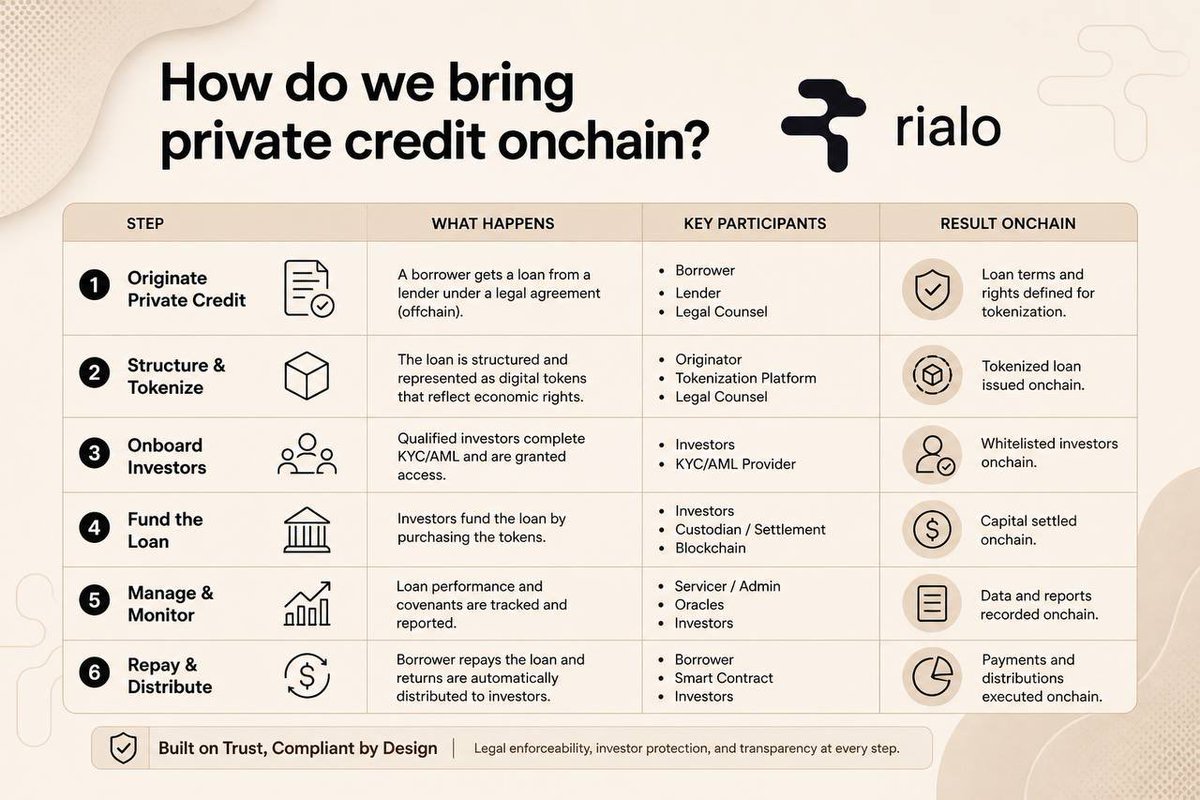
Good evening everyone,How do we bring private credit onchain in a practical way?
Lets Explain:
Private credit is large but inefficient.Most processes are manual, slow, and hard to verify. Bringing it onchain means turning each step into something structured, visible and automated.
It starts with origination. A borrower and lender agree on terms under a legal framework. This remains offchain but defines everything that follows.
Next is structuring and tokenization.The loan is represented as digital units that reflect real rights like repayments and yield. These are linked to the legal agreement.
Then comes investor onboarding. Participants complete KYC and AML. Access is controlled at the system level so only approved investors can join.
Funding happens onchain. Investors provide capital by interacting with the contract. Settlement is direct and recorded in real time.
After that, management and monitoring run continuously. Loan performance, covenants, and updates are tracked and recorded. Everyone works from the same data.
Finally, repayment and distribution are automated. When the borrower pays, funds are distributed to investors through contract logic without delays.
English
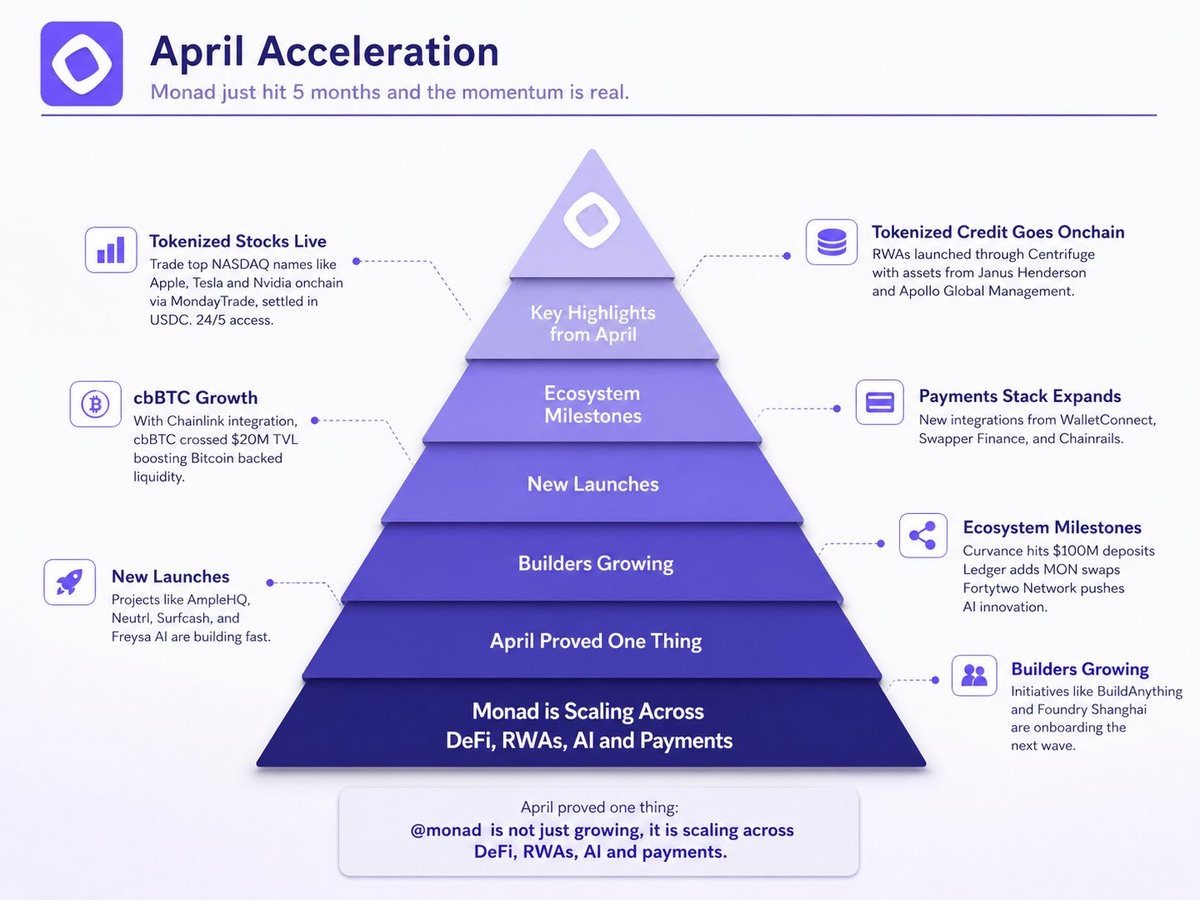
April Acceleration
Monad just hit 5 months and the momentum is real.
Key Highlights from April
👁🗨Tokenized Stocks Live
Trade top NASDAQ names like Apple Tesla and Nvidia onchain via MondayTrade settled in USDC 24/5 access.
👁🗨Tokenized Credit Goes Onchain
RWAs launched through Centrifuge with assets from Janus Henderson and Apollo Global Management.
👁🗨cbBTC Growth
With Chainlink integration cbBTC crossed $20M TVL boosting Bitcoin backed liquidity.
👁🗨Payments Stack Expands
New integrations from WalletConnect Swapper Finance and Chainrails.
👁🗨Ecosystem Milestones
Curvance hits $100M deposits
Ledger adds MON swaps
Fortytwo Network pushes AI innovation
👁🗨New Launches
Projects like AmpleHQ, Neutrl, Surfcash, and Freysa AI are building fast.
👁🗨Builders Growing
Initiatives like BuildAnything and Foundry Shanghai are onboarding the next wave.
April proved one thing
@monad is not just growing it is scaling across DeFi RWAs AI and payments.
English

Digital agreements have long operated as inert instruments. They are deployed, recorded, and then left dormant until a human hand decides to act. That dependency on manual intervention is not a minor inconvenience. It is a fundamental limitation embedded into the foundation of how decentralized systems currently function.
RialoHQ challenges that foundation entirely.
The platform introduces an execution model built around environmental response rather than human initiation. Agreements are no longer passive records waiting to be activated.
They are intelligent structures designed to recognize conditions and respond to them without delay. The operative sequence is straightforward: an event occurs, it is verified, and the corresponding logic executes. Nothing more is required.
This architecture eliminates the coordination overhead that traditionally sits between intention and outcome. There is no queue of approvals, no reliance on external operators, and no window of inaction created by human latency. The system moves because the world moves.
At the infrastructure level, RialoHQ advances a model of continuous operational intelligence. Rather than measuring performance against fixed benchmarks, the platform enables systems that adapt in real time to shifting conditions, sustain uninterrupted function across variable environments, and process logic derived from verified external inputs.
Programmability, in this context, extends well beyond contract execution and into the behavioral fabric of the system itself.
Privacy is engineered as a structural principle rather than an optional feature. Sensitive data remains under defined control while systems continue to operate with full efficiency on verified conditions. Users are never asked to compromise protection in exchange for functionality. Both coexist by design.
What emerges from this approach is a meaningful departure from conventional decentralized architecture. Agreements become active participants in a live environment. Automation replaces the friction of manual triggers. Isolated logic gives way to infrastructure that is genuinely responsive to the world it operates within.
The next phase of decentralized systems will not be defined by what is stored on chain. It will be defined by what is capable of acting on its own.
@RialoHQ | @AhmedNir | @RollinsR79

Ryve@ryvexbt
Decentralized finance has long measured progress through throughput, latency, and capital efficiency. These remain relevant benchmarks. However, the deeper architectural challenge confronting modern DeFi infrastructure operates beneath those metrics entirely. Today's execution environments are remarkably precise at confirming whether a transaction meets predefined conditions. What they cannot do is question whether those conditions remain appropriate given the surrounding context. A protocol executes because logic permits it, not because the moment warrants it. That distinction, largely ignored during periods of stability, becomes the most consequential gap during periods of stress. The structural consequence is significant. Execution proceeds with mechanical certainty while remaining functionally blind to emergent risk signals, behavioral irregularities, and shifting market dynamics. When exploits materialize or systemic vulnerabilities surface, they rarely represent a system malfunction. They represent a system performing precisely as architected, absent any capacity for situational awareness. The next generation of financial infrastructure addresses this gap directly. Rather than optimizing solely for speed, forward thinking protocols are embedding evaluative intelligence at the moment of execution itself. This means transactions encounter not just conditional gates but contextual judgment, drawing from real time market data, pattern recognition, and adaptive risk logic before finalization occurs. This evolution does not compromise decentralization. It deepens its integrity. The transition from passive validation toward active evaluation equips systems with the capacity to recognize anomalies, adjust dynamically, and preserve participant value under conditions that static logic alone cannot anticipate. In an economy governed by automation, operational resilience will ultimately belong to the systems that do not merely process actions but genuinely comprehend them. @RialoHQ | @AhmedNir | @RollinsR79
English

Rialo is taking a fresh look at how blockchains should actually be built. For a long time, the conversation revolved around “modular vs. monolithic.” That framing used to make sense. But today? Not so much. Speed is everywhere.
Fees are lower across the board. Even interoperability isn’t rare anymore. Those things don’t really set a chain apart like they used to. What matters now is simpler, but deeper how well the different parts of a system truly work together.
That’s where @RialoHQ shifts the perspective with this idea of supermodularity. It’s not about stacking features or integrating everything just because you can. It’s more selective than that. Only the components that genuinely reinforce each other get combined. And when that happens, something interesting emerges something that feels bigger than the individual pieces. Think about how smartphones came together by merging GPS, payments, and connectivity. None of those were new on their own, but together, they unlocked entirely new industries.
Rialo brings that same mindset into blockchain design. It weaves together execution, automation, oracles, and web access but only where there’s a clear benefit in doing so. The outcome isn’t just a chain that’s faster on paper. It’s one that’s actually more useful in practice. You start to see things like transactions that run on their own, payments that repeat without constant oversight, even financial systems that can adjust themselves in real time based on incoming data.
At the same time, there’s restraint. Not everything needs to be integrated. If something doesn’t meaningfully add value like fiat onramps. it’s kept outside and treated as a commodity. That choice keeps the system lean, avoids unnecessary complexity, and lets Rialo focus on what really drives impact.
In the end, Rialo isn’t trying to win an outdated debate. It’s moving past it. The real goal is building systems where the right pieces click together in a way that actually makes the whole thing more powerful.

Izh Imon@IzhImon
Upgrading distributed systems is usually difficult and risky because upgrades are tightly connected to the consensus system, so changing one thing often means changing everything, which can lead to complex processes, failures or even downtime. Rialo’s Gauss solves this by separating upgrades from consensus, making the system more flexible and easier to manage. Its core idea is simple: not everything recorded by the system needs to be executed. Gauss uses two logs an inner log that contains everything (including system messages) and an outer log that contains only real transactions. The system filters the inner log and only executes the clean outer log. During upgrades, Gauss follows three simple steps: prepare, handover, and shutdown, with a clear boundary that ensures anything after that point in the old system is ignored. This keeps all nodes in sync and avoids inconsistencies. As a result, upgrades become smoother, safer, and can happen with little or no downtime, allowing systems to evolve without interruption. @RialoHQ
English

Rialo makes blockchain easy to understand and easy to use.
Right now, most blockchains don’t really react to the real world.
They need users, bots, or extra tools to trigger actions.
That means more steps, more cost, and more chances to fail.
Rialo is a system where blockchain reacts automatically to real world events.
When something happens in real life, the smart contract can run by itself.
No bots.
No manual work.
No delay.
Just simple flow:
Real world event → Rialo detects → Smart contract runs → Result stored on chain.
This makes everything faster and more reliable.
• Saves time no waiting for someone to trigger actions
• Reduces cost no need for extra tools or middlemen
• More secure fewer moving parts means fewer risks
• Easier for developers less complex systems to build
• Better for users smooth and simple experience
Old way:
User Bot Delay Execution
Too many steps. Too much risk.
Rialo way
Event Rialo Instant execution
Clean. Direct. Simple.
Insurance that pays automatically when events happen
Payments that trigger in real time
Apps that react instantly to real world data
Financial systems that run without manual control
Smarter DeFi with real world connection
Rialo is not just another blockchain idea. It’s a better way to connect real life with onchain systems.
It brings real world data directly into execution,
so blockchain finally works like real infrastructure.
Simple idea. Big impact.
@RialoHQ = Real world + Blockchain, working together in real time.

English

Blockchains are not usually reactive, they are in waiting mode.
If there is no user transaction, nothing happens.
This is the traditional model.
But real world systems do not work like this.
Here, systems react according to events.
Payment is actually processed
Action is triggered when data changes
Workflow is executed when conditions are met
This is where @RialoHQ makes a difference
Rialo introduces the event-driven execution model,
where the contract does not just wait for a call,
but detects events and reacts automatically.
This makes it possible:
• conditional transactions
• real time data access
• automated execution logic
What is the result?
Blockchain is no longer a passive system
but an active system
where logic does not just run
evolves according to time, data, and events
Event driven development is not just about changing architecture
It changes the mindset of using blockchain
@JanCamenisch @itachee_x @ericargent31113

English