

Manishak.eth | Web3 Growth
3.7K posts

Manishak.eth | Web3 Growth
@Manisha_kh
Marketoor | Crypto, AI & Deeptech | Comms @vault__summit | Agency @MindFrameLabs
Katılım Nisan 2021
2.3K Takip Edilen2.1K Takipçiler

What does institutional adoption actually look like?
It looks like onchain finance builders in the same room with capital allocators, asset managers and financial institutions.
That is Vault Summit.

English
@debayo_xx def not funny. they should be held accountable
English


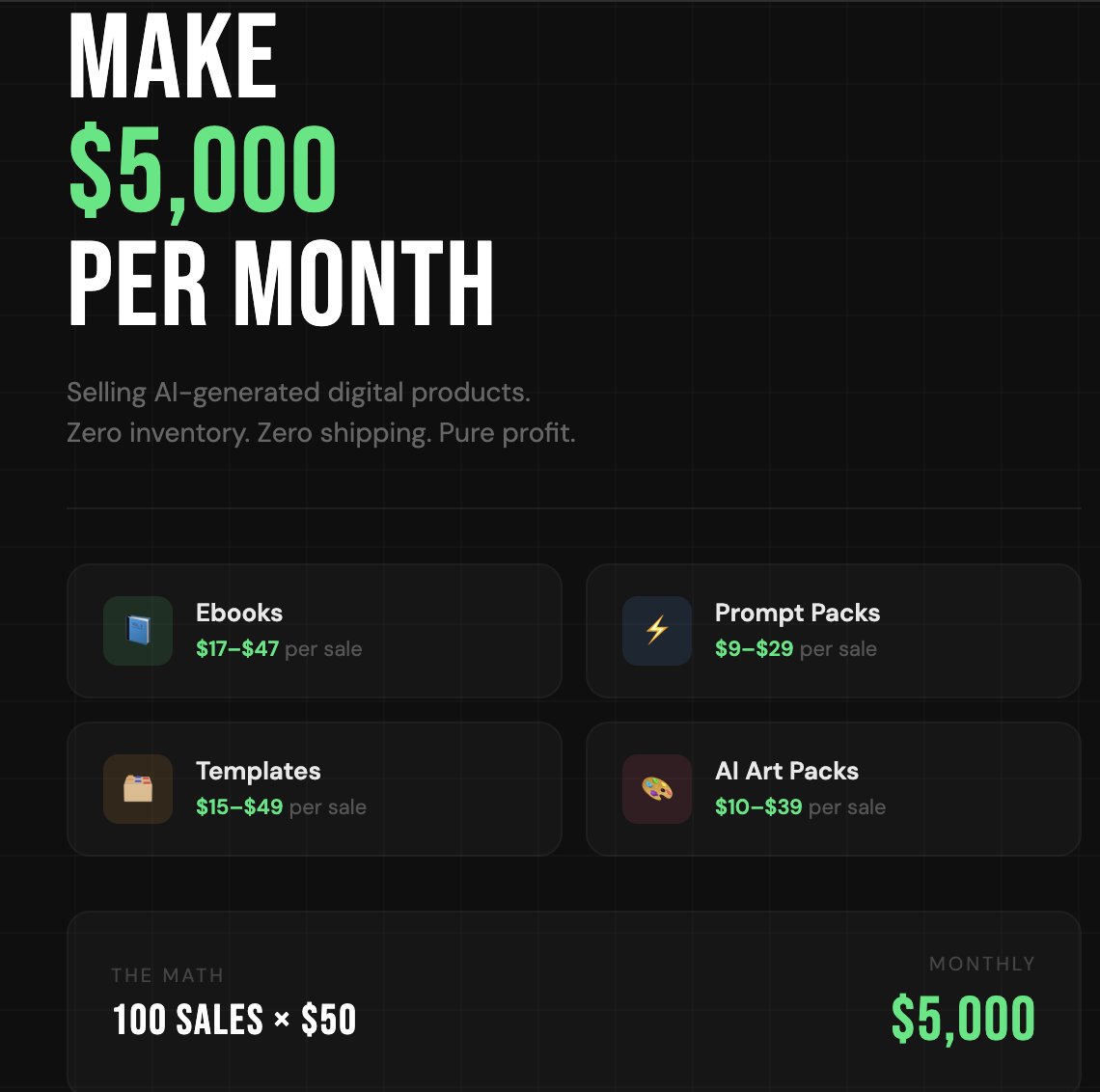
How to make $5,000/month selling AI-generated digital products
- No inventory.
- No shipping.
- No employees.
Just you, an AI tool, and a laptop.
Here's exactly how it works 🧵
1. Ebooks
Pick a niche people are desperate to learn.
Finance. Fitness. Dating. Business.
Use AI to write it in a day.
Design the cover in Canva.
Sell it on Gumroad for $17-$47.
One viral post can do $2,000 in a weekend.
2. Prompt Packs
People are paying for good prompts.
Bundle 50-100 prompts for a specific use case.
ChatGPT prompts for copywriters.
Midjourney prompts for designers.
Sell them for $9-$29 a pack.
Low price = high volume.
3. Templates
Notion templates. Canva templates. Excel dashboards.
AI helps you build them 10x faster.
A good Notion template can sell for $15-$49.
Build it once.
Sell it forever.
4. AI Art Packs
Generate 50 high quality images around a theme.
Sell them as commercial use assets.
Designers, brands, and content creators are buying these every day.
The math is simple:
100 sales/month at $50 = $5,000
You don't need millions of followers to get there.
You need the right product in front of the right people.
The barrier to entry has never been lower.
The only thing stopping most people is starting.
English
has worked in my favor all the time largely because I kept expanding my surface area for luck.
put yourself out there. send the message on X, LinkedIn, or DMs. talk to people. grow your network.
every client I’ve landed came through x, tg, or linkedIn. i genuinely can’t remember the last time I updated my CV or applied the traditional way.
English

I know people stuck in their crypto careers.
Usually not because they’re bad but because they stay too narrow for too long.
Best advice → expand your luck surface area.
If you only do one thing, you only get one type of opportunity.
More doors open if you start doing things in parallel with your niche:
- writing
- research
- community
- BD
- content
- ops
- product research
The more surface area you have the more chances luck has to hit you.
(-‿☀)

English
if AI isn't a service to people, what good is AI?
English

@Manisha_kh @shangenflow Do you mean personalized cold email?
English

WORST WAYS TO GET CLIENTS IN 2026:
- Cold calling
- DM appointment setting
- Buying leads from Apollo
- Case study sales pitches
- AI-generated Loom audits
- Automated cold email sequences
BEST WAYS TO GET CLIENTS IN 2026:
- Live webinars showcasing your skills
- Selling through real conversations
- Paid ads into lead magnets
- Founder-led hot outreach
- Upselling existing clients
- Strategic partnerships
English
Nobody tells you the real escape plan.
So here it is:
Step 1: Build one skill so valuable people pay you $500–$5,000 for it.
Step 2: Freelance that skill until you have $10,000 saved.
Step 3: Invest every spare dollar into assets that grow while you sleep.
Step 4: Reinvest every return. Touch nothing.
Step 5: Wake up 5 years later with a number that generates income without you.
It’s not complicated.
It’s not secret.
It just requires doing the unsexy thing consistently when nobody is watching.
The matrix isn’t a system.
It’s the decision to never start.
English
@BawsaXBT IMO, degrees should mean more than just landing a job. They’re about social sense, outlook, peer camaraderie, a focused learning environment, sports, arts, friendships, memories, critical thinking...
English

@hanshanhk Hot take: A surprising amount of crypto talent (even leadership) would struggle to get hired in TradFi today.
English

Crypto has a talent retention problem nobody talks about
Everyone's focused on hiring. The real issue is why the best people leave after 18 months.
It's not comp. Most people in crypto can make more in TradFi and they know it.
They leave because:
- The project pivoted three times and they don't believe in the current direction
- Leadership makes decisions based on token price instead of product
- There's no clear path from what they're building today to something that matters in 3 years
You can out-recruit your retention problem for a while. But eventually you end up with a team of people who've been there six months and nobody who remembers why you made half the decisions you did.
The projects that keep great people are the ones with a boring answer to the question: what are we actually building and why does it matter?
Stability is underrated in an industry that rewards chaos.
English
@danwestworld Talking to family benchmark sure needs to improve. Makes up for the reason why we are investing in the rest on that list
English

The 9 highest ROI habits on earth (do these daily):
- meditation (20 mins)
- prospecting (1 hour)
- speaking (30 mins)
- writing (1 hour)
- sungazing (1 min)
- workout (3x a week)
- talking to family (10 mins)
- walking (12,000 steps)
- reading (30 mins)
Compounding effects are insane.
English

Excited to chat all things @virtuals_io tomorrow at 10am PT / 1pm ET
House of Chimera@HouseofChimera
Tomorrow at 5 PM UTC, we join @0xbury to talk about @virtuals_io We'll get into: 🔹 The big vision: “Society of AI Agents” and Agentic GDP 🔸 The three core pillars: Agent Commerce Protocol, Butler, and Capital Markets Don't miss it 👇 x.com/i/spaces/1pJdR…
English
its wild how once you actually sit down and look at your own bullshit patterns with zero sugar coating, like really look at them, not the version you tell yourself but the actual patterns... you become kind of impossible to manipulate in the same ways.
English

As the world exponentially accelerates and gets more unpredictable, it’s more important than ever to mentally and physically condition oneself to withstand, adapt and embrace change.
Strong body = strong mind
Flexible body = flexible mind
As above, so below 🫡
Got a good session before AGNT Con by @innercircle_so starting at 4pm today
See you all in a few hours!
English
@HouseofChimera @0xPolygon @Mantle_Official @arbitrum @Optimism @Starknet @Scroll_ZKP @Stacks stark has been on my radar fo sure
English
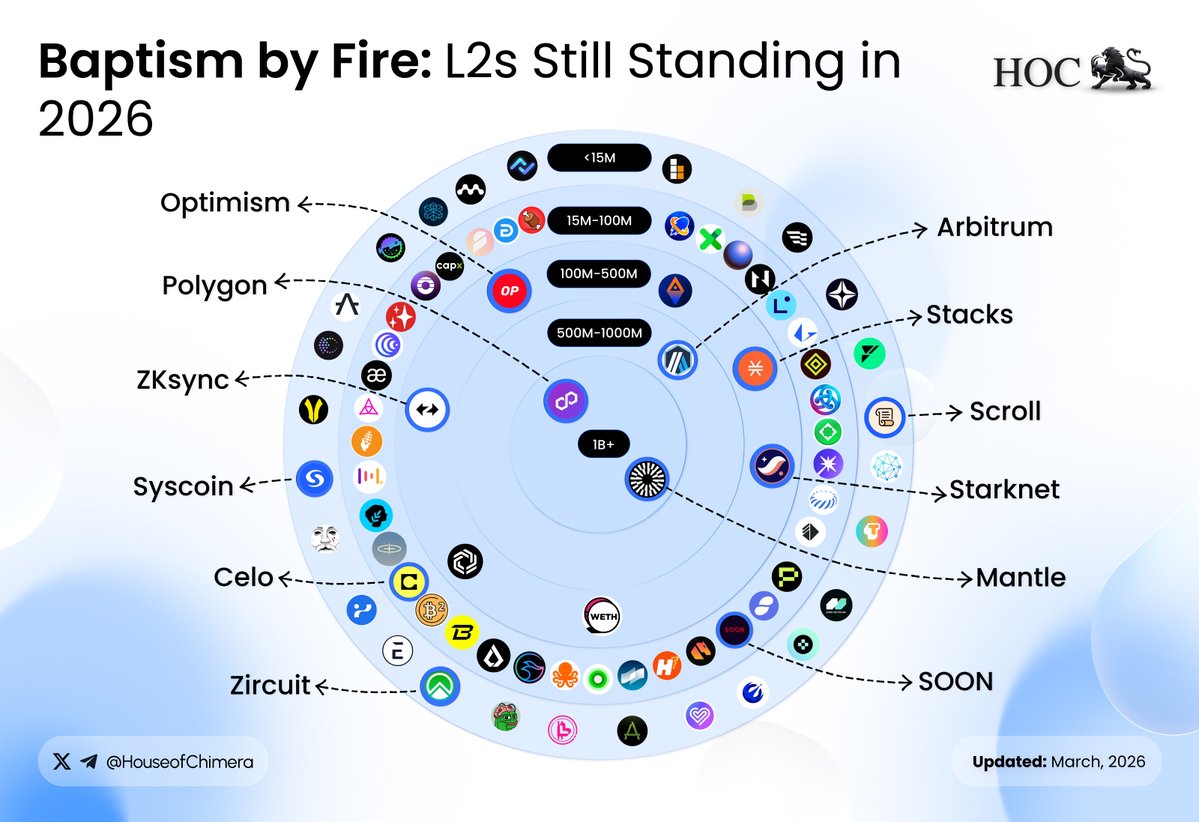
With Vitalik raising concerns on L2 fragmentation, many assumed the market would compress.
But multiple scaling layers are still accumulating liquidity, applications, and users.
🔹 @0xPolygon
🔸 @Mantle_Official
🔹 @arbitrum
🔸 @Optimism
🔹 @Starknet
🔸 @Scroll_ZKP
🔹 @Stacks
Which L2 are you watching anon?
English
Want to write better? Write more.
Want to coach better? Coach more.
Want to design better? Design more.
Want to sell better? Sell more.
Want to think better? Think more.
The pattern is obvious. The answer is always the same.
Just do more of the thing.
English
@benhwx @CryptoHayes @MaelstromFund wait...so which ones according to you seem like the clear underdogs?
English

Arthur Hayes ( @CryptoHayes, @MaelstromFund ) thinks stablecoins will consolidate to three.
I beg to differ.
I keep hearing the same prediction from smart people in crypto.
The conventional wisdom has crystallized into stablecoins being a "winner-take-most" market.
Network effects will dominate, and we're headed toward a world with maybe three major players i.e. @tether, @circle, and @ethena.
🟪 The Cure is Worse than the Disease
Look, I understand the seduction of the network effects argument.
I've lived through enough tech cycles to know that Facebook crushed MySpace, Google dominated search, and AWS won cloud infrastructure.
The "winner-takes-all" pattern is burned into every VC's brain.
When Circle's @jerallaire says stablecoins are like "other internet platform utilities" with network effects, he's speaking the language we all learned in Silicon Valley.
But fundamentally what stablecoins actually are?
The conventional wisdom states that stablecoins have network effects because more users mean more liquidity, more liquidity means more merchant acceptance, more acceptance means more users.
The flywheel spins, and eventually, you get two or three dominant players who control the entire market.
Tether and Circle are already there. Game over.
Except that's not what's happening. At ALL.
🟪 Feeling the Exponential
Last year, between January and June 2025, the number of active stablecoins nearly doubled from 136 to 259. Not three. Not five. Two hundred and fifty-nine. (Total stablechains tracked: 342 currently as of 2026 at @DefiLlama)
And if you think all these stablecoins are going to die off and consolidate down to the "Big Three," you're making the same mistake the early e-commerce VCs made when they tried to predict which categories would work online.
You remember that story, right?
A small group of VCs got together in the early 2000s to debate about how big e-commerce is going to be?
Will it be just electronics?
Maybe women won't use it because they're too tactile.
Food is probably impossible because of perishables.
Every single one of them was devastatingly wrong. E-commerce would sell everything, and the target audience was the whole fucking world.
The stablecoin market in 2025 according to me is exactly like that. Everyone's trying to predict which three stablecoins will win, when the real answer feels like there won't be just three.
There will be hundreds. Maybe thousands.
Because more than just being a product category, stablecoins will and are acting like the infrastructure rail the future of money will be built on.
🟪 The Data Doesn't Lie
Let's look at what actually happened in 2025.
Stablecoin market cap hit $308 billion in October, then pulled back slightly to $303 billion in November, but that's still up from $200 billion at the start of the year.
Monthly transaction volumes reached $4.1 trillion in February 2025, up 115% year-over-year. By August, stablecoins were processing over $4 trillion in monthly volume.
But above all, while USDT and USDC still dominate with 87% market share by supply, new players are exploding.
-> PayPal's PYUSD grew 15.5% in a single month to reach $2.76 billion.
-> @SkyEcosystem's USDS surged 21.7% to $5.31 billion.
-> Ethena's USDe went from $620 million to $6.2 billion in one year, a 10x increase.
-> @aave's GHO grew to over $3.5 billion by June 2025.
Does that look like consolidation to you?
Because it doesn't to me.
🟪 Why Network Effects Don't Apply
Here's what the "winner-takes-all" crowd gets wrong about stablecoins.
They think distribution is the moat. But distribution isn't the only moat. You are forgetting about compliance.
In December 2025, SoFi became the first national bank to launch a stablecoin on a public blockchain.
Not Circle. Not Tether. @SoFi. A bank.
Furthermore, they're offering white-label stablecoin infrastructure to other banks and fintechs.
-> JPMorgan launched its deposit token on Base.
-> Société Générale announced plans for USDCV on Ethereum and Solana.
-> Visa launched USDC settlement in the United States.
A consortium of nine European banks announced plans for a euro-denominated stablecoin.
Because banks looked at Tether making $13 billion in net profit in 2024 and thought: why the hell are we letting someone else make that money?
The GENIUS Act created a regulated market where banks can issue stablecoins.
And banks have something Circle and Tether don't: federal charters, deposit insurance, and direct access to the Federal Reserve.
When SoFi says their stablecoin is "fully reserved 1:1 by cash held at the Federal Reserve," they're not competing on network effects.
They're competing on trust. On regulatory compliance. On zero liquidity risk and zero credit risk.
And that's a totally different game.
🟪 The Regulatory Arbitrage
Here's another thing the consolidation thesis misses aka regulatory fragmentation creates stablecoin fragmentation.
- The US has the GENIUS Act.
- Europe has MiCA, which caps non-euro stablecoin transactions at €200 million per day.
- Hong Kong has its Stablecoins Ordinance with high-threshold licensing.
- China is talking about RMB-pegged stablecoins.
USDC is the only top-10 stablecoin that's fully MiCA-compliant. USDT isn't. So European institutions that want to comply with MiCA can't use USDT, they need either USDC or a new euro-denominated stablecoin.
That's not network effects. That's regulatory fragmentation creating demand for multiple stablecoins.
And it's going to get worse.
Every major economy is going to want its own stablecoin framework.
Every major economy is going to want stablecoins that comply with its rules.
That means we're not consolidating to three stablecoin & we're fragmenting into dozens.
🟪 The Use Case Explosion
But the most important reason the consolidation thesis is wrong is because stablecoins are finding product-market fit in completely different use cases.
USDT dominates P2P transactions, particularly in emerging markets.
@trondao handles over 50% of P2P stablecoin transfers.
In Argentina and Venezuela, over 30% of digital wallets hold stablecoins for daily spending.
In Latin America, 71% of stablecoin activity is cross-border payments.
USDC dominates DeFi. It accounts for 66% of stablecoin transfer volume, most of which is decentralized finance activity.
Circle went public specifically to capture institutional demand.
Ethena's USDe is designed for yield generation, backed by crypto-native returns instead of fiat reserves. It's competing in a totally different category, not transactional stablecoins but investment stablecoins.
PayPal's PYUSD lives mostly within the PayPal ecosystem for digital payments.
It's not trying to be USDT or USDC. It's trying to be the stablecoin you use when you're already using PayPal.
These are not the same product. They're not even trying to be the same product. And network effects only matter when everyone's trying to build the same thing.
🟪 The Real Future
So no, I don't think we're headed toward a world with three stablecoins.
I think we're headed toward a world with hundreds of stablecoins, each optimized for different use cases, different regulatory regimes, different distribution channels.
USDT will continue to dominate P2P transfers and emerging market usage.
USDC will own institutional and DeFi flows. Ethena and similar yield-bearing stablecoins will capture the investment use case.
Banks will issue their own stablecoins for internal treasury operations and B2B settlement.
Fintechs will white-label stablecoins for their specific user bases.
Corporations like Amazon and Walmart might eventually issue their own for customer loyalty and payments.
And all of this will run on shared infrastructure like Circle's Arc, Stripe's Tempo, Alchemy's Chain, whatever Tether builds.
The infrastructure layer will be valuable precisely because it enables fragmentation, not consolidation.
The consolidation thesis is the cure that's worse than the disease. It assumes stablecoins are a product when they're actually a protocol.
It assumes winner-takes-all when the real dynamic is infrastructure-enables-all. It assumes we're fighting over a fixed pie when the pie is growing exponentially.
Arthur Hayes is a smart guy. Circle's CEO Jeremy is a smart guy. But on this one, I think they're wrong.
You still don't believe in the exponential. Because the exponential's answer is always the same: it doesn't matter.
This stuff is going to be so much bigger than it is today.
And when it's absolutely enormous, there will be room for everyone.
Or almost everyone. Because the real question is who controls the infrastructure?
And on that question, the battle has only just begun.
P.S. video credit: Longitude by @Cointelegraph
English
ai can write your research report.
it can’t:
• get you a founder intro in 10 minutes
• calm a community that’s melting down
• negotiate a listing when everyone’s panicking
• run an event that feels like a movement
• navigate compliance without killing momentum
crypto runs on trust.
English

Key insight from the panel!
AI and blockchain aren't separate trends. The operating system of finance is being rewired. Most people won't notice - it'll just be faster, cheaper, more efficient.
English
RWA WEEK @rwaweek finally dropped their panels and the AI x Tokenization panel did not disappoint!
`Seamless Transactions: AI's Role in Bridging TradFi & Digital Assets' brought together some of the biggest names in TradFi, crypto, and legal to break down where this space is actually headed.
THE PANEL:
- Glendy Kam - @tassatgroup
- @alanlau999 - @animocabrands
- Geoff Kot - @StanChart
- Marcos Chow - HKT
- Rocky Mui - @Clifford_Chance
High-level takeaways below👇

English