

𝙼𝚊𝚛𝚌 𝗚𝗼𝗹𝗱𝗶𝗰𝗵
10.6K posts

𝙼𝚊𝚛𝚌 𝗚𝗼𝗹𝗱𝗶𝗰𝗵
@MarcGoldich
𝔾ℂ @proximityfi ⋈ | 𝔹𝔹ℚ 𝔾𝕣𝕚𝕝𝕝𝕚𝕤𝕥
Katılım Mart 2012
2.8K Takip Edilen4.8K Takipçiler


I recently got a CO2 monitor for my office and learned it hovers at 1200-1300 when I'm working, which diminished my IQ by at least 1 sigma. Now keeping a window open and noticing an enormous difference in my ability to maintain focus over long durations. Get one now! Link below.
yatharth ༺༒༻@AskYatharth
CO₂ monitors are surprisingly actionable i carried it with me everywhere; to my professors' basement offices, to my room where i lit candles, to my bedroom after just a few weeks of carrying it everywhere, i stopped needing it and changed certain behaviours forever
English
𝙼𝚊𝚛𝚌 𝗚𝗼𝗹𝗱𝗶𝗰𝗵 retweetledi

The future of Stablecoin swaps: NEAR Intents.
@kendaIIc at NEARCON ‘26 👇🏻
NEAR Intents@near_intents
Stablecoins are exploding. Banks & fintechs are launching their own. What if stablecoin swaps across chains felt like using Venmo? At NEARCON, @kendaIIc explains how NEAR Intents make it possible with the Stablecoin Transport Protocol expanding across more stablecoins. Rec ↓
English
𝙼𝚊𝚛𝚌 𝗚𝗼𝗹𝗱𝗶𝗰𝗵 retweetledi

near still feels like the most underrated team in crypto to me
new feature releases basically every other week on an actually scalable chain
privacy, ai, trading verticals focus
founder not checked out
yet xrp/ada is way above them. idk man
Illia (root.near) (🇺🇦, ⋈)@ilblackdragon
NEAR.com is here! For the first time, you can transact confidentially with any asset, across all chains, with one account – powered by @near_intents.
English
𝙼𝚊𝚛𝚌 𝗚𝗼𝗹𝗱𝗶𝗰𝗵 retweetledi

That’s a wrap on NEARCON 2026. Two days of shipping across the entire stack.
Here's what you need to know:
✦ Tokenomics: Increased value capture through revenue growth and $NEAR buybacks.
✦ NEAR Intents Fee Switch: Automatic revenue sharing with integration partners.
✦ near.com: A super-app on crypto rails, powered by NEAR Intents. 35+ chains. P2P trading. Confidential flows. One account. Much more coming soon.
✦ IronClaw: Always-on AI agents running inside encrypted enclaves. Hardware-enforced security for the age of agents.
✦ Confidential GPU Marketplace: The first TEE-secured compute network for enterprise AI workloads, built on NEAR DCML.
✦ Multimodal: Run text, image, and voice models in NEAR AI Cloud.
✦ Multiprivacy: Deploy fully confidential AI models inside TEEs or access models anonymously via a TEE-secured gateway.
✦ Nightshade 3.0: Separation of consensus and execution. Atomic transactions. A live private shard.
✦ Confidential Intents: Confidential cross-chain execution, built directly into NEAR Intents and powered by a NEAR private shard.
Asynchronous scaling. Universal cross-chain. Confidential AI. Real economics. One frictionless frontend. This is the unified commerce layer for assets and agents. This is NEAR.
GIF
English
𝙼𝚊𝚛𝚌 𝗚𝗼𝗹𝗱𝗶𝗰𝗵 retweetledi

Huge launch. Standing on the shoulders of the Zcash giants, @NEARProtocol just debuted Confidential Intents allowing confidential execution for cross-chain transactions. This the way. Privacy first.
chronear@chronear
🧵 Just over a year ago, we unveiled NEAR Intents to the world with one goal — building the universal liquidity layer by giving users access to all asset types and order types across chains. We've always believed that privacy-first should be the norm rather than an exception for anything on-chain and today with the launch of Confidential Intents, we've taken a big leap towards the end game for NEAR Intents. We are standing on the shoulders of giants (h/t Zcash) and commit to furthering individual sovereignty through practical privacy that can serve billions of agents and humans alike. This is our biggest product release till date for NEAR Intents and several nodes across the NEAR ecosystem (DeFuse Labs, NEAR One, Proximity Labs, NF) came together to make this happen. Try near.com today and experience confidential intents yourself. Coming soon to frontends across crypto. We are only getting started. Accelerate. 🛡️
English
𝙼𝚊𝚛𝚌 𝗚𝗼𝗹𝗱𝗶𝗰𝗵 retweetledi

🧵 Just over a year ago, we unveiled NEAR Intents to the world with one goal — building the universal liquidity layer by giving users access to all asset types and order types across chains.
We've always believed that privacy-first should be the norm rather than an exception for anything on-chain and today with the launch of Confidential Intents, we've taken a big leap towards the end game for NEAR Intents.
We are standing on the shoulders of giants (h/t Zcash) and commit to furthering individual sovereignty through practical privacy that can serve billions of agents and humans alike.
This is our biggest product release till date for NEAR Intents and several nodes across the NEAR ecosystem (DeFuse Labs, NEAR One, Proximity Labs, NF) came together to make this happen.
Try near.com today and experience confidential intents yourself. Coming soon to frontends across crypto.
We are only getting started.
Accelerate. 🛡️
NEAR Protocol@NEARProtocol
Introducing Confidential Intents. Confidential execution for cross-chain transactions—built into NEAR Intents 🧵
English
𝙼𝚊𝚛𝚌 𝗚𝗼𝗹𝗱𝗶𝗰𝗵 retweetledi
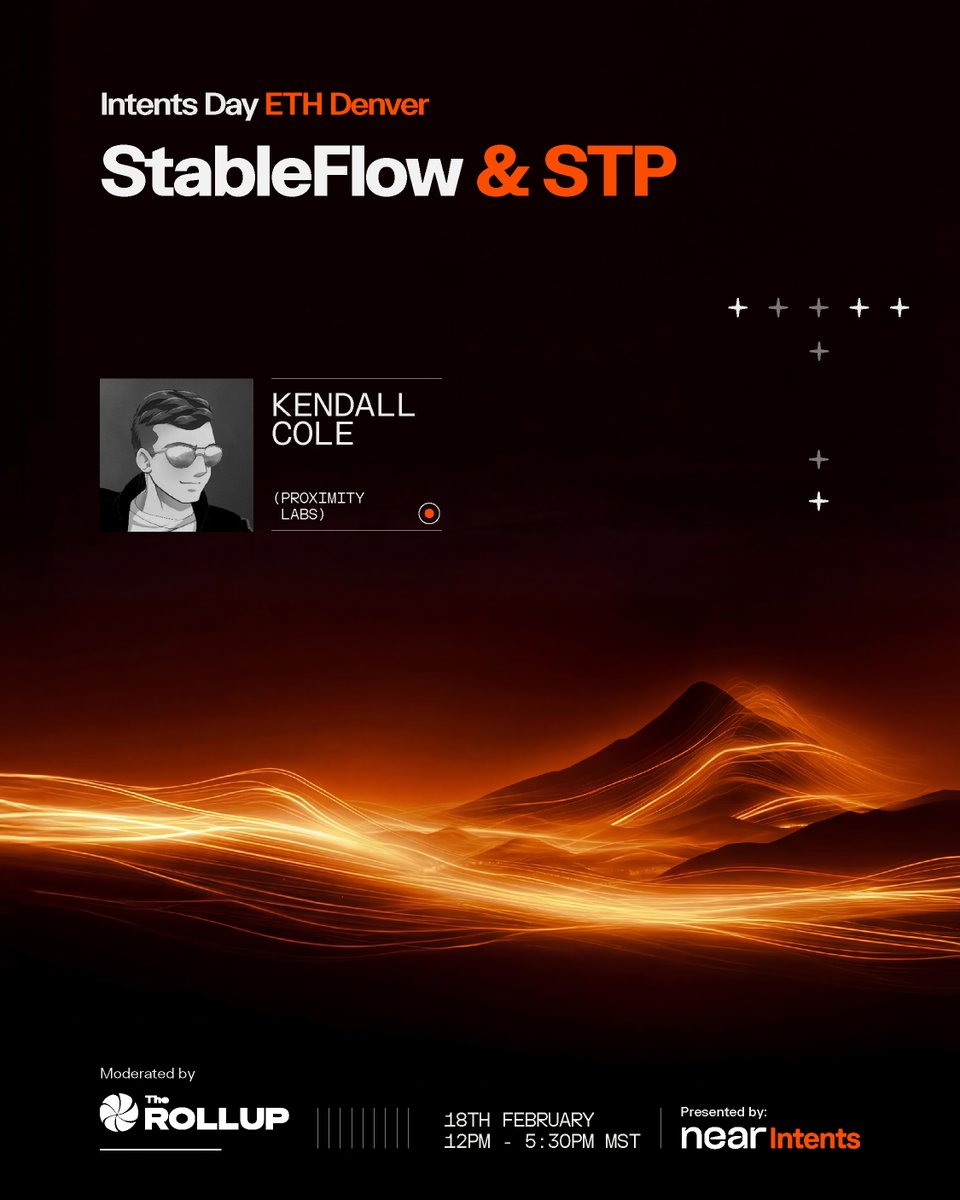
Kendall Cole (@proximityfi) will follow up with a fireside on StableFlow and STP.
Stableflow allows users to move stable coins at scale efficiently and securely.
🗓️ Feb 18 | 1:50-2:05 PM MST
English
Using AI does not waive privilege. Disclosure to a third party waives privilege. If no third party can access the content, there is no waiver.
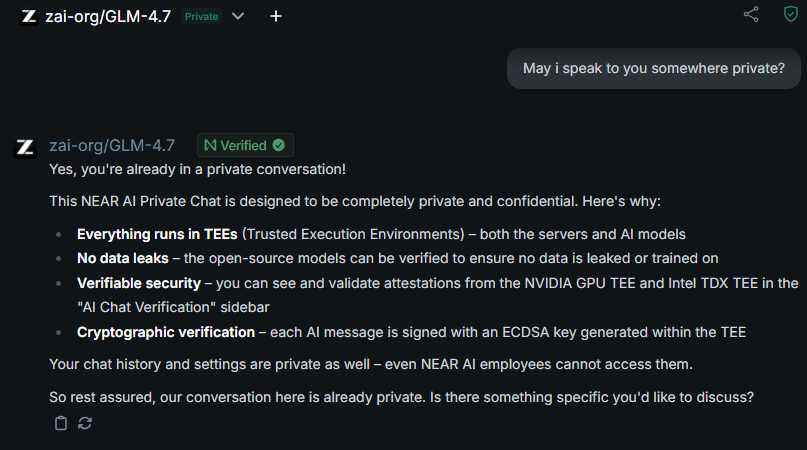
NEAR AI Private Chat
NEAR Protocol@NEARProtocol
Use NEAR AI Private Chat and you can confidently talk to your AI like your lawyer.
English
𝙼𝚊𝚛𝚌 𝗚𝗼𝗹𝗱𝗶𝗰𝗵 retweetledi
Use NEAR AI Private Chat and you can confidently talk to your AI like your lawyer.
Moish Peltz@mpeltz
Your AI conversations aren't privileged. Yesterday, Judge Jed Rakoff ruled that 31 documents a defendant generated using an AI tool and later shared with his defense attorneys are not protected by attorney-client privilege or work product doctrine. The logic is simple: an AI tool is not an attorney. It has no law license, owes no duty of loyalty, and its terms of service explicitly disclaim any attorney-client relationship. Sharing case details with an AI platform is legally no different from talking through your legal situation with a friend (which is not privileged). You can't fix it after the fact, either. Sending unprivileged documents to your lawyer doesn't retroactively make them privileged. That's been settled law for years. It just hadn't been tested with AI until now. And here's what really hurt the defendant: the AI provider's privacy policy (Claude), in effect when he used the tool, expressly permits disclosure of user prompts and outputs to governmental authorities. There was no reasonable expectation of confidentiality. The core problem is the gap between how people experience AI and what's actually happening. The conversational interface feels private. It feels like talking to an advisor. But unless you negotiate for an enterprise agreement that says otherwise, you're inputting information into a third-party commercial platform that retains your data and reserves broad rights to disclose it. Judge Rakoff also flagged an interesting wrinkle: the defendant reportedly fed information from his attorneys into the AI tool. If prosecutors try to use these documents at trial, defense counsel could become a fact witness, potentially forcing a mistrial. Winning on privilege doesn't make the evidentiary picture simple. For anyone advising clients or managing legal risk, this is a wake-up call. AI tools are not a safe space for clients to process their counsel's advice and to regurgitate their legal strategy. Every prompt is a potential disclosure. Every output is a potentially discoverable document. So what do we do about it? First, attorneys need to be proactive. Advise clients explicitly that anything they put into an AI tool may be discoverable and is almost certainly not privileged. Put it in your engagement letters. Make it part of onboarding. Don't assume clients understand this, because most don't. Second, if clients want to use AI to help process legal issues (and they clearly will, increasingly), then let's give them a way to do it inside the privilege. Collaborative AI workspaces shared between attorney and client, where the AI interaction happens under counsel's direction and within the attorney-client relationship, can change the analysis entirely. I'm excited to be planning this kind of approach, and I think it's where the industry needs to head. storage.courtlistener.com/recap/gov.usco…
English
𝙼𝚊𝚛𝚌 𝗚𝗼𝗹𝗱𝗶𝗰𝗵 retweetledi

Coordinated anti-prediction market media effort on display here.
@CNBC hosts: fake outrage that you can't stop non-insiders with specialized information from sharing the info.
@mansourtarek_: Then we won't stop them.
CNBC: That's insider trading!
Tarek: You just said they aren't insiders and can use the info however they want.
Tarek's answer was perfectly reasonable and strikes a balance between being overly restrictive and overly lenient.
The whole point of these markets is to aggregate information. If you have better info, you win. If you have worse info, you lose.
The cardinal rule: Protect yourself at all times.
Joon Lee@joonlee
On Squawk Box, Kalshi CEO Tarek Mansour struggles to answer why a Bad Bunny dancer -- who watched rehearsals -- betting on the Halftime Show predictions markets would not be considered insider trading. Sports was estimated to be 90% of betting on Kalshi during the NFL season.
English




𝙼𝚊𝚛𝚌 𝗚𝗼𝗹𝗱𝗶𝗰𝗵 retweetledi
𝙼𝚊𝚛𝚌 𝗚𝗼𝗹𝗱𝗶𝗰𝗵 retweetledi
1/6 Today we introduce the Stablecoin Transport Protocol (STP) litepaper.
Developed by Yonder Labs, STP enables cross-chain stablecoin swaps in sizes of 1M to 10M+ with no slippage and very low fees (1 to 3bp).
Stablecoin Transport Protocol is purpose built for maximum capital efficiency and scale.
Read the Full Litepaper : stablecointransport.com
English
@ChefBonsaidemic @lex_node Anyway, for all those who celebrate
UberFacts@UberFacts
December 22nd is National Short Person Day
English
@ChefBonsaidemic @lex_node For sure. Both things can be true… he was diagnosed with a disorder and the club paid for the treatment because they saw potential in him
English

this was actually a thing in elite boarding schools as far back as the 1990s, I went to highschool with a kid who was was really short, his parents intervened with a medical regime and he became one of the tallest in the class over the course of one year. . .
Crémieux@cremieuxrecueil
Everyone should wake up to this trend. Yes, rich people are making their kids taller.
English