
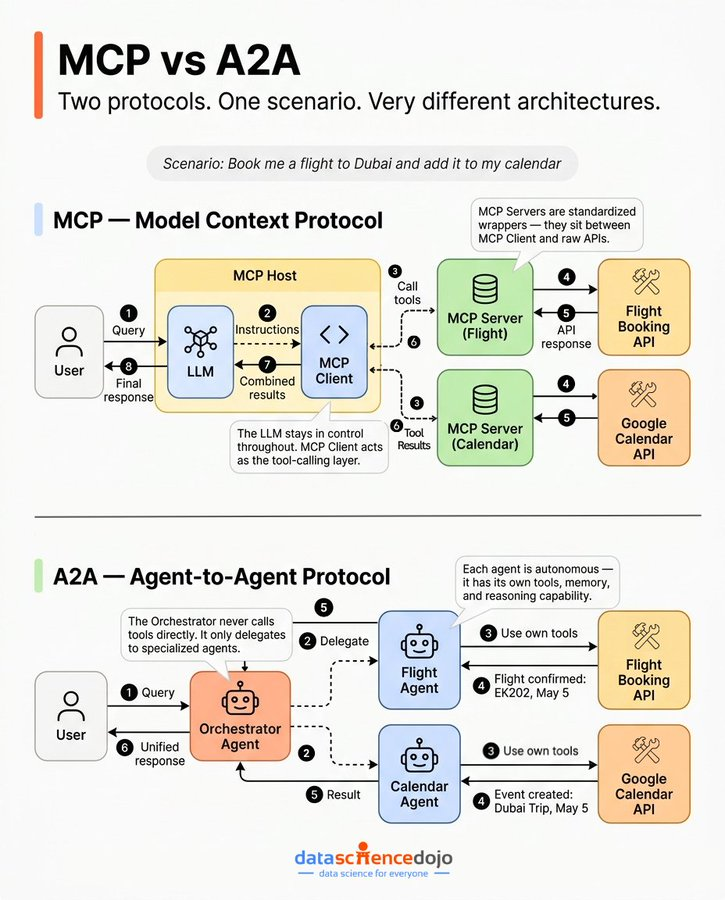
MCP and A2A are both agent protocols but they operate at completely different layers. MCP (Model Context Protocol) is about giving one LLM access to external tools. The model stays in the driver's seat throughout: it receives your query, decides which tools to call, gets the results back through an MCP Client, and assembles the final response. The MCP Servers in between are just standardized wrappers around raw APIs — Flight Booking, Google Calendar, whatever you need. One brain. Centralized control. A2A (Agent-to-Agent Protocol) is about coordination between autonomous agents. There's no single LLM managing everything — instead, an Orchestrator Agent delegates subtasks to specialized agents, each of which has its own tools, its own memory, and its own reasoning loop. The Orchestrator never touches the Flight API directly. It talks to a Flight Agent, which handles that domain entirely on its own, then reports back. The architectural difference matters when you're building: MCP works well when one model can reasonably handle the full task with tool access. A2A becomes necessary when subtasks are complex enough to need dedicated reasoning — or when you want agents that can operate in parallel without bottlenecking through a single model. Same scenario — "book me a flight and add it to my calendar" — but one architecture keeps control centralized, the other distributes it across specialists. If you're building agentic systems in 2026, understanding where this boundary sits will shape every design decision you make. #agenticai #aiarchitecture #mcp #google #anthropic #aiengineering #multiagentsystems