Marketswithomair

61 posts

Marketswithomair

Marketswithomair

@Marketswidomair

Capital Markets | Business Systems Analyst | AI Enablement Trade Lifecycle | Digital Banking | Building smarter financial systems

Canada Katılım Mart 2026
45 Takip Edilen7 Takipçiler
Marketswithomair
Marketswithomair@Marketswidomair·
Semiconductor index up 143% in one year. Datadog +30% this week. Apple at an all-time high. Nvidia reports Wednesday — $3.3 trillion market cap. Meanwhile yields are spiking, oil is back above $100 and the Fed's new chair just walked in the door. Next week is going to be loud. #MacroEconomics #Nvidia #FridayMarkets #CapitalMeetsCode
English
0
2
2
52
Marketswithomair
Marketswithomair@Marketswidomair·
Trump flew to Beijing to pressure Xi on Iran. Xi listened. Nodded. Said the right things. Iran still hasn't signed anything. Ceasefire "on life support." 10-year yield: 4.55% — one-year high. Rate hike odds: 45% — was 1% a month ago. S&P hit another record this week. The market keeps going up. The war keeps going on. #FridayMarkets #CapitalMeetsCode
English
0
0
0
30
Marketswithomair
Marketswithomair@Marketswidomair·
The three waves of AI (simplified): Wave 1: Explicit rules programmed by humans Wave 2: Systems that learn patterns from data Wave 3: Deep neural networks trained on billions of examples Most AI failures in financial institutions happen because people don't know which wave they're working with. That's what this series fixes. #ThinkThursday #AIEducation #CapitalMeetsCode
English
0
2
2
48
Marketswithomair
Marketswithomair@Marketswidomair·
Tweet 1: Most finance professionals have heard "AI" thousands of times. Very few could explain what it actually is — with any precision. Today we start a new series on #ThinkThursday. 120 topics. One per week. Built for finance professionals. Topic 1: What is Artificial Intelligence — and what are its three waves?We start at the beginning. 🧠#AIinFinance #CapitalMeetsCode
English
0
2
2
36
Marketswithomair
Marketswithomair@Marketswidomair·
Jamie Dimon has warned that private credit's surge echoes how subprime mortgage origination moved outside the banking system before 2008. Private credit decisions are only as good as the data feeding them. The fintech disruption of lending is largely positive. The governance infrastructure catching up to it is still a work in progress. #FinTech #PrivateCredit #CapitalMeetsCode
English
0
2
2
30
Marketswithomair
Marketswithomair@Marketswidomair·
Private credit: $40 trillion globally. Nearly $2 trillion in direct lending in the US alone. Fintechs account for 50% of new personal loan balances — up from near zero a decade ago. But the "true" default rate, once selective defaults are included, approaches 5%. The disruption is real. So is the risk building underneath it. #TechTuesday #PrivateCredit #CapitalMeetsCode
English
1
2
3
31
Marketswithomair
Marketswithomair@Marketswidomair·
The "boring" compliance topic just became one of the most consequential stories in Canadian finance. Bill C-12. The FINTRAC reset. Perpetual KYC. Agentic AI in compliance. Issue #3 of Capital Meets Code unpacks how the architecture of trust is being rewritten in 2026. linkedin.com/pulse/who-youa…
English
0
2
2
63
Marketswithomair
Marketswithomair@Marketswidomair·
The credential gets you considered. The relationship gets you chosen. Projects get approved because someone trusts the presenter. Roles get filled before they're posted because the manager already knows who they want. Invest in the people around you long before you need them. That's not networking. That's just being a good professional. #WisdomWednesday #CareerGrowth #CapitalMeetsCode
English
0
2
2
15
Marketswithomair
Marketswithomair@Marketswidomair·
I used to think credentials were the answer. Get the qualification. Get the job. Build the career. They open doors. That part is true. But somewhere across five countries and multiple industries, I noticed something. The professionals moving fastest weren't always the most qualified. They were the most trusted. #WisdomWednesday #CapitalMeetsCode
English
0
2
2
24
Marketswithomair
Marketswithomair@Marketswidomair·
In 2024, banks paid $19.3 billion in regulatory penalties. A record. RegTech — AI, cloud and analytics applied to compliance — is what the industry built in response. 90% of financial institutions now use some form of it. The question is no longer whether to adopt it. It's how well. #TechTuesday #RegTech #CapitalMeetsCode
English
0
2
2
15
Marketswithomair
Marketswithomair@Marketswidomair·
This week in markets: ● Fed holds — but is it Powell's last meeting? ● Microsoft, Amazon, Meta, Alphabet report Wednesday ● $650B in combined AI capex — do the revenues justify it? ● Q1 GDP — first read on growth during wartime ● Iran new Hormuz proposal — White House response pending The most data-dense week of 2026. #MacroEconomics #FOMC #CapitalMeetsCode
English
0
2
2
49
Marketswithomair
Marketswithomair@Marketswidomair·
Trump cancelled the Islamabad peace talks Saturday. Said Iran should just "call him." Iran submitted a new proposal Monday through Pakistani mediators. Nobody has called anyone yet. Meanwhile this week: FOMC. Microsoft. Amazon. Meta. Alphabet. GDP. PCE. Apple. All in 72 hours. Good morning. ☕ #MarketMonday #CapitalMeetsCode
English
0
2
2
63
Marketswithomair retweetledi
Elias Al
Elias Al@iam_elias1·
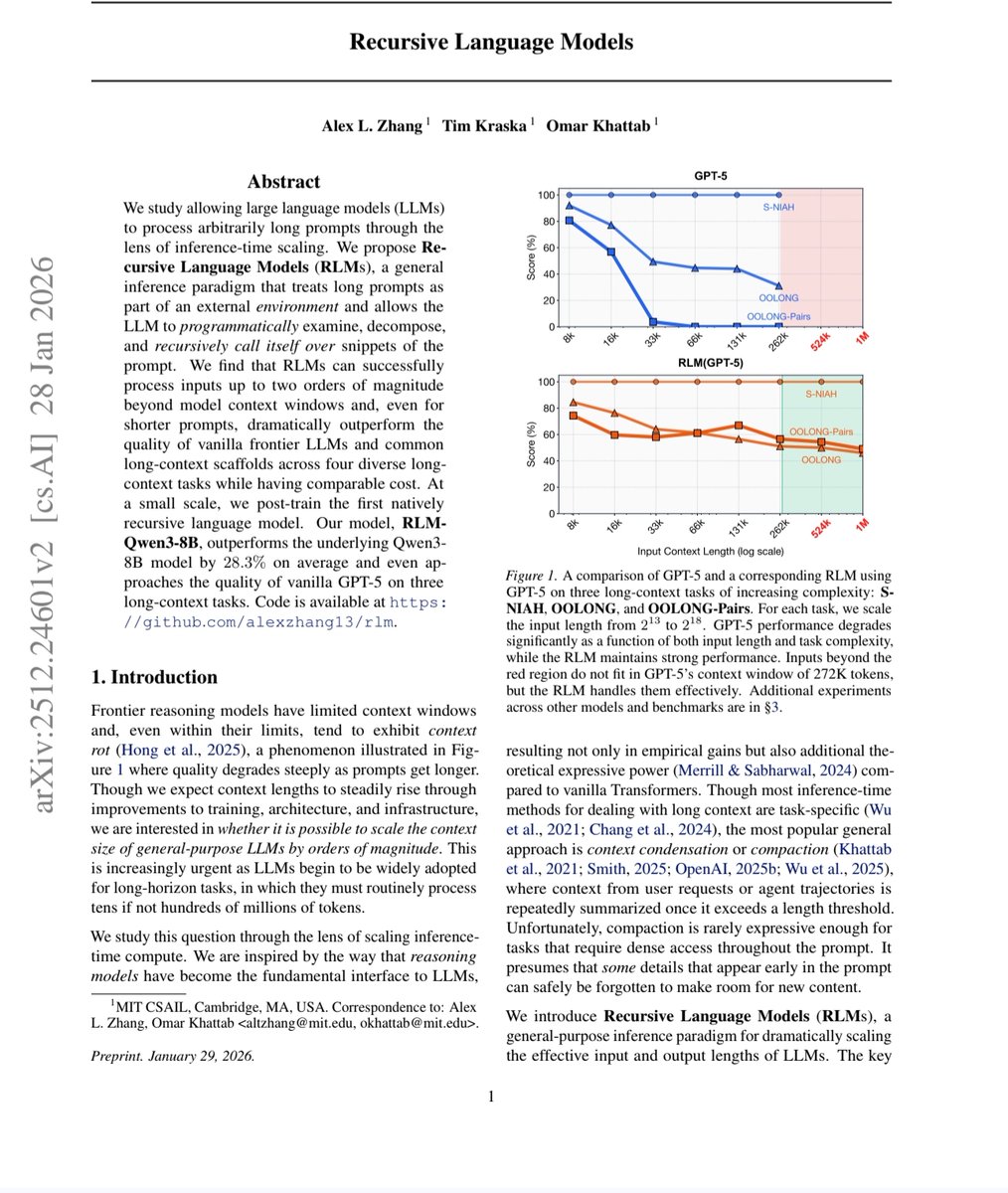
MIT just made every AI company's billion dollar bet look embarrassing. They solved AI memory. Not by building a bigger brain. By teaching it how to read. The paper dropped on December 31, 2025. Three MIT CSAIL researchers. One idea so obvious it hurts. And a result that makes five years of context window arms racing look like the wrong war entirely. Here is the problem nobody solved. Every AI model on the planet has a hard ceiling. A context window. The maximum amount of text it can hold in working memory at once. Cross that line and something ugly happens — something researchers have a clinical name for. Context rot. The more you pack into an AI's context, the worse it performs on everything already inside it. Facts blur. Information buried in the middle vanishes. The model does not become more capable as you feed it more. It becomes more confused. You give it your entire codebase and it forgets what it read three files ago. You hand it a 500-page legal document and it loses the clause from page 12 by the time it reaches page 400. So the industry built a workaround. RAG. Retrieval Augmented Generation. Chop the document into chunks. Store them in a database. Retrieve the relevant ones when needed. It was always a compromise dressed up as a solution. The retriever guesses which chunks matter before the AI has read anything. If it guesses wrong — and it does, constantly — the AI never sees the information it needed. The act of chunking destroys every relationship between distant paragraphs. The full picture gets shredded into fragments that the AI then tries to reassemble blindfolded. Two bad options. One broken industry. Three MIT researchers and a deadline of December 31st. Here is what they built. Stop putting the document in the AI's memory at all. That is the entire idea. That is the breakthrough. Store the document as a Python variable outside the AI's context window entirely. Tell the AI the variable exists and how big it is. Then get out of the way. When you ask a question, the AI does not try to remember anything. It behaves like a human expert dropped into a library with a computer. It writes code. It searches the document with regular expressions. It slices to the exact section it needs. It scans the structure. It navigates. It finds precisely what is relevant and pulls only that into its active window. Then it does something that makes this recursive. When the AI finds relevant material, it spawns smaller sub-AI instances to read and analyze those sections in parallel. Each one focused. Each one fast. Each one reporting back. The root AI synthesizes everything and produces an answer. No summarization. No deletion. No information loss. No decay. Every byte of the original document remains intact, accessible, and queryable for as long as you need it. Now here are the numbers. Standard frontier models on the hardest long-context reasoning benchmarks: scores near zero. Complete collapse. GPT-5 on a benchmark requiring it to track complex code history beyond 75,000 tokens — could not solve even 10% of problems. RLMs on the same benchmarks: solved them. Dramatically. Double-digit percentage gains over every alternative approach. Successfully handling inputs up to 10 million tokens — 100 times beyond a model's native context window. Cost per query: comparable to or cheaper than standard massive context calls. Read that again. One hundred times the context. Better answers. Same price. The timeline of the arms race makes this sting harder. GPT-3 in 2020: 4,000 tokens. GPT-4: 32,000. Claude 3: 200,000. Gemini: 1 million. Gemini 2: 2 million. Every generation, every company, billions of dollars spent, all betting on the same assumption. More context equals better performance. MIT just proved that assumption was wrong the entire time. Not slightly wrong. Fundamentally wrong. The entire premise of the last five years of context window research — that the solution to AI memory was a bigger window — was the wrong answer to the wrong question. The right question was never how much can you force an AI to hold in its head. It was whether you could teach an AI to know where to look. A human expert handed a 10,000-page archive does not read all 10,000 pages before answering your question. They navigate. They search. They find the relevant section, read it deeply, and synthesize the answer. RLMs are the first AI architecture that works the same way. The code is open source. On GitHub right now. Free. No license fees. No API costs. Drop it in as a replacement for your existing LLM API calls and your application does not even notice the difference — except that it suddenly works on inputs it used to fail on entirely. Prime Intellect — one of the leading AI research labs in the space — has already called RLMs a major research focus and described what comes next: teaching models to manage their own context through reinforcement learning, enabling agents to solve tasks spanning not hours, but weeks and months. The context window wars are over. MIT won them by walking away from the battlefield. Source: Zhang, Kraska, Khattab · MIT CSAIL · arXiv:2512.24601 Paper: arxiv.org/abs/2512.24601 GitHub: github.com/alexzhang13/rlm
Elias Al tweet media
English
147
446
2.2K
325.5K
Marketswithomair
Marketswithomair@Marketswidomair·
Next week is the one that matters. Microsoft. Amazon. Meta. Alphabet. All reporting. FOMC rate decision Wednesday — first since the war began. $650 billion in Big Tech AI capex commitments in 2026 alone. The earnings season that started quietly is about to get very loud. #MacroEconomics #FridayMarkets #CapitalMeetsCode
English
0
2
2
42
Marketswithomair
Marketswithomair@Marketswidomair·
The S&P hit a record high 3 times this week. Oil crossed $100 twice. The Iran ceasefire was extended, violated and debated — all before Thursday. Markets have decided the war is background noise. Whether that's wisdom or complacency — nobody wants to answer yet. 88% of S&P earnings beating estimates. Intel +25% today. #FridayMarkets #CapitalMeetsCode
English
0
2
2
50
Marketswithomair
Marketswithomair@Marketswidomair·
The most accurate AI models are often the least explainable. That's the real trade-off regulators are forcing banks to confront. OSFI E-23. EU AI Act. Basel. OCC. They all want the same thing: Explainability built into the architecture — not bolted on at the end. #AIinFinance #RiskManagement #CapitalMeetsCode
English
0
2
2
41
Marketswithomair
Marketswithomair@Marketswidomair·
A bank's AI model denies your loan. You ask why. The compliance officer asks why. The regulator asks why. Nobody can fully answer. That's the black box problem. In 2026, regulators have officially run out of patience with it. EU AI Act fines: up to €35M or 7% of global revenue. #ThinkThursday #AIinFinance #CapitalMeetsCode
English
0
2
2
26
Marketswithomair
Marketswithomair@Marketswidomair·
AI is automating the documentation layer of the BSA role. What it cannot automate is genuine curiosity about how a business actually works. The BSAs who will thrive aren't the ones who document requirements faster. They're the ones who know which requirements were wrong to begin with. #WisdomWednesday #AIinFinance #CapitalMeetsCode
English
0
2
2
56
Marketswithomair
Marketswithomair@Marketswidomair·
The best BSAs I've worked with weren't always the most technical. They were relentlessly curious about the business — not just the system. They asked why a process existed before asking how to improve it. That one habit separated the good from the exceptional. #WisdomWednesday #BSA #CapitalMeetsCode
English
0
2
2
13
Marketswithomair
Marketswithomair@Marketswidomair·
The insight: Blockchain doesn't replace your OMS overnight. It has to integrate with it.Legacy workflows. Data contracts. On-chain/off-chain governance. That's not a technology problem. That's a systems design problem. Its not a hype anymore, the architecture era has begun. #Blockchain #CapitalMarkets #CapitalMeetsCode
English
0
2
2
36