4/4

153 posts

4/4 banner
4/4

4/4

@MartianArray

Katılım Aralık 2024
274 Takip Edilen44 Takipçiler
4/4 retweetledi
Hao Zhao
Hao Zhao@HaoZhao_AIRSUN·
Really excited to see UniVidX out! A clean step toward unifying multimodal video generation under diffusion priors — and yes, it handles way more than you’d expect from <1k videos. Great work by the team 🔥
Anyi Rao@raoanyi

#SIGGRAPH2026 Journal UniVidX is a unified multimodal framework that uses video diffusion model priors for versatile video generation through stochastic condition masking, decoupled gated LoRA, and cross-modal self-attention mechanisms. arxiv: arxiv.org/pdf/2605.00658 code: github.com/houyuanchen111… project page: huggingface.co/houyuanchen/Un…

English
0
7
14
1.2K
4/4 retweetledi
pyc
pyc@pc1259·
pyc tweet media
ZXX
0
2
7
155
4/4
4/4@MartianArray·
Danfei Xu:人类数据,行为克隆,机器人GPT-3,全栈,EgoMimic,遥操作,UMI,斯坦福 | WhynotTV Podcast #5 youtu.be/__P5yygfRRQ?si… 来自 @YouTube
YouTube video
YouTube
中文
0
0
1
56
4/4 retweetledi
Lukas Ziegler
Lukas Ziegler@lukas_m_ziegler·
Linear actuators playing football! ⚽️ You can keep scrolling... The "Magic Field" is a pretty impressive display of ball-handling skill, showcasing what fixed automation can achieve. There are no robots at all. Instead of robots, over 300 linear actuators precisely control the ball’s movement on the field, demonstrating incredible accuracy. The setup even includes an advanced kicking mechanism, similar to a SCARA robot, that uses two linear actuators and one rotary actuator to kick the ball into the net. 🥅 This fixed automation shows how powerful and precise automation can be without needing mobile robots on the field. When starting an automation project, it's interesting to consider if fixed automation like this or flexible robots might be the best fit. ~~ ♻️ Join the weekly robotics newsletter, and never miss any news → ziegler.substack.com
English
7
31
152
22.9K
4/4 retweetledi
Suren Atoyan
Suren Atoyan@suren_at·
weekend update: system identification~ two hands are not enough here 😀
English
3
6
72
3.8K
4/4 retweetledi
General Autonomy
General Autonomy@GeneralAutonomy·
RUN PARAM! RUN!
Latviešu
28
154
993
53.6K
4/4 retweetledi
たくぽん
たくぽん@takupon009·
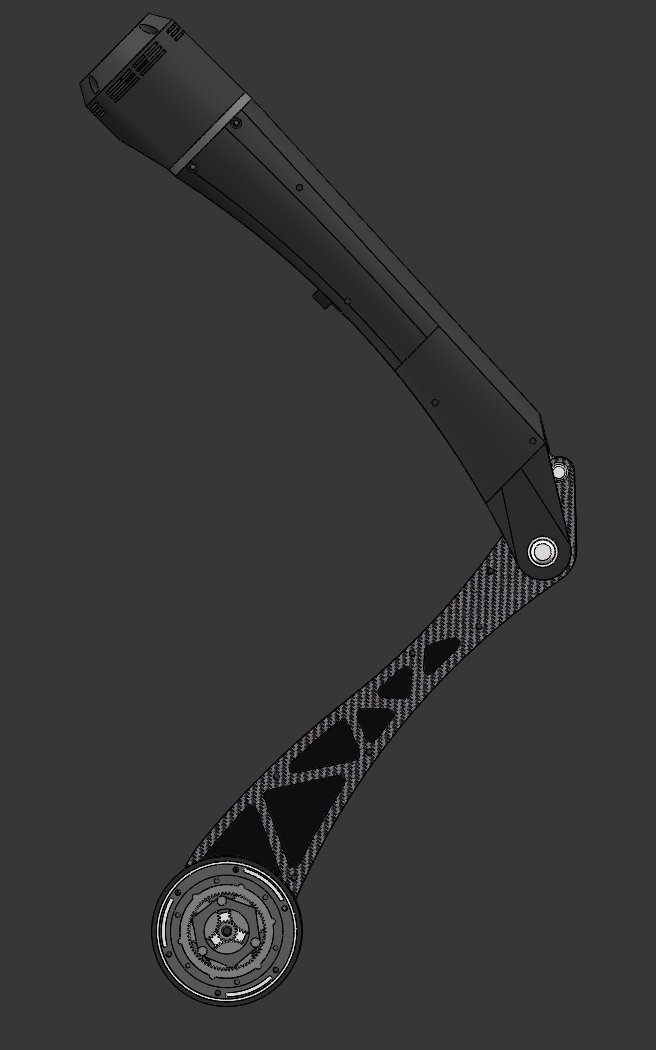
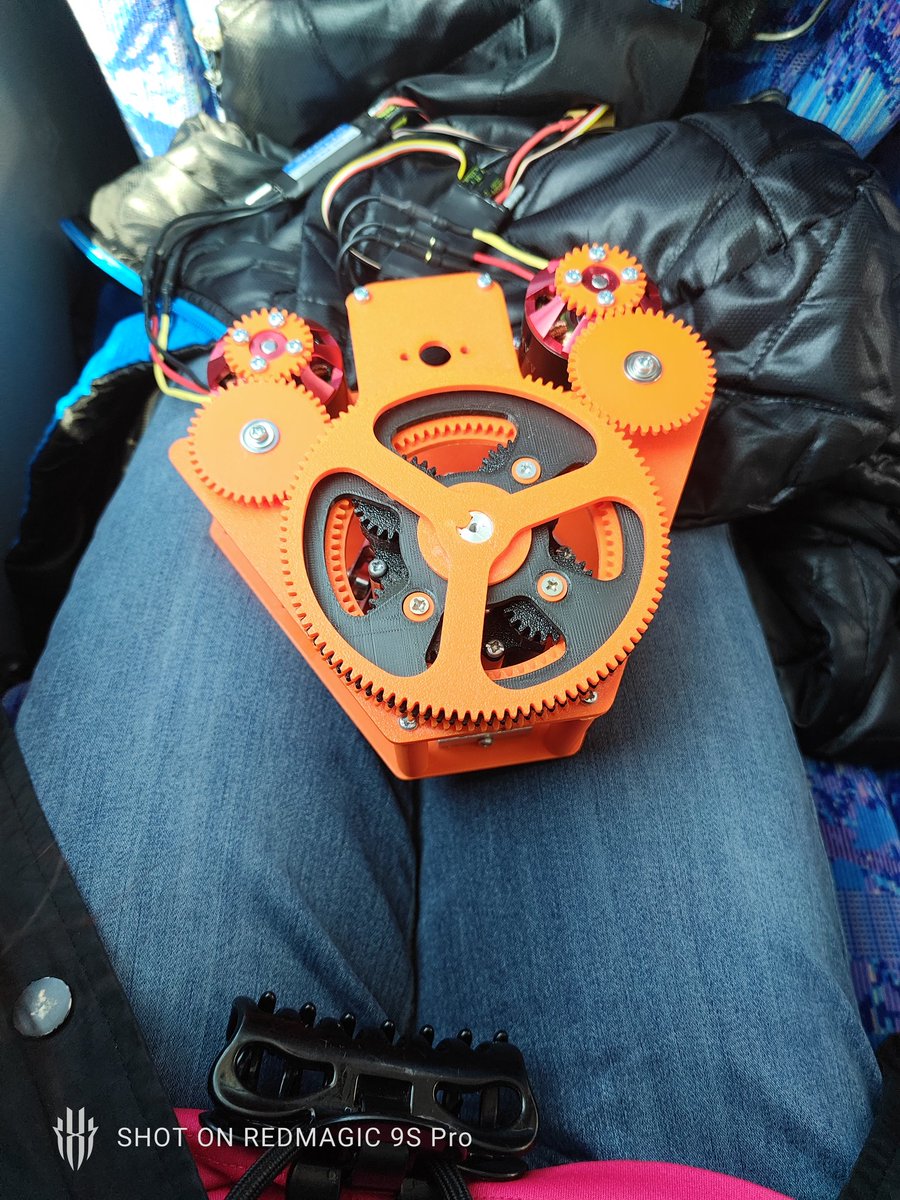
続いてエンドエフェクタを動かすための直動・回転の差動機構です。 重いモーターを機体後方に取り付けることでバランスを取ることを目的にこの形式を取りました。 二人でマックで30秒くらい話して思い付いた機構です。 設計者は@goto_statement です! #キャチロボ
日本語
1
47
245
0
4/4 retweetledi
SKYF
SKYF@SKYF9·
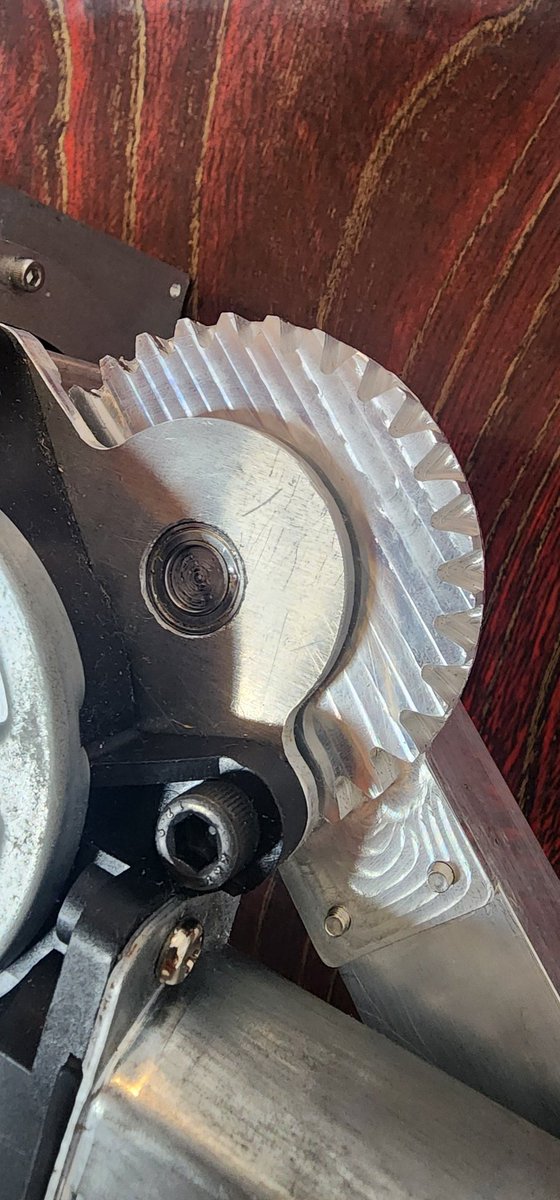
機構について 先端の吸盤は3DP製で、垂直2kgは余裕で持てます。全ロボに持ってった吸盤はBLD用に開発したものだったりします。 重要部はアルミ製で自作CNCにて爆速加工しました。お陰で破損も少なかった(かな) ↓お気に入り削りだしギア
SKYF tweet mediaSKYF tweet media
SKYF@SKYF9

#CoREjp #TRU TRU BLDのアーム作ってました。角度操作が難しい設計になってしまってなかなか回収することが出来ませんでした..。悔しい

日本語
0
9
83
4.6K
4/4 retweetledi
Hao Zhao
Hao Zhao@HaoZhao_AIRSUN·
[CVPR 2026] The embodied AI community is going all-in on human data: teleop, mocap, ego videos… We take a different path: 👉 Generate HOI data from simulation 👉 Bridge to realism with diffusion 👉 Use it to replace human data Introducing PAM — a unified Pose–Appearance–Motion engine. gasaiyu.github.io/PAM.github.io/ github.com/GasaiYU/PAM
English
0
23
104
8.9K
4/4 retweetledi
Kayoum
Kayoum@kayoum_·
This was one of the most asked-for features; users kept telling us the same thing: “Why is checking and iterating on a URDF still such a pain?” So we built it into OORB Studio: drag in a full assembly or individual parts, render instantly, edit XML live, convert URDF <-> MJCF, sync it with the workspace and sim, and use the agent to make changes directly. As a founder, these are my favorite moments, when a feature I wish existed becomes real because we can just go build it. Try it at oorb.io #ROS2 #Robotics #URDF #MJCF
English
0
4
8
1.1K
4/4 retweetledi
Hao Zhao
Hao Zhao@HaoZhao_AIRSUN·
🚀 ORV: 4D Occupancy-centric Robot Video Generation (CVPR 2026) github.com/OrangeSodahub/… What if we could generate photorealistic robot manipulation videos with precise 4D control? With ORV, we condition video generation on 4D semantic occupancy, enabling: ✨ High-fidelity robot videos with fine-grained motion control 🎥 Multi-view generation for building consistent 4D scenes 🧠 Simulation-to-real transfer by plugging directly into physics simulators 🤖 Better downstream robot learning with scalable synthetic data We also release the largest tabletop manipulation occupancy dataset ever built. 🎬 Watch the video ↓
English
2
22
85
14.5K
4/4 retweetledi
Bell🔱🏮😈
Bell🔱🏮😈@uririnriver·
今日のステアも機嫌良さげかな?
Bell🔱🏮😈 tweet media
日本語
1
1
60
1.2K
Forest
Forest@3dsForest·
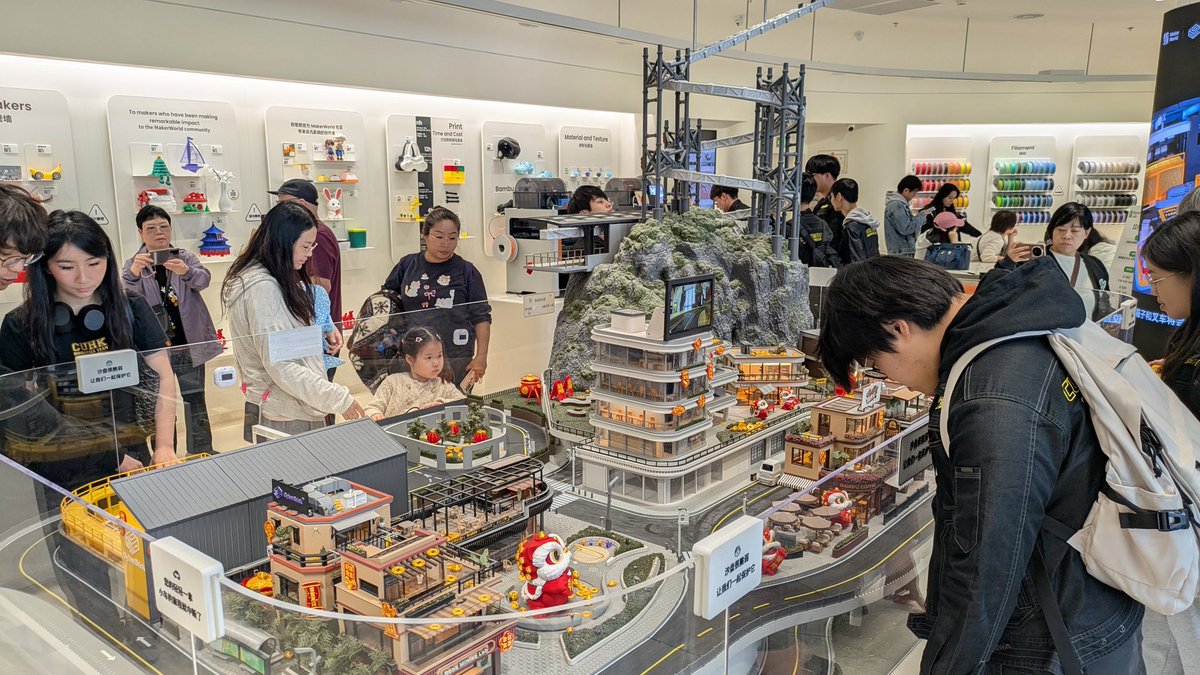
深圳にあるBambuLabのショップ 全部プリンターのジオラマ凄かった!
Forest tweet mediaForest tweet mediaForest tweet media
日本語
1
2
57
2.9K
4/4 retweetledi
Siyuan Huang
Siyuan Huang@siyuanhuang95·
You might have seen the WuBOT performing at the 2026 Spring Festival Gala; however, most high-dynamic extreme motions you see are executed by overfitted tracking policies. Until now, training a unified policy capable of performing various extreme motions with a high success rate remained an unsolved challenge. We spent an entire year digging into the barrier between general tracking and extreme physical behaviors. After burning through dozens of G1 robots, we finally identified the bottleneck of learning and physical executability. With these discoveries, we developed OmniXtreme: the first general policy that can execute diverse extreme motions, including consecutive flips, extreme balancing, and even breakdancing with rapid contact switches! This capability is achieved by pre-training a flow-based generative control policy and then post-training with actuation-aware residual RL for complex physical dynamics—a step we found critical for successful real-world transfer. This work is a joint collaboration with @UnitreeRobotics. Together, we are pushing the physical limits of humanoid robots. It is incredibly exciting to see a general "robot gymnast" and "robot breakdancer" come to life! It was also our first time publishing a paper with XingXing, which was an enlightening experience. The model checkpoints are now released—we welcome you to play with them! 📦 📄 Paper: arxiv.org/abs/2602.23843 🌐 Project: extreme-humanoid.github.io 💻 Code: github.com/Perkins729/Omn…
English
34
149
757
105.4K
4/4 retweetledi
Harrison Kinsley
Harrison Kinsley@Sentdex·
In a world of PPO everything for reinforcement learning, I've been tinkering with SAC for training a quadruped gait. This gait is trained purely on CPU (training on one of the Dell GB10s) on a single environment. Training any particular run is obviously slower than PPO on an RTX Pro 6000 with 8092 envs, if you already know the exact hyperparams/rwd function for your PPO algo... but, if we're honest with ourselves, then we know we usually spend days tuning our PPO algo and fighting it to do what we want. In contrast, SAC has kind of been a breath of fresh air, very amenable to changing the reward function to tune behavior. So far, my first attempts to tune things have consistently just worked immediately rather than 15 different variations of reward hacking only to find previous tuned behaviors got lost in the process. There is also FastSAC, which I've not yet tried, but can speed things up potentially and introduce scale back into the equation. My main painpoint in getting SAC to work for gait was actually getting it to learn to step. It seems as though SAC is not as good as PPO at significant exploration on its own. I ended up starting with a sinusoidal gait (basically just a rule to make legs swing) as training wheels then blended it out through training as phase 1, then began working on smoothing things out after this. I think if we look at end to end dev time rather than any particular run that finally managed to work, SAC may actually be the "faster" algorithm to train. Quadruped gaits are inherently easier than bipedal and maybe there are areas where SAC falls short, but I'll definitely be spending more time with SAC.
English
18
26
314
26.7K
4/4 retweetledi
The Humanoid Hub
The Humanoid Hub@TheHumanoidHub·
Perceptive Humanoid Parkour (PHP) introduces a modular framework that enables the Unitree G1 humanoid to perform long-horizon, vision-based parkour. - It chains retargeted human motion clips into diverse, long-horizon kinematic reference trajectories. - RL expert policies learn individual skills that are distilled into a depth-conditioned student policy. - The robot autonomously selects the appropriate skill based on the obstacle geometry.
English
19
128
775
60.7K