Martin

15.6K posts

Martin banner
Martin

Martin

@MartinTweats

Exploring the Principle of Sufficient Reason and its implications for metaphysics, epistemology, ontology, phenomenology, and logic.

Ancient Kingdom of Mercia (UK) Katılım Şubat 2026
607 Takip Edilen632 Takipçiler
Sabitlenmiş Tweet
Martin
Martin@MartinTweats·
I present 14 A priori and a posteriori arguments for the existence of God including logic. A PRIORI ARGUMENTS 1. ONTOLOGICAL ARGUMENT (ANSELM) Idea: God is defined as the greatest conceivable being. A being that exists necessarily is greater than one that exists only contingently. Formalization: 1. God is, by definition, a being than which no greater being can be conceived. 2. A being that exists necessarily is greater than a being that exists contingently. 3. If God exists only in the understanding but not in reality, then a greater being could be conceived (one that exists in reality). 4. Therefore, a greater being than God could be conceived. 5. This contradicts the definition of God. 6. Therefore, God exists. Symbolically: - Let G = God exists. - Let N(x) = x exists necessarily. - Let M(x) = x is the greatest conceivable being. - M(G) -> N(G) - N(G) -> G Therefore: G 2. MODAL ONTOLOGICAL ARGUMENT (PLANTINGA) Idea: If God's existence is possible, then because God is a necessary being, God exists in all possible worlds. Definitions: □ = necessarily ◇ = possibly Premises: It is possible that a maximally great being exists. ◊G A maximally great being exists necessarily if it exists. G -> □G If something possibly exists necessarily, then it necessarily exists. ◊□G -> □G Conclusion: □G Therefore: G 3. ARGUMENT FROM NECESSARY EXISTENCE Idea: Contingent reality cannot ultimately explain itself. Definitions: C(x) = x is contingent N(x) = x is necessary E(x) = x explains existence Premises: Some contingent things exist. ∃x(C(x) ^ E(x)) Every contingent thing requires an explanation. ∀x(C(x) -> ∃y(E(y,x))) An infinite chain of contingent explanations cannot provide a sufficient explanation. ¬∞C Therefore, there must be a necessary foundation. ∃x(N(x)) The necessary foundation is God. N(x) -> G Conclusion: G 4. MORAL ARGUMENT (KANTIAN / CONTEMPORARY) Idea: Objective moral values require an objective grounding. Definitions: O = objective moral values exist G = God exists Premises: Objective moral values exist. O If objective moral values exist, then God exists. O -> G Conclusion: G 5. ARGUMENT FROM ABSTRACT OBJECTS Idea: Mathematical and logical truths exist necessarily. Necessary truths require a necessary mind. Definitions: A = abstract objects exist M = a necessary mind exists Premises: Necessary truths exist. ∃x(N(x)) Necessary truths require a necessary foundation. N(x) -> M The best candidate for a necessary mind is God. M -> G Conclusion: G A POSTERIORI ARGUMENTS 6. KALAM COSMOLOGICAL ARGUMENT Idea: Whatever begins to exist has a cause. The universe began to exist. Therefore, the universe has a cause. Definitions: B(x) = x begins to exist C(x) = x has a cause Premises: Everything that begins to exist has a cause. ∀x(B(x) -> C(x)) The universe began to exist. B(U) Therefore, the universe has a cause. C(U) The cause of the universe must be outside space and time. C(U) -> T A timeless, spaceless, immaterial, powerful personal cause is God. T -> G Conclusion: G 7. LEIBNIZIAN CONTINGENCY ARGUMENT Idea: Everything that exists has an explanation. The universe cannot explain itself. Definitions: R(x) = x has a sufficient reason C(x) = x is contingent Premises: Everything that exists has a sufficient reason. ∀x(E(x) -> R(x)) The universe exists. E(U) The universe is contingent. C(U) The explanation of the universe cannot itself be contingent. C(x) -> ¬R(x) Therefore, the explanation must be necessary. N(x) A necessary being is God. N(x) -> G Conclusion: G 8. TELEOLOGICAL / DESIGN ARGUMENT Idea: Order and complexity suggest intelligence. Definitions: O = order/complexity exists D = designer exists Premises: The universe displays specified complexity/order. O Such order is more likely produced by intelligence than chance. O -> D A cosmic designer is God. D -> G Conclusion: G 9. FINE-TUNING ARGUMENT Idea: The constants of physics appear extraordinarily calibrated for life. Definitions: F = universe is fine-tuned D = design C = chance Premises: The universe is fine-tuned. F Fine-tuning is more probable under design than chance. P(F∣D) > P(F∣C) Therefore, design is the best explanation. D Design implies God. D -> G Conclusion: G 10. ARGUMENT FROM CONSCIOUSNESS Idea: Consciousness may not be explainable by physical processes alone. Definitions: C = consciousness exists P = physicalism is true G = God exists Premises: Consciousness exists. C If physicalism is true, consciousness should be reducible to physical processes. P -> R Consciousness is not reducible to physical processes. ¬R Therefore physicalism is false. ¬P A non-physical foundation of consciousness exists. N God is the best explanation of this foundation. N -> G Conclusion: G 11. ARGUMENT FROM REASON Idea: Rational thought requires a rational foundation. Premises: We trust reason. R If naturalism is true, human reasoning is only the product of survival pressures. N -> S Survival does not guarantee truth. S !-> T Therefore, naturalism undermines confidence in reason. N -> ¬R A rational source of reason explains reason. G -> R Conclusion: G 12. RELIGIOUS EXPERIENCE ARGUMENT Idea: Experiences of God provide evidence for God. Premises: Many people report experiences of God. E Unless there is a defeater, people are generally justified in trusting experiences. E -> J Religious experiences are not defeated. ¬D Therefore, belief in God is justified. J(G) Conclusion: G 13. MIRACLE ARGUMENT Idea: Certain events are best explained by divine intervention. Premises: A miracle occurred. M A miracle is more probable given God than naturalism. P(M∣G) > P(M∣¬G) Therefore, God is the best explanation. G 14. RESURRECTION ARGUMENT Idea: Historical facts surrounding Jesus' death and appearances support resurrection. Premises: Jesus was crucified. C His followers sincerely believed they saw him alive afterward. A The resurrection hypothesis best explains these facts. R > H Resurrection implies divine action. R -> G Conclusion: G #God #Theism #Atheism
English
29
3
16
1.5K
Martin
Martin@MartinTweats·
@JCrikets36515 The necessary part is not an attribute, but essence.
English
1
0
0
30
Philosophy Jim
Philosophy Jim@JCrikets36515·
@MartinTweats So given that he doesn’t need anything with both interaction or reaction to anything in the world, not a possible world. Then the necessary being part isn’t needed as a description of him. Due to the lack of him not needing anything as you say.
English
1
0
0
26
Martin
Martin@MartinTweats·
MODAL ONTOLOGICAL ARGUMENT (PLANTINGA) Idea: If God's existence is possible, then because God is a necessary being, God exists in all possible worlds. Definitions: □ = necessarily ◇ = possibly Premises: It is possible that a maximally great being exists. ◊G A maximally great being exists necessarily if it exists. G -> □G If something possibly exists necessarily, then it necessarily exists. ◊□G -> □G Conclusion: □G Therefore: G
English
34
1
25
1.5K
Bruce Wayne
Bruce Wayne@BruceWayneDND·
@MartinTweats I’m not affirming or conceding either one. I’m pointing out that neither modal claim has been established. The burden is to justify “is it possible that god exists”, not assume it by default.
English
3
0
1
23
視界のノイズ
視界のノイズ@athletes_kotoba·
本当の綿菓子は細部に隠されている
日本語
133
235
5.3K
2M
Martin
Martin@MartinTweats·
@JCrikets36515 God does not require anything. If God required just one thing, then that one thing would mean that God is contingent rather than necessary.
English
1
0
1
29
Philosophy Jim
Philosophy Jim@JCrikets36515·
Requires a chemical reaction. So a necessary being requires something. Which according to what was wrote is the opposite of immaterial existence? So it requires immaterial substance. With that being said according to your standard. God requires an interaction and requires an immaterial substance. There hasn’t been an interaction or a reaction since the resurrection. This is divine hiddenness. So in a real world not a possible world lacking interaction or reaction. God can’t be a necessary being.
English
1
0
0
27
Martin
Martin@MartinTweats·
@BruceWayneDND Is it necessary that God does not exist, or is it possible that God exists?
English
1
0
0
27
Bruce Wayne
Bruce Wayne@BruceWayneDND·
@MartinTweats Side note: plantinga is a great read whether you agree with him or not.
English
1
0
1
37
Martin
Martin@MartinTweats·
@JCrikets36515 Dragons have material existence, e.g., a body, head, tail, wings and usually breath fire that requires a chemical reaction. Therefore, the dragon is contingent on extension, relation, mass and spacetime, i.e., the dragon is contingent, not necessary.
English
2
1
4
64
Philosophy Jim
Philosophy Jim@JCrikets36515·
Dragons don’t exist in spacetime. And who says it’s not a necessary being. Sure it has all the above. But I believe that one of them is possible to be the greatest maximum being dragon. Having all the characteristics of a god. Just not the label unfortunately. This comes to a circular argument just like possible worlds is a circular argument.
English
1
0
0
22
Martin
Martin@MartinTweats·
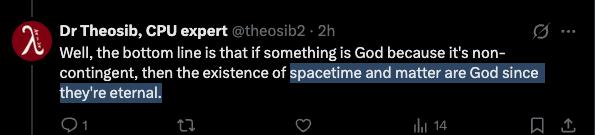
@theosib2 @AleMartnezR1 @Danish_SMF 1. You said that spacetime and matter are eternal (see screenshot). 2. You then said that you don't accept that assumption. But it was your claim.
Martin tweet media
English
1
0
0
13
Danish Gerd
Danish Gerd@Danish_SMF·
The argument is circular. It assumes what it needs to prove: that God is not contingent. If you can accept a necessary being without evidence, the universe is a simpler candidate. Your argument doesn't get you to God It just restates your belief. 2
Natural Theist@AleMartnezR1

1. If it were possible for God not to exist, then God would be no different from creatures in their contingency. 2. God is different from creatures in their contingency. Therefore, is not possible for God not to exist

English
6
0
12
905
Martin
Martin@MartinTweats·
@theosib2 @AleMartnezR1 @Danish_SMF Is it true or false that a object being contingent on 𝐗 = ∑ [n = 1 to N] Δ𝐱ₙ and T = ∑ [n = 1 to N] Δtₙ entail that the object is contingent itself, as it would fail to exist without X and T?
English
1
0
0
13
Martin
Martin@MartinTweats·
@JCrikets36515 @sq9wjg A dragon is not a necessary being, e.g., it has extension, volume, quantity, mass and exists in spacetime.
English
0
0
0
13
Philosophy Jim
Philosophy Jim@JCrikets36515·
Who is to say dragons aren’t necessary beings? Or unicorns? Platinga himself recognized these possible issues being brought up. You just like to hear the one side instead of the other. Platinga brings up great arguments but as a philosopher he also brings up great counters. Religion or religious people prefer one side. Philosophy see both arguments. And it’s up to the person to determine the best explanation. Possible worlds is not the best explanation if anything it’s stretching for some “truth”. Smuggling in the characteristics of a necessary being for it. And then it tops it off with special pleading with your own example of dragons not being necessary.
English
2
0
0
22
Martin
Martin@MartinTweats·
@JCrikets36515 A unicorn is not a necessary being, e.g., it has extension, volume, quantity, mass and exists in spacetime. A dragon is not a necessary being, e.g., it has extension, volume, quantity, mass and exists in spacetime. Therefore, your analogy fails.
English
2
0
3
39
Philosophy Jim
Philosophy Jim@JCrikets36515·
All possible worlds is horrid idea to believe. Everyone can use this possible worlds with the same ontological value and argument for dragons, unicorns. I brought up dragons and unicorns that could exist with the same ontological values as your god. In a possible world due to your belief in it. You will need to tell me why they don’t exist.
English
3
0
1
82
Martin retweetledi
Natural Theist
Natural Theist@AleMartnezR1·
Dr. Andrew Loke´s cosmological argument 1. There exist entities that: (i) are members of a causal series; and (ii) begin to exist. 2. Everything that begins to exist has a cause. 3. If there is an entity that: (i) is a member of a causal series; and (ii) begins to exist, then there is an uncaused entity X. 4. There exists an X which is uncaused and beginningless (From 1, 2 and 3). 5. If X is uncaused and beginningless, nothing exists prior to it, and therefore it is a First Cause. 6. X is a First Cause (From 4 and 5).
English
5
4
6
393
Martin
Martin@MartinTweats·
@BruceWayneDND Yes. Plantinga argues that it is possible unless a contradiction can be shown.
English
1
0
1
52
Martin
Martin@MartinTweats·
@theosib2 @AleMartnezR1 @Danish_SMF Your mistake here is in assuming that I was not talking about time, when in fact I referred to time not only once, not only twice but three times. I don't think I could have been more explicit in pointing out that I was talking about time.
Martin tweet media
English
1
0
0
17
Dr Theosib, CPU expert
@MartinTweats @AleMartnezR1 @Danish_SMF Your mistake here is in assuming that all causal chains are of infinite length. They are not. You can perfectly well have infinite time but all finite causal chains, resulting in an infinitude of things that come into being.
English
1
0
1
20
Martin
Martin@MartinTweats·
To your first point, you claim that it is only the properties of extension that are contingent, but not the object that has the property of extension. On the contrary, if an object has extension, then it is contingent on (a) space to extend into, and (b) time for it to extend. We can describe space as: 𝐗 = ∑ [n = 1 to N] Δ𝐱ₙ An object requires X to exist in order for it to extend: At time t1, object A starts extending into X. At time t2, object A has extended X. The events at t1 and t2 are both contingent on space, e.g., object A cannot start extending unless X exists, and cannot finish extending unless X has a bounded amount of space. In regards to time, we can describe it as: T = ∑ [n = 1 to N] Δtₙ An object is contingent on T in order to extend into X. At time t1, object A starts extending into X where t1 is unequal to t2. At time t2, object A has extended into X where t2 is unequal to t1. Therefore, it is the case that if a thing has extension then it is contingent on the existence of time and space, that is: Object A <-> (𝐗 = ∑ [n = 1 to N] Δ𝐱ₙ ^ T = ∑ [n = 1 to N] Δtₙ) To your second point, you stated that God having no extension, relation, quantity, mass and does not exist in spacetime is an unjustified assumption. On the contrary, if God had any of those properties, then God would not be God, as he would be a non-God. You are breaking the law of identify: A = A That is, you are redefining God as a thing that is not God. God's identity at the start of the argument is: A = A But you try to redefine God's identify as: A = B Therefore, you have made God unidentical to Himself, which of course is a fallacy. If God has any of those properties, then He could fail to exist, i.e., contingency.
Dr Theosib, CPU expert@theosib2

@MartinTweats @AleMartnezR1 @Danish_SMF The stuff making up the thing with extension, etc. isn't contingent. Only the extension, etc are. = Spacetime and the matter/energy in it are a necessary being. "God has no extension, relation, quantity, mass and does not exist in spacetime" Unjustified assumption.

English
0
1
9
409
Martin
Martin@MartinTweats·
To your first point, you claim that it is only the properties of extension that are contingent, but not the object that has the property of extension. On the contrary, if an object has extension, then it is contingent on (a) space to extend into, and (b) time for it to extend. We can describe space as: 𝐗 = ∑ [n = 1 to N] Δ𝐱ₙ An object requires X to exist in order for it to extend: At time t1, object A starts extending into X. At time t2, object A has extended X. The events at t1 and t2 are both contingent on space, e.g., object A cannot start extending unless X exists, and cannot finish extending unless X has a bounded amount of space. In regards to time, we can describe it as: T = ∑ [n = 1 to N] Δtₙ An object is contingent on T in order to extend into X. At time t1, object A starts extending into X where t1 is unequal to t2. At time t2, object A has extended into X where t2 is unequal to t1. Therefore, it is the case that if a thing has extension then it is contingent on the existence of time and space, that is: Object A <-> (𝐗 = ∑ [n = 1 to N] Δ𝐱ₙ ^ T = ∑ [n = 1 to N] Δtₙ) To your second point, you stated that God having no extension, relation, quantity, mass and does not exist in spacetime is an unjustified assumption. On the contrary, if God had any of those properties, then God would not be God, as he would be a non-God. You are breaking the law of identify: A = A That is, you are redefining God as a thing that is not God. God's identity at the start of the argument is: A = A But you try to redefine God's identify as: A = B Therefore, you have made God unidentical to Himself, which of course is a fallacy. If God has any of those properties, then He could fail to exist, i.e., contingency.
English
1
0
0
29
Dr Theosib, CPU expert
@MartinTweats @AleMartnezR1 @Danish_SMF The stuff making up the thing with extension, etc. isn't contingent. Only the extension, etc are. = Spacetime and the matter/energy in it are a necessary being. "God has no extension, relation, quantity, mass and does not exist in spacetime" Unjustified assumption.
English
1
0
0
444
Martin
Martin@MartinTweats·
@theosib2 @AleMartnezR1 @Danish_SMF If spacetime and matter are eternal then and infinite amount of unbounded time would have to pass in order for you to come into being; that is, you would never come into being. However, you have come into a being; therefore, time is certainly not eternal.
English
1
0
1
22