
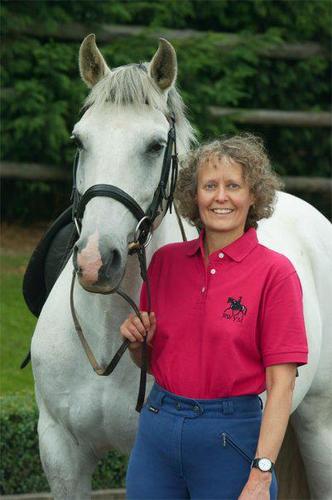
Mary Wanless

410 posts

Mary Wanless banner
Mary Wanless

Mary Wanless

@MaryWanless

Mary Wanless is an internationally renowned rider biomechanics coach and author of the 'Ride With Your Mind' books and videos

Katılım Temmuz 2013
301 Takip Edilen490 Takipçiler
Mary Wanless
Mary Wanless@MaryWanless·
I love the quote from T S Elliot: ‘We shall not cease from exploration, and the end of all our exploring will be to arrive where we started and know the place for the first time.’ There is only walk, trot and canter-and repeatedly, we get to know them ‘as if for the first time’.
English
1
0
12
0
Mary Wanless
Mary Wanless@MaryWanless·
This is like looking through the kineasthetic version of looking through ever stronger microscope lenses, perceiving subtleties that you could not have noticed (or even imagined) before. There was a time when you didn’t know what there is to know… and actually you still don’t!
English
0
0
2
0
Mary Wanless
Mary Wanless@MaryWanless·
Supposing you ride for 30 years. What changes in that time is the ’its’ that you get and lose, and the sophistication of the nervous system through which you process those ‘its’. 10,000 hours is needed for the nervous system (your feel sense) to develop elite perceptual skills.
English
0
0
5
0
Mary Wanless
Mary Wanless@MaryWanless·
Whatever life you lead, your goal can always be incremental, continuous improvement. Expect this to require concentration and commitment; dedication, determination and discipline. Expect it to be challenging and captivating. With or without the Olympics it will change your life!
English
0
3
10
0
Mary Wanless
Mary Wanless@MaryWanless·
10,000 hours is 4 hours/day, 5 days/week, 50 weeks/year, for 10 years! Not everyone’s life allows this - and not everyone whose life allows it maintains enough focus for deliberate practice. Only this counts: so ignore any time you spent trying, day dreaming, etc. What’s left?
English
0
0
6
0
Mary Wanless
Mary Wanless@MaryWanless·
Research has shown that becoming elite at any skill (clocking up all of those repetitions in various stages of conscious competence) takes 10,000 hours of deliberate practice. You keep ’getting it’ and ‘losing it’ within a sequence of increasingly subtle ‘its’. #dressage
English
0
3
8
0
Mary Wanless
Mary Wanless@MaryWanless·
I have seen experienced riders become very good at feeling & using language in more descriptive & innovative ways. All they needed was to be given permission and offered some suggestions. When language becomes your servant and not your master, your whole world changes. #horse
English
0
0
4
0
Mary Wanless
Mary Wanless@MaryWanless·
Inuit people have many words for snow - their life depends on making distinctions and passing these on to their children. Some native tribes have very few words for colours, and with only 3 words they (literally) see only 3 colours. Language expands or limits our perceptions.
English
0
0
7
0
Mary Wanless
Mary Wanless@MaryWanless·
I would love to hear elite riders talk openly about their ongoing learning. Our traditional language presents a huge limitation - like censorship it prohibits riders from thinking ‘out of the box’. Few describe their experience in ways that go beyond traditional prescriptions.
English
0
1
13
0
Mary Wanless
Mary Wanless@MaryWanless·
The horse world vastly over-rates automation. Famous tennis players & golfers talk about opening rewiring their serve/swing etc. In order to not go backwards in the rankings they have to be going forwards. They are role models who create expectations about honing skill - forever!
English
0
0
6
0
Mary Wanless
Mary Wanless@MaryWanless·
It does not pay to do anything that makes your learning harder! There may be kudos to training with an elite rider who is a known name. But can she cross the gap between you and her, and break her skill into ‘bite size chunks’? When the answer is ‘No’, there’s a price being paid.
English
0
2
8
0
Mary Wanless
Mary Wanless@MaryWanless·
In Zen philosophy the learning process is a ‘school of hard knocks’ - an emotional journey in which the pupil learns about herself through being ‘up against it’. But learning riding skills is hard enough even when you stack the odds in your favour and know how learning works!
English
0
0
4
0
Mary Wanless
Mary Wanless@MaryWanless·
The beginner has habits that run her. ‘Premature automation’ has left her stuck in a repeating grove (like a broken record). The Master has ingrained habits that she runs. They are fast, efficient and reliable, enabling her to ‘read’ her horse and improvise in each moment. #horse
English
0
0
2
0
Mary Wanless
Mary Wanless@MaryWanless·
When the ‘HOW TO’S’ fail it’s tempting to ‘shout louder at the natives’: ’Do it; Do it now; Do it more; Do it again; Do it better!’ I heard of an international team squad, whose big-name trainer would end up yelling ‘Ride better!’. Even with elite riders this has limited success!
English
0
0
6
0
Mary Wanless
Mary Wanless@MaryWanless·
The territory an elite rider has mapped is determined by the fixes she’s made. When trainers meet someone whose problem is not on their map, most do not know what to do. Those riders are often dismissed or shouted at. Despite their hopes and dreams, no magic rubs off on them!
English
0
0
4
0
Mary Wanless
Mary Wanless@MaryWanless·
Less talented riders have mapped a lot of territory - they have rewired many defaults.Their map might not go high as an elite rider's, but it has a broader base. When they see a rider with a problem, that issue is probably one they’ve mapped (and hopefully remembered)! #horse
English
0
0
6
0
Mary Wanless
Mary Wanless@MaryWanless·
Research has shown that athletes with a more conscious understanding of their skill are less prone to slumps - bad days/weeks/months. When something goes wrong and they ‘lose it’ they are more able to self-diagnose and find the missing pieces in the puzzle. #dressage #horse
English
0
2
10
0
Mary Wanless
Mary Wanless@MaryWanless·
‘Autopilot’ - where we no longer know (consciously) what we know (unconsciously) - is efficient, as it frees up the brain for new learning. But it is ironic that we work so hard to make and insulate those new circuits, and then forget that we did so! hashtag? #dressage #horse
English
0
0
4
0
Mary Wanless
Mary Wanless@MaryWanless·
It is natural to forget the ABCs etc. as unconscious competence creates ‘expertise induced amnesia’. So committed coaches teach from memory, retaining words to say it. They have to work hard to remember (& validate) skills that are now unconscious (automatic) in their own riding.
English
0
1
5
0