John Horton Conway was not only a profound contributor to serious mathematics but also someone who embraced the beauty of play—bringing ideas to life through puzzles, games, and infectious enthusiasm. Like Richard Feynman, his lectures were packed not just for insight, but for the experience.
One day in 1927, the great Hofrat Julius Wagner-Jauregg of Vienna was sitting in a compartment of a railway carriage in Sweden, waiting for the train to take him to Stockholm, where he was to receive the Nobel Prize in Medicine.
He had won the prize for his discovery of a treatment for mental illness by raising patients’ body temperatures, in practice by inducing fevers through malaria.
As he waited for the train to start, a lady stepped into the compartment and sat opposite him. They fell into conversation, and it turned out that she too was on her way to the Royal Palace in Stockholm to receive a Nobel Prize. Hers was the Prize in Literature. She was the Sardinian poet Grazia Deledda.
She had written a novel about a young man who was insane and, in his madness, wandered through the Macedonian marshes. There he became soaked, developed a high fever, and was cured of his insanity.
This story is from an article by the well-known biochemist W. E. van Heyningen, published in Trends in Biochemical Sciences, No. 177, August 1979.
Look at Marie Curie, the only woman at the Solvay Conference with giants like Einstein, Bohr, Planck, Schrödinger, and Dirac, and completely owning her place.
Born into poverty in Poland, denied higher education because she was a woman, she moved to France at 24 and earned not one but two degrees while supporting herself.
Then she did the unthinkable. She became the first, and still the only, person to win two Nobel Prizes in different sciences, Physics and Chemistry.
During World War I, she created mobile X-ray units, brought radiology to the battlefield, and donated her Nobel Prize money to the war effort, yet received little recognition.
She and Pierre Curie refused wealth, shared their discoveries freely, and never patented their work because science, to her, belonged to humanity.
She kept working even as radiation slowly killed her.
Someone once asked A. C. Aitken, a professor at Edinburgh University, to convert 4 ÷ 47 into a decimal.
After four seconds, he began and produced another digit every three-quarters of a second: “0.08510638297872340425531914.”
He stopped, discussed the problem for one minute, and then restarted: “191489”—after a five-second pause—“361702127659574468. Now that’s the repeating part. It starts again with 085. So if that’s forty-six places, I’m right.”
To many of us, such a man seems to be from another planet, especially in light of his final comment.
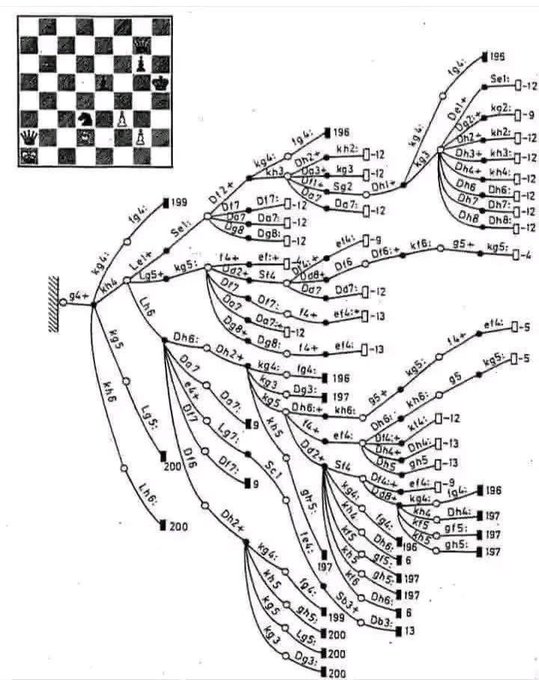
At the start of a chess game, you have 20 possible moves. After just one full move, there are over 400 positions. By move 3, it’s about 8,900, and by move 4, nearly 200,000.
By move 40, the number of possible games grows to around 10⁴⁰ — similar to the number of atoms in the observable universe.
An engineer, a physicist, a mathematician, and a chemist walk into a bar.
The engineer orders a half pint.
The physicist orders 1/2 pint.
The mathematician orders 0.5 pint.
The chemist orders 5.0 × 10⁻¹ pints.