
Matt Kelly

2.5K posts

Matt Kelly banner
Matt Kelly

Matt Kelly

@MattShawnKelly

I am an imperfect human, trying to continually improve as a husband, father, friend & leader | Virtue • Diligence • Love | Stillness is where truth is found

Austin, TX, USA Katılım Eylül 2011
824 Takip Edilen289 Takipçiler
Matt Kelly retweetledi
Avi Chawla
Avi Chawla@_avichawla·
Karpathy said something you'll regret ignoring: "Remove yourself as the bottleneck. Maximize your leverage. Put in very few tokens, and a huge amount of stuff happens on your behalf." The reason most people can't do this today is because their AI has little to no memory of their work. You sit in meetings, read threads, make decisions, and your brain quietly drops half of it by next week. Then you spend time re-reading, re-asking, re-explaining context to your own AI. You can't remove yourself from the loop when YOU are the only one who remembers what happened. That's why the smartest builders are setting up AI second brains that compound everything automatically. Rowboat is an open-source implementation of exactly this, built on top of the same Markdown-and-Obsidian foundation that Karpathy uses, but extended into a work context. Emails, meetings, decisions, commitments, and deadlines, everything is linked in a knowledge graph that gets denser every day without you touching it. And the whole setup runs 100% locally. 6 months from now, you'll either have an AI second brain or wish you did. Find my full 100% local setup guide in the article quoted below to start today. Here's the Rowboat Repo: github.com/rowboatlabs/ro… (don't forget to star it 🌟)
Avi Chawla@_avichawla

x.com/i/article/2052…

English
35
86
925
177.7K
Matt Kelly retweetledi
Ole Lehmann
Ole Lehmann@itsolelehmann·
POV: claude traveled 6 months into the future and told you exactly how your next move failed. it's called a premortem. daniel kahneman (nobel prize-winning psychologist behind "thinking fast and slow") called it his single most valuable decision-making technique. google, goldman sachs, and procter & gamble all use it before major launches. here's the problem it solves. when you ask claude "is this a good plan?" it finds all the reasons to say yes. that's what it was trained to do. so you walk away feeling confident. you execute, and spend weeks / months building on top of that plan. then it blows up. and you realize the problem was obvious in hindsight, you just never stress-tested it because claude told you it was solid. a premortem fixes this by flipping the frame. instead of asking "what could go wrong?" you tell claude "it's 6 months from now and this is already dead. tell me how it died." that shift turns off claude's optimism because there's nothing to be optimistic about. the premise already says it failed. so claude stops looking for reasons your plan will work and starts explaining how it fell apart. claude comes back with every way your plan could die, each one with a full failure story and the early warning signs to watch for. then a synthesis pulls it all together: > which failure is most likely > which failure is most dangerous > the single biggest hidden assumption you're making (often the most valuable part) > a revised version of your plan with the gaps closed you say "premortem this" and give it your plan. the skill handles the rest.
Ole Lehmann tweet media
English
142
620
6.1K
658.6K
Matt Kelly retweetledi
Shann³
Shann³@shannholmberg·
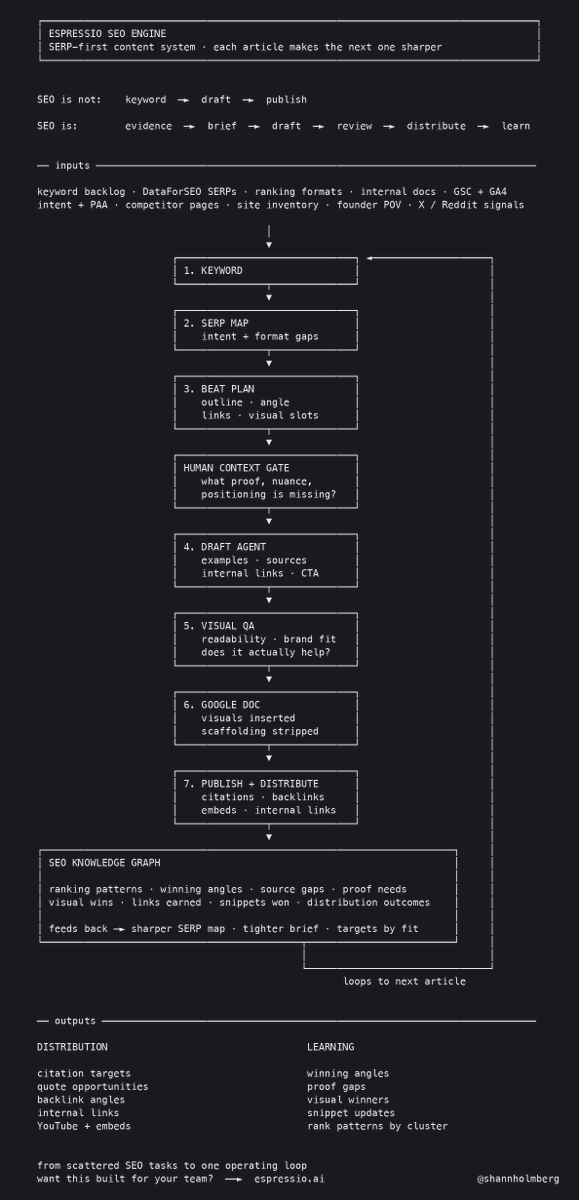
how to get AI SEO articles indexed and ranking in under 14 days most SEO workflows break between keyword research, drafting, review, and distribution at Espressio we turned ours into one operating loop, 7 agents passing work from keyword backlog to distributing backlinks what kills the slop is a human input that system waits on before anything gets written here´s how it runs 🧵
Shann³ tweet media
English
27
34
363
58.9K
Matt Kelly retweetledi
Rohit Ghumare
Rohit Ghumare@ghumare64·
This closes a loop I've been working on for three months. Every agent harness debate has a hidden assumption: that the harness is a thing on top of the backend. Anthropic, OpenAI, LangChain, CrewAI argue about how thick that wrapper should be. Nobody questions that it's a wrapper. Mike's argument is harder. The harness isn't on top of the backend. The harness IS the backend, once you have the right primitives. The math that forces the issue: N agents and M services produce N² × M stochastic paths to debug. One agent + 5 services = 5 paths. Four agents + 5 services = 80. You can't ship that and sleep. What most teams build today: agent runs in a Python process, decides to act, translates a tool call into an HTTP request, which triggers a queue publish, which writes to a database. Three retry schedules. Three timeout policies. No shared trace. Debugging means timestamp correlation across systems with different log formats. This is stochastic LLMs ran unning inside deterministic backends, and it's why production agent bills look the way they do. Stop treating the agent's loop, tools, and memory as a separate layer. Make them participants in the same execution model as everything else. Three primitives: → Worker, any process that connects (Python, TS, Rust, browser tab, microVM) → Function, a unit of work with a stable ID (orders::validate, llm::summarize) → Trigger, what causes a function to run (HTTP, cron, queue, state change, stream) An agent is a worker. A queue is a worker. A sandbox is a worker. They all register functions and triggers. They all participate in the same discovery, observability, and trace pipeline. Three properties drop out that legacy architectures can't produce: Live discovery: a connecting worker gets the full catalog of every function on every other worker. For agents this is cognitive infrastructure. No stale tool descriptions. Live extensibility: add capabilities to a running system without redeploys. The agent can install a new worker mid-task and use it on the next call. Live observability: one trace across languages, across queue handoffs, across the agent-backend boundary. Not three systems with timestamp correlation. The recursion is where it gets interesting. An agent worker can spawn a sandbox worker at runtime. Hardware-isolated. Registers its own functions. Joins the live catalog. Gets torn down when done. Same primitive. The agent extended itself with a capability that didn't exist when it started. This also collapses the thin vs. thick harness debate. A thin harness is a worker with few functions. A thick harness is a worker with more functions and explicit gates. Same system, different composition. The pattern is the same one that's worked twice before. Everything-is-a-file made Unix composable. Components-as-functions made React's mental model stick. Worker / Function / Trigger is the same shape applied to backend execution. Paradigm shifts don't add features. They collapse categories.
Mike Piccolo@mfpiccolo

x.com/i/article/2049…

English
29
46
608
108.3K
Matt Kelly retweetledi
Charlie Hills
Charlie Hills@charliejhills·
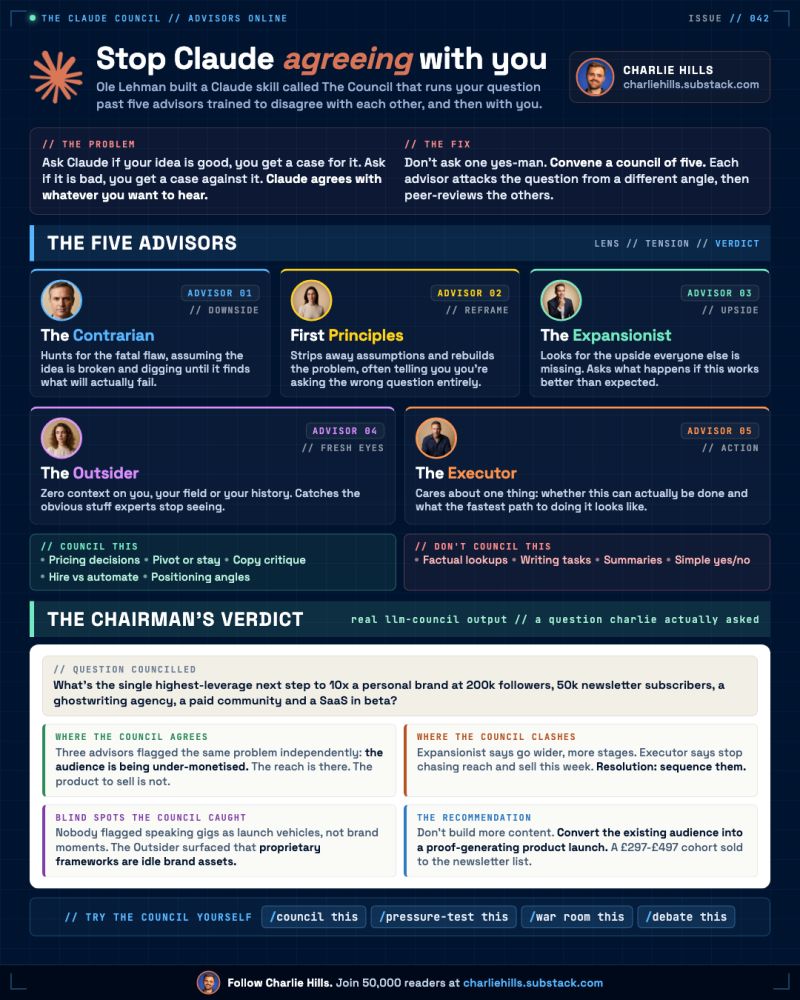
Claude will gaslight you, until you install this skill. It's called The LLM Council. You ask a question. 5 advisors attack it from different angles. Then they peer-review each other before giving you the verdict. How it works: 1. You ask a real decision question. 2. 5 advisors attack it from different angles. 3. They grade each other's work anonymously. 4. Chairman synthesises one verdict and the next step. Install in 4 steps: 1. Download the skill drive.google.com/file/d/16N7dwX… 2. Open Customise skills in Claude 3. Upload the SKILL.md file 4. Type /llm-council One Claude tells you you're right. Five Claudes show you where you're wrong. Get more free AI guides here charliehills.substack.com Repost ♻️ to help someone in your network. P.S. Credit to Ole Lehmann for building it.
Charlie Hills tweet media
English
117
394
3K
327.5K
Matt Kelly retweetledi
Shann³
Shann³@shannholmberg·
the 5 levels of AI marketing is still the clearest map I have for where most marketing teams are stuck and how to move up L1 to L2 is where 90% sit, the gap to L3+ is brand foundation, knowledge graph & taste, not better prompts generated a breakdown of the article below save it and send it to your agent
Shann³ tweet media
Shann³@shannholmberg

x.com/i/article/2033…

English
15
44
364
47.4K
Matt Kelly retweetledi
Atal
Atal@ZabihullahAtal·
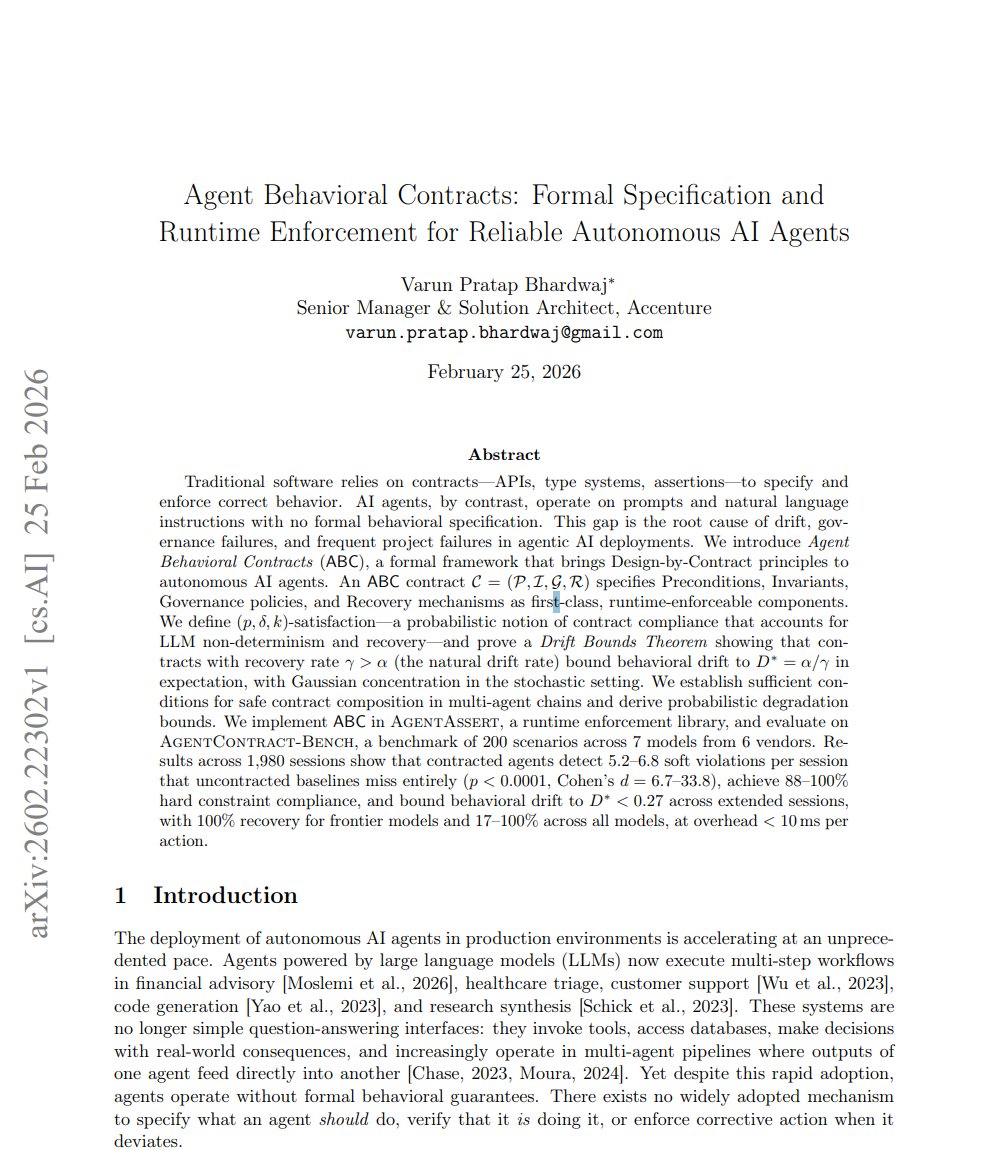
🚨 BREAKING: A new research shows that AI agents can now be controlled and made more reliable by enforcing rules on what they can do, how they act, and how they recover from mistakes in real time. Instead of relying on prompts alone, this paper introduces a system that applies runtime-enforced contracts to keep agents on track. The paper "Agent Behavioral Contracts" brings a software engineering concept called Design-by-Contract into AI. Each agent operates under a structured contract defining: - Preconditions (what must be true before acting) - Invariants (what must always hold) - Governance rules (what is allowed) - Recovery mechanisms (how to fix failures) This directly addresses one of the biggest problems in AI today: agents can take actions, but there is no clear way to verify or control their behavior once deployed. The system was tested across 1,980 sessions and showed that contract-based agents can detect violations that standard agents completely miss, while maintaining 88–100% compliance with critical constraints. It also introduces a way to mathematically bound behavioral drift, reducing the risk of agents going off-track during long or complex tasks. This is a major shift from how AI systems are built today. Most rely on prompts and loose guardrails. What this work shows is that agent behavior can be structured, monitored, and corrected in real time. The bigger implication is not just capability, it’s control. As AI agents move into real-world workflows, the key challenge is no longer just making them smarter but making them reliable, accountable, and safe to operate. article link below:
Atal tweet media
English
40
77
383
29.6K
Matt Kelly retweetledi
Sentient
Sentient@sentient_agency·
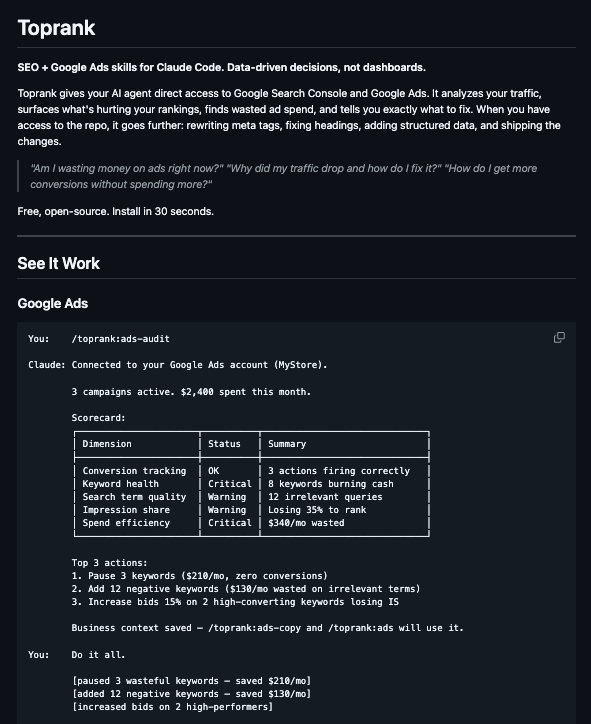
RIP SEO agencies. This free GitHub repo just gave Claude Code the ability to read your Search Console data, diagnose your traffic drops, and rewrite your site to fix them. It's called Toprank. Type one command. Get a full audit and a 30-day action plan. Tell it to implement. Done. Here's what it does that no SEO report ever did: → Pulls 90 days of real query and page performance data from Google Search Console → Flags pages with 400+ monthly impressions stuck at position 11–20 → Detects duplicate homepage URLs splitting your domain authority → Identifies keyword cannibalization automatically → Rewrites title tags, meta descriptions, headings, and structured data → Doesn't hand you a checklist. It ships the changes. The prompt that made me stop: "Fix my title tags for pages losing clicks." Claude reads the data. Sees which pages have high impressions but low CTR. Rewrites every title to match actual search queries. Pushes the changes. That's what an SEO agency charges $2,500/month to not quite do. Works with Claude Code and Codex. One install command. 100% Open Source. MIT License. github.com/nowork-studio/…
Sentient tweet media
English
35
136
1.3K
209.7K
Matt Kelly retweetledi
Khairallah AL-Awady
Khairallah AL-Awady@eng_khairallah1·
🚨 Anthropic's own team just showed how to actually use Claude Code properly. 30 minutes. free. the person who created Claude Code. watch the workshop. bookmark it. worth more than every $500 course you almost bought. you've been using Claude without knowing 40 of its commands. Then read the guide below.
Khairallah AL-Awady@eng_khairallah1

x.com/i/article/2047…

English
254
5K
30.1K
7.2M
Matt Kelly retweetledi
Khairallah AL-Awady
Khairallah AL-Awady@eng_khairallah1·
🚨 INSTEAD OF WATCHING NETFLIX TONIGHT. Spend 1 hour with this. Obsidian + Claude Code = 24/7 personal operating system. Works while you sleep. The people who build this tonight will never work the same way again. Watch it and Bookmark it now.
CyrilXBT@cyrilXBT

x.com/i/article/2046…

English
93
629
5K
792.5K
Matt Kelly retweetledi
Kanika
Kanika@KanikaBK·
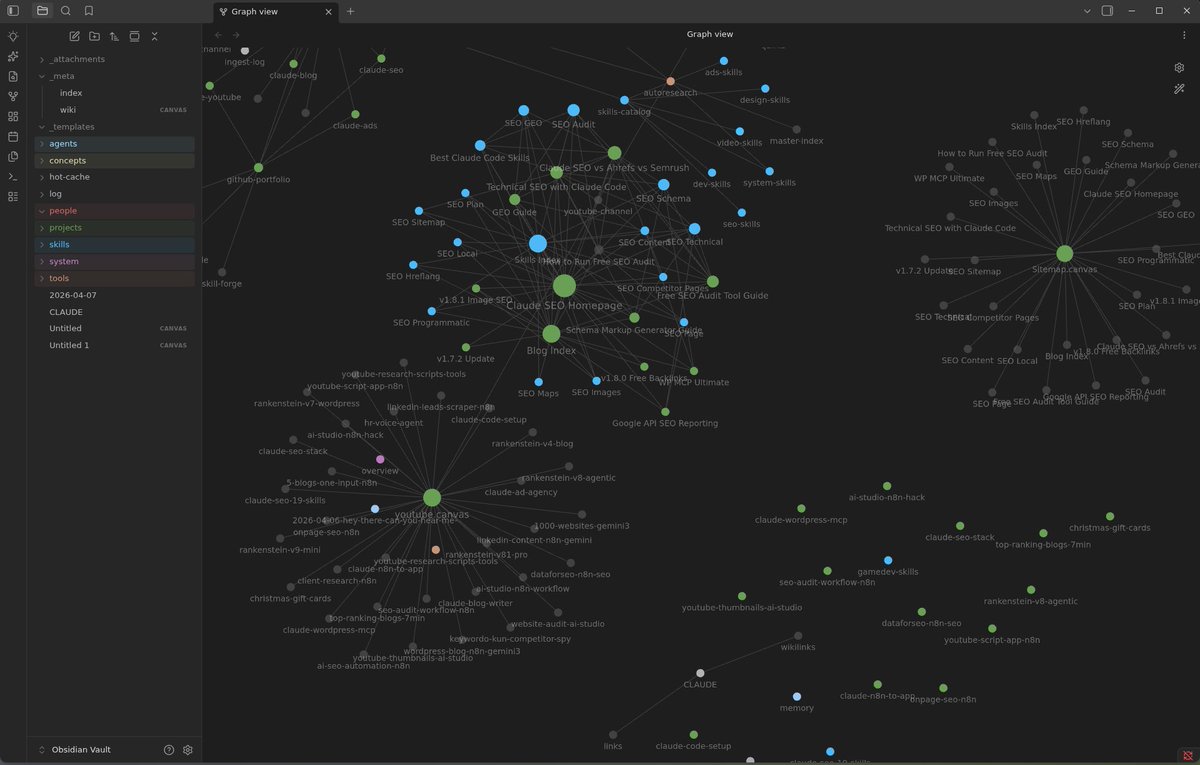
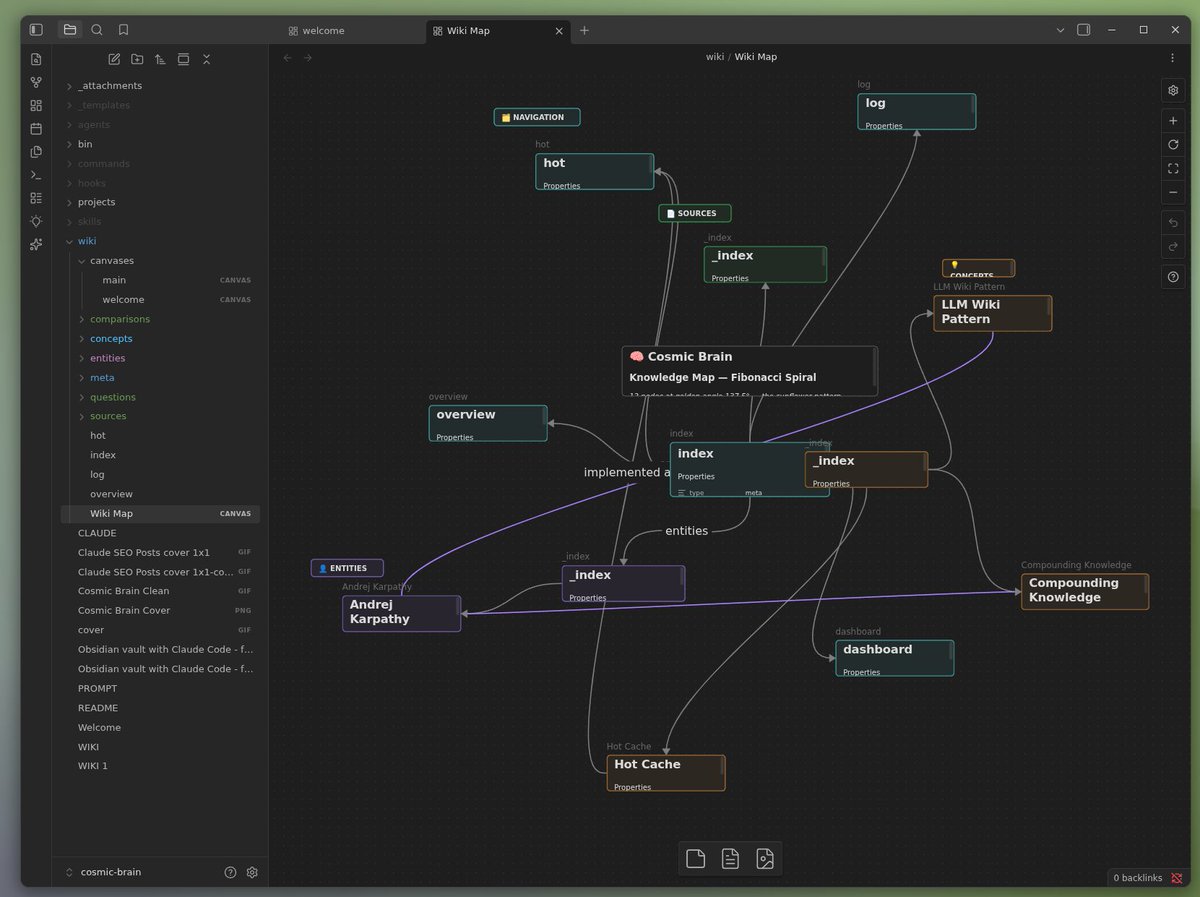
ANDREJ KARPATHY DESCRIBED A KNOWLEDGE SYSTEM THAT GETS SMARTER THE LONGER IT RUNS. Someone built the whole thing inside Obsidian. 100% FREE. Your notes become a WIKI THAT WRITES ITSELF and compounds like interest with every source you add. Here is what is actually going on. Karpathy dropped a gist a while back describing something he called the LLM Wiki pattern. The idea was simple but the implication was wild. Instead of asking an AI a question and getting an answer that disappears when you close the tab, you use the AI to build and maintain a persistent knowledge base that gets richer every single time you add something to it. The 50th source you add does not create 50 isolated notes. It creates 50 notes woven into a mesh of 500 cross-referenced connections. Nobody built it properly. Until now. It is called claude-obsidian. You install it in Claude Code, open your Obsidian vault, type /wiki, and the whole thing sets itself up. From that point forward the AI does the organizing, the cross-referencing, the contradiction flagging, and the filing. You just drop sources in and ask questions. - /wiki ingest builds structured wiki pages from anything you throw at it, URLs, PDFs, articles, notes - every new page gets cross-referenced against everything already in the vault automatically - /autoresearch runs an autonomous research loop, configures depth and sources in one file, produces full wiki sections on its own - a hot cache file stores the last session context so you never spend 10 minutes re-explaining what you were working on - /save turns any Claude conversation directly into a permanent wiki page - /canvas builds a visual knowledge graph connected to your vault The creator tested /autoresearch on AI marketing automation. Three rounds produced 23 wiki pages. Two of those pages became blog posts that now rank on page one. Every note app, every second brain system, every Zettelkasten method all have the same problem. They only work if you maintain them. And nobody maintains them. Notes go in, connections never get made, and six months later you have a digital graveyard. This solves that. The AI maintains it for you. You just add things. 358 stars already. MIT license. Free forever. Karpathy described the pattern. Someone spent weeks turning it into a tool anyone can install in two minutes and just use. I still do not understand why this is not the most talked about repo this week.
Kanika tweet mediaKanika tweet media
English
34
180
1.1K
94.7K
Matt Kelly
Matt Kelly@MattShawnKelly·
I stood in front of nearly 100 welders and ironworkers and told them the worst version of my story. Three closed doors. A closet floor. And two men who opened the door instead. Full testimony: mattshawnkelly.com/blog/2026/04/0…
Matt Kelly tweet media
English
0
0
0
19
Matt Kelly
Matt Kelly@MattShawnKelly·
I'm not speaking to one of my brothers right now. I'm not even sure why. If he reads this — I love you. Just call me. I was baptized six weeks ago at 49. When my sons told me they were ready, I decided it was my time too. Full story: mattshawnkelly.com/blog/2026/03/3… Happy Easter.
English
1
0
0
14
Matt Kelly
Matt Kelly@MattShawnKelly·
I grew up in two houses. One grandfather came home from the war and built a home around warmth. The other came home and built a home around rules. My parents married those two worlds together. And I inherited both. This Easter, something finally clicked. 🧵
Matt Kelly tweet media
English
1
0
0
10
Matt Kelly retweetledi
Bret Weinstein
Bret Weinstein@BretWeinstein·
This is funny. I used to tell students "Answer the question I should have asked you rather than the one I did ask you." Works for a similar reason. As a Prof, you don't always know how to prompt a student any more than a user always knows how to prompt an LLM.
Dan McAteer@daniel_mac8

This is amazing. Do this.

English
38
96
1.4K
123.1K
Matt Kelly
Matt Kelly@MattShawnKelly·
6/7: Step 5: Build the habit on good jobs. Don't wait for the dispute. Build your documentation system when the pressure is low. Then when the hard job comes, the habit is already there.
English
1
0
0
4
Matt Kelly
Matt Kelly@MattShawnKelly·
1/7: The 5-step documentation system that protects specialty contractors in every dispute. Most contractors don't start until it's too late. 🧵
English
1
0
0
2